Pillar — Sleep hypnosis
Sleep hypnosis: how it works and how to use it tonight
Sleep hypnosis is guided relaxation and suggestion played while you fall asleep. It works with a real feature of the night: the drowsy border between waking and sleep, when the analytical mind loosens and words land softer. Here's what it is, what the evidence supports, and how to use it well.
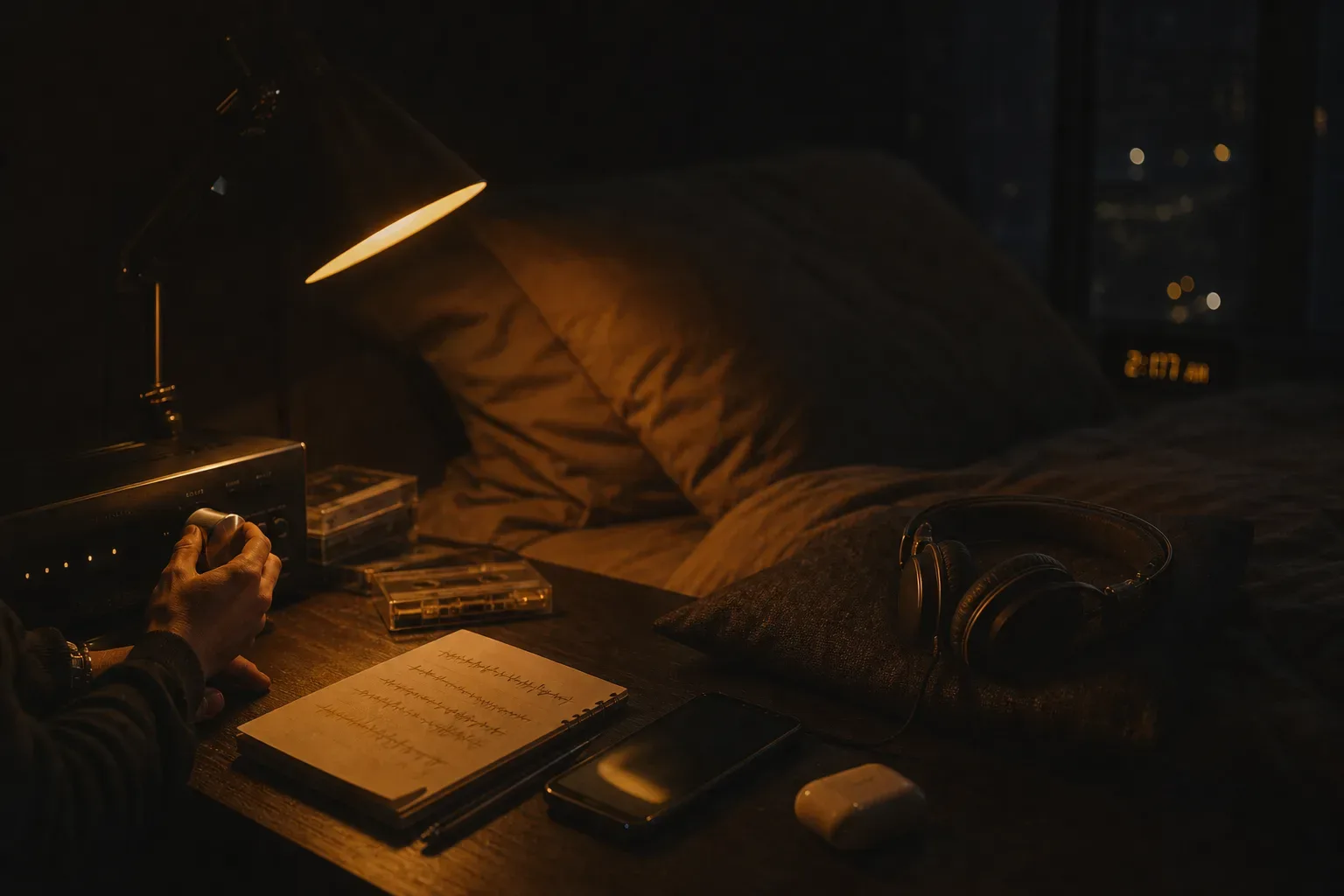
Sleep hypnosis is a guided audio practice: a slow, steady voice walks you down through relaxation and imagery, then offers suggestions — for sleep itself, or for the thing you’re working on — while you drift. No pocket watch, no trance takeover. Just structured words, placed in the one window of the day when words land without a fight.
Why does the falling-asleep window matter?
Between waking and sleep there’s a border region — hypnagogia — where attention softens, imagery arrives on its own, and the running commentary of the day quiets. You’ve felt it: the moment thoughts stop being sentences and start being scenes.
Two useful things are true about this window. You’re still hearing — audition is the last sense to fade. And you’re less analytical — the part of you that fact-checks every kind sentence is going off duty. Hypnotherapists have used this border deliberately for a century; every “listen while you fall asleep” practice, from hypnosis tracks to affirmations to the AYA Method’s night listening, is built on the same ground.
What the window is not is a download port. Once you’re properly asleep, studies of sleep learning find very little gets through beyond simple associations — the dream of learning French from a pillow speaker died in the lab decades ago. The practice works at the border, not past it.
What does the evidence say?
Honestly: moderate, promising, unfinished.
- A 2018 review of hypnotherapy-for-sleep studies found improved sleep outcomes in about 58% of included trials — encouraging, with the authors noting small samples and uneven methods.
- Lab work from the University of Zurich found that hypnotizable listeners who heard a hypnotic suggestion before a nap spent measurably more time in slow-wave sleep — around 80% more in the strongest condition — than controls.
- For suggestions aimed at habits and confidence, results track hypnotizability, which varies widely between people. Roughly one person in five responds strongly; most respond somewhat; some barely.
So the fair summary: sleep hypnosis reliably helps people relax into sleep, measurably deepens sleep for some, and delivers suggestion effects that range from real to mild depending on the listener. As night practices go, that’s a strong evidence base — most of what people play at night has less.
How do you actually do it?
The practice is simple enough to start tonight:
- Pick one recording with a script you’d approve of awake. Named practitioner, plain language, suggestions you actually want. Twenty to forty-five minutes is typical.
- Set the scene for sleep, not for listening. Lights off, phone face down, volume low — the voice should feel like it’s coming from the next room.
- Follow the voice down, and let go of following. The instructions at the start are for the waking you. The suggestions later are for the drowsy you. Falling asleep during the track isn’t failure; it’s the design.
- Repeat nightly for two weeks before judging. Suggestion works by repetition, the same as every identity practice. One night tells you nothing.
If a recording ever leaves you alert, unsettled, or awake at 2 a.m., it’s the wrong recording. The first rule of every night practice: nothing is worth your sleep.
Self-hypnosis without a recording
The recording is scaffolding. The structure underneath is learnable: settle the body (slow breath, longer exhales), narrow attention (one image, one phrase), then repeat a suggestion in plain present tense — I sleep deeply; I speak easily; the work is going well. Ten minutes at lights-out, same words each night.
The hard part isn’t technique — it’s authorship. Writing suggestions that are specific, believable, and actually yours is a skill, and most people’s first drafts are either too grand to believe or too vague to matter. Which is exactly the problem the next section addresses.
Where the AYA Method fits
The AYA Method is, in one sense, sleep hypnosis with the hardest part done for you. Each day you listen to a Dream-Self Moment — a short recording narrated by the version of you who has already arrived, written from a 28-step intake that captures your actual life and intentions. The suggestions aren’t a stranger’s script; they’re your specifics, spoken back to you in the future tense made present.
Played at night, it uses the same border window hypnosis uses — audible words, drowsy mind, repetition over weeks. You can hear everything, check everything, and the voice you’re internalizing was built to be yours. Many people run both: a hypnosis track for the descent, the Dream-Self Moment as the last thing before the border. The audio is the method; the rest is bedding.
Tonight, then
Choose the voice you’ll fall asleep to on purpose. That’s the entire practice, whether the voice belongs to a hypnotherapist, to a recording of your own suggestions, or to the you who’s already on the other side of what you’re working toward. The window opens every night either way. Something is always playing in it — even if it’s just the day, rerun. Better to choose.