Pillar — Subliminals
Subliminals: What They Are and What the Evidence Says
A subliminal is an affirmation you can't consciously hear — recorded, lowered in volume or shifted in frequency, and hidden under music or rain. Millions of people fall asleep to them. Here's what's actually on the track, what the research found, and where the practice goes from here.
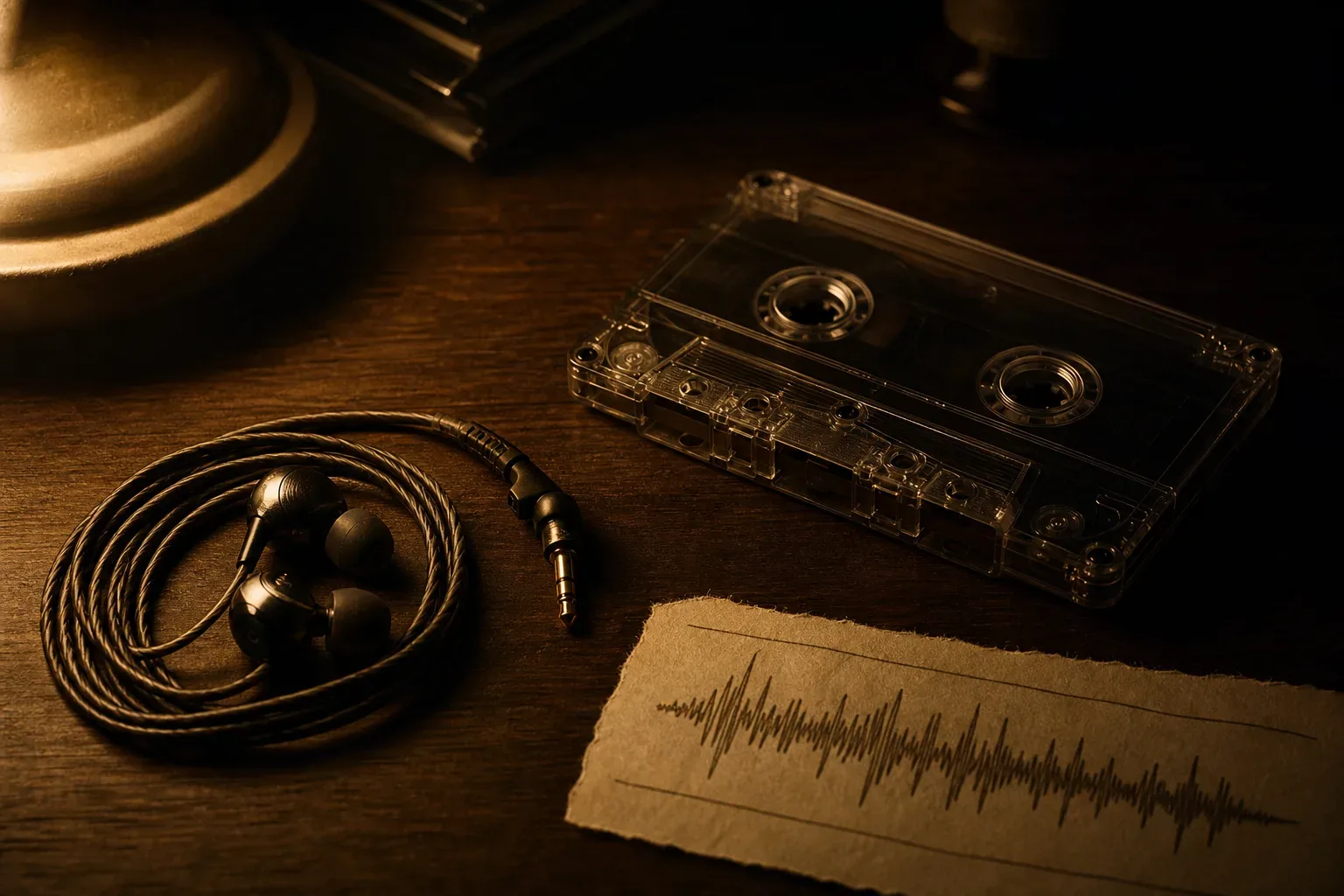
A subliminal is a recorded affirmation played below the level of conscious hearing — buried under rain sounds, music, or white noise, or shifted to a frequency the adult ear barely registers. You press play, you hear the rain, and the words run underneath. That’s the entire mechanism, and the entire controversy.
The word itself is older than the YouTube tracks. Sub limen — below the threshold. Psychology has used it since the 1800s for any stimulus too weak to reach conscious awareness. The modern practice is younger: affirmation audio, usually looped, usually played at night, with the words deliberately hidden.
What’s actually on a subliminal track?
Under the mask, a subliminal is nothing exotic: a voice reading affirmations. What makes it “subliminal” is the processing. Creators use one of two techniques.
Volume masking. The affirmations are recorded normally, then lowered 20–40 decibels beneath a foreground sound — rain, ocean, lo-fi music. Your conscious attention follows the mask; the words sit under it, technically present in the file, practically inaudible.
Frequency shifting. The voice is pitched up to sit around 17,500 Hz, near the ceiling of adult hearing. Younger ears may catch a thin whine; most adults hear nothing. Whether meaningful speech information survives that shift is one of the practice’s open questions — a heavily shifted voice is no longer speech in any ordinary sense.
Either way, the claim is the same: the conscious mind can’t argue with what it can’t hear, so the words slip past resistance and repeat, night after night, until something shifts.
Where did subliminals come from?
The modern fear — and fascination — starts with a hoax. In 1957, a market researcher named James Vicary claimed he’d flashed “Eat popcorn” and “Drink Coca-Cola” for a fraction of a second during film screenings in a New Jersey theater, and that sales rose sharply. The story ran everywhere. Congress held hearings. Broadcasters banned the technique.
Vicary later admitted he’d fabricated the data. The experiment, as described, never happened. But the idea had already settled into the culture: hidden messages might steer you. The 1970s and 80s added backmasked records and courtroom panics. The self-help industry noticed the same door and walked through it politely — if hidden messages could harm, surely they could help. Subliminal self-help tapes sold in the millions through the 80s and 90s.
Then YouTube and TikTok rebuilt the practice for a new generation. Search “subliminal” today and you’ll find channels with millions of subscribers, tracks for confidence, sleep, focus — and, at the ambitious end, changed eye color and bone structure. The distance between what’s claimed and what’s plausible is the reason this page exists.
Do subliminals work? What the research actually says
Two findings can both be true, and in this case they are.
Subliminal perception is real. Decades of priming studies show that stimuli below conscious awareness can register. Flash the word “thirst” too fast to read, and people pour slightly more of a drink. Show a masked happy face, and people rate a neutral image a little more warmly. These effects are real, replicated, and honest researchers describe them the same way: small, short-lived, and strongest when the person already has the matching need. Minutes, not months.
Subliminal self-help audio has not shown measurable trait change. The best-known test remains a 1991 study by Anthony Greenwald and colleagues: volunteers used commercial subliminal tapes for memory or self-esteem, except half the tapes were secretly swapped. People improved slightly on whatever they believed they were using — the label worked, the hidden content didn’t. That result, an expectancy effect wearing a lab coat, has aged better than any claim it tested.
There’s also the physical problem. Speech masked 30 dB under rain may not deliver intelligible phonemes to the auditory system at all, and speech shifted to 17,500 Hz almost certainly doesn’t. For the strongest claims — that the words are decoded, understood, and acted on for months — the mechanism has to do work no one has demonstrated it can do.
So why do so many people report results? Partly expectancy — belief is genuinely useful and not embarrassing. Partly the ritual: someone who plays a confidence track nightly has decided, nightly, that confidence matters to them. That decision, repeated for a month, is not nothing. It’s attention, rehearsed. The track is the container; the intention is the content.
How do people actually use subliminals?
The practice, as it exists in bedrooms rather than laboratories, is fairly consistent:
- At night, at low volume. Most listeners play tracks while falling asleep — the one time of day repetition costs nothing.
- One intention at a time. Experienced listeners pick a single track and stay with it for two to eight weeks. Playlist-hopping is the most common reason people report nothing.
- On a timer, not till morning. An hour at sleep onset gives you the drowsy window without eight hours of looped audio.
- From creators who publish their affirmation lists. This is the community’s own hygiene rule, and it’s a good one. If you can’t read the words, you’re outsourcing your inner voice to a stranger.
Held to that shape — quiet, consistent, transparent — the practice is a nightly ritual of choosing what you want. That has value regardless of what the hidden layer delivers.
What are the real risks?
Not the ones the 1950s feared. Hidden audio can’t install desires you don’t have; the priming literature is clear that even measurable effects need an existing motivation to push on. The practical risks are smaller and more boring:
- Volume. Anything played for hours should be quiet. Ear fatigue and hearing damage don’t care whether the sound is labeled “healing.”
- Sleep. If a track wakes you, shortens your sleep, or makes falling asleep a project, it costs more than it gives. Sleep is the foundation the whole practice sits on.
- Unknown scripts. Unpublished affirmation lists deserve your skepticism, especially on channels that trade in fear (“remove toxic energy blockages”) rather than intention.
- Medical claims. Tracks promising to fix eyesight, illness, or body structure are selling something no mechanism supports. Keep your night practice away from your health decisions.
Why hide the words at all?
The theory says: to slip past resistance. If you say “I’m confident” to someone who feels otherwise, their mind objects. Hide the sentence, and there’s nothing to argue with.
But there’s another reading of the same problem. The objection isn’t noise — it’s information. It tells you the affirmation is too far from where you stand. The fix doesn’t have to be hiding the words. It can be better words: specific, believable, close enough to your actual life that hearing them doesn’t trigger the argument.
This is where the practice has quietly been heading. The most-loved tracks are the ones with published scripts, honest tone, and affirmations people would happily hear out loud. Which raises the obvious question: if the words are good enough to hear, why not hear them?
Fully audible: where the AYA Method comes in
The AYA Method is what the subliminal ritual looks like with nothing hidden. Each day, you listen to a short personalized recording — a Dream-Self Moment — narrated from the version of you who has already arrived. The words are built from a 28-step intake: your name, your specifics, your intentions in your own terms. You can hear every word, because every word was written from you.
The nightly shape is identical to what subliminal listeners already do — press play, lie down, let repetition work. The differences are the ones that matter: the script is yours, the voice speaks as you, and nothing rides under the rain. If subliminals are the practice of choosing your words and hoping they land, this is the version where they land audibly.
The app also includes a daily affirmation and a Manifestation Board for those who want them — complements, not the practice. The audio is the method.
What to do tonight
If you’re keeping subliminals in your routine, keep them well: one track, published script, low volume, a timer, and two honest weeks before you judge it. Write down what you’re asking for — the ritual works better when you can say it in daylight.
And if you’re ready to hear the words, start with the intake. The recording that comes back is the sentence you were hiding under the rain, spoken plainly, in a voice you’ll recognize eventually as yours.