subliminals
Are Subliminals Safe? 7 Sleep Rules Before Play
Are subliminals safe to play while you sleep? Learn seven quiet rules for volume, timing, source checks, and sleep hygiene before you press play.
Are subliminals safe for sleep? Usually, yes for healthy adults when the audio is quiet, the source is trustworthy, and the practice does not steal sleep. The risk is less about secret mind control and more about volume, hidden wording, anxiety, and using a night track when your body needs ordinary rest.
Are subliminals safe to play while you sleep?
Subliminals are usually safe when they are treated as low-volume sleep audio, not as medicine or a force that can override you.
A subliminal is an affirmation you cannot consciously hear. That is the whole trick, and also the reason to be careful. Research on subliminal priming is real, but modest. A 2006 paper by Dijksterhuis and Nordgren helped popularize unconscious processing research, while many later priming findings have been smaller and harder to repeat outside controlled labs. YouTube claims are usually not the same thing as peer-reviewed evidence.
The honest answer sits in the middle. A hidden message in a rain track is unlikely to take over your life. It may still shape attention, mood, or expectation a little, especially if you listen every night for 30 days. Repetition teaches the nervous system what to expect from the night. That does not make the practice magical. It makes it worth choosing with care.
If you want the wider definition before you choose a track, read the Subliminals pillar. The short version is this: the safer subliminal is quiet, boring, consent-based, and easy to stop. The unsafe one uses fear, secrecy, dependency, or volume as a shortcut.
What you hear while you sleep does not need to be dramatic to matter.
For sleep itself, the American Academy of Sleep Medicine and Sleep Research Society recommend at least 7 hours for most adults. If a subliminal practice cuts that down, it is not helping. If insomnia is persistent, severe, or tied to panic, pain, or mood changes, talk with a qualified clinician.
What should you check before you trust a subliminal track?
Trust the track only if you can understand its aim, its creator, and its limits before it reaches your pillow.
Most problems start before bedtime. A title promises a new face, instant romance, impossible money, or a personality change by morning. The audio may be soft, but the promise is loud. In my own tracking, a one-month test is the minimum before I believe any sleep practice. Three nights mostly tells you whether the novelty kept you awake.
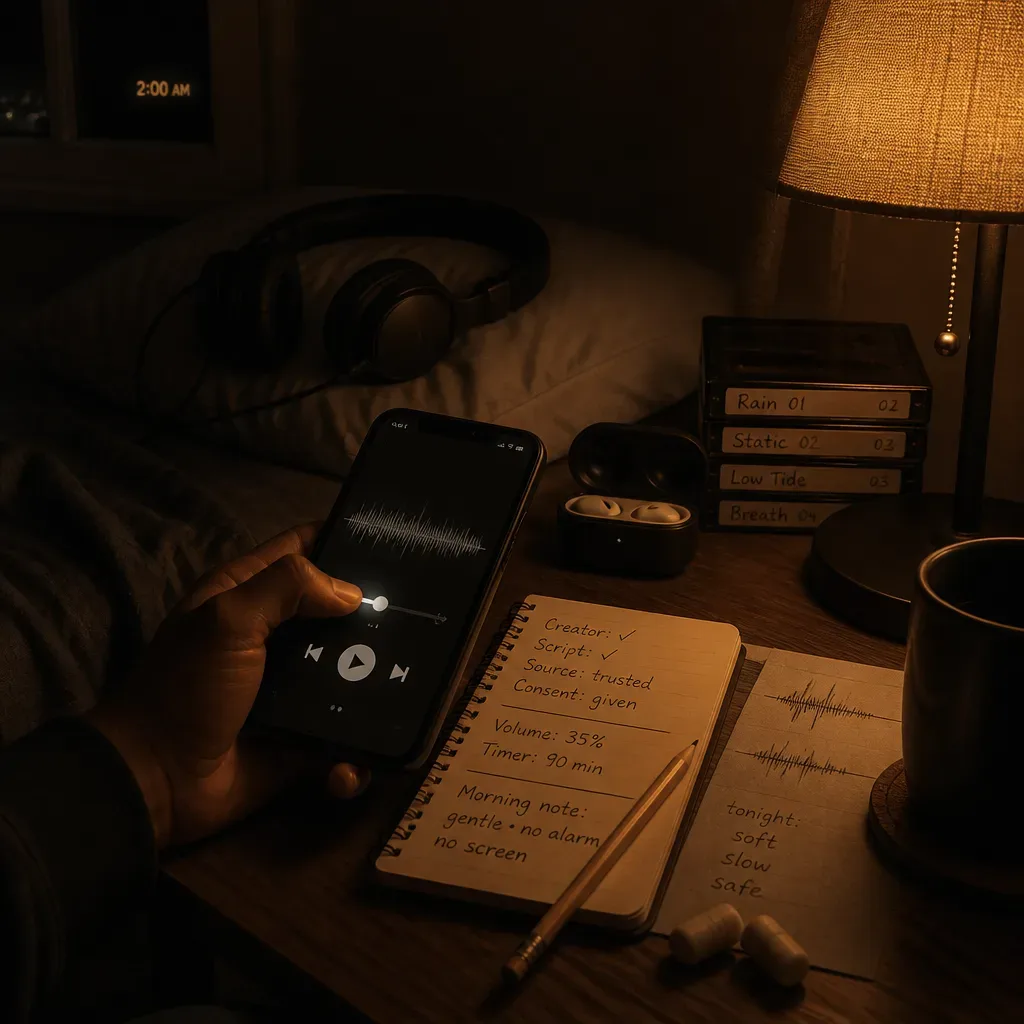
Use these seven sleep rules before you press play:
- Read the title and description like a consent form.
- Choose creators who disclose the affirmation themes or provide a script.
- Avoid tracks that use fear, urgency, curses, forced obsession, or punishment language.
- Play it once while awake if the words are audible anywhere in the mix.
- Keep the first trial short, around 20 to 45 minutes.
- Use a timer, not an all-night autoplay queue.
- Stop if your sleep, mood, or self-trust gets worse.
A good subliminal does not need to scare you into loyalty. The Federal Trade Commission has warned for years that health and body claims need evidence; that same skeptical reading helps here, even when the track is free. Free audio can still cost you a night of sleep.
Look for signs that the creator respects the listener:
- Plain language about what the affirmations are for
- No promises of guaranteed physical change
- No hidden bundles of unrelated goals
- No threats about skipping nights
- No advice to ignore medical, legal, or financial care
A safe sleep practice should make you more able to rest without it over time. Dependence is not proof that the audio works. It is a signal to lower the dose.
How loud should sleep subliminals be?
Set sleep subliminals barely above the room, because volume is the most measurable safety issue in the whole practice.
Hidden words are not the only thing to care about. Your ears, alarms, roommates, children, pets, and smoke detector all live in the same night. The World Health Organization has used 30 dB as a guideline value for indoor night noise, roughly a quiet bedroom. OSHA allows 85 dBA across an 8-hour workday as an occupational exposure limit, but sleep is not factory work. You do not need anything close to that in bed.
If you use a speaker, start lower than you think. Put the phone or speaker at least an arm length away, then lower it until the rain or music is present but not demanding. If you can hear crisp consonants in the affirmation layer, it may not be subliminal, and that is not automatically bad. It simply means you are using audible affirmation audio.
| Setup | Safer range | Watch for |
|---|---|---|
| Bedside speaker | Barely audible | Masking alarms or waking partners |
| Sleep headband | Very low | Ear warmth, pressure, irritation |
| Earbuds | Short sessions only | Sore ears or sound too close |
| Wired headphones | Avoid in bed | Cord tangling and pressure |
The Sleep cycle calculator tool can help you plan the end of a playlist around a normal wake time. Adult sleep cycles are often estimated around 90 minutes, though real cycles vary by person and night. A 30-minute timer is safer than eight hours of autoplay you did not choose.
Your body should not have to fight the thing you call soothing. If the track makes your jaw tight, your dreams sharp, or your morning dull, turn it down first. If that does not help, stop.
When should you press play at night?
Press play only after the basics are handled: alarm set, lights low, phone away, and no more decisions required.
The last 10 minutes before sleep are suggestible because attention narrows and the day loosens. That does not mean the mind becomes helpless. It means the last input can become the tone of the night. Dr. Andrew Huberman often points listeners back to regular wake times, light timing, and temperature as practical levers for sleep. Audio should sit underneath those basics, not replace them.
I like the small-window rule. Use subliminals as a landing strip, not as an eight-hour project. Twenty minutes is enough for many people to repeat a message several times, and 45 minutes covers a longer settling period without taking over the whole night. If you often fall asleep in less than 15 minutes, shorter is better.
A simple order works:
- Set tomorrow morning’s alarm.
- Put the phone face down or across the room.
- Start the audio on a timer.
- Lower the volume after the first minute.
- Let the track end without autoplay.
The National Sleep Foundation’s 2015 consensus report lists 7 to 9 hours as the recommended range for adults aged 18 to 64. If your subliminal habit makes you stay up scrolling for the perfect file, you have already traded the main thing away. The best night track is the one that does not ask you to manage it after lights out.
For people who like spoken-word practices but want clearer consent, Sleep affirmations pillar explains the audible version. Hearing the words can be less mysterious and more reassuring. There is no prize for making the message harder to trust.
Who should be more cautious with subliminals?
Be more cautious if you are anxious, under 18, highly suggestible, grieving, manic, psychotic, obsessive, trauma-triggered, or already losing sleep.
That list is not meant to frighten you. It is meant to keep the practice in proportion. Subliminals often sit close to identity: body, desirability, confidence, control, safety. If you are in a season where those themes already hurt, hidden wording may not be the kindest format. Audible words, a plain relaxation track, or no words at all may be better.
The Journal of Behavioral Medicine has published many studies on relaxation, stress, and health behavior, but subliminal sleep tracks as they appear online are not a standardized clinical tool. That matters. A hospital relaxation recording and a mystery upload with 4 million views do not have the same review process. Popularity is not consent.
Children and teens deserve extra caution. Their sleep needs are higher than adults: the American Academy of Sleep Medicine recommends 8 to 10 hours for teens aged 13 to 18. If a track is being used by a young person because they feel defective without it, the issue is no longer just audio. It is self-talk, body image, and pressure.
If a method costs you sleep, it costs more than it gives.
Stop immediately if a track increases compulsive checking, fear of missing a night, intrusive thoughts, or a belief that someone else must fix you through hidden sound. That is not a moral failure. It is useful data. You can return to silence, brown noise, breath counting, or an audible script you wrote yourself.
How do subliminals compare with audible sleep audio?
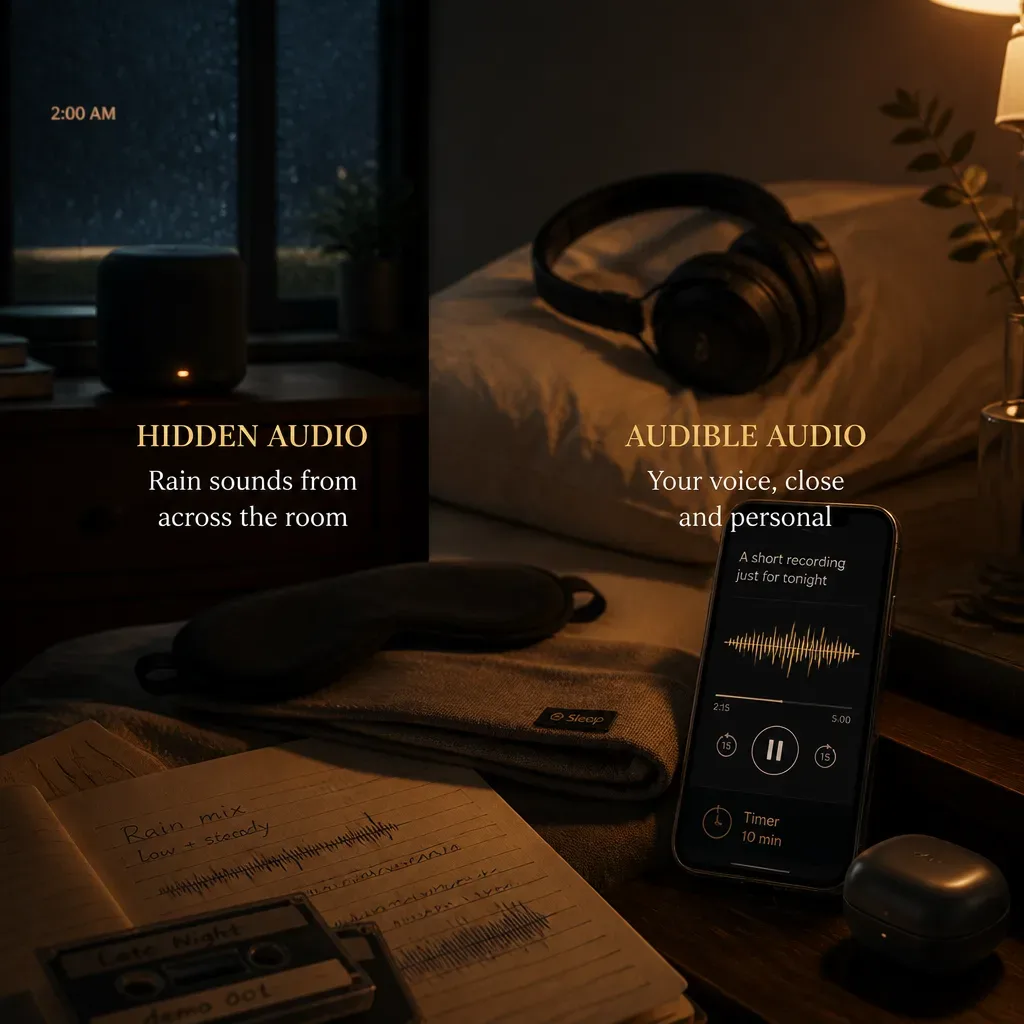
Audible sleep audio is usually easier to consent to, while subliminals trade clarity for a softer conscious load.
That trade is the center of the safety question. Some listeners prefer subliminals because direct affirmations feel embarrassing or false. I understand that. When a sentence like I am safe feels too far away, a low mixed version can feel gentler. Neville Goddard wrote often about the state before sleep as a creative mental interval; modern listeners have adapted that idea into affirmations, hypnosis, shifting scripts, and subliminals. The practice is old in spirit, even when the files are new.
But there is a cleaner option when you want words and consent together. The AYA Method is a daily audio manifestation practice. Each day you listen to a short personalized recording, your Dream-Self Moment, narrated from the version of you who has already manifested the life you intend. Listening is the practice. Repetition is the work. The audio is the method.
The difference is not that one is real and the other is fake. The difference is audibility and ownership. With the AYA Method, you can hear every word, and the voice is yours. The daily affirmation and Manifestation Board can support the practice, but they are complements. The audio is the method.
| Practice | Can you hear the words? | Main safety advantage | Main caution |
|---|---|---|---|
| Subliminals | Usually no | Low conscious resistance | Hidden wording requires trust |
| Sleep affirmations | Yes | Clear consent | May feel too direct |
| Sleep hypnosis | Usually yes | Guided relaxation | Choose trained, ethical voices |
| AYA Method | Yes, personalized | You know the script and narrator | Needs daily repetition |
Joe Dispenza and other popular teachers speak often about rehearsal, attention, and identity. The evidence around these claims varies widely, but the practical principle is simple: repeated words can become familiar. Familiar is not the same as proven. It is still worth choosing what becomes familiar.
What should you notice by week two?
By week two, a safe subliminal should feel neutral to calming, not urgent, addictive, or sleep-disrupting.
I keep boring notes because memory lies after midnight. Write down four numbers for 14 nights: bedtime, estimated time to fall asleep, number of awakenings, and morning mood from 1 to 5. You do not need a wearable. In fact, some sleep researchers call obsessive sleep tracking orthosomnia; a 2017 Journal of Clinical Sleep Medicine case report described how tracker anxiety can worsen sleep worry. Use notes as a dim lamp, not a courtroom.
What counts as a good sign? You fall asleep about as easily or a little more easily. You do not dread the track. You can skip it without panic. Your morning self does not feel argued with. If the affirmation theme is confidence, you may notice tiny behavioral shifts, like less rehearsal of old criticism. Tiny is believable. Instant personality replacement is marketing.
What counts as a bad sign? You delay sleep to find a stronger file. You stack five tracks because one no longer feels enough. You wake tense. You feel punished for missing a night. You start trusting the hidden audio more than your own perception. That is the moment to stop and return to something plain.
The safest subliminal is optional.
If you want a structured path through the basics again, return to the Subliminals pillar and pair it with a realistic bedtime from the Sleep cycle calculator tool. The tools are not the practice. Your quiet, repeated choice is the practice.
Press play softly, then let the night stay yours.