subliminals
How Long Should Subliminals Be? The 3-Minute Rule
How long should subliminals be? Learn why 3 minutes is enough for one clear script, when longer loops help, and what to play before sleep.
If you’re asking how long should subliminals be, the useful answer is: make the core audio about 3 minutes, then loop it if you want a longer session. Three minutes is enough for a focused script, easy to repeat nightly, and short enough that the words don’t blur into a dozen mixed intentions.
Is 3 minutes really enough for a subliminal?
Yes, 3 minutes is enough when the subliminal has one topic, a clean script, and repetitions you’d still approve of if you heard them clearly.
A subliminal is an affirmation you can’t consciously hear, usually hidden under music, rain, brown noise, or another sound bed. That’s the whole trick, and also the whole problem. Because you can’t audit the words while listening, the written script has to do more work. Three minutes forces the script to stay narrow. In practice, that often means 8 to 15 lines, repeated 2 to 5 times depending on speaking speed.
The research doesn’t give you a magic duration. In the well-known 1991 study by Greenwald, Spangenberg, Pratkanis, and Eskenazi on commercial subliminal self-help tapes, listeners often believed they improved, but measured effects didn’t match the tape labels. That matters. The confidence claim on YouTube isn’t the same thing as laboratory evidence. Still, brief unconscious cues have shown modest effects in priming studies, especially when the cue connects to an existing goal or state.
The 3-minute rule is not a law of the mind. It’s a design rule for attention, repetition, and sleep. If a line matters, it should survive being repeated quietly. If a line needs a 45-minute track to feel convincing, the line may be too broad.
A short subliminal doesn’t win by being tiny. It wins by being repeatable.
For sleep, 3 minutes also respects the nervous system. The American Academy of Sleep Medicine tells adults to aim for at least 7 hours of sleep, and sleep quality depends on fewer interruptions, not more audio. If the file is short, soft, and familiar, you can play it once or loop it without turning the night into a listening test.
What does the 3-minute audio rule actually mean?
The 3-minute audio rule means you build one complete subliminal script that can stand alone in about 180 seconds.
Think of the 3-minute file as the master copy. You can upload it as a single short listen, loop it 5 times for a 15-minute session, or place it inside a longer sleep track. The important part is that the core message stays complete and coherent. A listener shouldn’t need 40 minutes to receive the first full pass of the idea.
Here’s a practical structure I use when writing short sleep audio:
- Choose one topic. Sleep, study, self-worth, calm social confidence, or one specific wish.
- Write 8 to 15 short lines. Keep most lines under 10 words.
- Use first person and present tense. “I return to my work” is cleaner than “You will become successful.”
- Repeat the set 2 to 5 times. Repetition is the point, not variety.
- Test it aloud at a whisper. If it embarrasses you, it will bounce off you at 2 a.m. too.
A normal speaking pace is about 120 to 160 words per minute, according to common speech-rate measures used in communication training. For subliminals, you’ll often record slower or layer under sound, so a 3-minute script might contain only 120 to 300 spoken words. That’s not a weakness. At the edge of sleep, the attention budget is nearly zero.
| Track length | Best use | Risk |
|---|---|---|
| 30–60 seconds | Testing a script or sound bed | Too little repetition |
| 3 minutes | One focused subliminal | Needs looping for longer sessions |
| 10–30 minutes | Repeated listening before sleep | Can become filler |
| 8 hours | Overnight background | May disturb sleep |
The question isn’t “How much can I fit?” The question is “What can I repeat without resistance?” For a deeper overview of hidden-audio practice, see the Subliminals pillar.
When should a subliminal be longer than 3 minutes?
A subliminal should be longer than 3 minutes when the extra time is repetition, not extra topics.
There’s nothing wrong with a 20-minute subliminal if it’s basically a 3-minute script repeated gently. That can be useful before sleep because you don’t have to restart the audio. It also gives the body time to settle. Many sleep routines take 10 to 20 minutes to feel boring enough, and boring is not an insult here. Boring is often the gate.
Where longer tracks go wrong is topic stacking. A single file promises money, beauty, confidence, revision, grades, luck, and lucid dreams. The listener presses play because more sounds efficient. But the mind doesn’t always respond well to a crowded instruction sheet, especially at night. In cognitive load research, working memory is often described as limited; Miller’s older “7 plus or minus 2” estimate has been revised downward by later researchers, but the point remains: fewer items are easier to hold.
A longer track can help when:
- the sound bed is steady and low
- the same short script repeats
- the listener uses it as a wind-down cue
- the file ends before it fragments sleep
- the topic is emotionally tolerable, not grand or fake-sounding
Dr. Andrew Huberman often explains sleep timing through 90-minute cycles, which is a useful caution even if you don’t plan your whole night by a calculator. If audio wakes you between cycles, you may remember it as “restless sleep,” not as a useful practice. If you want to time your night more carefully, use the Sleep cycle calculator tool and place audio before the sleep window instead of across the whole thing.
Longer is better only when longer stays quiet. A 30-minute loop of one honest script is cleaner than a 3-hour file full of claims you’d reject in daylight.
How loud should subliminals be before sleep?
Subliminals before sleep should be quiet enough that the words aren’t consciously clear, but not so loud that the masking sound keeps you alert.
This is where many people accidentally make the practice harder. They turn the rain up to hide the voice. Then the rain becomes the thing the body has to tolerate. The National Institute for Occupational Safety and Health sets 85 dBA as a workplace exposure limit over 8 hours, but sleep audio should be far below anything that feels like exposure. A phone speaker by the bed should sound low, almost boring. Headphones need even more care.
If you can hear sharp consonants, the voice may be too exposed for a subliminal. If you can’t relax because the sound bed is hissing, pulsing, or busy, the masking layer is too much. The sweet spot is not dramatic. It’s the point where the audio can repeat without asking you to monitor it.
Try this simple volume check:
- Start at your normal spoken-audio volume.
- Lower it by about 50 percent.
- Lie down in your real sleep position.
- Wait 2 minutes.
- If you keep checking the sound, lower it again.
For sleep affirmations you do want to hear, the rule changes. Audible affirmations should be soft but intelligible, because conscious listening is part of the practice. If that’s closer to what you need tonight, use the Sleep affirmations pillar as a clearer starting point.
The last ten minutes before sleep are suggestible. Choose what goes in.
If you have insomnia that lasts, worsens, or affects daily functioning, talk to a qualified professional. Audio can support sleep hygiene, but it shouldn’t be asked to carry a medical problem by itself.
How many times should you repeat a subliminal track?
Repeat a subliminal daily for at least 7 to 14 nights before judging whether it belongs in your routine.
Repetition matters more than a heroic first night. A 3-minute file played once every evening for 2 weeks gives you 14 clean touches with the same script. If you loop it for 15 minutes, that may be 70 minutes of total exposure across the same period. Those numbers are ordinary, and that’s part of why they work as a habit. They don’t require you to rearrange your life.
Behavior research tends to treat habit formation as variable, not instant. A widely cited 2009 study by Phillippa Lally and colleagues found an average of 66 days for a new behavior to become automatic, with a wide range across people and behaviors. Subliminal listening is not the same as drinking water after breakfast, but the lesson still helps: repeatable beats intense.
Here’s a simple 14-night test:
| Night range | What to do | What to notice |
|---|---|---|
| 1–3 | Play once or loop 15 minutes | Comfort, volume, irritation |
| 4–7 | Keep the same file | Sleep quality, resistance |
| 8–14 | Continue without editing | Mood on waking, natural self-talk |
Don’t change the script every night. That’s the hidden cost of having too many files saved. Every edit restarts the test. If the words are yours, or at least believable to you, give them time to become familiar.
Familiar words enter more softly than impressive words.
If you prefer fully audible, personal audio, the AYA Method is the closest neighbor to this practice. The AYA Method is a daily audio manifestation practice. Each day you listen to a short personalized recording — your Dream-Self Moment — narrated from the version of you who has already manifested the life you intend. Listening is the practice. Repetition is the work. The audio is the method.
What should you put inside a 3-minute subliminal?
Put one believable intention inside a 3-minute subliminal, written in short present-tense lines you’d accept on a bad day.
This is where my copywriter brain gets strict. Most weak affirmations don’t fail because they’re too small. They fail because they sound like slogans. “I am the most successful person alive” may feel exciting for 3 seconds, but many minds reject it immediately. “I finish the next task in front of me” has less shine and more contact with real behavior.
A good 3-minute subliminal script often has 3 layers:
- Safety lines: “I am safe to rest.” “My body can soften.”
- Identity lines: “I keep promises to myself.” “I return to my work.”
- Action lines: “I choose the next clear step.” “I start before I feel ready.”
The Journal of Behavioral Medicine has published many studies on self-talk, stress, and behavioral change, but the pattern across this area is cautious: words can help when they support action, attention, and regulation. They’re not a spell. They’re a rehearsal.
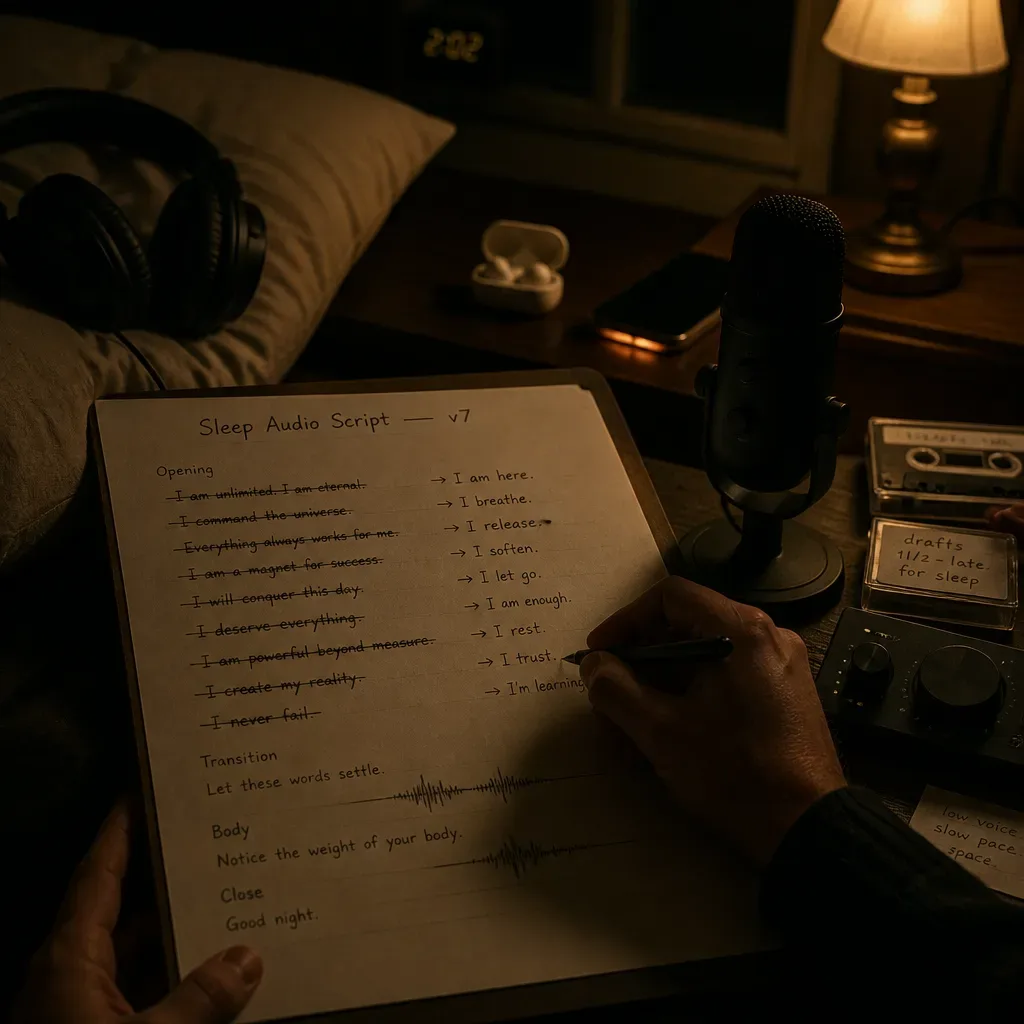
For a 3-minute track, I’d rather write 10 lines well than 60 lines badly. Use concrete nouns. Use verbs you can picture. Avoid flattery you don’t believe. If your mind argues with a sentence, soften it until the argument stops.
Try these swaps:
| Too grand | Better for sleep audio |
|---|---|
| I always win at everything | I meet this day steadily |
| Everyone loves me | I let safe connection find me |
| I never fail | I learn and return |
| I have perfect discipline | I take the next small step |
A subliminal hides the voice, but it shouldn’t hide careless writing. For audible alternatives and examples of lines that hold up at night, return to Sleep affirmations pillar.
Are subliminals or audible audio better for nightly practice?
Audible audio is usually better for trust and personalization, while subliminals can be useful when you want a soft background cue.
This is the honest split. Subliminals appeal because they feel effortless. You can play rain, music, or noise and let the words sit underneath. That can be comforting. It can also create a trust issue, especially if you didn’t write the script. If you can’t hear the words, you’re depending on the creator’s choices.
Audible audio has fewer mysteries. You hear every word. You can reject a line, rewrite it, or lower the claim until it feels yours. That matters because belief is not a switch. Neville Goddard’s work, whatever you make of its metaphysics, understood the role of repeated inner speech before sleep. Joe Dispenza’s audience also returns to repetition and rehearsal, even when his claims go beyond what cautious evidence can support. The shared practical piece is simple: repeat the state you want to make familiar.
Use this comparison when choosing tonight’s audio:
| Practice | You hear the words? | Best for | Main caution |
|---|---|---|---|
| Subliminals | No or barely | Background repetition | Script trust |
| Sleep affirmations | Yes | Clear self-talk before sleep | Lines must feel believable |
| Sleep hypnosis | Yes | Guided relaxation | Voice may be too engaging |
| AYA-style personal audio | Yes | Daily personal rehearsal | Needs honest intake |
If a method costs you sleep, it costs more than it gives. That line applies to shifting methods, subliminal marathons, and all-night playlists. The night is not a contest.
For most listeners, the cleanest routine is modest: 3 minutes of focused audio, looped only if it helps you settle, used daily for 2 weeks, then kept or cut. You can also read more at The AYA Method if you want a practice where the voice is personal and the words stay audible.
Keep the voice low, and return tomorrow.