subliminals
Do Subliminals Need Headphones? Night Audio Rules
Do subliminals need headphones, or can you use speakers at night? Here are quiet, honest rules for volume, stereo tracks, sleep, and safety.
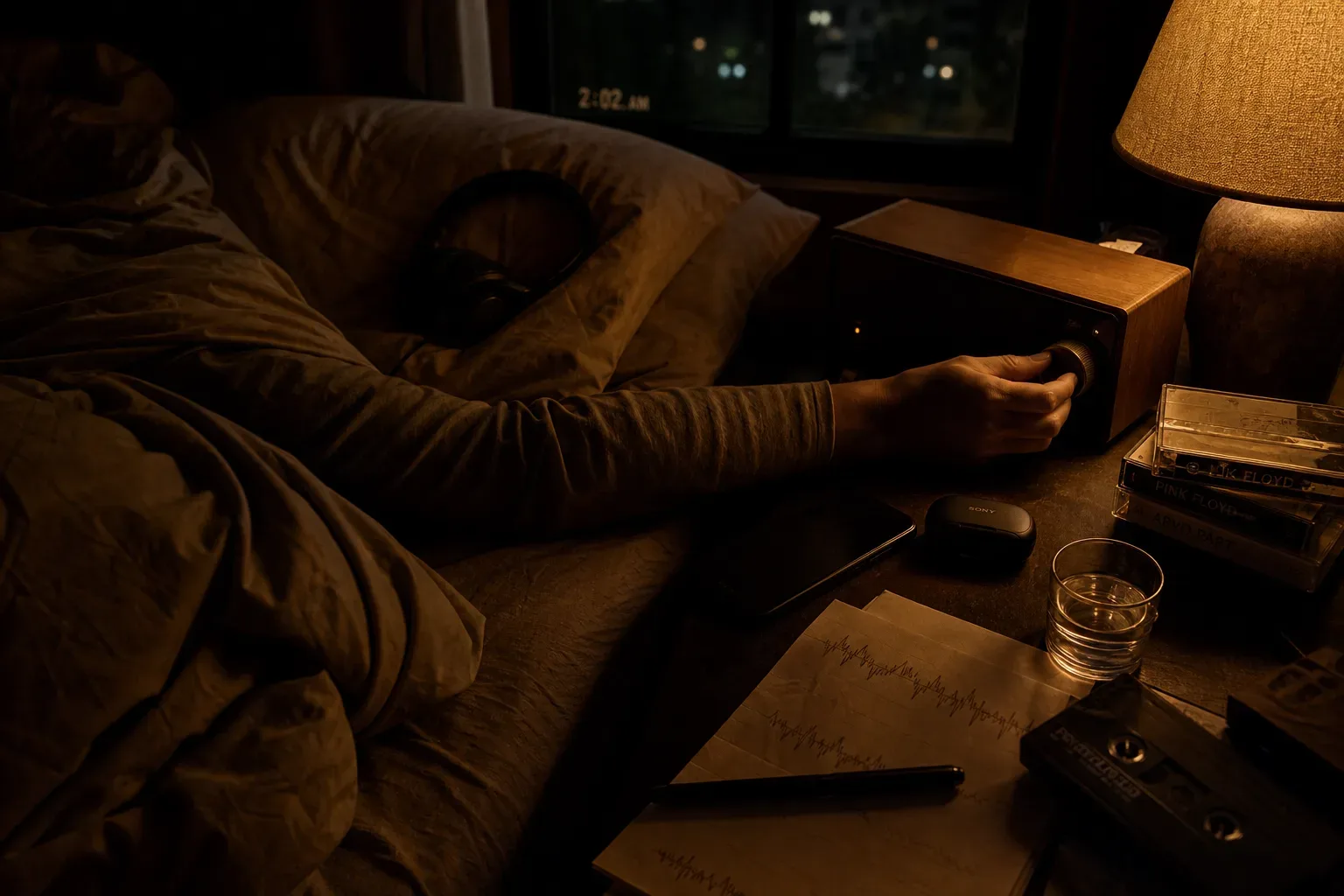
Most subliminals do not need headphones. Speakers are fine unless the track uses binaural beats, left-right stereo cues, or instructions that say headphones are required. At night, the better question is quieter: can you hear the carrier sound softly without hurting sleep, ears, or comfort?
Do subliminals need headphones, or are speakers enough?
Most subliminals work through repeated masked words, so speakers are enough when the mix is not built around stereo separation.
A subliminal is an affirmation you cannot consciously hear. That is the whole trick, and also the whole problem. If the words are hidden under rain, music, pink noise, or a soft drone, the playback device matters less than the consistency of listening. The research on unconscious priming is real but modest; the large claims on video platforms are not the same thing as clinical evidence. In a 2006 review, Ap Dijksterhuis and colleagues argued that unconscious cues can influence judgment, but the effect depends on context, attention, and measurement.
Headphones become useful when the producer has made the left and right channels do different jobs. Binaural beats, for example, require each ear to receive a slightly different frequency; a 2015 review in Psychological Research described mixed findings, with some small effects and many limits. If you play that through one phone speaker, the stereo design collapses. A left-ear whisper and right-ear tone become one small noise.
For ordinary masked affirmations, a bedside speaker is often kinder. It leaves your ears uncovered, reduces pressure, and lowers the chance that you wake at 3 a.m. because an earbud shifted. The U.S. Centers for Disease Control and Prevention says adults generally need at least 7 hours of sleep per night. That number matters more than whether your subliminal was in perfect stereo.
Use this quick rule:
| Track type | Headphones needed? | Night note |
|---|---|---|
| Masked affirmations under rain or music | Usually no | Speaker is fine if quiet |
| Binaural beats | Yes | Needs true left-right separation |
| Panned whispers or ear-specific cues | Usually yes | Check the creator notes |
| Audible affirmations | No | Comfort and clarity matter more |
| Sleep hypnosis | Optional | Avoid anything that startles you awake |
A practice that keeps you awake is not a sleep practice. It is just more audio in the dark.
If you want a fuller map of masked tracks, start with the Subliminals pillar. It gives the background without pretending that every quiet track has the same design.
When do headphones actually change the subliminal?
Headphones change the subliminal when the file depends on stereo, precise volume, or private listening.
The first case is technical. Binaural beats need one frequency in the left ear and another in the right. The brain hears the difference as a perceived beat. A 2019 meta-analysis in Psychological Research found that binaural beats may have small effects on anxiety and cognition, but the evidence was mixed and depended heavily on frequency and study design. Whatever you think of the effect, the setup itself requires headphones.
The second case is masking. Some subliminal makers bury speech very low under the carrier sound. If your room has a fan, traffic, a partner breathing, or a heating system clicking every 12 minutes, a speaker may lose the quiet details. Headphones can make the mix more controlled. But controlled does not mean stronger in any guaranteed way. It just means fewer room variables.
The third case is privacy. If your track contains personal affirmations, you may simply not want it playing aloud. That is reasonable. A soft sleep headband or pillow speaker can be a middle path, especially if earbuds make your ear canal sore. The American Speech-Language-Hearing Association notes that long listening sessions at high volume can contribute to hearing risk, and sleep audio can become long by accident.
There is also an emotional detail. Headphones can make a voice feel closer. For sleep hypnosis, that closeness may help you follow instructions. For subliminals, closeness may make you keep checking whether you can hear the words. Checking is arousal. Arousal is the opposite of sleep.
Here is the quiet decision sequence I use with clients and my own recordings:
- Read the track notes for binaural or stereo instructions.
- Listen for 2 minutes while awake, at the lowest comfortable volume.
- Try one night with speakers and one night with headphones.
- Notice sleep quality the next morning, not just belief in the track.
- Keep the setup that makes repeating easy for 7 nights.
The body votes by sleeping. Listen to that vote.
What volume should subliminals be at while you sleep?
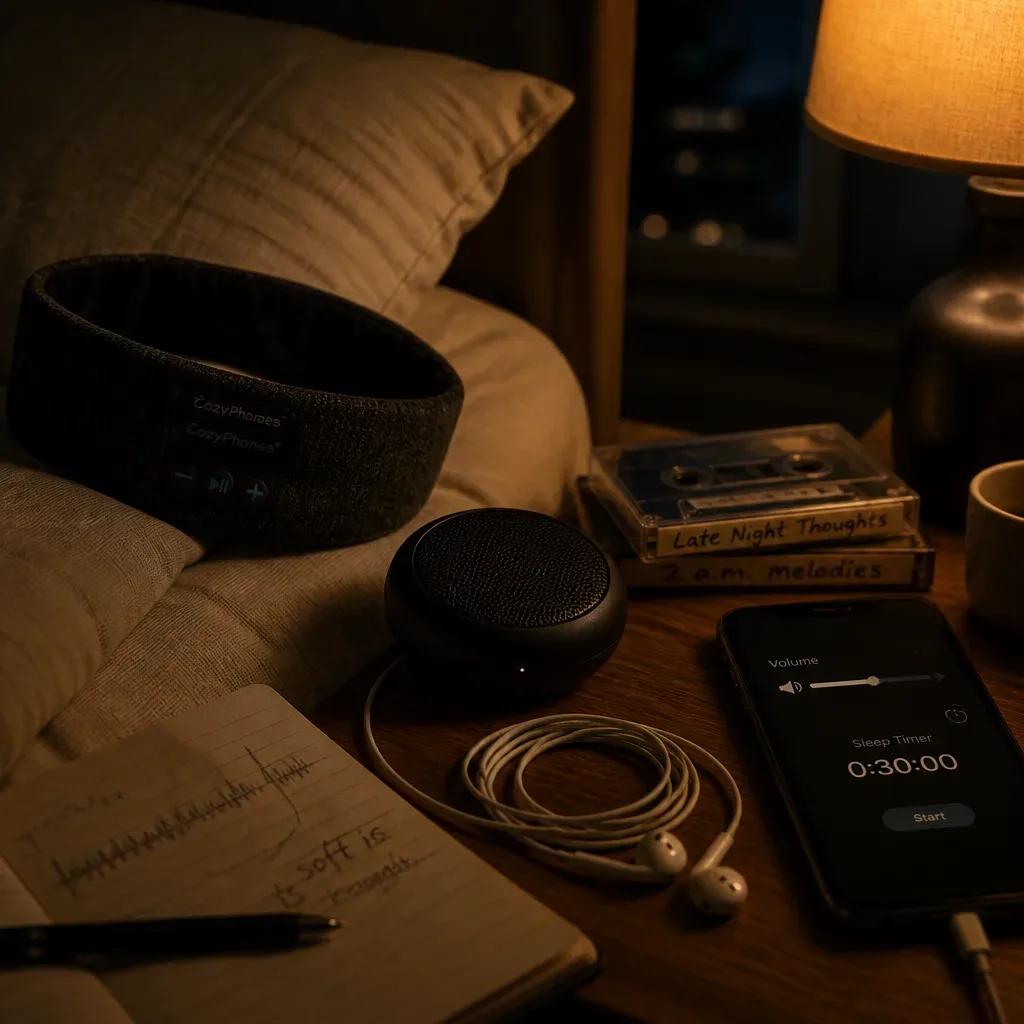
Use the lowest volume that lets the carrier sound sit in the room without pulling your attention back.
Night listening is not a contest of intensity. The safer target is quiet, steady, and boring. The World Health Organization’s Night Noise Guidelines for Europe connected nighttime noise with sleep disturbance and long-term health concerns, and older indoor guidance often points toward roughly 30 dB for continuous bedroom noise. Most people cannot measure that perfectly at home, but they can tell when audio is asking to be noticed.
Try the pillow test. Set the subliminal playing, lie down, turn your head away, and breathe normally. If the sound feels like a soft fan, you are close. If you can follow melody changes, spoken edges, or bass movement, lower it. If you need to strain to know whether it is on, raise it only one step. Phone volume jumps can be large; on some devices, one click may be several decibels.
Hearing safety matters more than manifestation habits. NIOSH uses 85 dBA over 8 hours as a recommended exposure limit for workplace noise, with allowed time dropping as volume rises. You do not need to be anywhere near that at night. Earbuds also create a sealed, close sound field, so a number that seems low on the slider can still feel loud in the ear.
A simple night setting looks like this:
- Speaker: 1 to 3 feet from the bed, not under the pillow.
- Earbuds: lowest audible carrier sound, no pressure pain.
- Sleep headband: flat speakers over the ear, checked for heat and tightness.
- Timer: 20 to 45 minutes before sleep, unless you already know looping does not wake you.
- Track choice: steady texture, no sudden bells, ads, or volume spikes.
Your nervous system does not need to be impressed. It needs to feel safe enough to let go.
For timing, the Sleep cycle calculator tool can help you choose a bedtime that respects full cycles instead of turning audio into another reason to stay up.
Is it better to play subliminals before sleep or all night?
Before sleep is usually better, because it protects sleep while still using a suggestible window.
The last minutes before sleep are not magical, but they are different. Attention narrows. The analytical mind loosens. Hypnagogic imagery can appear. In sleep research, this border is often discussed as the transition from wakefulness into stage N1 sleep. According to the American Academy of Sleep Medicine scoring framework, N1 is light sleep and can be easily interrupted. That is why harsh audio at the edge can break the very state you were trying to use.
A 10 to 20 minute pre-sleep listen is often enough for repetition. It gives the mind a phrase, a tone, and a direction without asking the ears to work all night. I have recorded sleep scripts for years, and the boring versions almost always age better than the dramatic ones. A steady voice can be returned to. A theatrical track becomes something to monitor.
All-night loops can work for some people, especially if the sound is as neutral as a fan. But looping creates more chances for disruption: Bluetooth disconnection tones, ads, battery warnings, playlist changes, or a sudden volume difference between tracks. Pew Research Center reported in 2021 that 31% of U.S. adults say they are online almost constantly. Many bedrooms already have enough digital presence. Night audio should not add more alerts.
If you do loop, use offline files, disable notifications, and test the whole playlist in daylight. A single ad at 2:40 a.m. can undo a careful bedtime. If a method costs you sleep, it costs more than it gives.
This is also where audible personal audio differs from subliminals. The AYA Method is a daily audio manifestation practice. Each day you listen to a short personalized recording — your Dream-Self Moment — narrated from the version of you who has already manifested the life you intend. Listening is the practice. Repetition is the work. The audio is the method. Because you can hear every word, you are not guessing what entered the room before sleep.
What kind of night audio should you avoid?
Avoid audio that startles, strains, promises medical results, or makes sleep feel like a test.
Start with volume spikes. Many online subliminals are not mastered for sleep. A soft intro may be followed by a loud chorus, a mid-roll ad, or a creator tag at the end. The European Environment Agency and WHO have both treated night noise as a sleep issue because interruptions matter even when you do not fully wake. Your body can react to sound before your story-making mind catches up.
Avoid aggressive claims. A track title promising instant body changes, guaranteed obsession, or overnight personality shifts is not evidence. It is marketing. Research on self-affirmation, including work by Claude Steele in the 1980s and later health-behavior studies in the Journal of Behavioral Medicine, suggests that affirming valued identity can reduce defensiveness in some contexts. That is a long way from saying inaudible words can force a result by morning.
Avoid tracks that make you uneasy. This sounds too simple, but it is central. If the title, comments, or hidden nature of a track makes you suspicious, do not bring it into bed. The bed is not the place to argue with a stranger’s script. Use creators who publish their affirmations, or make your own. Audible does not mean weaker. Sometimes audible means honest.
Also avoid sleep deprivation dressed as discipline. If you are replaying a file six times because you fear missing a night, the practice has turned sharp. The National Sleep Foundation’s general adult recommendation is 7 to 9 hours. Your subliminal habit should fit inside that, not compete with it.
If you are drawn to gentler spoken practices, the Sleep affirmations pillar explains how audible phrases before bed can support self-talk without hiding the words.
How do subliminals compare with sleep affirmations and sleep hypnosis?
Subliminals hide the words, affirmations make the words clear, and sleep hypnosis uses voice pacing to guide attention.
These practices overlap because they all use repetition near sleep. They differ in consent and attention. With a subliminal, you usually consent to a theme but not to every sentence in real time. With sleep affirmations, you can hear the exact phrase. With sleep hypnosis, the voice may guide breathing, muscle release, imagery, and suggestion. The mechanism is less mysterious: you listen, soften, and repeat.
Neville Goddard’s popular bedtime practice, often called the state akin to sleep, asks people to enter drowsiness and repeat a chosen inner scene. Joe Dispenza’s work uses meditation and rehearsal language, though his claims are broader and should be separated from controlled sleep science. Dr. Andrew Huberman often emphasizes light, temperature, and regularity for sleep; those basics are not glamorous, but they are measurable. Morning bright light exposure, for example, is commonly discussed in circadian research because it helps anchor the body clock.
Here is the practical difference:
| Practice | Can you hear the words? | Best use at night | Main caution |
|---|---|---|---|
| Subliminals | Usually no | Soft background repetition | You may not know the exact script |
| Sleep affirmations | Yes | Clear self-talk before sleep | Phrases can feel forced if badly written |
| Sleep hypnosis | Yes | Relaxation plus suggestion | Poor pacing can keep you alert |
| AYA-style personal audio | Yes | Daily listening to your own Dream-Self Moment | Needs honest wording you can live with |
The hidden word is not always the deeper word. Often, the sentence you can bear to hear is the one you can repeat.
For a broader practice map, read sleep hypnosis basics and then compare it with how subliminals are usually built. The overlap is useful, but the differences keep your expectations clean.
What are the best headphone options if you still want them?
The best headphone option is the one you can forget you are wearing while keeping the volume low.
For side sleepers, hard earbuds often fail first. They press into the ear, shift the jaw, or create soreness by morning. Sleep headbands with flat speakers can be more comfortable, though they can feel warm. Pillow speakers keep your ears open, but the sound may leak into the room. Bone-conduction devices leave the ear canal open, yet some people find the vibration distracting.
There is no perfect device. There is only the least intrusive device for your body. Consumer Reports and hearing-health organizations often give the same broad advice: keep volume conservative, take breaks, and watch for ringing or muffled hearing. For overnight use, the break may be the timer. A 30 minute timer is a kindness, not a lack of commitment.
Consider this buying checklist before you make a night habit:
- Can you lie on your side without pressure pain for 10 minutes?
- Does it have physical volume control, not just app control?
- Can it play offline, without ads or alerts?
- Does it avoid bright lights near your face?
- Can you clean it easily, especially if it touches the ear?
- Will you hear important sounds, like a child, alarm, or safety signal?
If you share a bed, speakers may disturb someone else even when they seem soft to you. A pillow speaker or one-ear setup can help, but do not sacrifice your own comfort to keep a track running. The practice is repetition over weeks, not heroics in one night.
A small study can be enough for your own life: test 3 nights with speakers, 3 nights with headphones, and 3 nights with no audio. Track sleep length, awakenings, and mood on waking. Nine nights will teach you more than 90 comment threads.
What night rules should you follow for a clean subliminal practice?
Follow rules that protect sleep first, make the script knowable when possible, and keep repetition gentle.
The cleanest subliminal practice is boring in the best way. Same time. Same low volume. Same safe source. Same exit timer. You are not trying to overpower the night. You are giving the mind one repeated cue and then getting out of the way. In behavioral research, repetition and cue consistency matter because habits attach to contexts; BJ Fogg’s behavior model, for example, puts prompts and ease at the center of repeatable action.
Use these night audio rules:
- Choose tracks with published affirmations when possible.
- Avoid medical, coercive, or fear-based titles.
- Keep volume lower than daytime listening.
- Use headphones only when the track design needs them or privacy matters.
- Set a 20 to 45 minute timer before trying all-night loops.
- Download files or use an ad-free source.
- Stop any track that makes your sleep worse for 2 nights in a row.
If insomnia is ongoing, painful, or affecting your daytime life, speak with a qualified clinician. Sleep audio can be part of hygiene, but it is not treatment for a sleep disorder.
Your method should feel repeatable on an ordinary Tuesday. That is one reason personal audio can be cleaner than anonymous hidden tracks: you know the words, the timing, and the voice. The daily affirmation and Manifestation Board can support a practice, but the audio is the method when you are using AYA. For subliminals, the audio is still the container; choose it with care.
The last ten minutes before sleep are suggestible. Choose what goes in.
Low enough to rest, clear enough to trust, repeated enough to become yours.