reality shifting
Intention Method Shifting: A Sleep-Safe Audio Cue
Intention method shifting can stay sleep-safe when you use one clear audio cue, a short cutoff time, and a grounded plan for the morning after.
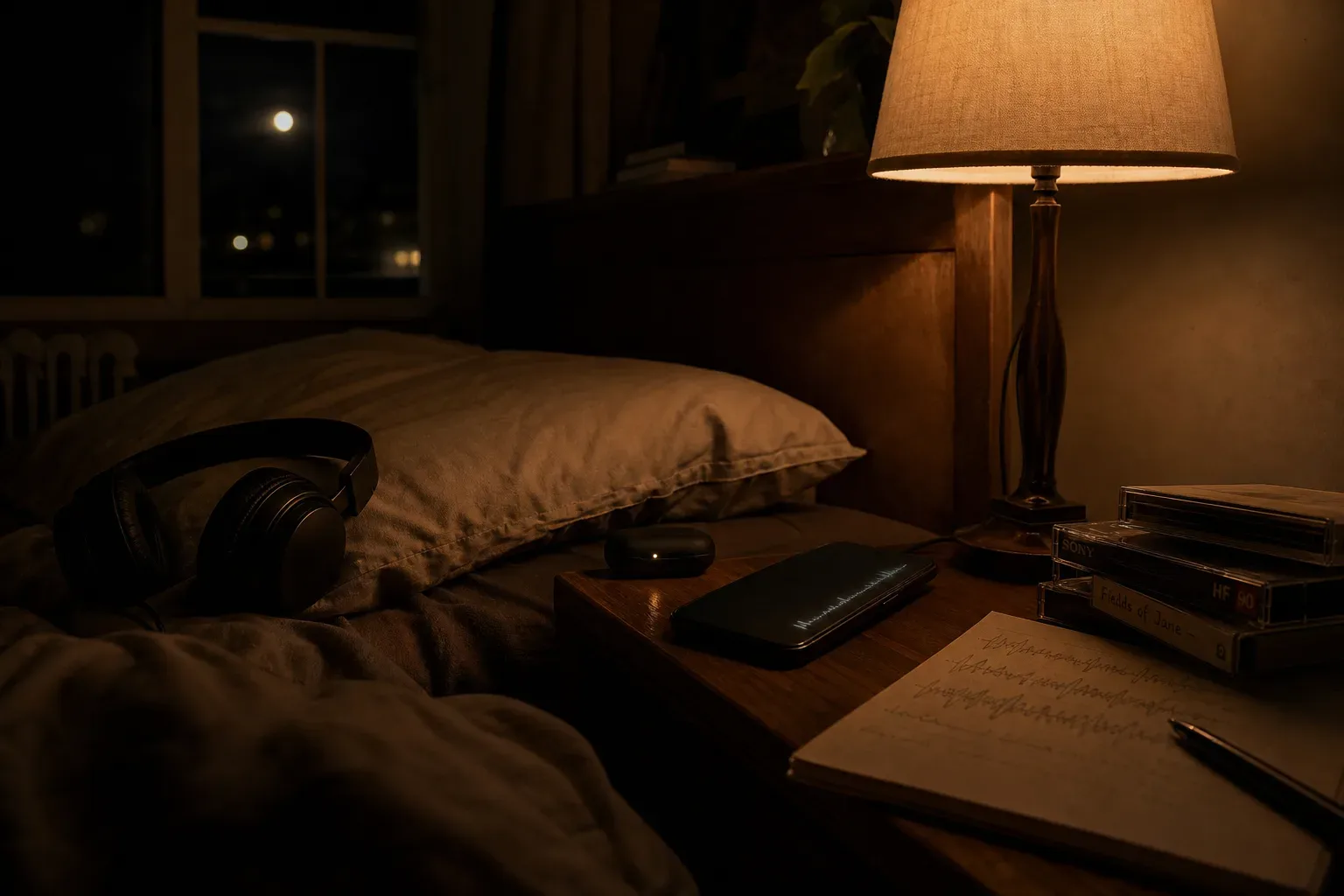
Intention method shifting is the practice of setting one clear shifting intention before sleep, then letting sleep do what effort can’t. A sleep-safe audio cue helps by giving your mind a repeatable closing signal: hear the phrase, stop trying, and rest. The cue supports the method, but sleep stays first.
What is intention method shifting, in plain terms?
Intention method shifting is a low-effort reality shifting method built around deciding, stating, and releasing one intention before sleep.
In the shifting community, the intention method is the quiet cousin of counting methods, raven-style positions, long scripts, and heavy visualization. You choose a desired reality, decide that you intend to wake there or become aware there, and then you go to sleep. That’s the whole shape. The method’s appeal is obvious: it doesn’t ask you to stay awake for 40 minutes counting to 100, and it doesn’t require a perfect mental movie.
That matters because sleep is not a cute side detail. The American Academy of Sleep Medicine says adults should regularly sleep 7 or more hours per night, while the CDC reports that about 1 in 3 U.S. adults don’t get enough sleep. If a shifting method makes you lose another hour, the cost is real.
The honest evidence line is simple. There is no peer-reviewed proof that intention method shifting transfers awareness to another reality. There is, however, research showing that intention, suggestion, and pre-sleep thought can shape attention, dream themes, and memory. Studies on dream incubation go back decades, and small modern studies still find that pre-sleep prompts can influence dream content for some sleepers.
A sleep method that keeps you awake has already missed the point.
A sleep-safe version treats the intention as a cue, not a performance. You don’t need to feel symptoms. You don’t need buzzing, floating, spinning, or a perfect body position. You need a short phrase, a repeatable routine, and permission to lose consciousness like any other night.
This is where audio can help. Not because audio proves the metaphysics. It helps because the same heard phrase, repeated nightly, gives the practice a beginning and an end. If you already read about reality shifting through community posts, this guide narrows the practice to one sleep-safe version you can actually maintain.
Why use an audio cue instead of just saying the intention?
An audio cue helps because it makes the intention consistent without asking your tired mind to keep producing it.
When you speak an intention silently, it can turn into negotiation. You start with one sentence and end up revising your script, checking symptoms, testing your eyelids, and wondering whether you said it correctly. Audio lowers that load. You record the cue once while awake, then at bedtime you only listen.
Sleep researchers often describe the pre-sleep period as a shift in attention and sensory gating. Stage N1, the lightest sleep stage, can begin within minutes for some people and is associated with drifting images, loose thought, and reduced external monitoring. Sleep cycles tend to run about 90 minutes, though individual cycles vary. A cue should meet that softness, not fight it.
There is also a practical reason to prefer audio: timing. A cue can be set to stop after 10 or 20 minutes. A thought loop has no timer. The National Heart, Lung, and Blood Institute gives a common adult sleep range of 7 to 9 hours; shaving that down with late-night effort is not harmless just because the practice feels meaningful.
Here is the clean comparison:
| Practice style | What it asks from you | Sleep risk | Best use |
|---|---|---|---|
| Silent intention | Remember and repeat the phrase | Medium | Short nights, familiar scripts |
| Long guided shifting audio | Follow imagery for 30 to 60 minutes | Higher | Earlier evening, not lights-out |
| Subliminal loop | Trust words you can’t clearly hear | Variable | Daytime or low-stakes listening |
| Short audio cue | Hear one clear phrase, then sleep | Lower | Bedtime intention method shifting |
A subliminal is different. In subliminals, the words are usually hidden under music or noise. That can feel comforting, but it also means you can’t always verify what you’re hearing. For a sleep-safe shifting cue, clear words are better. You want your nervous system to know the practice is done.
The best cue is boring enough to sleep through and clear enough to return to.
How do you write a sleep-safe shifting intention?
A sleep-safe shifting intention is one sentence that names the desired shift without turning bedtime into a test.
Keep the sentence short enough to remember when you’re half asleep. If it takes 3 paragraphs to say, it belongs in a daytime script, not in your bed. The intention method works best when the line feels like a door closing gently, not a contract you’re afraid to get wrong.
A useful structure is: I intend to rest safely and become aware in [desired reality or scene] when it is right for me. That may sound less dramatic than community posts that promise instant results, but it has two advantages. First, it includes rest. Second, it removes the pressure to monitor every sensation. In behavioral research, implementation intentions often use simple if-then plans; psychologist Peter Gollwitzer’s work from the 1990s found that specific cues can help people follow through with intended actions more reliably than vague goals.
Use this 5-part filter before recording:
- One place: name one desired reality, room, person, or scene.
- One tone: use calm wording you’d still trust at 2 a.m.
- One safety line: include sleep, rest, or waking well.
- One ending: say the phrase once or twice, not twenty times.
- One morning note: decide how you’ll record what happened after waking.
Examples you can adapt:
- I intend to sleep safely and wake with clear memory of where my awareness goes.
- I intend to rest now and become aware in my intended room when my mind is ready.
- I intend to fall asleep easily, and if shifting happens tonight, I’ll notice calmly.
- I intend to return to this practice without forcing it.
The line can be mystical to you and still practical in design. A 2021 review in the journal Sleep Medicine Reviews discussed how cognitive arousal before bed can interfere with sleep; that includes exciting thoughts, not only anxious ones. Shifting can be absorbing. Treat it with that respect.
If you like spoken affirmations, sleep affirmations can teach you the pacing: slow, low, repeatable, and not too clever. The difference is that this cue is not a long affirmation track. It is a finish line.
How do you record the audio cue step by step?
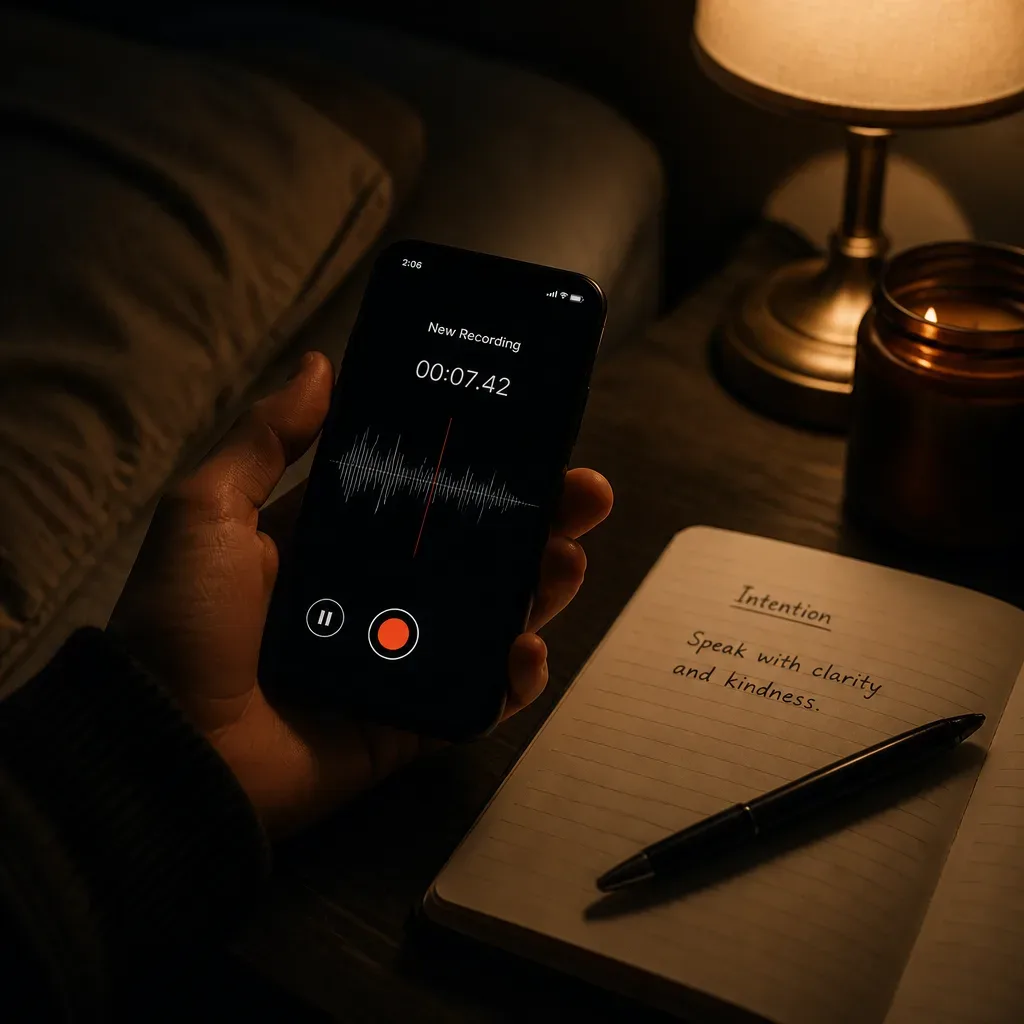
Record a short, audible cue in your own voice, then set it to stop before it can become a sleep problem.
You do not need studio sound. You need clean enough audio that you won’t strain to hear it. Most phone voice memo apps are fine. Record in a room with soft surfaces, hold the phone about 6 to 10 inches from your mouth, and speak more slowly than you think you should. Many guided meditation recordings sit around 60 to 90 words per minute; your cue can be even slower because it is brief.
Here is a simple recording script:
- Sit somewhere awake, not already in bed.
- Take 3 normal breaths without making them special.
- Say your intention once.
- Add one closing line: I don’t need to check. I can sleep now.
- Leave 5 seconds of silence at the end.
- Save it with a plain name, such as shifting cue night.
Your finished file should be 20 to 60 seconds. If you want music under it, keep the voice clearly audible and avoid sudden volume changes. The World Health Organization’s 2018 environmental noise guidance treats night noise as a sleep concern when it is high or disruptive; you don’t need a medical-grade meter to apply the principle. Soft and steady wins.
A safe playback plan looks like this:
| Setting | Recommended range | Why it helps |
|---|---|---|
| Cue length | 20 to 60 seconds | Keeps the method simple |
| Playback window | 10 to 20 minutes | Prevents all-night monitoring |
| Volume | Lowest clear level | Lets sleep take over |
| Repeat schedule | 5 to 14 nights | Gives enough data without obsession |
| Morning note | 1 to 3 lines | Tracks sleep, not only shifts |
This is also where the AYA Method is worth naming clearly. The AYA Method is a daily audio manifestation practice. Each day you listen to a short personalized recording — your Dream-Self Moment — narrated from the version of you who has already manifested the life you intend. Listening is the practice. Repetition is the work. The audio is the method.
That’s close to this guide in one way and different in another. Both value audible, personal audio. But intention method shifting is a community shifting practice aimed at sleep-adjacent awareness. The AYA Method is a daily audio manifestation practice; a daily affirmation or Manifestation Board may complement it, but they are not the core. The recording is.
If you can hear every word, you can choose whether those words belong in your night.
When should you play the cue so it doesn’t steal sleep?
Play the cue after your ordinary bedtime routine, for 10 to 20 minutes, then let silence or neutral sound take over.
The worst time to build a new shifting ritual is after you’re already sleep deprived and emotionally keyed up. If it is past your bedtime by 45 minutes, use the shortest version or skip the practice. Missing one night is not failure. It is maintenance.
A basic timing plan:
- 30 minutes before bed: stop reading intense shifting threads.
- 15 minutes before bed: set your audio and timer.
- 5 minutes before bed: dim the room and put the phone face down.
- Lights out: play the cue quietly.
- After 10 to 20 minutes: audio stops, and you do nothing else.
The Sleep Foundation often describes a wind-down window of 30 to 60 minutes as helpful for many sleepers. That does not mean everyone needs a long ritual. It means your brain benefits from fewer surprises. Your shifting cue should be one of the least surprising parts of the night.
If you use a sleep tracker, don’t let it become a second method. Consumer sleep trackers can estimate sleep timing, but studies have found they vary in accuracy, especially for sleep stages. Use them for rough patterns, not verdicts. If you want a simple bedtime anchor, the sleep cycle calculator can help you choose a wake time that respects full sleep windows.
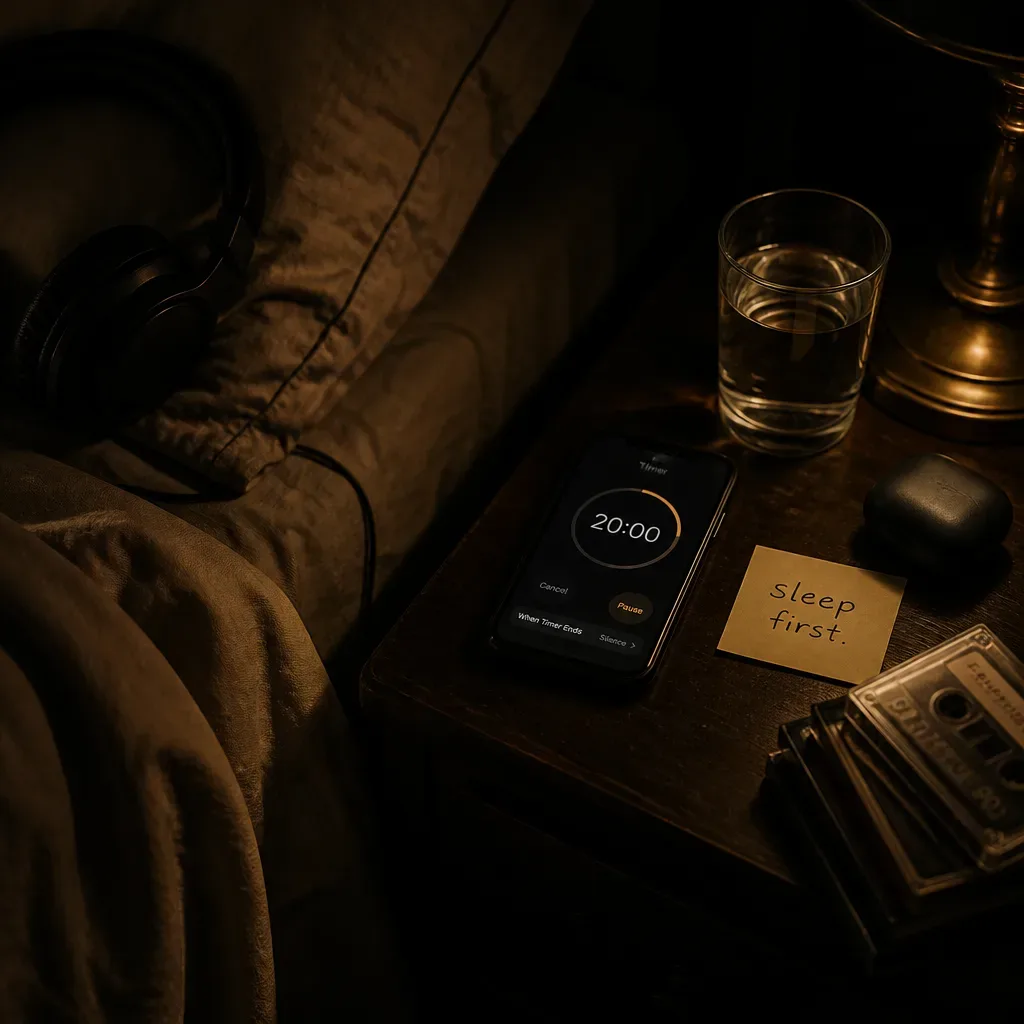
There is one firm line here: if the cue makes you lie awake, remove it from bedtime. Move it to early evening, or record a calmer version. No method gets to outrank your sleep. Teens should be even more careful; the American Academy of Sleep Medicine recommends 8 to 10 hours for ages 13 to 18.
What should you expect by week two?
By week two, you should expect a clearer routine, not guaranteed shifting results.
A lot of community harm comes from treating every night as a pass-fail test. That makes sleep tense. For the first 14 nights, track ordinary outcomes first: how fast you fell asleep, how rested you felt, whether dreams became easier to remember, and whether the practice stayed emotionally steady.
Small studies of dream incubation suggest some people can influence dream themes with pre-sleep prompts, but results are not universal. In one classic line of dream research, Deirdre Barrett reported that focused pre-sleep problem statements sometimes appeared in dreams. That is interesting. It is not the same as proving shifting. The honest middle is enough: your pre-sleep input may matter, and it may matter modestly.
Use a 14-night check like this:
| Question | Good sign | Warning sign |
|---|---|---|
| Did I fall asleep within a normal window? | Most nights, yes | Awake 30 to 60 extra minutes |
| Did I keep the cue short? | 10 to 20 minutes | All-night loops |
| Did my mood stay steady? | Curious, calm | Panicked or ashamed |
| Did I dream more? | Maybe, with notes | Fixated on proof |
| Did I live my next day? | Yes | Daytime withdrawal |
Shifting practice should widen your inner life, not shrink your actual one.
If you notice more dream recall, write it down without over-reading it. If nothing happens, you can still keep the cue as a gentle intention practice, adjust the wording, or stop. The method owes you rest before it owes you results.
This is also a good time to compare the cue with other audio practices. Sleep affirmations repeat supportive phrases for mood and identity. Subliminals often hide affirmations below awareness. Intention method shifting uses one conscious cue to mark a desired direction, then asks you to release the work.
If you’re prone to insomnia, nightmares, dissociation, or anxiety that spikes at night, keep the practice daytime-only and consider talking with a clinician. That sentence is not here to scare you. It is here because intense inner practices can feel larger at 2 a.m., and you deserve support that is bigger than a comment section.
How do you keep the practice grounded if the community gets intense?
You keep it grounded by treating shifting content as folklore, not as a sleep command you must obey.
I love this community enough to be careful with it. Shifting methods are internet folklore in fast-forward: names appear, rules harden, someone says you must drink water or count in a certain position, then 2 months later everyone is doing something else. That doesn’t make it fake or worthless. It means you should not let a trend write laws for your nervous system.
Pew Research Center reported in 2022 that 95% of U.S. teens use YouTube and 67% use TikTok. Those platforms shape how shifting methods spread: short posts, high emotion, strong claims, very little follow-up. A method can become famous because it is shareable, not because it is safe at midnight.
Keep these rules near the practice:
- If a method costs you sleep, it costs more than it gives.
- If a rule makes you afraid, it is not your rule.
- If you need proof tonight, you are too activated for bedtime practice.
- If your script feels like homework, make it smaller.
- If the audio feels comforting but unclear, rewrite it until it is plain.
There are also older cousins to this practice. Neville Goddard taught imaginal scenes before sleep. Joe Dispenza speaks often about mental rehearsal and identity. Dr. Andrew Huberman has discussed how light, timing, and nervous system arousal affect sleep readiness. None of those sources prove shifting. They do point to a shared practical truth: what you repeat before sleep can steer attention.
The Princeton Engineering Anomalies Research lab and the later Global Consciousness Project are sometimes cited in manifestation spaces. Their data remain debated and do not prove personal shifting. Use them as a reminder to stay curious, not as a reason to abandon discernment.
Your best protection is a small method. One cue. One timer. One morning note. The rest of your night belongs to sleep.
Let the last words be few, and let them be yours.