reality shifting
Alice in Wonderland Method for Sleep-Safe Shifting
A sleep-safe guide to the alice in wonderland method for shifting, with audio setup, bedtime steps, and honest limits around evidence.
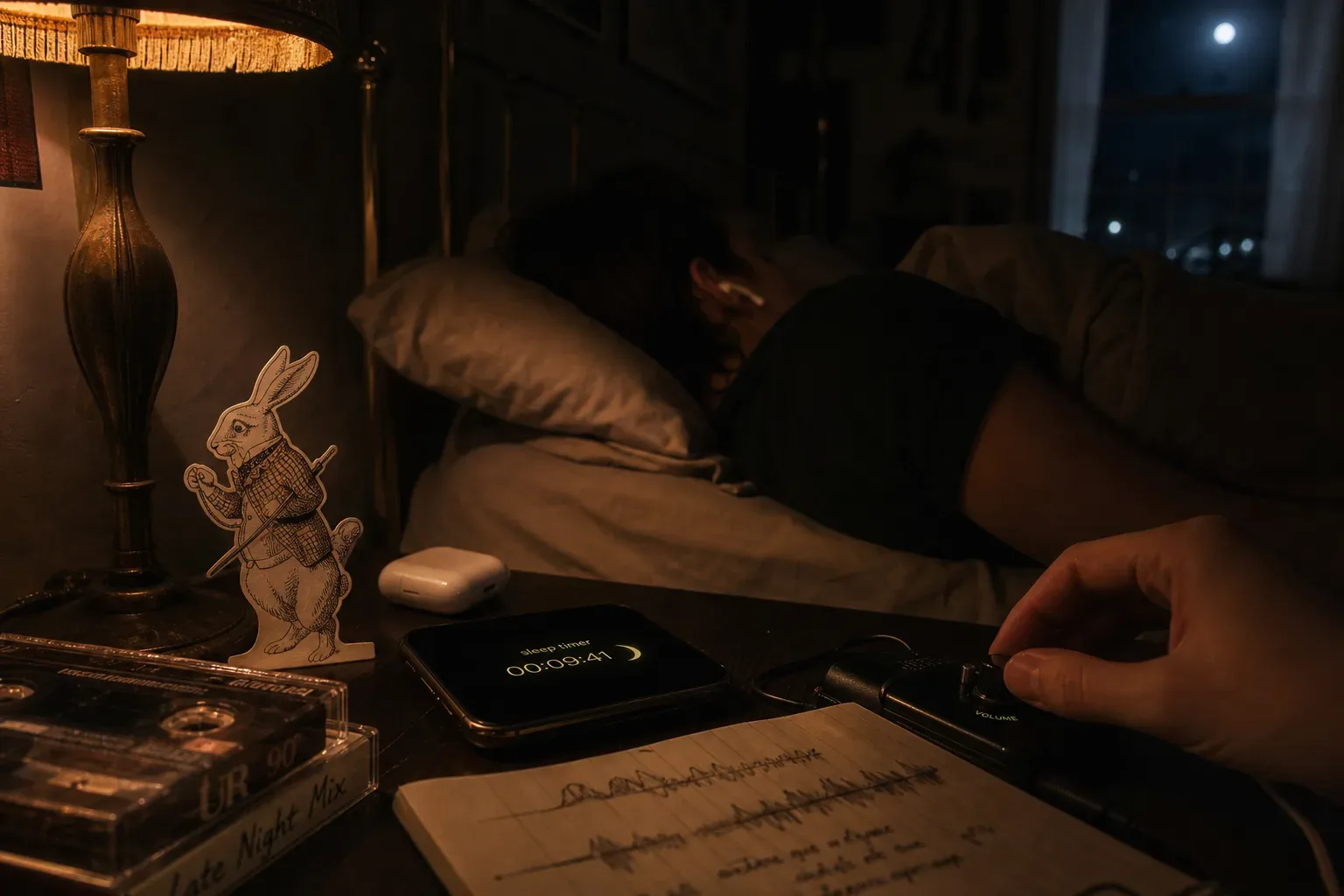
The alice in wonderland method is a reality shifting practice done before sleep: you follow a guided Alice-style scene, often the White Rabbit and a falling passage, toward a desired reality. Use it like gentle audio rehearsal, not a test. Keep it short, quiet, and easy to abandon if sleep is asking for you.
What is the Alice in Wonderland method, really?
The Alice in Wonderland method is a symbolic bedtime visualization for shifting, usually built around following the White Rabbit into a door, tunnel, or room that stands for your desired reality.
Most versions came from shifting communities rather than clinical sleep research. That matters. The method has personal meaning for many listeners, but there are no controlled trials showing that it moves a person into another reality. What the research does support, modestly, is that mental imagery can affect emotion and sleep onset. A 2002 study by Allison Harvey and colleagues found that imagery distraction helped some people with insomnia fall asleep faster than problem-focused distraction.
The Alice frame works because it gives the mind a sequence. First, you are in bed. Then you notice the rabbit. Then you follow. Then you fall, float, or descend. Then you open a door. Sleep likes sequence. In normal adult sleep, cycles tend to run about 90 minutes, though they vary by person and by night. A method that takes 15 minutes can fit inside a normal bedtime; a method that takes 90 minutes has become something else.
A useful way to hold it is this: the scene is not the proof; the scene is the handle. You are giving your tired attention one soft thing to hold.
That is why the method belongs close to sleep affirmations, guided imagery, and sleep hypnosis, not next to all-night forcing. If a method makes you fight your body, it has missed the night. If it lets you rehearse an identity and then drift off, it may be worth keeping.
How do you prepare without damaging your sleep?
You prepare by making sleep the priority before the method begins.
Start with a hard boundary: the method gets 10 to 20 minutes, then sleep wins. The American Academy of Sleep Medicine recommends that adults get 7 or more hours of sleep per night on a regular basis. That number is not a moral rule. It is a useful guardrail. If your shifting practice cuts into your sleep by an hour every night, the cost is no longer small.
Set the room up like you would for any audio before sleep. Dim the screen at least 30 minutes before bed if you can. Keep the phone face down. Use a sleep timer. If you use earbuds, keep volume low enough that you could still hear your name spoken nearby. The World Health Organization has warned that long exposure to loud personal audio can risk hearing health; bedtime listening should be soft by design.
Here is the simple setup I use when testing a night method:
| Element | Sleep-safe choice | Why it matters |
|---|---|---|
| Length | 10 to 20 minutes | Long enough to settle, short enough to stop |
| Volume | Low spoken voice | No strain, no startle |
| Device | Screen down, timer on | Less checking, fewer blue-light cues |
| Script tone | Calm, present tense | Reduces effort and performance pressure |
| Exit plan | Permission to sleep | Keeps rest above results |
Do these in order:
- Choose the audio before you get in bed.
- Set a timer for one play or 20 minutes.
- Put the screen away.
- Lie down in your normal sleep position.
- Start the guide and stop managing it.
Your body does not need a perfect ritual. It needs a repeatable cue. The quieter the setup, the easier it is to return tomorrow.
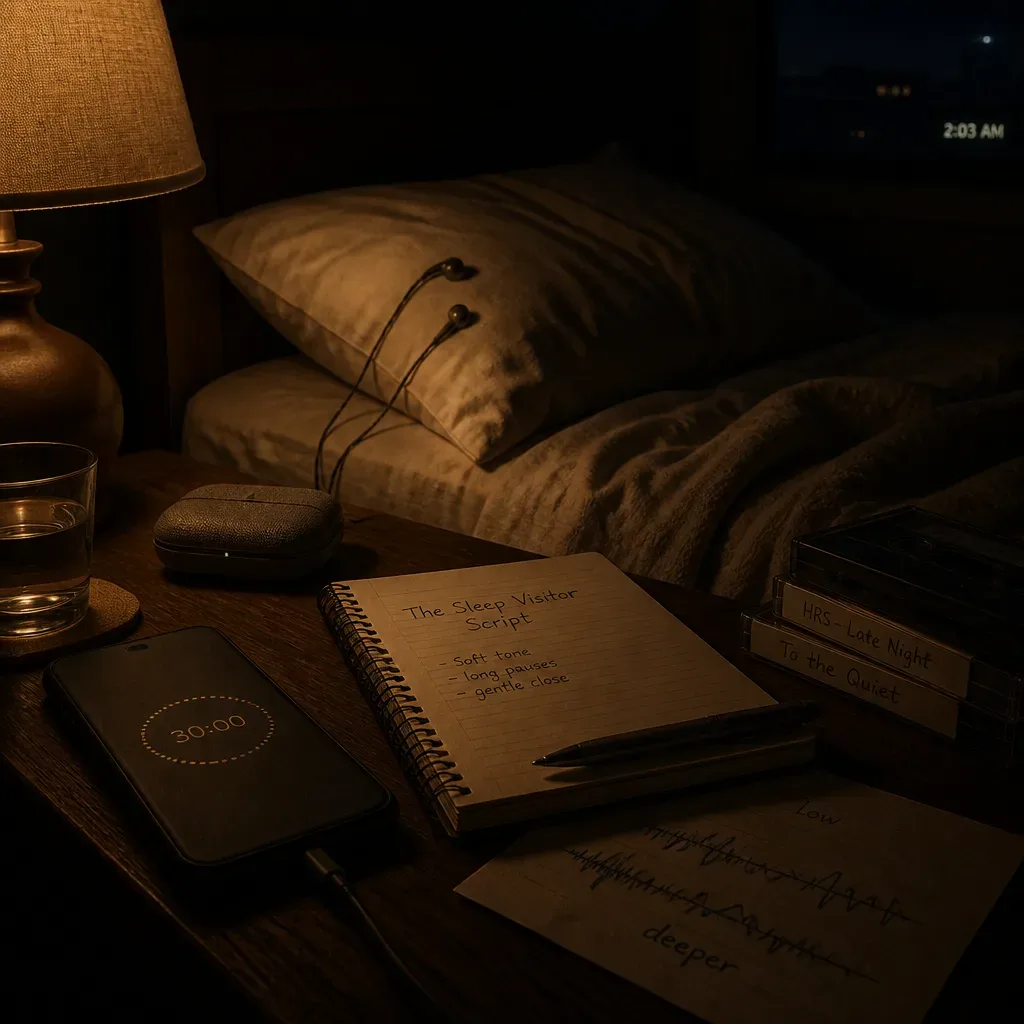
What audio should you use for the method?
Use audio that stays audible, slow, and personal enough to keep you calm.
There are three good options. The first is a spoken Alice in Wonderland guide made for sleep, with no sudden sound effects. The second is a simple self-recorded script in your own voice. The third is a soft affirmation track that borrows Alice imagery but lets you fall asleep without needing to follow every sentence. If the words disappear under music, you are closer to subliminals. Subliminals can be interesting, but they raise a plain problem: you cannot check what you cannot hear.
I prefer audible words for this method. A subliminal is an affirmation you cannot consciously hear. That is the whole trick, and the whole problem. With the Alice in Wonderland method, the order of the images matters. You want to hear the voice say: follow, soften, fall, arrive, rest. That sequence gives the mind a rail. In priming research, effects are usually modest and context-dependent; the large claims made on video platforms are not the same thing as peer-reviewed evidence.
This is where the AYA Method sits nearby, though it is not a shifting method. The AYA Method is a daily audio manifestation practice. Each day you listen to a short personalized recording — your Dream-Self Moment — narrated from the version of you who has already manifested the life you intend. Listening is the practice. Repetition is the work. The audio is the method.
The difference is important. In the Alice method, you are following a story-symbol into a desired reality. In AYA, you are listening to a clear recording of your own future-self language daily, including at night if that suits you. The daily affirmation and Manifestation Board can support the practice, but the audio is the method.
A sentence lands differently when the speaker is you. If you record your own guide, keep it under 400 words for a 4 to 5 minute read at a slow pace. Leave 3 to 5 seconds of silence between major images. Silence is not empty in sleep audio. Silence lets the image become yours.
How do you do the Alice in Wonderland method step by step?
You do it by pairing a relaxed body with a short, repeated scene that ends in sleep rather than effort.
Use this script structure for your first week. Do not keep adding details every night. Novelty wakes the brain. Repetition settles it. Sleep researchers often describe conditioned cues around bedtime: when the same signals repeat, the body learns what comes next. That does not prove shifting, but it does explain why a stable method can feel easier after several nights.
A 20-minute sleep-safe version
- Minute 0 to 2: settle the body. Feel the bed under your back or side. Unclench your jaw. Let your tongue rest. You do not need a special breathing count, but if counting helps, try 4 seconds in and 6 seconds out for five rounds.
- Minute 2 to 5: enter the scene. Picture a quiet room. The White Rabbit appears without urgency. You notice it, but you do not chase. You follow at the pace of sleep.
- Minute 5 to 9: descend gently. You come to a passage, a hole, a staircase, or a soft fall. Keep the movement slow. No spinning. No fear. The body in bed stays safe.
- Minute 9 to 13: find the door. A door appears with one clear detail: color, handle, number, or sound. Behind it is your desired reality, but you do not have to force a full scene.
- Minute 13 to 17: step through. Notice one ordinary detail: a floor, a window, a familiar voice, your hands. Ordinary details are better than dramatic ones because they ask less of the nervous system.
- Minute 17 to 20: release. Say, silently or aloud, I can sleep now. If I return to this scene, I return softly.
If you lose the image, that is not failure. Wandering attention is normal before sleep. A 2010 Harvard study using phone-based sampling found that minds wander often during waking life, roughly 47 percent of sampled moments. At bedtime, drifting is part of the handoff.
Do not restart from the beginning every time you lose the rabbit. Return to the door, or return to the feeling of the bed. The method is not a maze you must solve. It is a lullaby with pictures.
What should you notice by the second week?
By week two, you should notice whether the method makes sleep easier, harder, or emotionally louder.
Keep notes, but make them small. A 30-second note in the morning is enough: bedtime, method length, sleep quality, dream recall, mood. Do not grade whether you shifted as pass or fail. That turns the practice into pressure. In sleep medicine, stimulus control often protects the bed as a place for sleep, not effort. If the bed becomes a testing room, your body may learn the wrong cue.
Look for these signs that the method suits you:
- You feel sleepy during or soon after the audio.
- You can stop without frustration.
- The scene becomes familiar after 4 to 7 nights.
- You wake with more dream recall, even if nothing dramatic happened.
- Your desired reality details become calmer and more ordinary.
Also watch for signs to change it:
- You stay awake longer than usual for 3 nights in a row.
- You replay the guide repeatedly to get it right.
- You feel anxious when you do not shift.
- You check the time more than once.
- You feel detached from daily life in a way that worries you.
The National Sleep Foundation has long described healthy sleep as enough, continuous, and restorative. You do not need perfect sleep architecture to practice shifting methods, but you do need the practice to respect the night. If a method costs you sleep, it costs more than it gives.
Week two is not where you demand proof. Week two is where you ask a quieter question: does this help me return to myself, or does it make me chase myself?
How do you keep the practice grounded if shifting feels intense?
You keep it grounded by treating intensity as information, not as evidence that you are close.
Shifting communities can be warm, inventive, and deeply supportive. They can also create pressure without meaning to. When you read many success stories in a row, your nervous system may start treating sleep as a performance. Pew Research has reported for years that teens and young adults spend heavy time on social platforms; for many people, that means bedtime is not private unless they make it private. Put the community down before you put your head down.
Use three grounding rules:
- Name the room. Before starting, say where you are: my bed, my room, tonight’s date.
- Keep the body included. Notice the pillow, blanket, and breath during the scene.
- End with sleep permission. The final line should always allow ordinary sleep.
If you use the sleep cycle calculator, set your wake time first and work backward. That keeps the method inside your sleep plan instead of letting it eat the edge of the night. Many adults structure sleep in 90-minute cycle estimates, but real cycles vary. Use the tool as a planning aid, not a law.
If you have ongoing insomnia, panic at night, or distressing dissociation, talk with a qualified professional. That sentence is not here to scare you. It is here because sleep is basic care, and methods should not stand between you and care.
The most grounded version of the Alice method is almost plain: you lie down, listen, picture a door, and let yourself sleep. No proving. No bargaining. No all-night attempt. A soft practice can be serious without becoming severe.
Is the Alice in Wonderland method better than other shifting methods?
It is not better for everyone; it is better for people who respond to story, imagery, and gentle sequence.
The Raven method often uses counting and a starfish position. The Pillow method usually places written intent under a pillow. The Julia method leans on identity statements such as I am. The Alice method is more cinematic than those, but cinematic does not mean more effective. It just means the mind has more visual material to follow.
Here is the honest comparison:
| Method | Best for | Watch out for |
|---|---|---|
| Alice in Wonderland | Visual thinkers, story comfort | Too much detail can wake you |
| Raven | People soothed by counting | Rigid positions can become uncomfortable |
| Pillow | People who like simple cues | Can become superstition if overbuilt |
| Julia | People who like identity phrases | Repetition can turn effortful |
| Audible affirmations | People who need clear language | Scripts must feel believable |
If you are drawn to words more than images, start with sleep affirmations or self-recorded audio. If you are curious about hidden-word tracks, read the Subliminals pillar first so you know the difference between a claim and a mechanism. If you want bedtime timing to be cleaner, use the Sleep cycle calculator tool before choosing a method length.
The best method is the one you can repeat without becoming less rested. In small habit studies, repetition in a stable context is one of the main ingredients of automaticity; a 2009 study in the European Journal of Social Psychology found habit formation varied widely, with an average of 66 days for a behavior to become automatic. Night practices are no different. The method that survives ordinary Tuesdays is the method you actually have.
For a first week, choose one method only. Do it once per night. Keep the same audio. Keep the exit line. After 7 nights, decide with your notes, not with the loudest story you read online.
The door can wait. Your sleep cannot.