subliminals
Morphic Fields vs Subliminals: Safer Night Audio Swap
Morphic fields vs subliminals, compared honestly for sleep: evidence, volume, consent, and a safer audible audio practice for night listening.
Morphic fields vs subliminals comes down to consent, clarity, and claims. Subliminals hide affirmations beneath sound; morphic field audio usually claims to transmit non-audible informational patterns. For night listening, the safer swap is audio you can hear, choose, and stop without losing sleep.
What are you actually comparing when you ask morphic fields vs subliminals?
You’re comparing two kinds of hidden audio promises: one hides the words, and the other often hides the mechanism.
A subliminal is usually an affirmation or suggestion placed below conscious hearing, masked by rain, music, pink noise, or another sound bed. The basic idea is older than YouTube: perception can be influenced by stimuli you don’t fully notice. Research on priming is real, but modest. A 2012 paper in Perspectives on Psychological Science helped start a broad replication conversation around social priming, and the honest version is simple: some cueing effects exist, but online claims often outrun the data.
A morphic field audio track is different. Creators may say the sound carries a field, frequency, or informational imprint meant to affect the body, mood, luck, appearance, or behavior. The term is often linked in public discussion to Rupert Sheldrake’s morphic resonance hypothesis, which remains outside mainstream biology. That doesn’t mean every listener is foolish. It means the claim is harder to test than an audible sentence like, “I handle tomorrow one step at a time.”
The night matters because sleep is not spare time. The American Academy of Sleep Medicine recommends at least 7 hours of sleep for most adults, and anything you play in bed has to be judged against that basic number. If a track keeps you checking comments at 1:13 a.m., it’s no longer a sleep aid. It’s a wakefulness ritual wearing headphones.
A night practice should make sleep easier to keep, not easier to bargain away.
Here’s the plain comparison:
| Question | Subliminals | Morphic fields | Safer night swap |
|---|---|---|---|
| Can you verify the words? | Sometimes, if the creator shares them | Usually not applicable or unclear | Yes, if audio is audible |
| Main claim | Hidden suggestions influence attention or belief | Sound carries non-obvious information | Repeated personal words support rehearsal |
| Evidence level | Modest priming and suggestion research | Much less direct evidence | Stronger consent and clearer sleep hygiene |
| Sleep risk | Volume, repetition, anxious checking | Claims anxiety, marathon listening | Short, low, predictable playback |
If you want the longer foundation on masked suggestion, read the Subliminals pillar. It separates what subliminals are from what comment sections say they are, which is useful before you put anything beside your pillow.
Why do morphic fields feel convincing at night?
They feel convincing because nighttime lowers resistance, narrows attention, and makes repetition feel more intimate.
At night, you’re not comparing studies with a clean mind. You’re tired. You’re suggestible. You may be lonely, hopeful, or sick of trying so hard in daylight. Sleep pressure rises across roughly 16 hours awake, and circadian alertness changes across the evening. Dr. Andrew Huberman often describes the late evening as a period when light, sound, and arousal cues can push sleep later. That doesn’t make night audio bad. It makes it influential.
Morphic field videos also use strong social proof. A track might have 500,000 views, 8,000 likes, and a comment section filled with rapid testimony: “I felt tingles in 3 minutes,” “my face changed,” “my ex texted.” A Pew Research Center report in 2024 noted that many adults use online platforms for health-related information, even when the quality varies widely. The pattern is familiar: when evidence is thin, comments become the evidence.
There’s another reason these tracks stick. They ask less of you than spoken practice. You don’t have to choose words. You don’t have to hear yourself. You can press play and let mystery do the work. I understand the appeal. As an affirmation writer, I also know the cost: if you can’t name what you’re practicing, you can’t revise it.
A hidden practice can become a hiding place.
That’s the main concern with morphic fields vs subliminals for sleep. Both can invite outsourcing. But subliminals at least contain language, and language can be inspected if the maker is transparent. Morphic field audio often depends on trust in the creator’s unseen process. Trust is not a small thing at midnight.
If you still like this category, keep it bounded. Don’t stack 12 tracks. Don’t play claims that scare you into obedience. Don’t choose anything that says results require discomfort, headaches, nightmares, or sleep loss. In clinical sleep hygiene, stimulus control often asks people to protect the bed as a cue for sleep; one common rule is to leave bed after about 20 minutes of wakeful frustration. That rule is practical. If the audio makes the bed feel like a test, stop.
What does the evidence say about subliminals while you sleep?
The evidence says sleeping brains can process some sound, but strong subliminal promises are not established.
Sleep is not a coma. Studies using EEG have shown the brain still responds to certain auditory cues during sleep, especially names, tones, and learned associations. A 2019 review in Current Biology discussed targeted memory reactivation, where sounds paired with learning can sometimes strengthen recall during sleep. That is not the same as changing your eye color, income, or personality by playing a masked track under rain.
Subliminal priming research is more believable when the claim is small. A word flashed or heard below awareness may nudge reaction time, attention, or preference in a lab task. Effects are usually measured in milliseconds, percentages, or short-term choices, not life-wide outcomes. The Journal of Behavioral Medicine has also published work on self-affirmation and stress-related behavior, but those studies typically involve conscious reflection, not inaudible sleep audio.
The best sleep audio has fewer moving parts than the most viral sleep audio.
That’s why audible affirmations are easier to defend. You can hear the sentence. You can decide whether it’s true enough to repeat. You can change it if your body rejects it. If the line says, “I am completely fearless,” and you aren’t, your mind may argue. If it says, “I can take the next small step tomorrow,” you may soften. For more on wording that works at night, see the Sleep affirmations pillar.
There’s also a practical sleep issue: volume. The World Health Organization and many hearing-health agencies use 85 decibels as a benchmark where long exposure becomes risky, but sleep audio should be much lower than that. Earbuds can sit close to the eardrum for 6 to 8 hours. If you’re using night audio, a quiet speaker across the room is often kinder than sealed earbuds.
A safer subliminal practice would look like this:
- Choose a creator who publishes the script.
- Play it for 10 to 20 minutes, not all night at first.
- Keep the volume low enough that rain or music doesn’t mask alarms.
- Track sleep quality for 7 nights before adding anything else.
- Stop if you feel anxious, compulsive, or more awake.
If you’re trying to time audio near bedtime, the Sleep cycle calculator tool can help you plan around 90-minute sleep cycles instead of guessing in the dark.
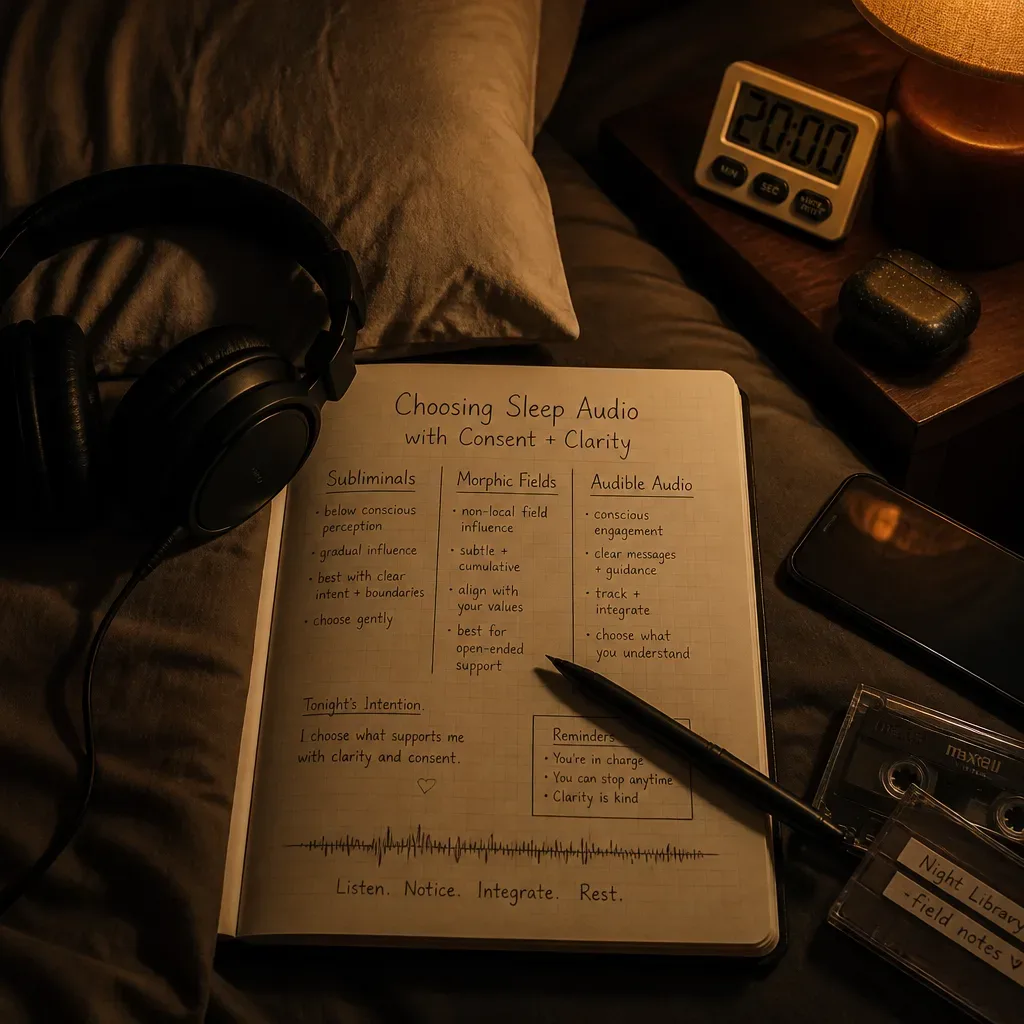
Which night audio is safer: hidden, mystical, or audible?
Audible, chosen audio is usually safer because you can consent to the exact words entering your night.
The safest swap isn’t from morphic fields to subliminals. It’s from hidden audio to knowable audio. Knowable doesn’t mean boring. It means you can answer three plain questions before you press play: What is this saying? How long will it run? What will I do if it keeps me awake? Those three questions prevent many 2 a.m. mistakes.
The AYA Method is a daily audio manifestation practice. Each day you listen to a short personalized recording — your Dream-Self Moment — narrated from the version of you who has already manifested the life you intend. Listening is the practice. Repetition is the work. The audio is the method. That’s why the AYA Method sits close to this topic: it keeps the audio personal and audible instead of asking you to trust a hidden track.
Notice the difference. A subliminal says, “You may not hear the words, but they’re there.” A morphic field says, “You may not understand the mechanism, but it’s there.” A personal audio practice says, “Here are the words. They’re yours. Listen again tomorrow.” That clarity matters at night, when your guard is low.
A sentence you can hear can be questioned, softened, and made honest.
Use this quick safety filter before playing any night audio:
- Clarity: Can you tell what the track contains or claims?
- Consent: Would you still choose it if the words were printed beside the play button?
- Duration: Is it under 30 minutes while you test it?
- Volume: Can someone whisper over it from the doorway?
- Aftereffect: Do you wake calmer, or do you wake checking for proof?
The National Sleep Foundation has long described a bedroom as best kept dark, cool, and quiet. Many recommendations name a temperature near 60 to 67°F, or about 16 to 19°C, as comfortable for sleep. Audio has to fit inside that kind of simplicity. If it makes the room feel busy, it may not belong there.
This is also where skepticism should stay kind. Some people use morphic fields because they feel out of options. Some use subliminals because ordinary affirmations feel embarrassing. I don’t want to mock either. I want your night back in your hands.
How can you swap morphic fields for safer night audio without losing the ritual?
Keep the ritual shape, but replace hidden claims with short, audible, low-volume repetition.
A ritual has parts: a time, a place, a sound, a rule for ending. You don’t have to throw that away. You can keep the lamp dim, the phone face down, the same pillow, the same 12-minute window. The swap is content. Instead of playing a three-hour track with dramatic claims, choose a short recording you understand.
Try a 14-night test. Fourteen nights is long enough to notice a pattern and short enough to avoid turning the practice into a life sentence. In sleep research, two-week diaries are common because they reveal bedtime, wake time, and awakenings better than one memory on a bad morning. Keep your notes simple: asleep faster, same, or slower; woke calmer, same, or worse.
Use these steps:
- Pick one track only. No stacking. One audio, one intention, 14 nights.
- Cap playback at 20 minutes. If you want sound after that, use plain rain or brown noise.
- Write the core sentence down. If you can’t write it, don’t sleep to it.
- Use the same volume nightly. Consistency matters more than drama.
- Review after 7 and 14 nights. Don’t judge from one strange dream.
A good night practice should be easy to stop for one night.
For affirmations, write like a tired person will hear you. Use first person, present tense, and modest claims. “I speak to myself with less cruelty” is often more believable than “I love every part of myself.” “I can answer one email tomorrow” may do more than “Success comes to me effortlessly.” The smaller sentence has somewhere to land.
If you want a simple script, record 6 to 10 lines and repeat them twice. That usually lands between 2 and 4 minutes, depending on your pace. Leave 3 seconds of silence between lines. Silence gives the nervous system room. Many meditation and hypnosis teachers use pauses for a reason: the body needs time to receive instruction without being crowded.
You can also use the Sleep affirmations pillar as a wording reference, then build your own version. The point isn’t to sound impressive. The point is to sound like someone you can trust in the dark.
What red flags should make you stop a night audio track?
Stop any track that increases fear, compulsion, sleep loss, or dependence on the creator.
Red flags are not subtle when you write them down. The trouble is that at night, people negotiate with them. A headache becomes “detox.” A nightmare becomes “purging.” A week of poor sleep becomes “resistance.” Be careful with any creator who explains every bad outcome as proof that the track is working. In health communication, that’s a closed loop: no result can disconfirm the claim.
The Centers for Disease Control and Prevention has reported that about 1 in 3 U.S. adults don’t get enough sleep. That baseline matters. Many people arrive at night already short on rest. If your audio practice takes another 45 minutes, it may be worsening the exact problem you hoped to soothe.
Watch for these signs:
- You feel anxious if you miss one night.
- You play multiple tracks because one no longer feels like enough.
- You wake to check your face, phone, body, bank account, or messages for proof.
- You ignore headaches, ear pain, or poor sleep because comments told you to persist.
- You use audio instead of getting help for symptoms that need a person.
If insomnia lasts more than a few weeks, or sleep loss is affecting your safety, mood, or work, talk to a qualified professional. Audio can support a routine. It should not become your only care.
Also notice content that uses pressure language. “Don’t skip or results reverse” is not a sleep support. “Listen overnight for fastest changes” ignores basic sleep hygiene. “Only high-frequency people can handle this” is status bait. You don’t need to earn rest by obeying a stranger’s upload schedule.
A practice that punishes doubt is not a practice I’d put in my ears.
For a cleaner boundary, decide your stopping rule before bed. For example: “If I’m awake after the track ends, I turn it off and rest in silence.” Or: “If I wake more than twice, I don’t use earbuds tomorrow.” The rule protects your sleeping self from your hopeful midnight self.
What should you choose tonight if you’re comparing morphic fields vs subliminals?
Choose the audio with the clearest words, lowest pressure, shortest duration, and smallest sleep cost.
If the choice is between a morphic field with sweeping claims and a subliminal with a published script, the subliminal is easier to evaluate. If the choice is between a subliminal you can’t verify and an audible personal recording, choose the audible recording. If any option makes you restless, choose quiet. Silence is not failure. It’s often the cleanest intervention.
For one night, keep the plan almost plain: 10 minutes, low speaker volume, phone face down, no comment scrolling, no results checking. A typical adult sleep cycle is often described as about 90 minutes, though it varies by person and by night. Your first job is to protect the next cycle, not to chase proof before morning.
Here’s a simple decision table:
| Tonight’s option | Use it? | Why |
|---|---|---|
| Morphic field with dramatic body or life claims | No, not for sleep | Too much uncertainty and pressure |
| Subliminal with no script and overnight instructions | Probably not | Hidden content plus long exposure |
| Subliminal with published affirmations, 15 minutes | Maybe | More consent, still test carefully |
| Audible personal affirmation audio, 5 to 15 minutes | Yes, if calming | Clear words, clear ending |
| Silence or neutral rain | Yes | Protects sleep when you’re unsure |
You can still be open without being careless. Neville Goddard wrote about the imaginal state before sleep; Joe Dispenza speaks often about rehearsal and identity; modern neuroscience talks more cautiously about attention, memory, and repetition. Those are not the same languages, but they meet at one practical point: what you repeat before sleep tends to matter to you.
The last ten minutes before sleep are suggestible. Choose what goes in.
If you want a bridge from subliminals into clear night practice, start with the AYA Method, then compare it with the Subliminals pillar. If you need timing help, use the Sleep cycle calculator tool before you decide when to press play. Keep the audio short enough that sleep stays the main event.
Tonight, let the words be few, audible, and yours.