reality shifting
Raven Method Shifting: A Sleep-Safe Audio Version
A sleep-safe raven method shifting guide using Dream-Self audio, low-volume repetition, and honest limits so the practice doesn't cost you rest.
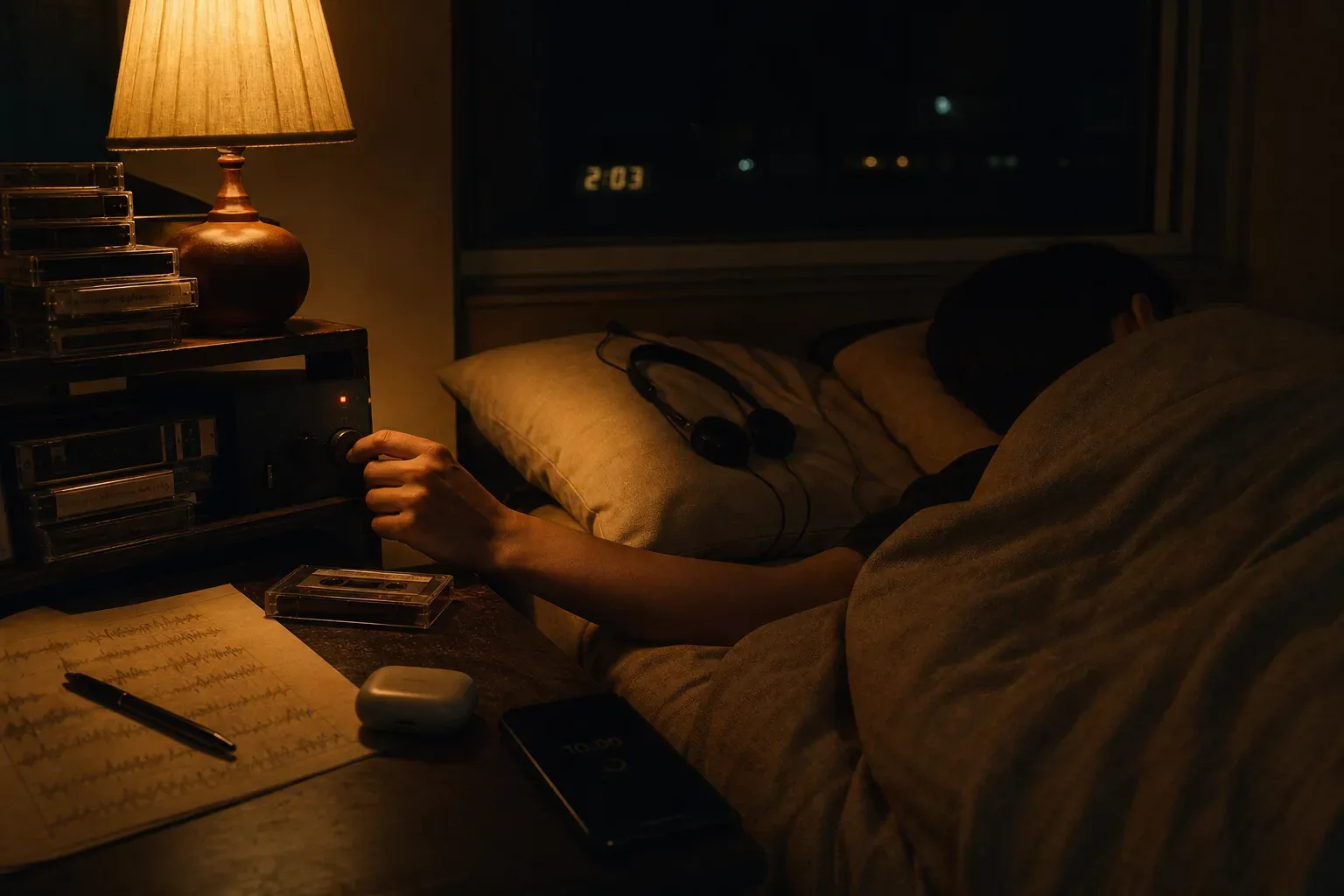
Raven method shifting is a bedtime shifting practice built around stillness, counting, and repeated affirmations. A sleep-safe version keeps the structure but removes the strain: you use a short audible Dream-Self audio, listen at low volume, stay physically comfortable, and stop if the method begins to cost you sleep.
What is the Raven Method, really?
The Raven Method is a community-made shifting routine that uses posture, counting, and repeated identity statements to carry attention toward a desired reality before sleep.
The classic version is simple: lie on your back in a starfish position, avoid moving, count from 1 to 100, and place an affirmation between numbers. Many scripts use lines like, “I am shifting,” or “I am in my desired reality.” The method became common on shifting TikTok and Reddit around 2020, when the hashtag #shifting reached large teen and young adult communities. TikTok doesn’t publish stable long-term counts by practice, but shifting videos have been measured in the billions of views across related tags.
There is no clinical evidence that Raven Method shifting moves a person into another physical reality. That sentence matters. There is evidence that attention, expectation, bedtime imagery, and repeated language can affect mood, dream content, and recall. A 2020 review in Sleep Medicine Reviews described hypnagogia, the transition into sleep, as a state where imagery and thought can become loose, vivid, and emotionally charged. That is a reasonable place to practice suggestion. It isn’t proof of shifting.
A fair reading is this: the Raven Method is a ritual of focused attention at the edge of sleep. Rituals can be meaningful without making every claim on the label true. The words you repeat before sleep may not move worlds, but they can move the tone of your night.
If you’re new to shifting, keep the promise small enough to test. Notice whether the method helps you soften, dream more vividly, or feel close to your desired self. Don’t measure it by whether you wake up with impossible evidence on night one. Three nights proves very little; 14 nights gives you a clearer read.
Why make a sleep-safe version instead of doing the classic method?
A sleep-safe version protects the one thing shifting practices often borrow from too freely: rest.
The American Academy of Sleep Medicine recommends 7 or more hours of sleep per night for healthy adults. For teenagers, the recommendation is usually 8 to 10 hours. If a method keeps you awake past your sleep window, it stops being a night practice and becomes a sleep debt practice. That debt is not subtle; even one short night can affect attention, mood, and reaction time the next day.
The classic starfish posture can also become a problem. Lying perfectly still may sound spiritual in a post, but a real bedroom is less obedient. Hips ache. Shoulders complain. Your nose itches. If the practice turns every body signal into a test of worthiness, your nervous system may become more alert, not less. Sleep usually arrives through permission, not inspection.
Use the Raven structure as scaffolding, not law. You can count. You can repeat. You can listen. But you don’t need to freeze. Sleep latency, the time it takes to fall asleep, is often cited as roughly 10 to 20 minutes for healthy adults, though it varies. If you are still intensely trying after 30 or 40 minutes, the method has probably become effort.
Here is the sleep-safe rule I use in my own notes: if a method costs you sleep, it costs more than it gives.
For insomnia that continues beyond basic sleep hygiene, speak with a qualified health professional. Shifting audio, hypnosis tracks, and bedtime affirmations are not medical care, and they shouldn’t be used to avoid help when you need it.
How does Dream-Self audio change raven method shifting?
Dream-Self audio turns the Raven Method from silent mental effort into a steady spoken cue you can rest under.
In the version I recommend, you record a short audio in your own voice, or use a personalized recording, and let it guide the counting and identity rehearsal. This is where the AYA Method sits close to shifting, without making the same claims. The AYA Method is a daily audio manifestation practice. Each day you listen to a short personalized recording — your Dream-Self Moment — narrated from the version of you who has already manifested the life you intend. Listening is the practice. Repetition is the work. The audio is the method.
That distinction matters. A subliminal hides words under sound. A Dream-Self audio lets you hear every word. If a line doesn’t sit right in your body, you can change it. If a phrase makes you tense, you can remove it. Audible practice gives you consent moment by moment.
Research on subliminal priming is real but modest. For example, decades of priming studies suggest that stimuli outside full awareness can slightly influence response speed or preference under specific lab conditions. That is not the same as a YouTube title promising overnight life changes. If you want the deeper background, read the Subliminals pillar and keep your skepticism gentle.
Your Dream-Self audio should sound like someone you trust speaking softly in the dark. Not grand. Not forced. The best sleep audio is not a speech; it is a place to put attention down.
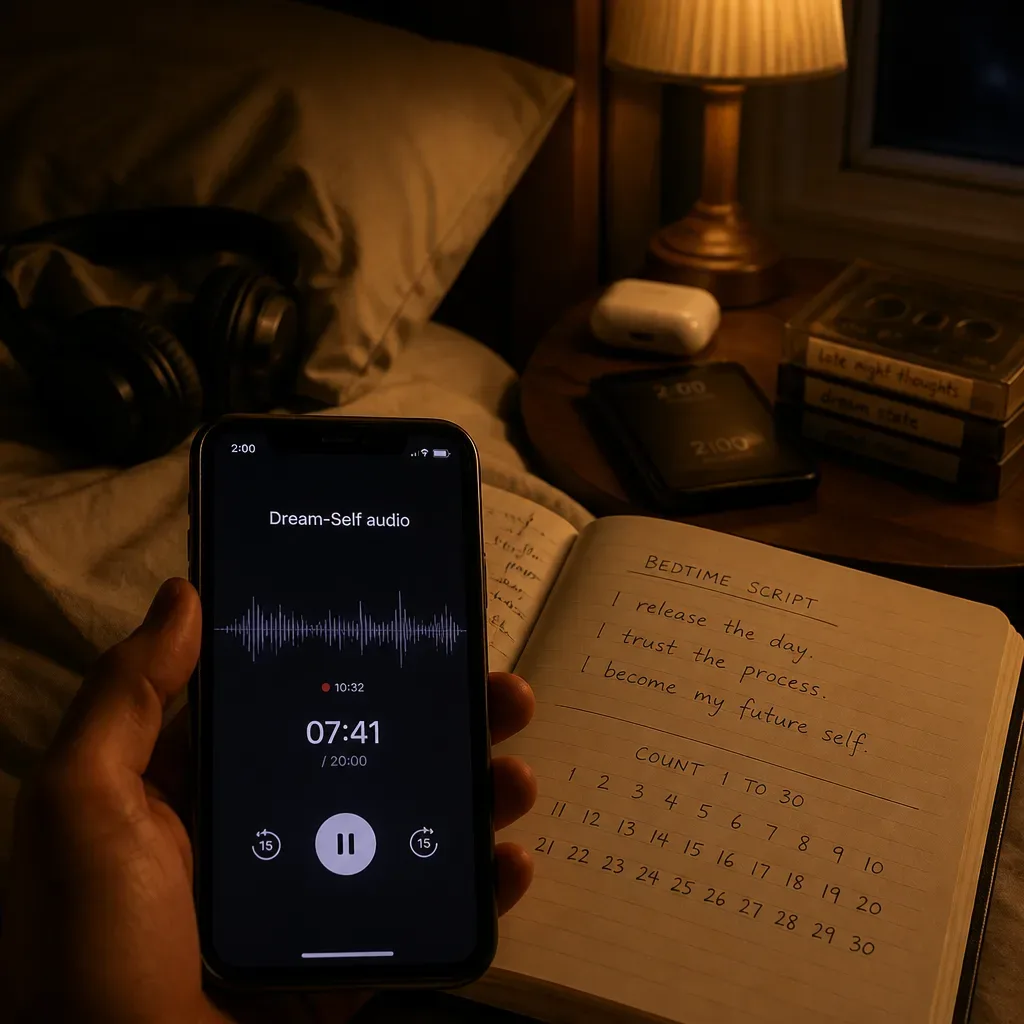
How do you set up the audio before bed?
Set up the audio so there is nothing left to manage once the lights are out.
First, decide whether tonight is a shifting night or a sleep-repair night. That sounds small, but it prevents bargaining at 1:13 a.m. If you slept badly last night, shorten the practice. If you are anxious, use a gentler recording. The Centers for Disease Control and Prevention has reported that about 1 in 3 U.S. adults doesn’t get enough sleep. Most of us don’t need a more intense bedtime; we need a kinder one.
Use this setup:
- Choose a 5 to 12 minute audio. Longer tracks can work, but short recordings are easier to repeat without keeping you awake.
- Set volume low enough that you can understand the words only when you attend to them.
- Use one earbud, pillow speaker, or room speaker if headphones bother you.
- Put your phone face down, out of reach, and enable sleep focus or do-not-disturb.
- Decide before you begin whether the audio plays once or loops for 20 to 30 minutes.
If you are timing bedtime around sleep cycles, use the Sleep cycle calculator tool before you get into bed, not after. A typical sleep cycle is often described as about 90 minutes, although real cycles vary across the night. The tool is a planning aid, not a command.
Here is a simple comparison:
| Setup choice | Better for sleep | Risk to watch |
|---|---|---|
| 5 to 12 minute audible recording | High | May feel too simple at first |
| 60 minute subliminal loop | Medium | Can keep attention checking for results |
| Silent counting only | Medium | Easy to turn into effort |
| Loud headphones all night | Low | Can fragment sleep or irritate ears |
Keep the room ordinary. You don’t need perfect candles, perfect posture, or a perfect belief state. You need a repeatable cue that your body can survive night after night.
What script should you record for a sleep-safe Raven Method?
Record a script that sounds like your desired self speaking calmly, not like someone trying to convince a courtroom.
Start with three parts: orientation, counting, and return. Orientation tells your body where it is. Counting gives your mind a soft rail. Return lets sleep take over without treating drifting as failure. In small studies of bedtime imagery and relaxation, structured mental routines have shown benefits for worry and pre-sleep arousal, though results vary by person. The boring structure is part of why they work for some of us.
Try this 8-minute outline:
- Minute 0 to 1: “I’m safe in my room. My body can rest while my mind rehearses.”
- Minute 1 to 4: Count slowly from 1 to 30, placing one short line after every few numbers.
- Minute 4 to 6: Speak as your Dream Self in ordinary details: waking, moving, choosing, being spoken to.
- Minute 6 to 8: Give permission to sleep, dream, forget, or remember.
Use lines like:
- “I don’t have to force this.”
- “I can hear the version of me I’m practicing.”
- “My body sleeps while my attention softens.”
- “If I drift, the practice is still working as rest.”
Avoid lines that create pressure, such as “I must shift tonight,” or “If I move, I fail.” Pressure is alerting. A 2014 paper in Journal of Behavioral Medicine on mindfulness and sleep noted that reducing cognitive arousal can support sleep quality for some adults. Whether you call it mindfulness, hypnosis, or shifting prep, the same practical point applies: less fighting usually helps.
If you already use Sleep affirmations, you can adapt them into this script. Keep them audible, slow, and personal. The daily affirmation can support the practice, but don’t mistake a sentence on a screen for the method. Here, the audio carries the night.
How do you practice it for 14 nights without losing sleep?
Practice for 14 nights by keeping the ritual fixed, tracking sleep first, and treating results as notes rather than verdicts.
A two-week trial is long enough to see patterns and short enough that you won’t build your whole identity around the method. In my own spreadsheet, the practices that lasted rarely showed themselves on night one. They showed up around nights 5 to 10 as less resistance, clearer recall, or fewer late-night negotiations with the phone.
Use this nightly structure:
- Before bed: Write one sentence about tonight’s desired self. Do this outside the bed.
- Lights out: Start the audio once. Get comfortable.
- Counting: Count softly from 1 to 100 if it soothes you. Skip numbers without correcting yourself.
- Drifting: If sleep arrives, let the method disappear.
- Morning: Record 3 facts: bedtime, wake time, and how rested you feel from 1 to 5.
The number scale matters because memory gets dramatic. A night can feel like a failure at 2 a.m. and still rate a 4 by breakfast. Sleep researchers often use diaries because subjective sleep has patterns that single memories miss. You don’t need lab equipment; you need honest repetition.
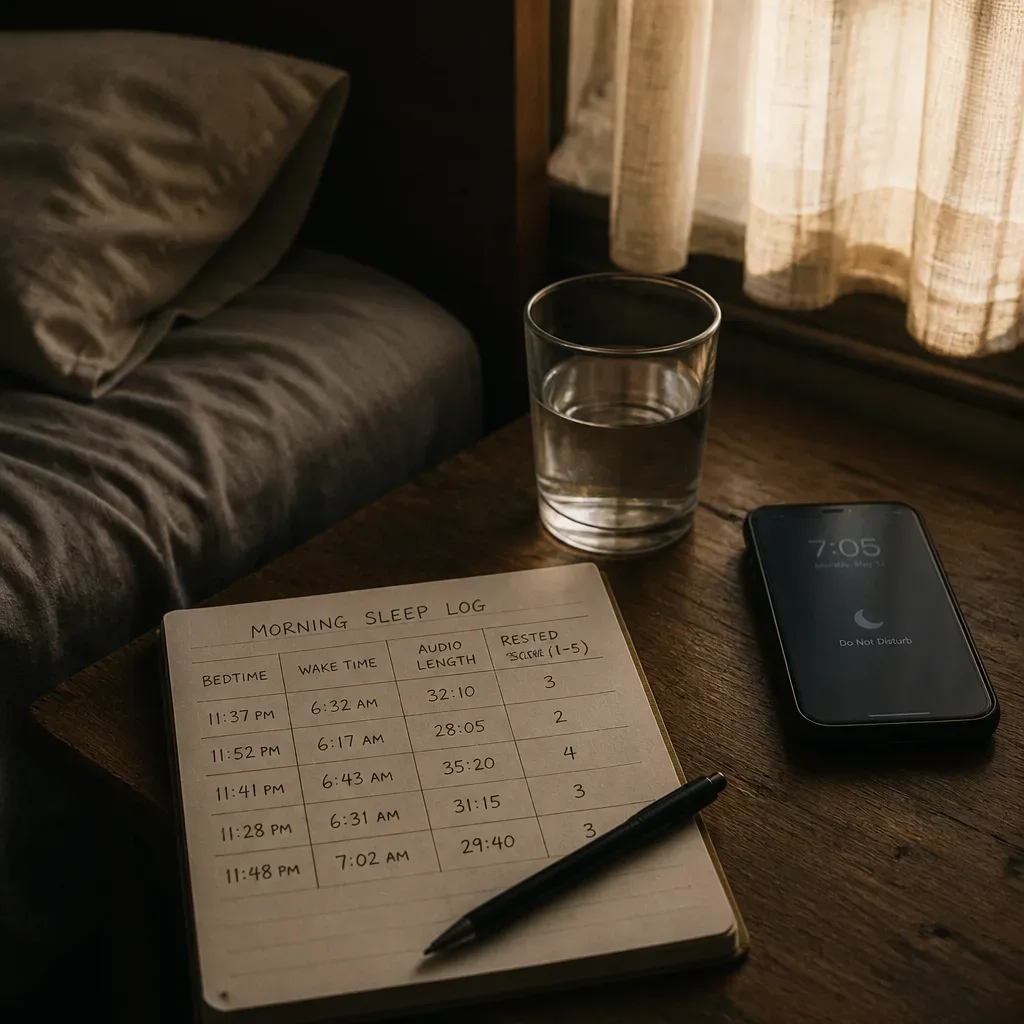
Your 14-night notes can include shifting signs if you want, but keep sleep at the top:
- Did I fall asleep within about 30 minutes?
- Did I wake more often than usual?
- Did the audio make me calm, sad, excited, or tense?
- Did I want to repeat it the next night?
- Did I feel more connected to my desired self during the day?
If your score drops for 3 nights in a row, simplify. Use the audio without counting, or switch to a plain rest track. The method should return you to night, not keep you performing in it.
How does this compare with subliminals, sleep hypnosis, and standard affirmations?
The sleep-safe Raven audio version sits between shifting ritual and audible manifestation practice.
Subliminals, hypnosis, affirmations, and shifting methods often get mixed together online, but they are not the same tool. A subliminal depends on not consciously hearing the words. Sleep hypnosis usually uses a guiding voice, relaxation cues, and suggestion. Standard affirmations are repeated phrases, often read or spoken while awake. Raven Method shifting adds a desired-reality frame, counting, and the edge of sleep.
The evidence is uneven. Hypnosis has clinical research in pain and anxiety, and some sleep-related studies, but quality varies. Affirmation research is more often linked to self-affirmation theory, including work by Claude Steele and later health-behavior studies, not to guaranteed bedtime outcomes. Princeton’s PEAR and Global Consciousness Project research is often cited in intention communities, but it doesn’t prove personal reality shifting. Honest practice can hold interest and doubt in the same hand.
Use this table as a plain map:
| Practice | You hear the words? | Main action | Best use |
|---|---|---|---|
| Subliminals | Usually no | Passive listening | Low-effort background repetition |
| Sleep hypnosis | Yes | Guided relaxation | Settling body and attention |
| Sleep affirmations | Yes | Repeating chosen lines | Rehearsing self-talk before sleep |
| Raven Method | Usually internal | Counting and shifting intent | Focused desired-reality ritual |
| Dream-Self audio Raven version | Yes | Listening plus gentle counting | Sleep-safe identity rehearsal |
If you like hidden-audio tracks, use them with care and read the Subliminals pillar before assuming volume or layering makes them stronger. If spoken lines help more, the Sleep affirmations pillar gives a cleaner base for wording.
A practice doesn’t become truer because it’s harder to do. Often, the version you can repeat for 30 quiet nights teaches you more than the version you abandon after two.
What should you expect by week two?
By week two, expect clearer familiarity with the audio, easier settling for some nights, and a better sense of whether this method belongs in your sleep routine.
Do not expect guaranteed shifting on a deadline. That kind of pressure is one reason people turn a soft practice into a nightly exam. What you may notice is more specific: the script starts to feel less awkward, the counting becomes less mechanical, and your desired-self details become easier to picture. You may also notice nothing except that you like having a voice to return to. That still counts as useful data.
Dream recall may change simply because you are paying more attention. Studies on dream journals and recall often find that intention and morning recording increase remembered dreams, though not for everyone. If you wake with fragments, write three words, not a full essay. The goal is to keep mornings calm enough that nights remain safe.
Here are the signs I would keep:
- You fall asleep at roughly your usual time or sooner.
- You feel neutral or calmer when the audio starts.
- You don’t dread the method.
- You can miss a night without panic.
- Your desired-self language feels more like yours.
Here are the signs I would stop for:
- You delay sleep to “try harder.”
- You feel afraid to move.
- You wake tired after using the track.
- You chase signs for an hour in the dark.
- You feel worse about your current life in the morning.
The kindest method is the one that lets you come back tomorrow. The voice can be soft. The claims can be modest. The repetition can be enough.
Play it low, then let the room go dark.