reality shifting
Shifting Script Template for a 3-Minute Dream-Self Audio
Use this shifting script template to write a safe 3-minute Dream-Self audio for bedtime, with prompts, timing, and sleep hygiene boundaries tonight.
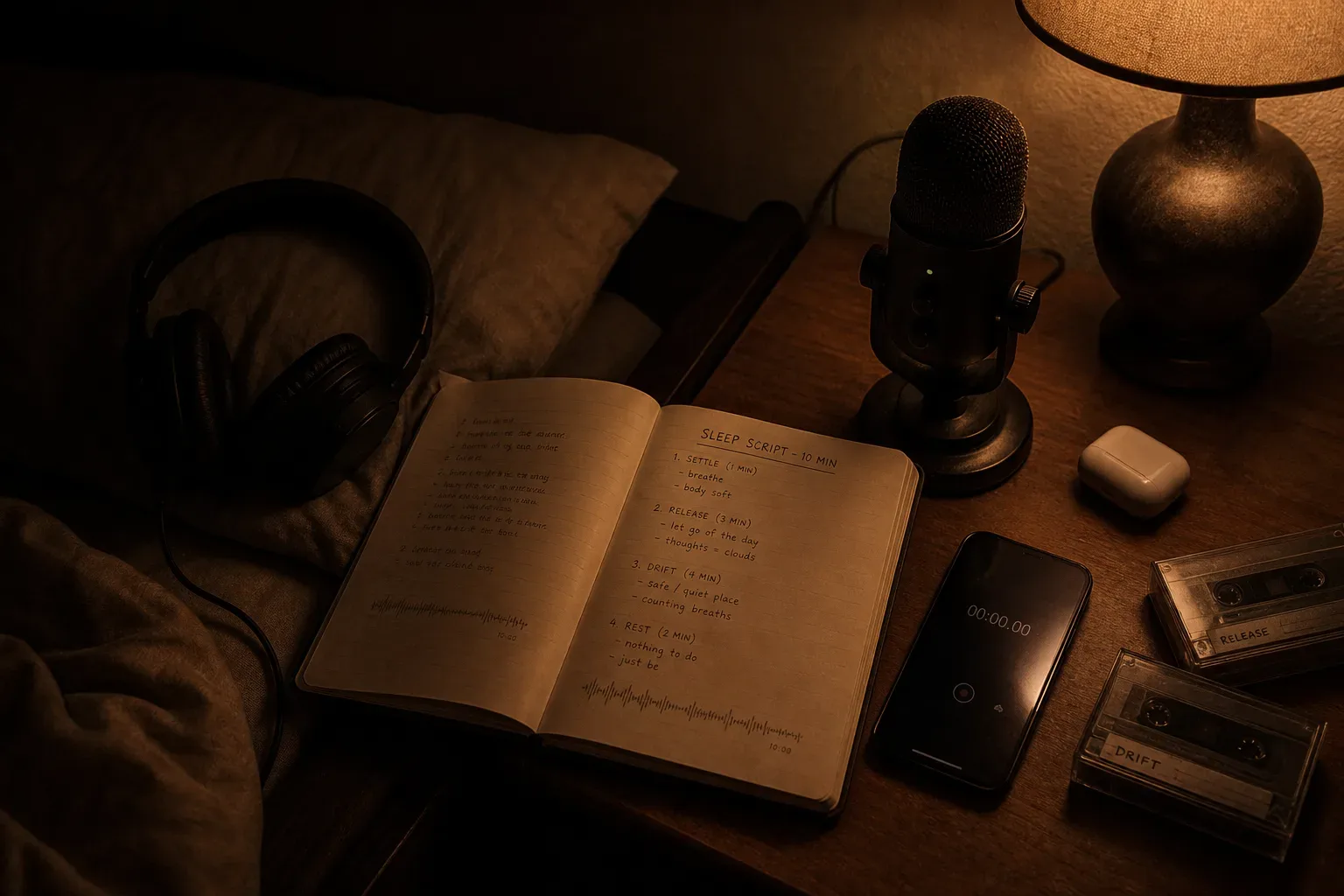
A shifting script template for a 3-minute Dream-Self audio is a short spoken structure for rehearsing who you are, where you are, and how safe you feel before sleep. Keep it audible, personal, and under 480 words. The aim is gentle repetition, not a perfect script or a lost night.
What is a shifting script template when it becomes audio?
A shifting script template becomes audio when your written details are shaped into something you can actually hear without effort.
Most shifting scripts online are built for reading: name, age, appearance, relationships, rules, safe words, room details, and whole episode arcs. That format grew fast during the first TikTok shifting wave around 2020, when many method posts were made by teenagers and early adults comparing notes in public. A spoken script needs less. At a common narration pace of 130 to 160 words per minute, 3 minutes gives you about 390 to 480 words, not a full notebook.
This matters because audio has a body. You have to breathe through it. You hear the tone. You notice when a sentence sounds like pressure. A written line can look fine and still feel too sharp at 11:40 p.m. The voice tells the truth before the theory does.
Use the template as a container, not a contract. A safe spoken shifting script usually includes:
- one identity cue, such as your name or role there
- one place cue, such as a room, street, school, or home
- one sensory cue, preferably sound or touch
- one ordinary action, not a huge arrival scene
- one safety line about sleep and return
- one closing line you can repeat without strain
The sleep part is not optional. The American Academy of Sleep Medicine and Sleep Research Society recommend that most adults get at least 7 hours of sleep per night. If a method costs you sleep, it costs more than it gives. That rule is boring. It is also the line that keeps a beautiful inner practice from becoming a 3 a.m. problem.
A script should give the mind a place to rest, not another task to complete.
What should fit inside three minutes?
Three minutes should hold one scene, one felt identity, and one clean ending.
Think of the audio as a small room. If you bring in every detail from a 20-page script, there is nowhere to sit. A 2010 review in the Journal of Applied Sport Psychology found that mental practice tends to work best when it is specific, repeated, and paired with physical or emotional familiarity. Shifting is not sport science, and that research does not prove shifting claims. It does support a quieter point: rehearsed imagery works better when it is not vague.
Here is a simple timing map for a 3-minute Dream-Self audio:
| Time | Purpose | Example |
|---|---|---|
| 0:00 to 0:30 | settle the body | My shoulders are loose. The room is quiet. |
| 0:30 to 1:10 | name the self | I know who I am here. My life feels familiar. |
| 1:10 to 2:15 | enter one scene | I hear the window, the floor, the voice nearby. |
| 2:15 to 2:45 | add safety | I sleep safely and wake rested in my body. |
| 2:45 to 3:00 | repeat a return line | I can rest. I can return. I am safe. |
Keep the first draft plain. Many community templates get crowded because they try to prevent every possible worry. That is understandable. The internet has built a lot of folklore around safe words, clones, time ratios, and waiting rooms. But a bedtime recording should not ask your nervous system to track 12 rules. Dr. Andrew Huberman often describes sleep onset as a state that benefits from lower arousal and reduced cognitive load; whether or not you follow his protocols, that basic sleep principle is useful here.
If you want a companion practice with audible, personal wording, the AYA Method is close to this territory: The AYA Method is a daily audio manifestation practice. Each day you listen to a short personalized recording, your Dream-Self Moment, narrated from the version of you who has already manifested the life you intend. Listening is the practice. Repetition is the work. The audio is the method.
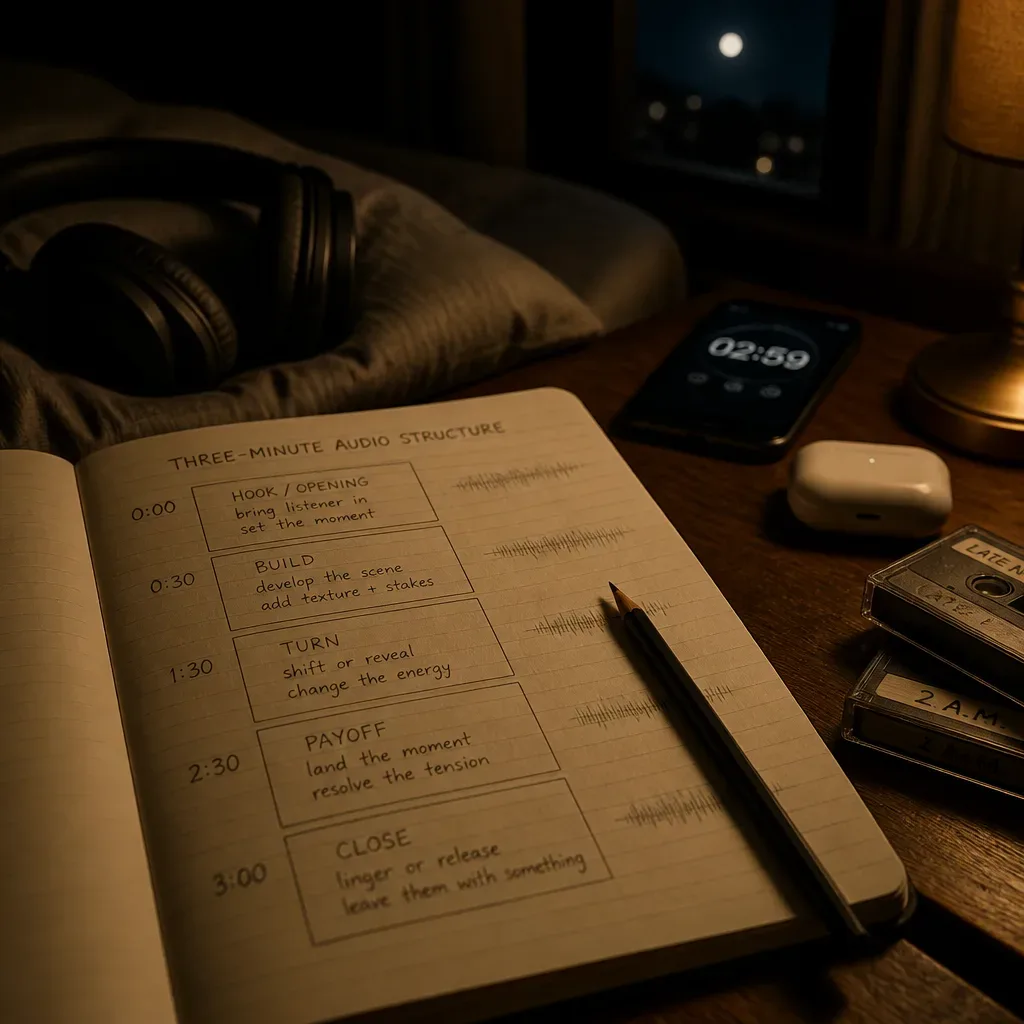
How do you write the first draft without making it too intense?
Write the first draft as a calm bedtime scene, not as proof that shifting will happen tonight.
Start with one ordinary moment. Not the dramatic portal. Not the argument. Not the scene where everyone notices you. Choose the kind of moment that lets the body stay sleepy: opening your eyes in a familiar room, hearing rain outside, touching a blanket, reading a message, walking down a hallway. Sleep researchers often describe the pre-sleep period as sensitive to rumination; a 2018 review in Sleep Medicine Reviews linked repetitive negative thinking with poorer sleep. Your script should not imitate rumination in prettier clothes.
Use this 6-part shifting script template:
- Body settle: I am lying here safely, and my breathing can stay easy.
- Identity cue: I know myself as the person I am becoming in this scene.
- Place cue: The room around me is familiar, quiet, and mine.
- Sensory cue: I hear one soft sound and feel one simple texture.
- Action cue: I do one ordinary thing that confirms I belong there.
- Return cue: I sleep safely, and I wake rested when morning comes.
Now turn it into your own words. If a line sounds like something a stranger on TikTok would say, cut it. If a line sounds like you, keep it. Neville Goddard used the phrase living in the end for imaginal practice, but even in that older tradition, the useful bedtime instruction was usually simple: repeat a short scene until it feels natural. The community did not invent all of this from nothing. It remixed older imagination practices through phones, fandom, and late-night group chats.
The best shifting audio is specific enough to be heard and soft enough to sleep through.
A practical word count helps. Write 420 words, then read it aloud with a timer. If you finish under 2 minutes 30 seconds, slow down and add pauses, not more plot. If you go over 3 minutes 30 seconds, remove adjectives first. The mind can fill in color. It needs fewer instructions than you think.
How should you record and listen before sleep?
Record it in your own quiet voice and listen low enough that the audio never competes with sleep.
Use your phone. Sit in a soft room. Turn off fans that click, alarms that chirp, and apps that send notifications. Most phone microphones are clean enough at 6 to 12 inches from your mouth. Speak slower than you want to. Leave a full second between lines. A normal conversation sits around 60 decibels; bedtime audio should feel lower than that in the room, especially if you are wearing earbuds.
Do not use dramatic swells, sudden rain tracks, or binaural claims you have not checked. Binaural beats have mixed evidence, and small studies often use controlled settings that do not match YouTube uploads. If sound helps, pick steady brown noise, rain, or a plain music bed with no volume jumps. For hidden-word audio, read the evidence carefully in the Subliminals pillar; priming research is real but modest, and YouTube claims are not the same as lab findings.
A safe recording routine looks like this:
- Put your phone on airplane mode.
- Record one full take without stopping.
- Listen once in daylight and remove any tense line.
- Set volume while sitting up, then lower it one notch.
- Play it once during the last 10 to 20 minutes before sleep.
- If it keeps you awake for 3 nights, move it earlier.
The 10-to-20-minute window matters because it respects sleep pressure. Many adults cycle through sleep in roughly 90-minute stages, though individual timing varies. If you want to plan bedtime around wake time, use the Sleep cycle calculator tool and leave room for actual falling asleep, not just the length of the audio.
No method should turn bedtime into a performance review. If you catch yourself grading every sensation, the audio is too demanding.
How is this different from subliminals or sleep affirmations?
A Dream-Self audio is audible and personal, while subliminals hide words and sleep affirmations repeat direct phrases.
The differences are not about which practice is more real. They are about what you can check. A subliminal is an affirmation you cannot consciously hear. That is the whole trick, and the whole problem. If the words are masked, you have to trust the maker or make the file yourself. With a Dream-Self audio, you hear every word before it becomes part of your night.
Sleep affirmations are simpler. They use repeated statements like I am safe, I rest easily, or I trust myself. If that is what your mind needs, there is no need to decorate it. The Sleep affirmations pillar is useful if you want direct lines rather than scenes. In small studies on self-affirmation, including work discussed in Social Cognitive and Affective Neuroscience, affirming personally meaningful values can reduce threat responses under stress. That does not prove a bedtime claim. It does suggest that words linked to identity can change how a moment feels.
Here is the clean comparison:
| Practice | Can you hear the words? | Best use before sleep | Main caution |
|---|---|---|---|
| Dream-Self audio | Yes | rehearsing one desired scene | too much detail can keep you alert |
| Subliminal | Usually no | low-effort background listening | you may not know the exact wording |
| Sleep affirmation | Yes | calming the body with repetition | lines can feel false if too big |
| Hypnosis-style track | Yes | guided relaxation and imagery | long tracks can delay sleep |
Reality shifting sits near hypnosis, fandom scripting, lucid dreaming culture, and older imaginal practices. It is not identical to any of them. The honest position is warm but careful: people report meaningful inner events, and the public evidence does not verify the big claims. Both sentences can stand together.
You do not need to mock a practice to ask for better sleep hygiene.
For more community context, you can keep a separate reading practice for reality shifting methods earlier in the day and reserve bedtime for the short audio only.
What should you expect by week two?
By week two, expect familiarity, clearer recall, and maybe calmer sleep onset, not guaranteed shifting.
Seven to fourteen nights is enough time to notice whether the recording is helping or costing you. Keep a tiny log with only 3 fields: bedtime, how long you think sleep took, and one sentence about mood in the morning. Do not write a page at 2 a.m. The CDC has reported that about 1 in 3 U.S. adults gets less than the recommended amount of sleep, so the baseline problem is already common. Your practice should not add to it.
Possible week-two signs include:
- the script feels less embarrassing in your own voice
- one scene becomes easier to picture
- you remember more dream fragments
- you feel calmer during the last few minutes before sleep
- you know which lines need to be removed
Dream recall can change simply because you are paying attention. A 2014 study in Neuropsychopharmacology linked high dream recall with different wakefulness patterns during sleep, which is a reminder to be careful: remembering more is not always the same as sleeping better. If recall rises but rest drops, choose rest.
Review your audio after 7 nights. Cut any sentence that creates urgency. Replace finality with permission. I must shift tonight becomes I can rest and return to this scene. I cannot fail becomes I do not have to force anything. The body hears pressure even when the words are dressed up.
Repetition works best when it feels like returning, not chasing.
If you want to keep going, make one small edit per week. Change the scene, not the whole self. Keep the same opening and closing lines for at least 14 nights so your mind learns the shape. The method is the listening. The script is only the path the voice walks.
Can you use the template tonight?
Yes, you can use a finished 3-minute template tonight if you keep it short, audible, and kind to sleep.
Here is a fill-in version. Read it aloud slowly. Replace the brackets. If a bracket makes you tense, choose something more ordinary.
I am lying here safely. The room is quiet enough for sleep, and I do not have to force anything. My body can rest while my mind returns to one simple scene.
In this scene, I know myself as [name or identity cue]. I am in [place], and it feels familiar in a quiet way. I do not need to explain how I arrived. I only notice that I am here.
I hear [soft sound]. I feel [texture or temperature]. There is light from [source], and my breathing stays easy. I do one ordinary thing: [small action]. This small action tells me I belong here.
Someone or something nearby reminds me of who I am in this life: [gentle confirmation]. I receive it without rushing. I let the scene stay simple. I let the details come only as much as they want to.
I sleep safely. I wake rested. I can return to my body whenever I need. I can return to this scene another night. Nothing has to be forced tonight.
I can rest. I can hear my own voice. I can come back softly.
At about 150 words per minute, that sample is a little under 2 minutes, so you have room to add one sensory sentence and two pauses. Do not add a cast list. Do not add rules at midnight. If you need a longer script, write it in daylight and edit it before dinner.
For a 25-minute total practice, spend 10 minutes writing, 5 minutes reading aloud, 5 minutes recording, and 5 minutes testing volume. Then stop. The night does not need more management.
Keep the voice low, and let the dark stay gentle.