subliminals
Subliminal Playlist Order for Safer Sleep Stacking
A sleep-safe subliminal playlist order for stacking audios at night: how many to use, what order to play them in, and when to stop.
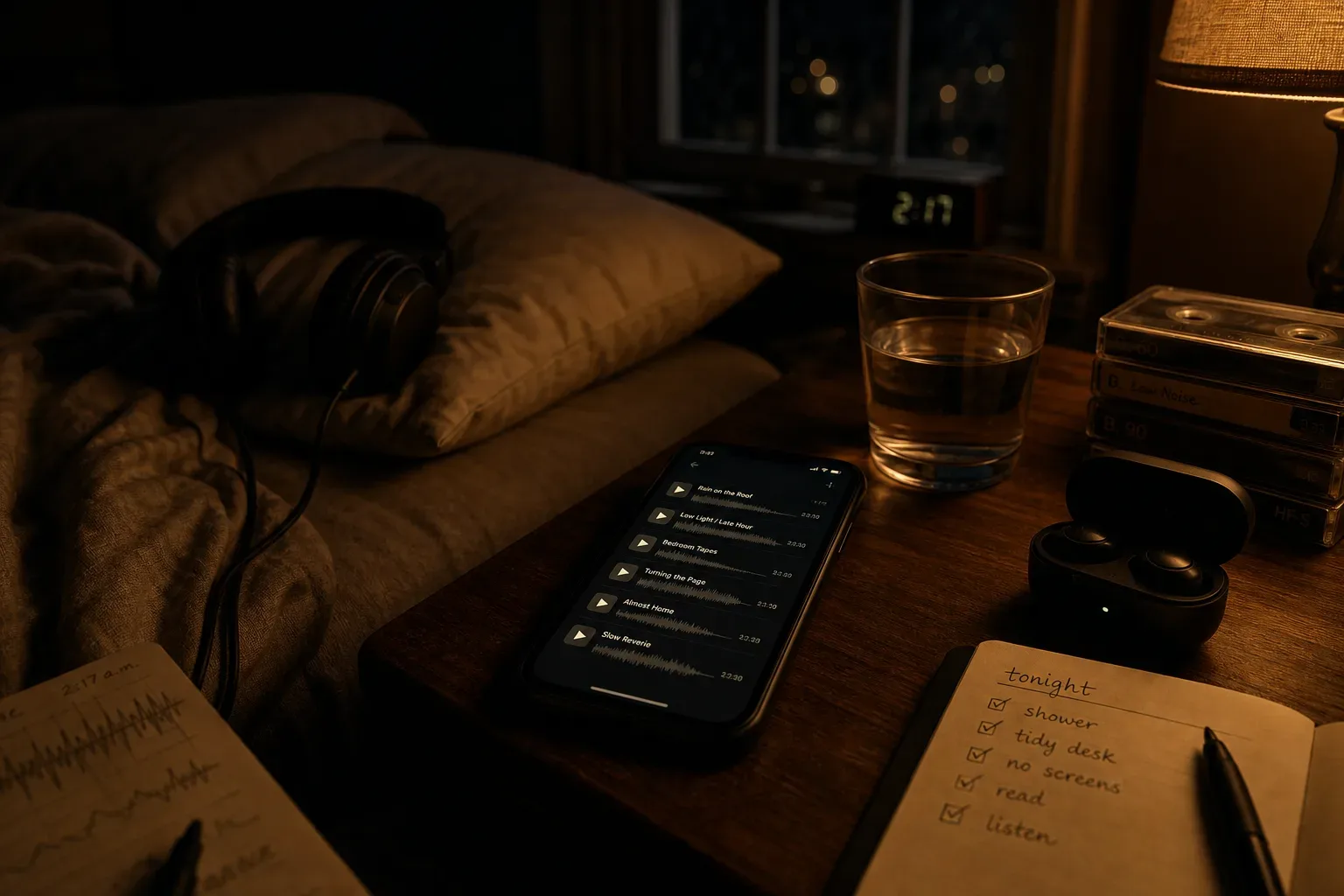
Subliminal playlist order is the sequence you use when stacking hidden or low-volume affirmation audios before sleep. A sleep-safe order keeps the stack short, puts the main intention early, avoids volume jumps, and protects sleep first. If the playlist costs you rest, the order is wrong.
What is a sleep-safe subliminal playlist order?
A sleep-safe subliminal playlist order is a short sequence that supports rest instead of competing with it.
The point is not to fit every desire into one night. The point is to decide what your sleeping body should have to hear, tolerate, and ignore. Adults are generally advised to get at least 7 hours of sleep per night by the American Academy of Sleep Medicine and the Sleep Research Society. That number matters more than any stack. If your playlist turns bedtime into a 2-hour editing session, the practice is already too expensive.
A subliminal stack usually means several audio files played in sequence: masked affirmations under rain, whispered scripts under brown noise, ultrasonic claims, binaural tones, or simple loops. If you want the background on what subliminals are and what the evidence can and cannot say, start with the subliminals guide. A subliminal is an affirmation you cannot consciously hear. That is the whole trick, and the whole problem.
For sleep, order should do 4 things:
- Keep the first 10 to 30 minutes calm and readable.
- Put the main topic before the support topics.
- Prevent sudden loudness, ads, or bright sounds after you drift off.
- Leave room for silence, because sleep is not empty time.
Sleep research gives a modest reason to care about timing. Targeted memory reactivation studies, including work reviewed by Northwestern sleep researchers, suggest that cues presented during sleep can influence memory in small, specific ways. That does not prove YouTube subliminals make outcomes happen. It only says the sleeping brain is not fully closed. The last ten minutes before sleep are suggestible. Choose what goes in.
Stacking is not a contest; it is a bedtime script with an exit.
How many subliminals should you stack before sleep?
Start with one to three subliminal tracks, then hold that stack steady for at least 7 nights.
Three is not a magic number. It is an engineering number. With one to three files, you can still identify what changed if you sleep badly, wake tense, or feel calmer by week two. With ten files, you have no useful data. You only have a long queue and a hunch.
I like a 30 to 60 minute first stack. That is long enough to cover the settling period for most sleepers, but short enough that it does not dominate the whole night. The National Sleep Foundation often cites 10 to 20 minutes as a typical healthy sleep latency window, though people vary. If you are usually asleep in 15 minutes, an 8-hour subliminal loop is not automatically better than a 45-minute playlist. More audio does not mean more practice.
Use this first-week cap:
- One main subliminal for the central topic.
- One support subliminal for sleep, calm, self-trust, or confidence.
- One neutral closer such as rain, low noise, or silence.
You do not need ten intentions at 1 a.m.; you need one clean signal.
If you already use sleep affirmations, count them as part of the stack. Audible affirmations and subliminals are different formats, but your nervous system still hears a night routine. A 12-minute spoken affirmation track plus 3 masked tracks is not a small stack. It is a full program.
If you have insomnia that does not improve with basic sleep hygiene, talk with a qualified clinician. Audio can be a ritual. It should not replace care.
Which audio should come first, middle, and last?
Put the clearest and most important audio first, use support tracks in the middle, and end with neutral sleep sound or silence.
The first slot matters because you are still awake enough to notice discomfort. If the file has a harsh high-frequency layer, an anxious script, a strange voice, or a loud intro, you can stop it. After sleep begins, your ability to protect yourself drops. That is why I do not put unknown files late in a night stack.
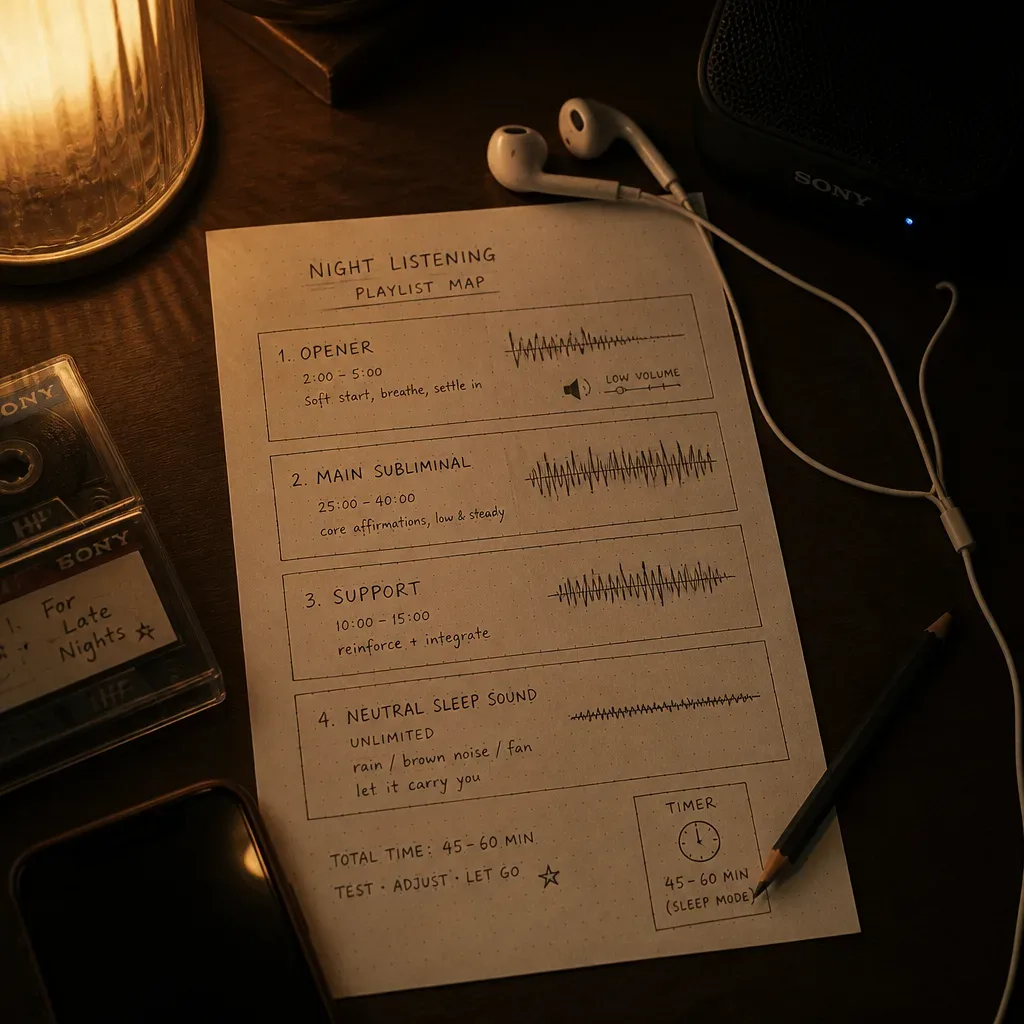
A simple sleep-safe order looks like this:
| Slot | Best choice | Why it goes there |
|---|---|---|
| 1 | Soft opener or audible affirmation | Lets your body settle while you can still adjust volume |
| 2 | Main subliminal topic | Puts the priority early, before sleep is deep |
| 3 | Support subliminal | Reinforces calm, confidence, or self-concept without adding a new demand |
| 4 | Neutral sleep sound or silence | Stops the playlist from pulling attention all night |
If you use an audible personal practice, keep it near the start. The AYA Method is a daily audio manifestation practice. Each day you listen to a short personalized recording — your Dream-Self Moment — narrated from the version of you who has already manifested the life you intend. Listening is the practice. Repetition is the work. The audio is the method. That is different from a hidden layer under rain because you can hear every word.
A safe stack might be 8 minutes of audible sleep affirmation, 20 minutes of the main masked subliminal, 15 minutes of calm support audio, then rain until the playlist stops. A messy stack might begin with five unrelated topics, jump from whispering to loud bells at minute 47, and loop until morning. The first one respects sleep. The second one keeps asking for attention.
Mystery is not a feature when your nervous system is trying to rest.
How loud should each track be when you are asleep?
Set every track low enough to sleep through, then match the loudness before you use the playlist overnight.
The most common mistake I see in subliminal stacks is not the script. It is level. A track that feels gentle at 10 p.m. can feel sharp at 3 a.m., especially if the next file is mastered louder. Streaming platforms often normalize audio near a target loudness. YouTube commonly plays many files around roughly -14 LUFS when normalization applies, but uploads still vary, ads vary, and downloaded files may not follow the same rule.
Use a simple test. Play the loudest part of each track through the speaker or earbuds you will actually use. Set the volume where the surface sound is clear but not demanding. Then move between tracks and listen for jumps. If one file feels 20 percent louder than the others, fix that before bed by lowering the file, replacing it, or putting it earlier where you can turn it off.
Safe listening matters even at night. The World Health Organization has warned that unsafe headphone listening can contribute to hearing risk, and its Make Listening Safe guidance often uses 80 dB for 40 hours a week as a reference point for adults. Sleep audio should usually be far below that. If you cannot hear your room at all, it may be too loud for overnight use.
Be extra careful with ultrasonic claims. Many adults hear less above 15 to 17 kHz as they age, and many phone speakers or cheap earbuds roll off high frequencies anyway. A file labeled 17,500 Hz may not be doing what the title says. Sometimes there are voices under the rain. Sometimes there is nothing but rain.
The safest playlist is the one you can sleep through and still understand in the morning.
How do you test a subliminal stack before using it overnight?
Test the entire playlist once while awake, then test it for one short sleep window before looping anything.
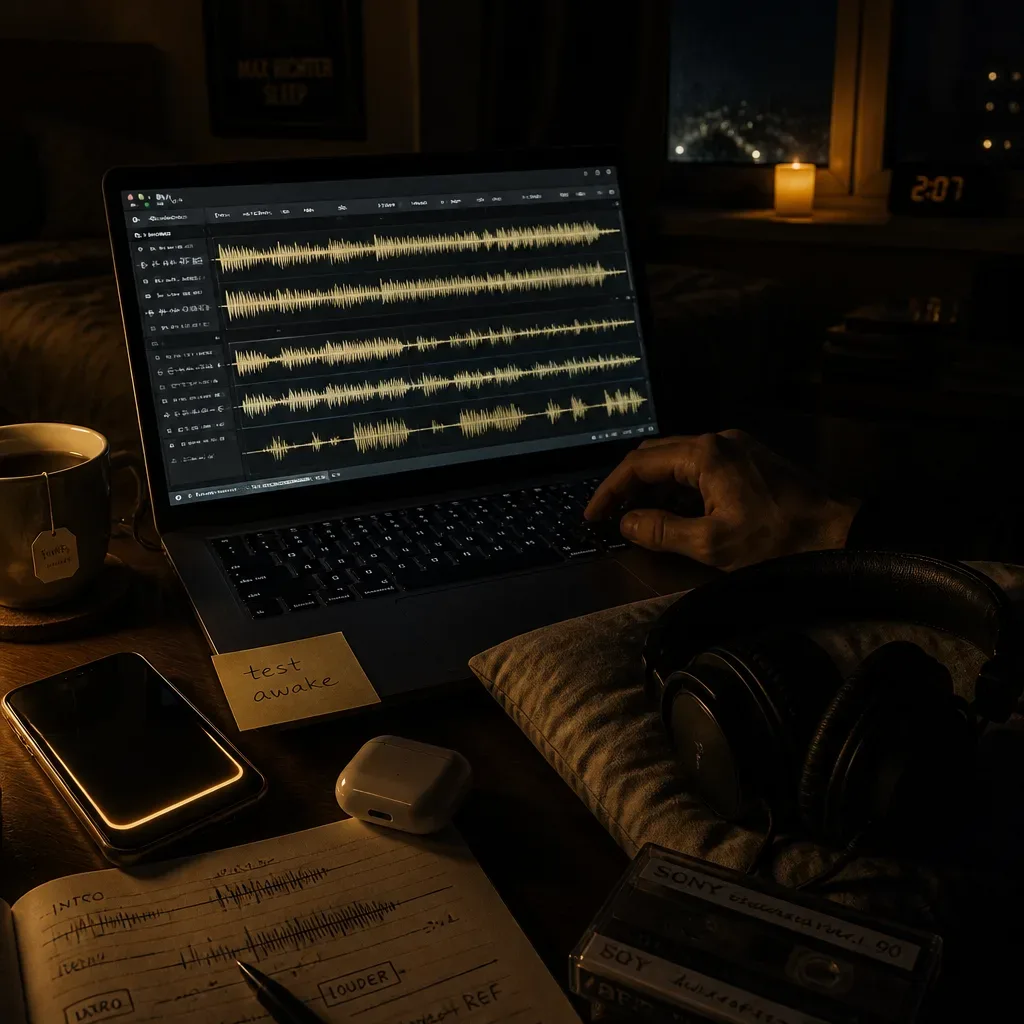
I know that sounds dull. It is also the part that saves you from waking up to an ad, a cymbal swell, or a creator tag shouted into your pillow. A 20-minute daytime test can catch most problems. You are listening for edits, clicks, harsh consonants, sudden music changes, strange script themes, and whether the file actually contains voice if it claims to.
Use this test sequence:
- Scan the source. Prefer creators who publish the script, topic, runtime, and whether the affirmations are audible, masked, or ultrasonic.
- Check the first and last 30 seconds. Intros and endings are where many loud surprises live.
- Jump through the middle. Listen at 25 percent, 50 percent, and 75 percent of the file.
- Run the full playlist once. Use your real device, real app, and real sleep timer.
- Sleep-test without looping. Try 30 to 60 minutes for the first night.
Consumer behavior matters here. Pew Research Center has reported for years that large majorities of adults sleep near smartphones or use them close to bedtime, and phone audio is now part of many night routines. That convenience brings app notifications, autoplay, and algorithmic next videos into bed with you. Turn off autoplay. Download if your app allows it. Use airplane mode when possible.
If you use the sleep cycle calculator, plan the playlist to end near the beginning of the night, not near a likely wake point. You want fewer reasons to surface at 4 a.m., not more.
Label what is on the tape. Your sleeping mind deserves at least that much courtesy.
What should you notice by week two?
By week two, you should notice whether the stack is easy to repeat, neutral for sleep, and emotionally steady in the morning.
Do not judge a subliminal playlist by one night. Sleep varies. Alcohol, late meals, stress, room temperature, and schedule changes can all move the needle. The CDC has reported that about 1 in 3 U.S. adults get less than the recommended amount of sleep. Against that background, one restless night does not prove your playlist caused anything. A pattern is more useful than a reaction.
Track only 5 things for 14 days:
- Bedtime and wake time.
- Estimated time to fall asleep.
- Number of remembered wake-ups.
- Morning mood, rated 1 to 5.
- Whether you wanted to play the stack again.
That last one matters. A practice that makes you dread bedtime will not last. Self-affirmation research, including work by David Creswell and colleagues, suggests that affirming personal values can reduce stress responses in some lab settings. The effects are real but modest. They do not excuse a playlist that leaves you tired.
By day 14, make only one change. Remove a track, move the main subliminal earlier, lower the volume, or shorten the runtime. Do not change all of it at once. Audio testing works when variables stay still.
The daily affirmation and a Manifestation Board can support a practice, but they are complements. The audio is the method when you are working with night listening. If you want a personal, audible alternative to hidden tracks, use one recording and repeat it daily before sleep rather than building a crowded stack around it.
If a method costs you sleep, it costs more than it gives.
When is stacking subliminals the wrong tool?
Stacking is the wrong tool when it increases anxiety, shortens sleep, or makes you dependent on perfect conditions.
There is a quiet line between ritual and monitoring. Ritual says, I play this, I rest, I return tomorrow. Monitoring says, I need the exact order, exact volume, exact frequency, exact number of repeats, or the night is wasted. The second version keeps the brain on duty.
Stop stacking, or reduce to one plain track, if you notice any of these signs:
- You keep checking the playlist after lights out.
- You wake to restart, reorder, or verify tracks.
- You feel guilty after missing one night.
- You choose audio length over 7 to 9 hours in bed.
- You feel worse when using hidden scripts you cannot review.
Joe Dispenza, Neville Goddard, and modern creators all put emphasis on repetition in different ways. Neuroscience people such as Dr. Andrew Huberman talk often about sleep regularity, light timing, and nervous system state. Those camps do not agree on everything, but they accidentally meet on one practical point: repeated practice works best when the body is not being dragged behind it.
Here is the simplest order I trust for most sleepers: one soft opener, one main subliminal, one support track, one neutral closer. Keep it under 60 minutes for the first week. Make it boring enough to sleep through. Make it honest enough that you would play it while awake.
Keep the last voice low, kind, and yours.