subliminals
Subliminal Results Tracker: 7-Day Audio Check-In
Use this subliminal results tracker to notice sleep, mood, choices, and Dream-Self audio effects over 7 nights without overreading noise.
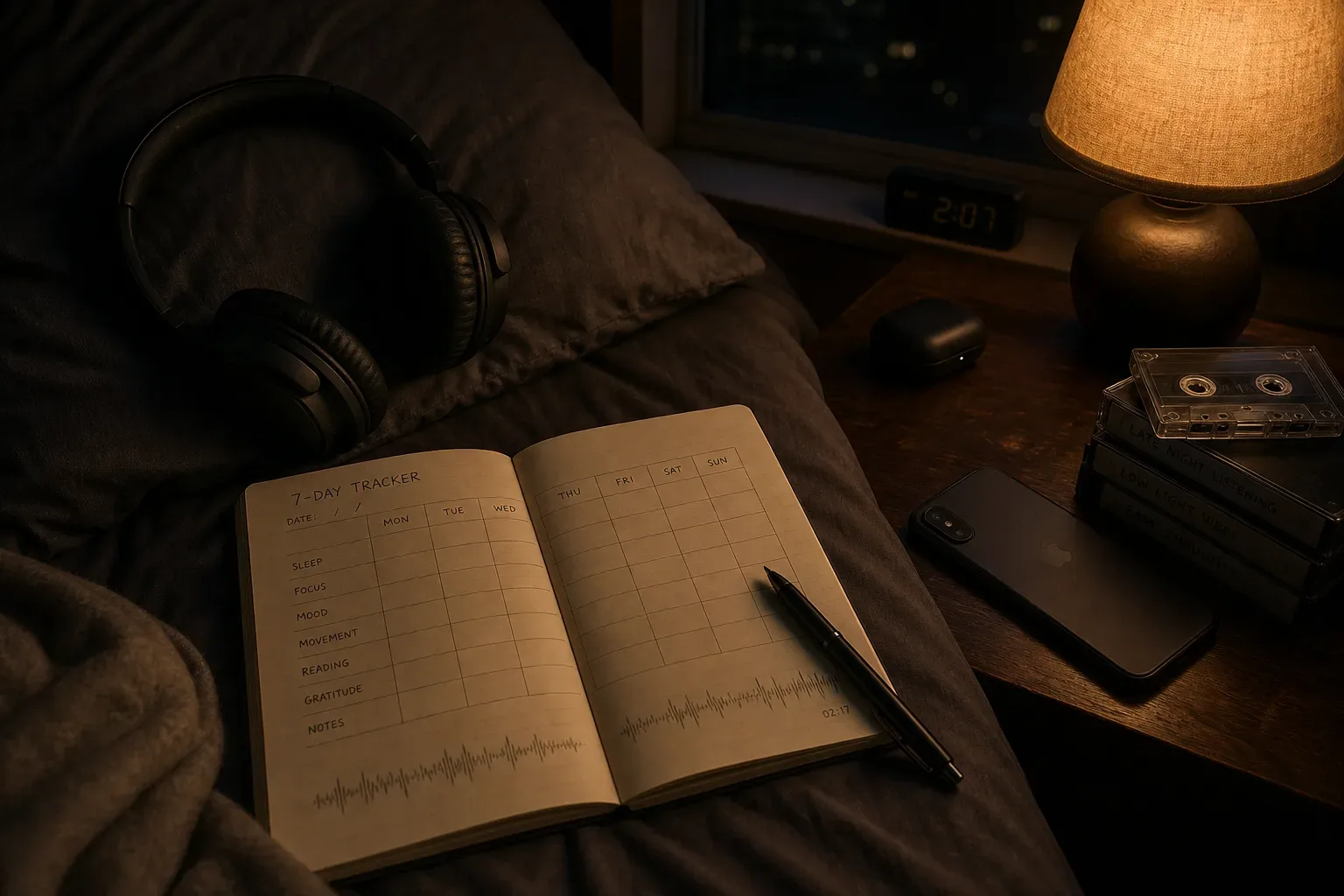
Subliminal results are easiest to judge when you track ordinary signals for 7 nights: sleep, mood, repeated thoughts, and one visible behavior. This check-in won’t prove hidden audio changed your life. It will show whether your nighttime listening is helping you rehearse the person you’re trying to become.
What counts as subliminal results after only 7 days?
A 7-day subliminal results tracker should count small, repeated signals, not one dramatic sign.
The first honest rule is this: a week is short. In habit research, Lally and colleagues reported in the European Journal of Social Psychology in 2010 that automaticity took a median of 66 days, with wide variation from 18 to 254 days. So 7 nights won’t tell you whether a new identity is settled. It can tell you whether the audio is easy to repeat, whether it leaves a trace in your attention, and whether your sleep stays intact.
Subliminal perception research is real, but modest. Studies such as Kunst-Wilson and Zajonc’s 1980 work on the mere exposure effect suggest that stimuli we don’t consciously recognize can still influence preference. That doesn’t mean a masked affirmation can force a new life into place. It means your nervous system may respond to cues below full awareness, especially when those cues are repeated and emotionally relevant.
For this tracker, count only signs that show up in ordinary daylight. A dream may matter to you, but pair it with something visible: a calmer message, a cleaner boundary, a task started before noon. A result that can’t touch Tuesday is still only a mood.
Use this 7-day window to notice four kinds of change:
- Sleep quality: did the audio help you settle or keep you awake?
- Emotional tone: did you wake with more dread, less dread, or no change?
- Cognitive residue: did a phrase, image, or goal return during the day?
- Behavior: did you do one small thing that matches the self you rehearsed?
If you want background on hidden audio claims before you start, read the Subliminals pillar. Keep your standards low and your attention sharp. Low standards aren’t laziness here. They’re how you stop fantasy from eating the data.
How do you set up a 7-day tracker without fooling yourself?
You set it up by choosing one audio, one listening time, and five measures you can complete in under 3 minutes.
The biggest tracking mistake is changing too many things at once. If you switch tracks on night 2, add a new affirmation on night 3, and start sleeping an hour later on night 4, your notes become fog. In experimental design, this is the basic confound problem: you can’t know which variable moved the outcome. You don’t need a laboratory. You need fewer moving parts.
Start with one audio. It can be a subliminal track, a soft spoken affirmation, or a Dream-Self recording. The AYA Method is a daily audio manifestation practice. Each day you listen to a short personalized recording - your Dream-Self Moment - narrated from the version of you who has already manifested the life you intend. Listening is the practice. Repetition is the work. The audio is the method. You can read more about the AYA Method if you want a fully audible alternative to masked words.
The AYA Method is not a hidden-message technique. You hear every word. That matters because Greenwald, Spangenberg, Pratkanis, and Eskenazi’s 1991 study of subliminal self-help tapes found that people often reported change according to what they believed the tape was for, not according to the tape’s actual content. Expectation isn’t fake. It’s part of how practice works. But if you can hear the words, you can consent to the script.
Make your tracker plain:
| Measure | Scale | Morning question |
|---|---|---|
| Listening | yes/no | Did I play the same audio last night? |
| Sleep quality | 1-5 | How rested do I feel? |
| Mood on waking | 1-5 | How heavy or steady is my morning? |
| Repeated phrase | one line | What words stayed with me? |
| Visible behavior | one line | What did I do differently yesterday? |
Give yourself a rule before night 1: no interpretation until day 7, except for sleep disruption. If the audio keeps you awake for 2 nights, adjust it. Sleep isn’t the sacrifice. Sleep is the ground.

What should you do each night before sleep?
Each night, play the same audio at a low volume during the last 10 to 20 minutes before sleep.
This is where the practice becomes physical. Put the phone where you won’t scroll. Dim the room. Choose a volume just loud enough to hear if the recording is audible, or low enough to soften the room if it’s subliminal. Dr. Andrew Huberman often points to light timing as a major sleep cue, and the American Academy of Sleep Medicine recommends adults get at least 7 hours of sleep. Your tracker should protect those basics.
The last minutes before sleep are not magical, but they are suggestible. You have fewer tasks competing for attention. Your body is downshifting. If you’re using sleep affirmations, this is the same reason short, repeated language can feel different at night than it does at 2 p.m. A sentence heard in the dark doesn’t have to fight a full inbox.
Use this nightly sequence:
- Set the same start time within a 30-minute window.
- Play the audio once, or loop it only if looping doesn’t wake you.
- Keep volume below the level of conversation.
- Don’t check results during the audio.
- If a thought appears, let it pass and return to listening.
- If sleep feels delayed, stop the audio and try again tomorrow.
For subliminals, avoid stacking five themes. Money, body, confidence, shifting, and reconciliation in one night gives your mind no clean cue. For Dream-Self audio, keep one scene clear enough to remember: how you speak, what you choose, what you no longer chase. A nighttime script works best when the morning knows what it was asked to notice.
If you use a sleep timer, set it before you start. Many people do best with 15 to 30 minutes. If you wake during the night and feel irritated by the sound, that’s data. A method that costs you sleep costs more than it gives.
What should you write down each morning?
Each morning, write facts first and meanings second.
Morning notes are dangerous because the mind likes a story. You wake from a vivid dream and want to name it a sign. You wake flat and want to call the audio useless. Neither move is careful. In psychology, demand characteristics and expectancy effects can shape self-report; Martin Orne described demand characteristics in 1962, and the problem hasn’t gone away. Your job is to make your report boring enough to be useful.
Open your tracker within the first 30 minutes of waking. If you wait until lunch, the day will rewrite the night. You don’t need a long journal. You need repeatable marks. The National Sleep Foundation has long emphasized consistent wake timing as a sleep hygiene cue; your note-taking can attach to that same cue.
Use this exact 3-minute morning check-in:
- Sleep score, 1-5: 1 means broken or heavy; 5 means rested.
- Mood score, 1-5: 1 means tense or low; 5 means steady or open.
- Audio memory: write one phrase, sound, or image you remember.
- Dream note: write one sentence only, if there was a dream.
- Yesterday’s matching action: name one behavior that fit the audio’s theme.
- Body note: mark headache, calm, agitation, or no clear change.
The behavior line matters most. If your audio is about being a confident speaker, a matching action might be asking one question in a meeting. If it’s about a calm future self, it might be pausing before replying. Behavior change research often favors specific cues over vague intentions; Peter Gollwitzer’s work on implementation intentions found that if-then planning can improve follow-through across many contexts.
Don’t score manifestation. Score contact with the practice. The tracker isn’t a courtroom. It’s a listening room with dates on the wall.
How do you read the pattern on day 4 without overreacting?
On day 4, look only for consistency problems and sleep effects, not final subliminal results.
Day 4 is the wobble point. The novelty has worn off, but the week isn’t complete. This is when people often change the track, raise the volume, or search for stronger subliminals. Don’t. In a 7-day tracker, day 4 is for checking the container: Did you listen at least 3 of the first 4 nights? Did sleep drop by 2 points? Did the audio make you tense?
There is a reason to be conservative. The famous 1957 James Vicary popcorn and Coca-Cola subliminal advertising claim was later exposed as unsupported, yet it still shaped public belief for decades. Subliminal claims spread faster than subliminal evidence. That history should make you gentler with your own interpretations, not cynical about your practice.
Ask three questions on day 4:
- Is my sleep stable? If sleep quality fell from 4 to 2 for 2 nights, lower the volume or stop looping.
- Is the audio tolerable? If you dread playing it, choose a softer version after the 7 days, not during.
- Is one phrase repeating? If the same line returned at least twice, mark it without calling it proof.
This is also a good time to check bedtime itself. Use the sleep cycle calculator tool if you keep waking in the middle of a cycle or guessing when to start. Most adult sleep cycles run around 90 minutes, though individual cycles vary. Timing won’t make subliminal results appear, but it may reduce the noise in your data.
If you’re using masked audio and feeling uneasy because you don’t know the words, switch next week to audible material or read the affirmations first. Consent matters at night. The room is dark. Your standards should be clear.
How do you review day 7 and decide what to keep?
On day 7, count patterns that appeared at least 3 times and ignore anything that happened only once.
This one rule will save you from most overreading. A single vivid dream can be meaningful personally, but it isn’t a pattern. One confident afternoon may be a good lunch, a kind text, or less caffeine. Three repeated signs across 7 days deserve attention. In small priming studies, effects often depend on timing, context, and motivation, so repetition across ordinary days is more useful than intensity on one day.
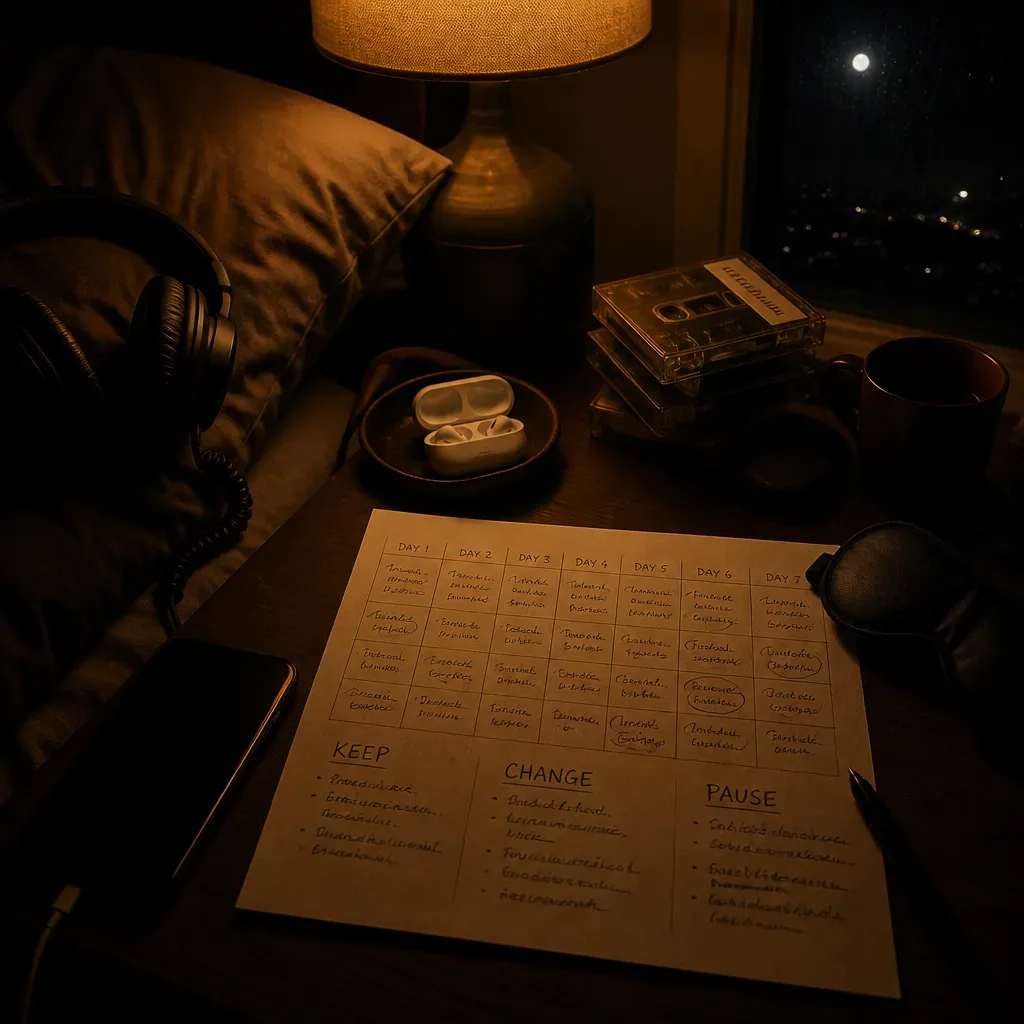
Make three columns: keep, change, pause. Put the audio in only one column.
| Decision | Use this if | What to do next |
|---|---|---|
| Keep | Sleep stayed stable and 3+ signals repeated | Continue 14 more nights |
| Change | Sleep was fine but wording felt vague | Rewrite or choose clearer audio |
| Pause | Sleep worsened or anxiety rose | Stop for 3 nights and reset |
For subliminal results, the best evidence in your tracker is usually behavioral. Did you avoid one old pattern? Did you start one small task faster? Did you speak in a way that matches the self you listen to at night? The cleanest sign of inner rehearsal is a quieter choice made under ordinary pressure.
Compare day 1 and day 7 without forcing a story. If mood moved from 2 to 4 and sleep stayed at 4, that’s worth respecting. If mood stayed flat but you listened 7 nights, that’s also data: the practice is repeatable, but maybe the wording isn’t touching the right place. If sleep fell, protect sleep first. Persistent insomnia, panic, or distress belongs with a qualified professional, not a stronger playlist.
If you want to keep going, choose one of two paths. Stay with the same subliminal for 14 more nights, or move to audible Dream-Self audio and use the same tracker. Don’t add five new practices. The daily affirmation and Manifestation Board can support the audio, but they aren’t the center here. The audio is the method.
What should your 7-day subliminal results tracker look like?
Your tracker should be short enough to use while you’re still half-asleep.
Copy this into a notes app or notebook. Seven rows are enough. If you love spreadsheets, fine, but don’t let the tool become a second practice. A 2023 Pew Research Center report found that 90% of U.S. adults own a smartphone, which means most people can track easily, but easy access also means easy distraction. If your phone pulls you into messages, use paper.
Use numbers sparingly. More numbers can feel scientific while making the signal worse. In clinical and behavioral self-monitoring, adherence drops when forms feel burdensome; that finding appears across many health behavior studies, even when exact rates differ by setting. Your tracker should ask less than your nighttime audio gives.
Here is the template:
| Day | Listened? | Sleep 1-5 | Mood 1-5 | Phrase or image | One matching action | Notes |
|---|---|---|---|---|---|---|
| 1 | ||||||
| 2 | ||||||
| 3 | ||||||
| 4 | ||||||
| 5 | ||||||
| 6 | ||||||
| 7 |
And here is the day-7 scoring rule:
- Circle any phrase or image that appeared 2 or more times.
- Star any behavior that appeared 3 or more times.
- Mark sleep as protected if the average score stayed 3 or higher.
- Mark the audio as usable only if you didn’t dread it.
- Choose keep, change, or pause within 5 minutes.
You can use this with hidden affirmations, spoken affirmations, or a Dream-Self Moment. If you’re comparing formats, read the sleep affirmations pillar beside the Subliminals pillar, then test only one format per week. Clear practice beats dramatic switching.
Leave the notebook where the morning can find it.