sleep hypnosis affirmations
Affirmations Before Bed: A 5-Minute Audio Routine
Use affirmations before bed with a quiet 5-minute audio routine: what to say, when to listen, how loud to play it, and what to expect.
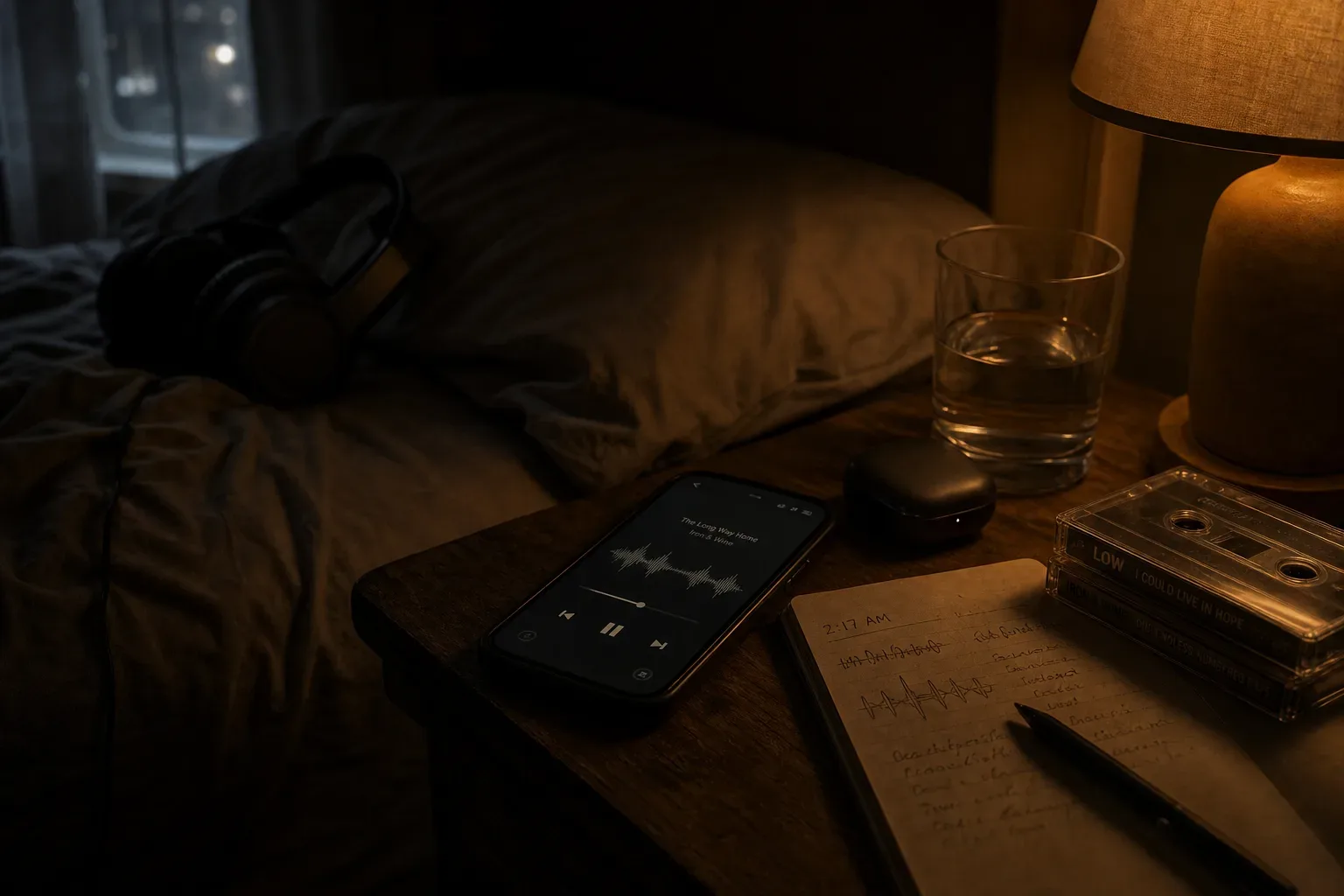
Affirmations before bed are short, believable sentences you listen to or repeat in the last minutes before sleep. A 5-minute audio routine works best when the words are quiet, specific, and easy to accept. The goal is not to force sleep. It is to choose the last voice your mind hears.
What are affirmations before bed supposed to do?
Affirmations before bed are meant to give your attention one soft place to land before sleep.
The last minutes of the day are noisy for many people. The body is tired, but the mind is still checking messages, replaying conversations, or rehearsing tomorrow. The American Academy of Sleep Medicine recommends at least 7 hours of sleep for most adults, yet CDC data has repeatedly found that about 1 in 3 U.S. adults report getting less than that. A short audio routine will not fix a schedule that is too full, but it can remove one source of friction: the habit of ending the day inside harsh self-talk.
The last words of the day do not need to be grand; they need to be believable. That is the first rule. If you tell yourself, I am completely fearless, while your chest is tight and your mind is loud, the sentence may irritate you. If you say, I can let tonight be simple, your body has less to argue with.
Affirmations also work as attention cues. In cognitive and social psychology, self-affirmation theory is usually linked to Claude Steele’s work from the 1980s: people can respond with less defensiveness when reminded of values or identities that matter to them. Later studies, including work published in the Journal of Behavioral Medicine, have found that self-affirmation can reduce stress responses in some settings. That does not mean a bedtime track can promise a new life by Friday. It means words can shift what you rehearse.
For sleep, the standard is lower and kinder. You are not trying to win a debate with your mind. You are giving it fewer sharp edges to hold. A good bedtime affirmation says, in effect, this is safe enough to stop carrying for one night.
If your sleep trouble is persistent, severe, or tied to panic, pain, medication, or trauma, talk with a qualified professional. A quiet audio habit can support sleep hygiene, but it is not medical care.
How do you make a 5-minute audio routine that you will repeat?
Make the routine so small that you can do it on a tired night without negotiating.
Five minutes is enough. At a slow bedtime pace, that gives you roughly 8 to 15 lines, with 8 to 12 seconds of silence after each one. The National Sleep Foundation often describes 10 to 20 minutes as a common sleep-onset window for healthy sleepers. Your audio does not need to cover that whole window. It only needs to mark the turn from doing to resting.
Use this simple structure:
- First 30 seconds: one cue to arrive, such as I am in bed now.
- Next 3 minutes: 8 to 12 affirmations on one theme.
- Next 60 seconds: repeat the 2 or 3 lines that feel most true.
- Final 30 seconds: leave silence, or end with one closing line.
Record it on your phone. Use the same plain voice you would use if someone you loved was half-asleep beside you. You do not need music. If you add sound, choose something steady and low, and avoid anything with sudden changes. Dr. Andrew Huberman often talks about downshifting the nervous system through breath, light, and predictable cues; the same principle applies here. Predictable audio asks less from the brain.
Here is a 5-minute routine you can copy tonight:
| Minute | What to play | Example |
|---|---|---|
| 0:00-0:30 | Arrival cue | I am here. The day is done enough. |
| 0:30-2:30 | Safety lines | My body can rest. This room is quiet enough. |
| 2:30-4:00 | Self-trust lines | I do not have to solve tomorrow tonight. |
| 4:00-5:00 | Repetition and silence | I can return to sleep. I can return to myself. |
Your bedtime audio should be quiet enough to ignore and clear enough to return to. If it starts to feel like homework, it is too complicated. The routine should take less effort than brushing your teeth.
What should the words actually say?
The best bedtime affirmations are short, first-person, present-tense, and modest enough to believe.
Lucia’s test is simple: whisper the line. If it embarrasses you, it will probably bounce off you at 2 a.m. too. A sentence like I am a radiant success may work for someone, somewhere, but many tired minds reject it on contact. A quieter sentence has a better chance: I can take the next small step tomorrow.
Joanne Wood, W. Q. Elaine Perunovic, and John Lee published a 2009 study in Psychological Science showing that positive self-statements such as I am a lovable person made some people with low self-esteem feel worse. That study is not a ban on affirmations. It is a warning about distance. When the sentence sits too far from your felt truth, the mind starts collecting evidence against it.
Use lines that are close enough to reach:
- I am allowed to stop for tonight.
- My worth is not measured by how much I finished.
- I can be kind to my body while it rests.
- I do not need to rehearse the hard part again.
- Tomorrow can wait until morning.
- I can return to one breath.
- I am safe enough in this moment.
- I can let the bed hold me.
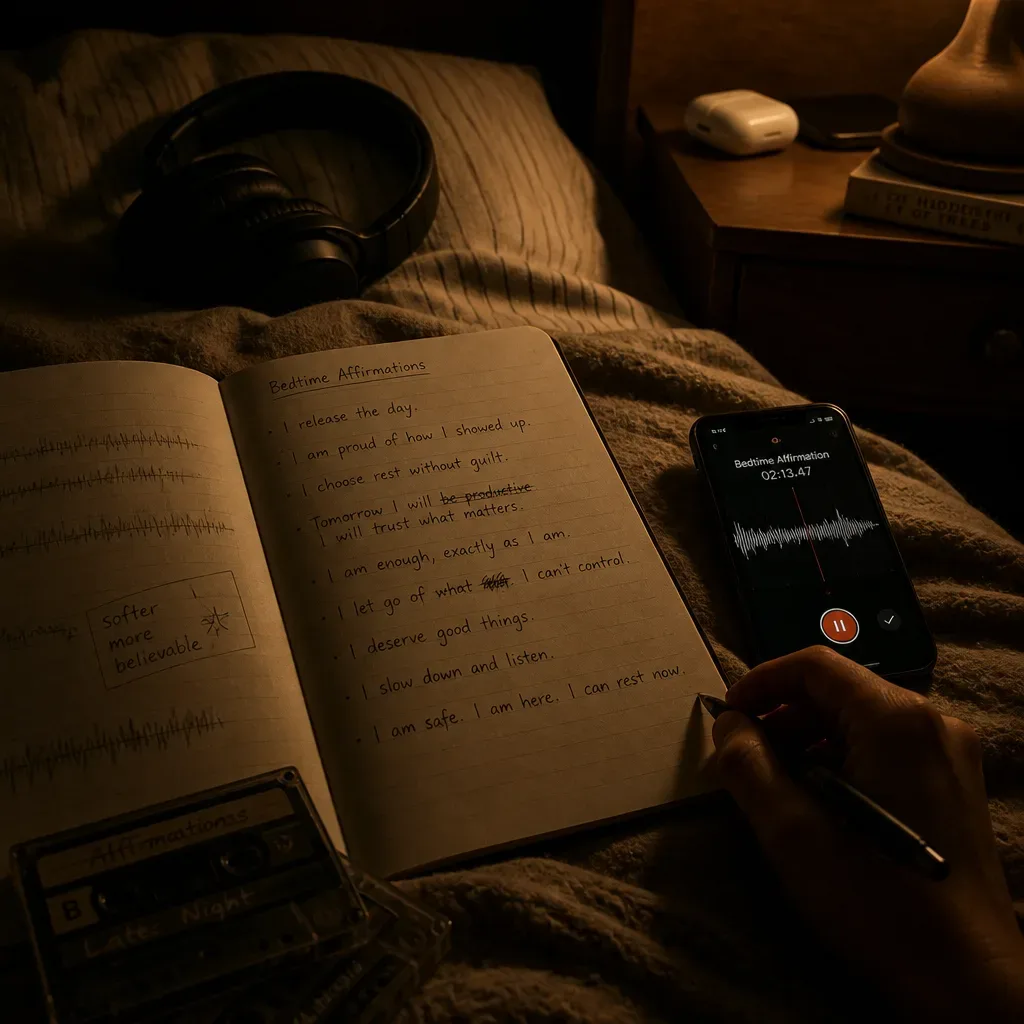
If you want more examples, the Sleep affirmations pillar collects different styles of lines for rest, self-worth, anxiety, and repair. Read them out loud before you record. The mouth knows things the page does not. If a line sounds like a slogan, cut it. If it sounds like something you might actually say to yourself on a hard night, keep it.
Repetition is not magic; it is familiarity with a sentence you are willing to live near. After 14 nights, the useful lines often start to feel less like instructions and more like a path your attention already knows.
Should you use spoken affirmations, subliminals, or the AYA Method?
Use spoken affirmations when you want clarity, subliminals when you like background audio, and the AYA Method when you want a personal recording you can hear every word of.
A subliminal is usually an affirmation hidden under music, noise, or another sound layer. You cannot consciously hear the words, and that is the whole trick. The evidence for subliminal priming is real but modest. Laboratory priming effects tend to be small, context-dependent, and much narrower than the claims you see in some comment sections. If you like that style, read the Subliminals pillar before you let a stranger’s hidden script run all night.
Spoken affirmations are more honest because you can inspect them. You can hear the sentence, notice your reaction, and edit it. An affirmation that you can hear is easier to question, edit, and trust. For bedtime, that matters. The mind near sleep is suggestible, but it is not stupid.
The AYA Method is a daily audio manifestation practice. Each day you listen to a short personalized recording — your Dream-Self Moment — narrated from the version of you who has already manifested the life you intend. Listening is the practice. Repetition is the work. The audio is the method.
The difference is audible. A generic affirmation track says, I am confident. A well-made personal audio might say, I answer the email before lunch, close the laptop at six, and sleep without replaying the whole day. Specific words land differently because they have fewer exits.
Here is the fair comparison:
| Practice | Can you hear the words? | Best use before bed | Main caution |
|---|---|---|---|
| Spoken affirmations | Yes | Calming self-talk | Keep the lines believable |
| Subliminals | Usually no | Background listening | You cannot inspect every word |
| AYA Method | Yes | Daily personal audio | Repeat it consistently |
The audio is the method. A daily affirmation or Manifestation Board can support it, but they are not the core. At night, what matters most is the recording you actually listen to.
How loud should bedtime affirmations be, and when should you press play?
Play affirmations at the lowest clear volume during the final 5 minutes before sleep.
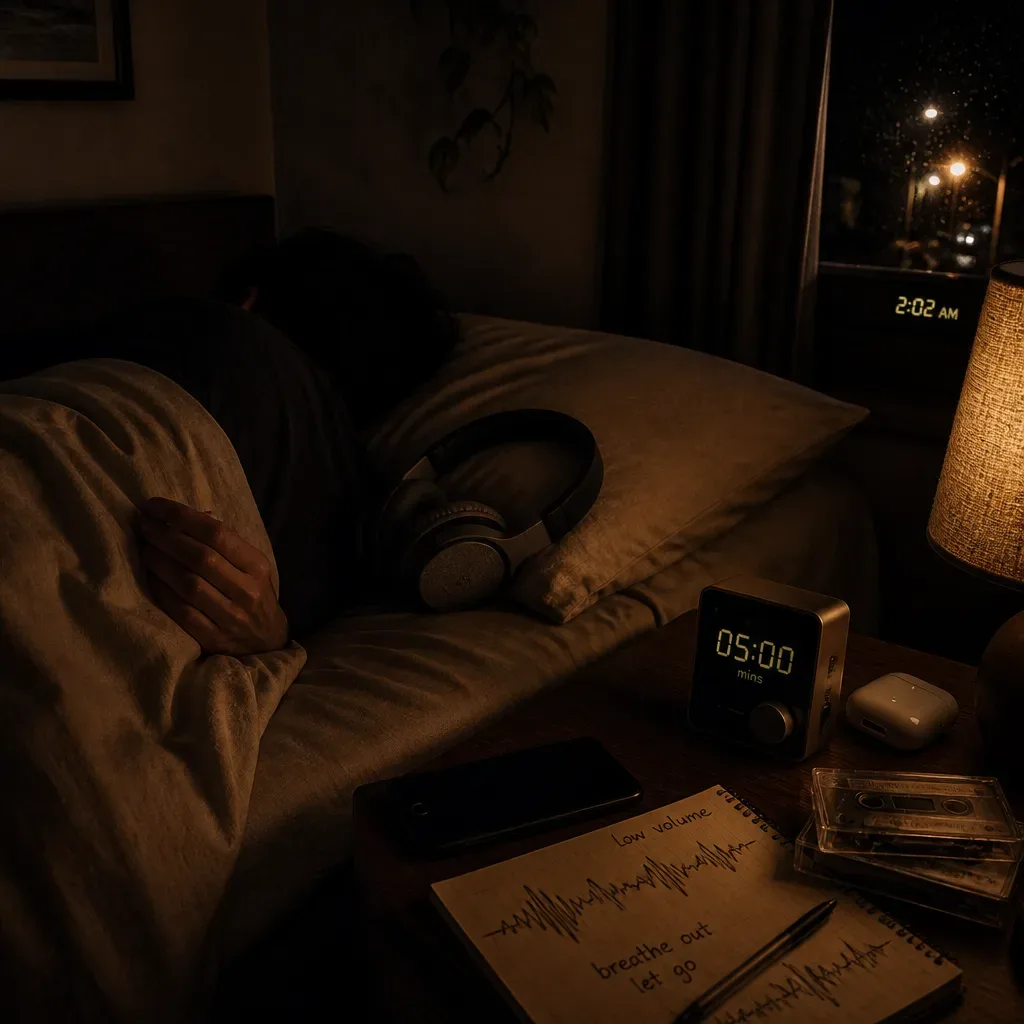
The volume rule is practical: if you strain to hear, the track becomes a task; if the voice pulls you awake, it is too loud. Aim for speech that sits just above the room. Many phones increase alertness because of light, not sound, so set the track before you get into bed or use audio controls without looking. Harvard sleep guidance has long warned that bright light at night can delay melatonin timing; even a brief scroll can make a 5-minute routine turn into 25 minutes.
Use a timer if the audio loops. A single 5-minute play is usually better than an all-night track. Sleep architecture moves through cycles of roughly 90 minutes, and sound can disturb lighter stages even when you do not fully wake. If you love sleeping with sound, keep it steady and low, but do not assume more words means more benefit.
A simple setup looks like this:
- Put the phone face down or across the room.
- Use one track, not a playlist.
- Set the volume before lights out.
- Keep the same start time for at least 7 nights.
- Stop the track if you feel more alert after it.
Pair the audio with one physical cue. It could be turning onto your side, placing one hand on your ribs, or taking 4 slow breaths. You are teaching your body a small sequence: bed, dark, voice, breath, release. In habit research, stable cues are often more important than motivation. One 2009 study by Phillippa Lally and colleagues found that automaticity took a median of 66 days to form, with wide variation. You do not need 66 days to notice a calmer bedtime, but repetition helps.
If timing is hard, use the Sleep cycle calculator tool to choose a bedtime that respects your wake time. The affirmations belong inside sleep hygiene, not on top of a schedule that already steals rest.
What should you expect after one or two weeks?
Expect small changes first: less argument with yourself, easier settling, and a clearer sense of which lines your mind accepts.
Week one is mostly information. You are learning which sentences soften you and which ones make you roll your eyes. Track three things in the morning: roughly how long it took to fall asleep, whether you woke during the night, and the one line you remember. Keep it simple. The point is not to turn sleep into a performance review.
By week two, many people notice the cue before the content. The first line starts to tell the body, this is the part where we stop. That is not a guarantee. It is conditioning. Athletes use repeated cues before performance; meditators use bells; children use bedtime stories. Adults are not above cues. We just pretend we are.
Here is what progress may look like over 14 nights:
| Time | What you may notice | What to adjust |
|---|---|---|
| Nights 1-3 | The words feel awkward | Lower the drama, shorten the lines |
| Nights 4-7 | One or two lines feel useful | Repeat those lines near the end |
| Nights 8-14 | The routine feels familiar | Keep the same track a bit longer |
The effect you are looking for is not a perfect mood. It is a smaller gap between lying down and letting go. If the line I am safe enough tonight makes your shoulders drop by 5 percent, that counts. Sleep is often helped by small permissions, not large speeches.
You can also combine this with a fuller nightly practice. The the AYA Method guide explains how a personalized Dream-Self Moment works as daily audio, and the Sleep affirmations pillar can help you refine the exact language. Keep the order clear: audio first, extra tools second.
When should you stop, change, or skip the routine?
Stop or change the routine if it costs you sleep, increases distress, or turns bedtime into work.
If a method costs you sleep, it costs more than it gives. This is especially true for shifting methods, long hypnosis tracks, and affirmation playlists that invite you to stay mentally active for an hour. Community practices can be meaningful, and many people use them with care. The line is sleep hygiene. If you are delaying rest to complete the method, the method is taking too much.
Change the recording when the words feel false, stale, or too bright for the night you are having. You do not need to be loyal to a sentence that no longer helps. Still, do not edit every night. Give a track at least 7 to 14 listens unless it clearly bothers you. Too much editing keeps the mind in workshop mode.
Skip the routine when you are so tired that pressing play becomes another demand. On those nights, one sentence is enough: I can stop here. The smallest version of the practice still counts because it protects the main thing. You are trying to sleep, not earn a badge for consistency.
Use this decision rule:
- If the audio calms you, repeat it.
- If the words irritate you, rewrite them.
- If the timing keeps you awake, move it earlier.
- If sleep problems persist, get support.
For more context on spoken-word practices at night, compare your routine with subliminal listening, revisit sleep affirmation examples, and keep your bedtime realistic with the sleep cycle calculator. None of these tools need to be dramatic to be useful.
Keep the volume low, and let the last sentence be yours.