sleep hypnosis affirmations
Gratitude Sleep Affirmations: 3-Minute Audio
Use gratitude sleep affirmations in a 3-minute Dream-Self audio before bed, with a simple script, timing, volume, and week-two expectations.
Gratitude sleep affirmations are short, believable statements of thanks played before sleep so your last mental input is softer than worry. A 3-minute Dream-Self audio works because it’s brief, repeatable, and personal: you hear a future version of you speak with calm gratitude, then let sleep do the rest.
What are gratitude sleep affirmations, exactly?
Gratitude sleep affirmations are bedtime statements that pair appreciation with a calm identity you can believe.
They’re not a demand to feel happy. They’re not a test of spiritual skill. They’re a small audio practice: words, heard at night, repeated often enough that your mind has something steadier to return to. The simplest version sounds like this: “I’m thankful for the quiet of this room. I’m thankful my body knows how to rest. I’m thankful I’m becoming kinder to myself.”
Gratitude research is real, but it’s modest. In 2003, Robert Emmons and Michael McCullough published a well-known study in the Journal of Personality and Social Psychology where people who counted blessings reported better well-being than comparison groups over 10 weeks. Later work by Alex Wood and colleagues linked gratitude with better sleep quality in the Journal of Psychosomatic Research in 2009. That doesn’t mean gratitude audio cures sleeplessness. It means attention has weight, especially when repeated.
The sleep part matters. The last minutes before sleep are often filled with unfinished conversations, money math, old shame, or tomorrow’s list. A bedtime affirmation gives that same verbal mind a different script. The sentence you repeat at night doesn’t need to be dramatic; it needs to be safe enough to hear again.
If you already use sleep affirmations, gratitude is one of the gentlest categories. It doesn’t ask you to leap into a fantasy. It asks you to notice one true thing: the blanket, the breath, the person who texted back, the fact that you made it to bed.
Why use a 3-minute Dream-Self audio instead of a long track?
A 3-minute Dream-Self audio is long enough to settle the mind and short enough not to become another task.
Most people don’t need a 45-minute bedtime recording every night. The American Academy of Sleep Medicine and Sleep Research Society recommend at least 7 hours of sleep for most adults, and any practice that delays bedtime too much starts working against itself. Three minutes respects the nervous system’s need for repetition without turning bedtime into homework.
A Dream-Self audio is a recording spoken from the version of you who has already become more steady, rested, and grateful. The wording is present-tense, but it should still feel human. “I’m grateful that I fall asleep in 30 seconds every night” may irritate you if it isn’t true. “I’m grateful I’m learning to meet the night with less fear” gives your mind a place to land.
This is also where the AYA Method comes close to the practice. The AYA Method is a daily audio manifestation practice. Each day you listen to a short personalized recording — your Dream-Self Moment — narrated from the version of you who has already manifested the life you intend. Listening is the practice. Repetition is the work. The audio is the method. If you also use a daily affirmation or Manifestation Board, treat them as complements; the audio carries the method.
There’s a practical reason for the 3-minute limit: it’s easy to repeat for 14 nights. In behavior research, consistency usually beats intensity. A small practice you actually do has more influence than a beautiful 30-minute track you skip after night three. At bedtime, the best script is the one that asks very little of you.
How do you prepare the words before you record?
Prepare the words by choosing five believable gratitude lines and one quiet Dream-Self line.
Start by writing, not recording. The first draft should be plain enough that you’d say it to yourself at 11:40 p.m. without rolling your eyes. If a line feels too shiny, lower it. Neville Goddard wrote often about the “state akin to sleep,” the drowsy border where suggestion lands differently. You don’t have to accept his whole system to notice the timing: a tired mind resists less, but it also dislikes performance.
Use this small table before you press record:
| Line type | Bedtime version | Why it works |
|---|---|---|
| Body gratitude | “I’m thankful my body can soften now.” | Names rest without forcing sleep |
| Room gratitude | “I’m thankful for this bed and this quiet.” | Anchors attention in the present |
| Relationship gratitude | “I’m thankful for the people who care in real ways.” | Invites safety without drama |
| Self-respect | “I’m thankful I kept going today.” | Reduces harsh self-talk |
| Dream-Self line | “I’m grateful I’m becoming someone who rests without arguing with the night.” | Points forward without pretending |
Keep the list small. Cognitive load matters near sleep. A 2019 review in Sleep Medicine Reviews noted that pre-sleep arousal, including cognitive arousal, is tied to poorer sleep. Too many lines can become mental sorting. Five or six lines is enough.
A good gratitude line has 3 traits:
- It’s true, or close enough to true.
- It uses ordinary words you’d actually say.
- It doesn’t make sleep a pass-fail event.
If you want to compare this with hidden-audio practices, the subliminals pillar explains the difference: subliminals place words below conscious hearing; this practice keeps the words audible, soft, and yours. A subliminal hides the sentence. A Dream-Self audio lets you hear what you’re agreeing to.
How do you record the 3-minute audio tonight?
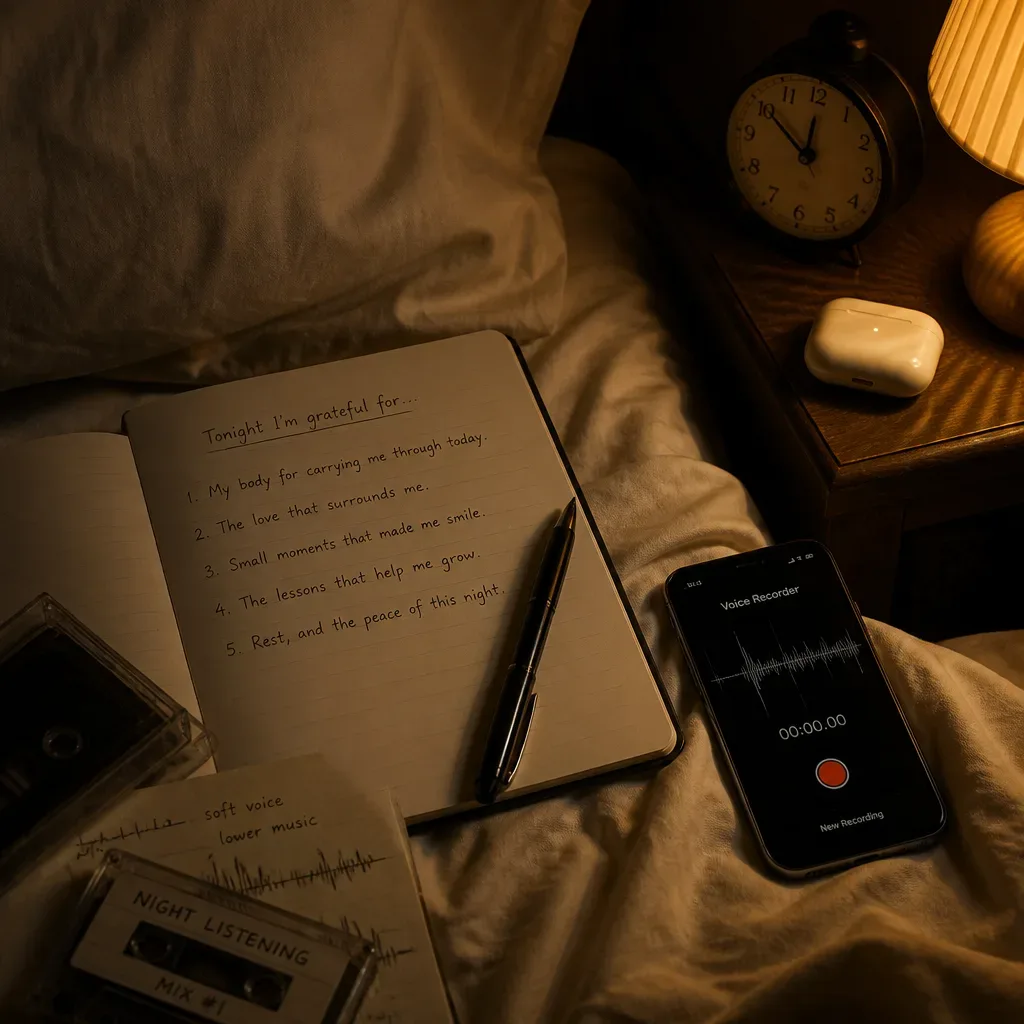
Record the audio in one take, slowly, with space between each line.
You don’t need a studio voice. You need a voice that won’t wake the house. Use your phone’s voice memo app, sit near soft fabric if the room echoes, and record after you’ve written the lines. Many sleep recordings use a pace near 90 to 120 words per minute; for bedtime, slower is kinder. I often aim closer to 70 to 85 words per minute when writing scripts.
Here’s a simple recording structure:
- Open with permission. Say, “You don’t have to do anything now.” This lowers effort.
- Name the room. Say, “The room is quiet enough. The bed is holding you.” This gives attention a location.
- Repeat your five gratitude lines. Leave 2 seconds of silence after each line.
- Add the Dream-Self line twice. Keep it calm, not grand.
- Close without a command. Say, “You can let the words fade.” Don’t order yourself to sleep.
Three minutes usually holds 220 to 260 slow words with pauses. If your recording reaches 5 minutes, don’t panic, but trim anything that sounds like persuasion. Sleep doesn’t need a speech; it needs fewer reasons to stay on guard.
Volume matters. The World Health Organization has warned that high leisure sound exposure can risk hearing over time, especially at louder levels and longer durations. Your bedtime audio should be low: audible when the room is quiet, not loud enough to compete with thought. If you use earbuds, consider one earbud or a pillow speaker at the lowest clear setting. Don’t use audio in a way that makes you feel trapped in sound.
If you wake easily, set the recording to stop instead of looping all night. The sleeping brain can process sound, but the evidence for learning complex new material during sleep is weak. Your goal isn’t overnight instruction. Your goal is a final, repeated cue before sleep.
When should you listen, and how loud should it be?
Listen after the lights are down, the alarm is set, and there’s nothing left to check.
The order matters more than the exact clock time. If you listen, then scroll for 20 minutes, your phone gets the last word. A 2023 National Sleep Foundation survey found that many adults use screens close to bedtime, and light plus emotional content can keep the mind alert. Put the audio after the phone, not before it.
A simple night order looks like this:
- Set tomorrow’s alarm.
- Put the phone face down or across the room.
- Turn the room light low.
- Press play on the 3-minute audio.
- Let the recording end without restarting it unless you’re still comfortable.
If you don’t know your best bedtime, use the sleep cycle calculator to choose a wake time and work backward in roughly 90-minute sleep cycles. Sleep cycles vary by person, but 90 minutes is a useful estimate for planning. Don’t make the calculator sacred. Use it as a reminder that your practice should protect sleep, not eat into it.
Volume should be just above the threshold of hearing. On a phone, that may be 10 to 25 percent, depending on the speaker and room. You should be able to miss a word without caring. If you strain to hear every syllable, you’ll stay too awake. If it’s loud enough to startle you when the next line begins, it’s too loud.
If a method costs you sleep, it costs more than it gives. That applies to affirmations, hypnosis, shifting methods, and manifestation audio. Persistent insomnia deserves professional support; a bedtime recording can sit beside care, but it shouldn’t replace it.
What should the actual script say?
The script should sound like a rested version of you speaking in gratitude, not a stranger trying to convince you.
Below is a 3-minute draft you can record as written or edit. Read it slowly. Leave silence where the line breaks are. The exact word count is less important than the pace. If you’re using this as a Dream-Self audio, keep the “I” voice. If you prefer a guided style, change some lines to “you.”
I’m thankful this day is allowed to be finished.
I’m thankful for the bed under me and the quiet around me.
I’m thankful my body knows many things I don’t have to manage.
I’m thankful for one small kindness I received today, even if it was easy to miss.
I’m thankful I kept going without needing to be perfect.
I’m grateful I’m becoming someone who can rest without arguing with the night.
I’m grateful my mind can soften one thought at a time.
I’m grateful that tomorrow doesn’t need to be solved from this pillow.
I’m grateful for the part of me that still wants gentleness.
I’m grateful I can return to my breath when the mind wanders.
Nothing has to be forced now.
The words can become quieter.
The night can hold what I’m not carrying.
That’s the whole practice. You can repeat the middle lines until the recording reaches 3 minutes. You can also add one personal line: a child’s name, a place you feel safe, a phrase your future self would use. Keep it private and plain.
For more options, the sleep affirmations pillar has broader categories, but don’t collect 50 lines tonight. Choose 6. Record once. Listen for 14 nights. Repetition is where the practice becomes audible inside you.
Some people prefer subliminals because they don’t want to consciously hear the words. That’s fair. But gratitude often benefits from being heard. You’re training attention toward what is safe, sufficient, and becoming easier. What you hear before sleep becomes part of the room you fall asleep in.
What should you notice by week two?
By week two, notice small changes in bedtime self-talk, not perfect sleep.
Fourteen nights is a fair first test because it’s long enough for repetition and short enough to stay honest. In small gratitude studies, changes often appear over weeks, not a single night. Emmons and McCullough used 10 weeks in their 2003 work; many mindfulness and relaxation studies use 4 to 8 weeks. A 2-week check-in is not a verdict. It’s a temperature reading.
Track only 3 things in the morning:
- Did I listen last night?
- Did the wording feel soothing, neutral, or irritating?
- What was my first repeated thought after waking?
Don’t score your worth. Don’t score your spirituality. You’re checking whether the audio is becoming a familiar cue. If one line starts to annoy you, change it. If the whole recording makes you alert, shorten it to 90 seconds. If you fall asleep before the end, that’s fine; hearing the whole thing isn’t required.
This is where audio differs from a written gratitude list. Writing uses the hand and the waking mind. Audio meets you after effort is mostly over. Dr. Andrew Huberman has often discussed non-sleep deep rest and hypnosis as practices that can help shift the body toward relaxation, while still separating them from sleep itself. That distinction is useful: your recording is not sleep. It’s the doorway behavior before sleep.
If you want to build from here, keep the audio stable and adjust the setting: darker room, cooler temperature, steadier bedtime. The National Sleep Foundation commonly suggests a cool bedroom, often around 60 to 67 degrees Fahrenheit, as a helpful range for many sleepers. The words matter, but the room is also speaking.
Let the last voice of the day be one that’s on your side.