sleep hypnosis affirmations
Sleep Hypnosis for Motivation: A 3-Minute Cue
Try sleep hypnosis for motivation with a quiet 3-minute Dream-Self cue: what to play, how loud, when to listen, and what to expect.
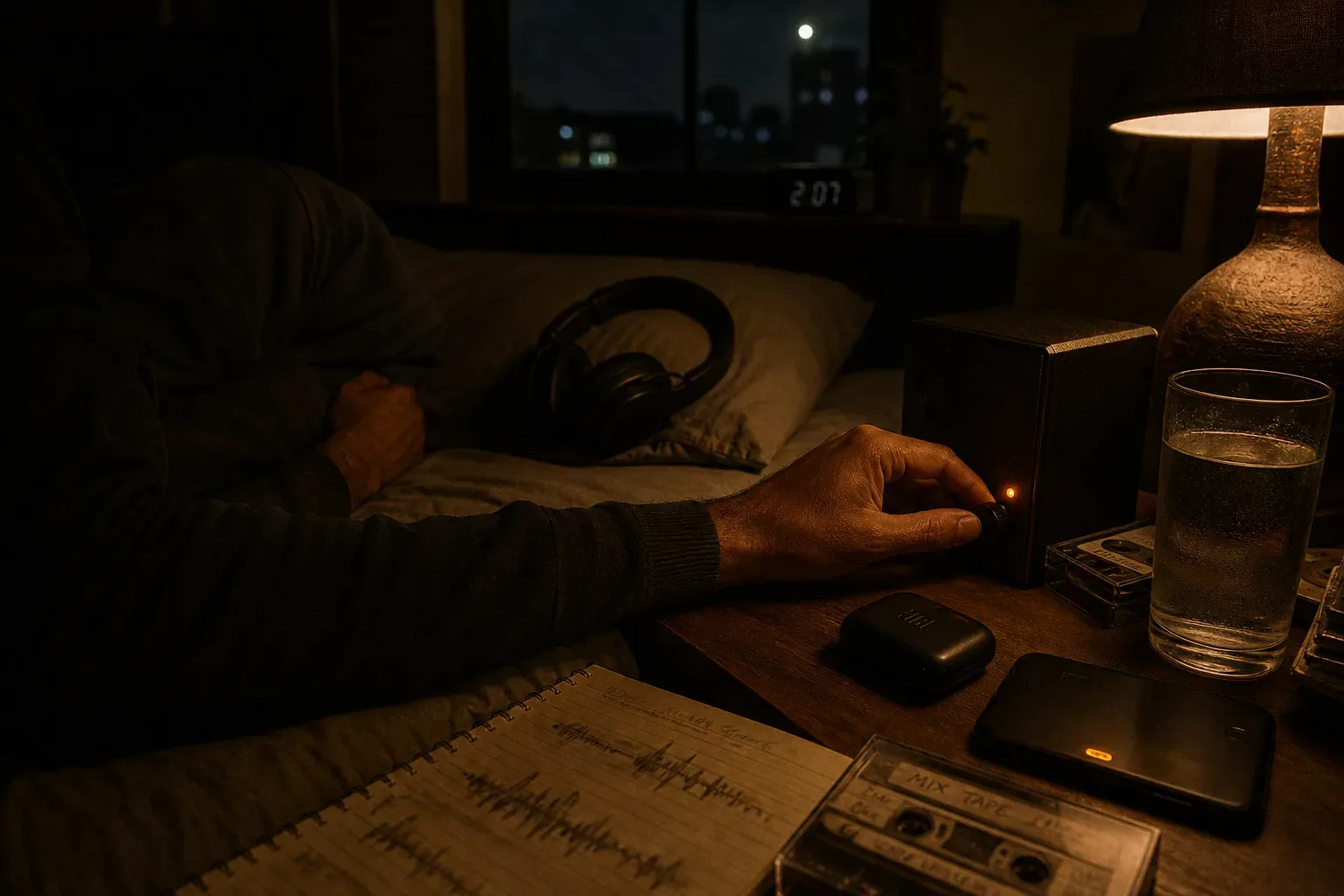
Sleep hypnosis for motivation is a short bedtime audio that pairs relaxation with a clear cue for tomorrow’s behavior. The safest version is quiet, audible, and brief: one 3-minute Dream-Self recording, played before sleep, repeated for 14 nights, with sleep protected above the practice.
What is sleep hypnosis for motivation, really?
Sleep hypnosis for motivation is guided suggestion at the edge of sleep, aimed at making one next action feel easier tomorrow.
It sits between ordinary sleep affirmations, clinical hypnosis, and the internet’s long habit of playing words under music at night. Hypnosis research doesn’t support the claim that a track can make you do anything against your will. It does support something smaller and more useful: attention, expectation, relaxation, and repeated suggestion can shape how a person rehearses behavior. A 2013 review by Oakley and Halligan described hypnosis as a state of focused attention and increased response to suggestion, not a magic channel into the mind.
For motivation, that matters because most people don’t fail from a lack of dramatic desire. They fail at the first hinge: opening the document, standing up, putting the shoes by the door, returning after missing one day. Peter Gollwitzer’s work on implementation intentions, summarized across dozens of studies, found that “if-then” plans reliably improve follow-through compared with vague goals. A good night cue borrows that plain structure.
The practice is not “I am unstoppable.” It’s closer to: “When I wake, I sit up, drink water, and open the page before I check messages.” Motivation at night should feel like a cue, not a command.
If you’re already using sleep affirmations, the difference is focus. Affirmations may repeat a broad self-statement. Sleep hypnosis adds a relaxed voice, a slower pace, and one behavioral target. If you’re curious about hidden-message audio, the Subliminals pillar is the better place to separate priming research from YouTube-sized promises.
How do you make a 3-minute Dream-Self cue?
You make it by choosing one tomorrow behavior, writing three believable lines, and recording them slowly enough that your body can stay sleepy.
The cue should be narrow. “Be motivated” is too wide to hold. “Open my study notes for 10 minutes before TikTok” is usable. The CDC and American Academy of Sleep Medicine recommend at least 7 hours of sleep for most adults, so the cue must not steal the night it’s trying to help. Three minutes is long enough to repeat the identity and the first action without turning bedtime into a project.
Use this simple structure:
- Name the future self in ordinary language. “I’m the kind of person who starts before I feel ready.”
- Attach it to one visible behavior. “When I wake, I put both feet down and open my notes.”
- Give yourself a return line. “If I drift, I come back gently and do the first two minutes.”
That return line matters. Motivation that has no plan for interruption becomes brittle. In habit research, tiny starts are useful because they lower friction. BJ Fogg’s behavior model, used widely at Stanford Behavior Design Lab, argues that behavior happens when motivation, ability, and a prompt meet at the same time. Your 3-minute cue is the prompt; the small action protects ability.
Here’s a draft you can adapt:
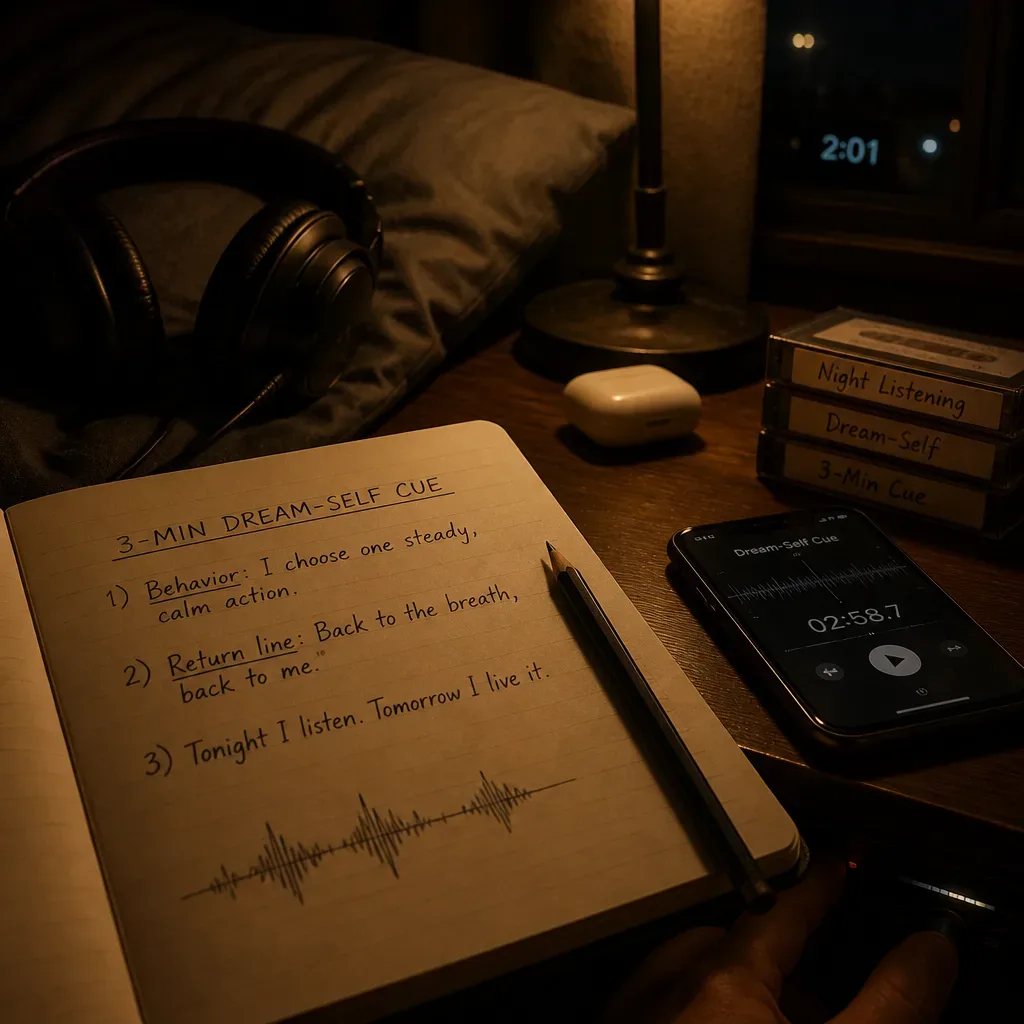
I’m hearing tomorrow from the version of me who begins quietly. When morning comes, I sit up, drink water, and open the first page before I ask how I feel. If resistance is there, I don’t argue with it. I start for two minutes, and the start is enough to return to myself.
Keep the words yours. A borrowed script can be pretty and still miss your life. The voice should sound like someone in the next room who wants you rested.
When should you play it so it helps without costing sleep?
Play it once after lights-out or during your last 10 minutes awake, at a volume low enough that you can stop tracking every word.
The last stretch before sleep is suggestible because your attention is narrowing and outside demands are falling away. That doesn’t mean your mind is open to anything. It means the room is quieter, your inner speech is easier to hear, and repeated cues may become familiar. Sleep cycles run about 90 minutes on average, though they vary, and the first part of the night leans toward deeper non-REM sleep. You don’t need to chase a perfect brainwave window.
If you use a sleep timer, set it to stop after the recording. Looping a voice all night can fragment sleep for some people, especially if the track changes volume or includes music swells. Dr. Andrew Huberman often talks about morning light and consistent wake time as anchors for alertness; that’s relevant here because night motivation works best when it doesn’t compete with circadian basics.
Use this quick timing table:
| Listening moment | Best for | Watch for |
|---|---|---|
| Last 10 minutes before sleep | Most people | Keep it to one play |
| Nap wind-down | Resetting a hard day | Avoid late naps if they hurt bedtime |
| Middle of the night waking | Usually not ideal | It can train wakeful listening |
| Morning replay | Reinforcing the cue | Use a brighter, shorter version |
If you need help choosing a wake time that respects full cycles, use the Sleep cycle calculator tool. It won’t make sleep perfect, but it can keep the practice from creeping into the hours your body needs.
The last voice you hear should lower the room, not raise your pulse.
What should the audio sound like?
The audio should be audible, slow, plain, and free of sudden changes.
A motivation track often fails because it sounds like a workout video wearing pajamas. Bedtime doesn’t need hype. It needs a stable signal. Aim for 60 to 80 spoken words per minute, with pauses after each sentence. Normal conversation is often around 150 words per minute, so this will feel almost too slow when you record it. That’s usually right.
Use headphones only if they’re comfortable and safe for your sleep position. A small speaker at low volume is often enough. Keep the recording around 3 minutes, which usually means 180 to 240 words with silence. If you add background sound, choose something steady: soft room tone, rain, or a low pad without melody. Melody can make the mind follow the song instead of the cue.
A quick checklist:
- Can you hear every word without straining?
- Does the volume stay even from start to finish?
- Are there no bells, risers, sudden bass, or whispered jumps?
- Does the script name one behavior, not five?
- Would the language still feel kind if you had a bad day?
This is where audible practice differs from hidden affirmations. A subliminal is an affirmation you can’t consciously hear; that’s the trick, and also the problem. You may enjoy subliminals, and priming research does suggest that unnoticed cues can influence small judgments under certain conditions. But those studies are not the same as “listen overnight and become disciplined by Friday.” With sleep hypnosis for motivation, you keep consent in the room because you can hear the words.
Words you can hear are words you can edit.
How does the AYA Method compare with sleep hypnosis and subliminals?
The AYA Method is closest to this practice when the cue is personal, audible, and repeated daily.
The AYA Method is a daily audio manifestation practice. Each day you listen to a short personalized recording — your Dream-Self Moment — narrated from the version of you who has already manifested the life you intend. Listening is the practice. Repetition is the work. The audio is the method.
That distinction is important. In many internet practices, the audio is treated as a carrier for something else: hidden affirmations, frequencies, background ambience, or a long visualization. In the AYA Method, the spoken recording itself is the daily practice. A daily affirmation or Manifestation Board can support it, but they aren’t the pillars. The work is returning to a voice that is personal enough to recognize and stable enough to repeat.
Here’s the fair comparison:
| Practice | What you hear | Main strength | Main caution |
|---|---|---|---|
| Sleep hypnosis for motivation | A guided voice and direct cues | Relaxed rehearsal before sleep | Can become too stimulating |
| Subliminals | Music or sound masking words | Easy to play, low effort | Claims often outrun evidence |
| Sleep affirmations | Repeated audible statements | Simple, memorable language | Can feel generic if copied |
| AYA Method | Your personalized Dream-Self Moment | Personal audible repetition | Needs honest intake and daily return |
Neville Goddard’s “state akin to sleep” language influenced a lot of modern nighttime manifestation culture, even when people don’t name him. Joe Dispenza also popularized future-self rehearsal, though his claims are broader than many researchers would endorse. The careful middle path is this: identity rehearsal can change what you notice and attempt; it shouldn’t be sold as a guarantee.
A good Dream-Self cue doesn’t bully the present self. It gives the present self a line to follow when the room gets quiet.
What should you expect by week two?
By week two, you should expect familiarity, slightly less friction around the first action, and clearer information about whether this cue fits you.
Don’t look for a dramatic personality change. Look for smaller markers. Do you remember the first line in the morning? Does the target behavior start 5 minutes earlier than usual? Do you argue with yourself for less time? In behavior change research, small improvements are still data. A 2006 meta-analysis on implementation intentions by Gollwitzer and Sheeran found a medium-to-large effect across many goal types, but those were structured plans, not sleepy internet audios. Your cue works best when it behaves like a plan.
Track only three things for 14 nights:
- Did I listen once before sleep?
- Did I protect my sleep time?
- Did I do the first two minutes of the target behavior the next day?
That’s enough. If you track 12 variables, the practice becomes homework with a pillow. If you miss a night, don’t restart the whole count unless that helps you. Just return. Repetition is not purity; repetition is coming back without making a speech about it.
If you also use sleep affirmations, keep them separate from the cue for the first two weeks. One audio, one behavior, one measure. After that, you can test changes: a different first action, your own voice instead of a generated voice, or a morning replay. Change one thing at a time so you can hear what helped.
By week two, the sentence should feel less like an instruction and more like a familiar path across a dark room.
When should you not use motivation hypnosis at night?
Don’t use it at night if it makes you alert, anxious, obsessive, or willing to trade sleep for a method.
This matters especially in shifting and manifestation spaces, where bedtime practices can turn into long sessions. I’ve watched community methods grow names in real time: raven method, pillow method, Julia method, five-senses scripts. Some are creative and comforting. Some keep people awake until 3 a.m. A practice that costs you sleep costs more than it gives.
Set firm stop rules. If you’re awake 20 to 30 minutes after starting, turn off the track and return to ordinary sleep hygiene. If the script makes you feel judged, rewrite it. If you notice compulsive checking, chasing signs, or fear that skipping one night will ruin everything, pause the practice for a week. The National Sleep Foundation and CBT-I clinicians often point people toward consistent wake times, stimulus control, and reducing wakeful effort in bed; those basics outrank any audio.
Also be careful with goals that carry shame. “I will fix my whole life tomorrow” is not motivation; it’s pressure in costume. Choose a behavior small enough that a tired person can do it. Put the phone across the room. Lay out the notebook. Use the Sleep cycle calculator tool if timing is the real issue. Read the Subliminals pillar if hidden-audio claims are making you uneasy.
If insomnia, panic, trauma symptoms, or mood changes are part of the picture, get support from a qualified professional rather than trying stronger nighttime suggestion.
Rest is not the reward for becoming disciplined. Rest is part of the discipline.
How do you record your cue tonight?
Record one soft 3-minute script tonight by choosing a morning action, writing from your Dream-Self voice, and listening once before sleep.
Here’s a complete 3-minute script template. Read it slowly. Leave silence where you see a line break. Replace the bracketed parts with your own words.
I’m speaking from the version of me who already begins [the action] gently and consistently.
Morning doesn’t need to be dramatic.
When I wake, I [first tiny action] before I check [usual distraction].I don’t wait for a perfect mood.
I make the start small enough to keep.
I open [object or app], set a timer for two minutes, and begin.If my mind complains, I hear it and keep the promise small.
Two minutes counts.
Returning counts.
I’m becoming someone who starts quietly and comes back kindly.
If you want a version closer to the AYA Method, make the recording more personal. Mention the room you wake in, the exact object you touch first, and the tone your future self uses. Keep every word audible. Don’t hide commands under music. Don’t make the script so long that sleep has to wait for it.
Before you press record, check the basics: your alarm is set, your wake time allows a realistic sleep window, and the file won’t loop all night. Most phones let you record a voice memo and set playback through a sleep timer. If your app can’t stop automatically, choose a different app or keep the speaker out of reach so you’re not tempted to tinker.
Tonight’s practice is not to become a different person by morning. It’s to give tomorrow one clear first line.
Speak softly, press play once, and let the rest of the night stay yours.