sleep hypnosis affirmations
Sleep Hypnosis Procrastination: A 3-Minute Audio Cue
Use sleep hypnosis procrastination practice with a calm 3-minute bedtime audio cue, honest evidence, and a two-week routine that protects sleep.
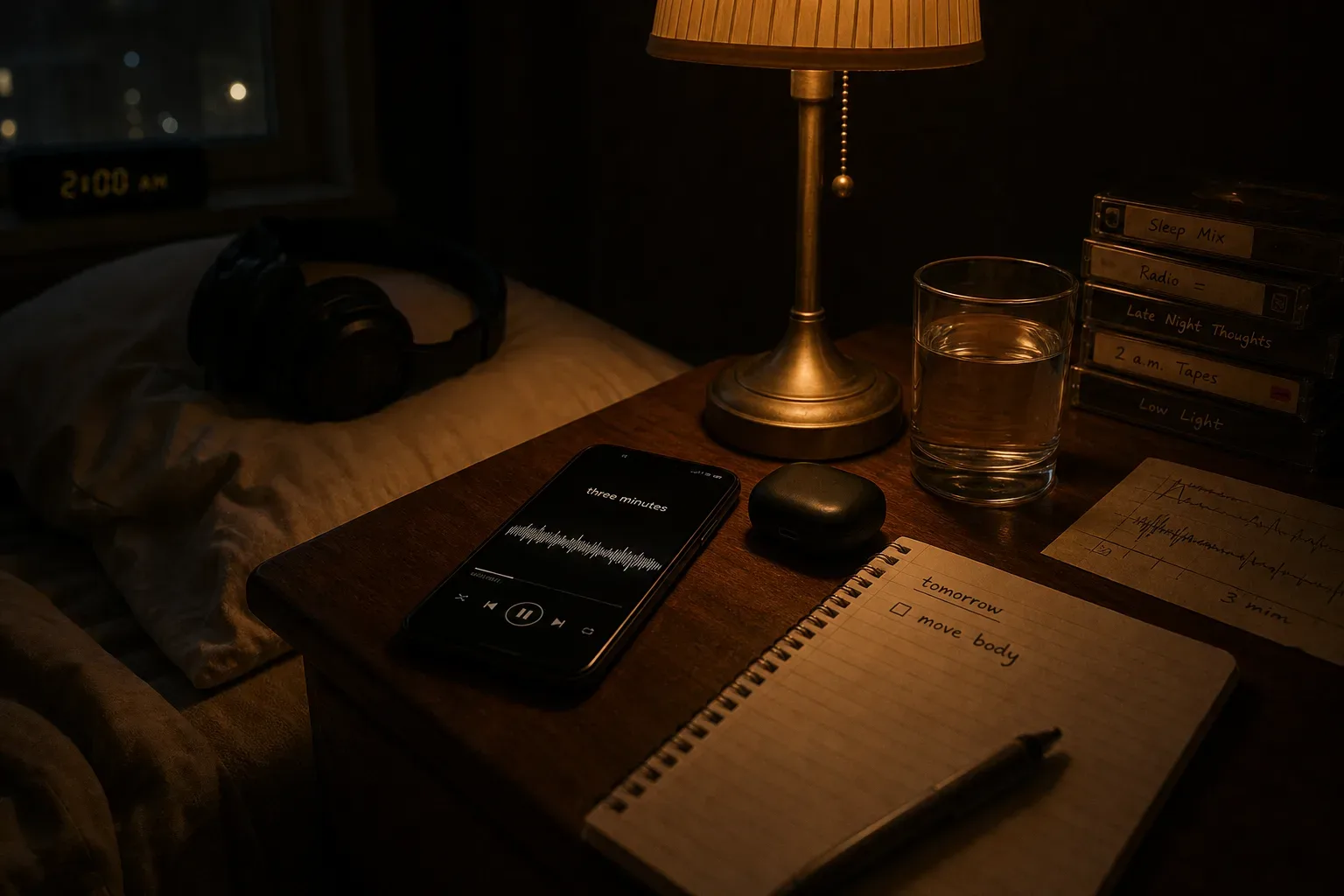
Sleep hypnosis procrastination practice is a short bedtime audio cue that rehearses tomorrow’s first action while you’re quiet enough to listen. It won’t erase avoidance, and it shouldn’t steal sleep. Used for 3 minutes, at low volume, it can make starting feel less sharp by morning.
What is a sleep hypnosis procrastination cue?
A sleep hypnosis procrastination cue is a brief recording that pairs relaxation with one clear start signal for tomorrow.
The point isn’t to become a different person overnight. The point is smaller and more useful: you hear a calm voice name the task, remove some threat from it, and rehearse the first move. Procrastination researchers Fuschia Sirois and Tim Pychyl described procrastination as a form of short-term mood repair in 2013, not simple laziness. That matters because a bedtime cue should soothe the task, not scold you into it.
A 3-minute cue is deliberately narrow. It doesn’t say, get your whole life together. It says, at 8:30, open the laptop, open the file, type one imperfect sentence. Steel’s 2007 meta-analysis in Psychological Bulletin found procrastination was strongly related to impulsiveness and task aversiveness across many studies. So the audio has two jobs: lower aversion and make the first action specific.
This is close to sleep hypnosis, but it’s more practical than theatrical. You don’t need trance music, a 40-minute induction, or a stranger promising a new identity by sunrise. You need a voice you can trust, slow pacing, and a sentence that can survive contact with a real morning. The cue is not a moral lecture. It’s a rehearsal whispered at the edge of sleep.
Use it for one task at a time:
- starting a paper or report
- sending one difficult email
- preparing gym clothes
- opening a tax folder
- studying for 10 minutes
- making one phone call
If the task has more than one step, the recording only names the first. That limit is the practice.
Why use the last few minutes before sleep?
The last few minutes before sleep are useful because attention is softer, but sleep still has to come first.
Sleep onset is not magic. It’s a biological transition. EEG studies commonly show a shift from relaxed wakefulness toward lighter sleep stages, and many people have less active resistance when the room is dark and the day has stopped asking for things. Dr. Andrew Huberman often talks about state-dependent learning in plain terms: the state you practice in changes what is easier to access later. That doesn’t prove a bedtime cue will fix procrastination, but it explains why repetition in a calm state can matter.
Keep the claim modest. Priming research is real, but small effects are common, and popular hypnosis videos often make claims larger than the studies. In a 2014 review in the Journal of Behavioral Medicine, hypnosis showed promise as an adjunct for some health behaviors, but adjunct means support, not standalone cure. Your audio is support for tomorrow’s first move.
The sleep part also has numbers. The American Academy of Sleep Medicine recommends at least 7 hours of sleep for most adults. A procrastination cue that pushes bedtime 45 minutes later is a bad trade. If a method costs you sleep, it costs more than it gives. Use the Sleep cycle calculator tool if you need a rough wake-time window, then keep the recording inside that boundary.
The sweet spot is usually once through, low volume, after lights are out or during your wind-down. If you notice your mind getting busy, move the cue earlier by 20 minutes. Sleep is not the prize you sacrifice for the method. Sleep is the floor under it.
How do you make the 3-minute audio cue?
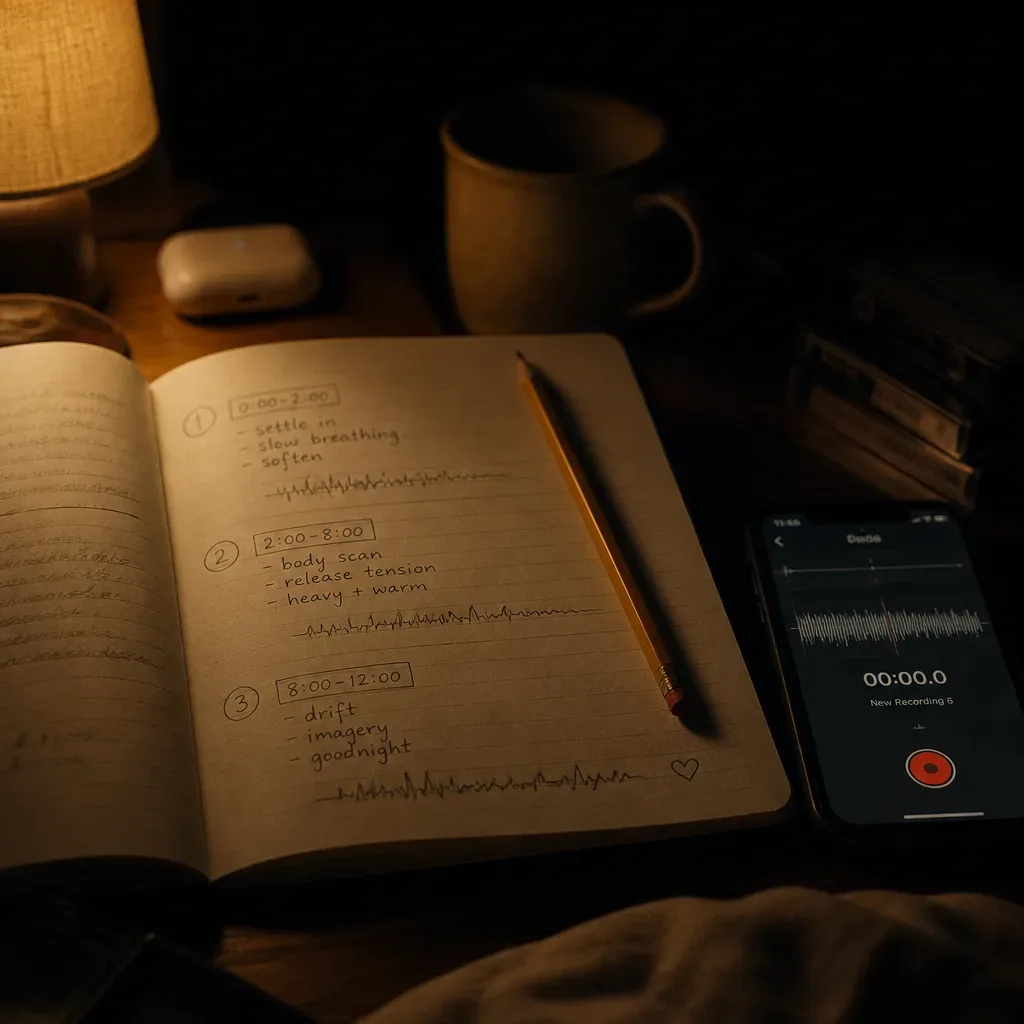
You make it by choosing one avoided task, naming the first visible action, and recording a slow script that takes less than 180 seconds.
Before you record, write the cue in plain words. A study on implementation intentions by Peter Gollwitzer found that if-then plans can improve follow-through across many contexts, with later meta-analyses reporting medium-to-large effects depending on the behavior. Your audio should borrow that structure without sounding stiff: when I sit down with tea, I open the file and write the ugly first line.
Use this 5-step build:
- Pick one task you’ve avoided for at least 24 hours.
- Choose a start time or anchor, such as after brushing teeth or after coffee.
- Name one physical action that takes under 2 minutes.
- Record in a quiet, slow voice for 3 minutes or less.
- Listen nightly for 14 nights, then keep or revise it.
Don’t record a speech. Record a cue. The difference is pressure. A speech tries to convince you. A cue helps your body recognize what comes next. The best bedtime instruction is small enough that tomorrow can obey it while half-awake.
Here’s a simple structure you can use:
| Time | What to say | Why it helps |
|---|---|---|
| 0:00 to 0:30 | Breathe out, unclench the jaw, let the room be dark | Lowers arousal before task language |
| 0:30 to 1:15 | Name the task without drama | Reduces avoidance through exposure |
| 1:15 to 2:15 | Rehearse the first physical action | Makes the start concrete |
| 2:15 to 3:00 | Give permission to stop after 5 minutes | Lowers the cost of beginning |
Use headphones only if they don’t bother your sleep. The National Sleep Foundation has reported that device use near bedtime is common, but light and notifications can delay sleep. Set the recording before you get into bed so you’re not editing at midnight.
What exact script should you record tonight?
Record a script that sounds kind, specific, and boring enough to sleep through.
Here is a 3-minute version you can adapt. Read it at about 110 to 130 words per minute, slower than normal speech. Many audiobooks sit near 150 to 160 words per minute, but bedtime audio needs more air. Leave 2 to 3 seconds between sentences where your breath naturally falls.
I’m done for today. The room is quiet, and nothing else needs to be solved tonight. Tomorrow, I begin with one small action. After I sit down with my drink, I open the document. I don’t need a good sentence. I type one plain sentence. If I feel resistance, I notice it and keep the action small. Open the document. Type one plain sentence. That is enough to begin. I can stop after 5 minutes if I need to. Starting is the practice. I already know the first move. My body can do it before my mood has an opinion. Tonight, I sleep. Tomorrow, I open the document.
Change the task words, not the whole script. If your task is a call, say, I open the contact, I write the first line, I press call. If your task is studying, say, I put the book on the desk, open to page 42, and read one paragraph. Specific numbers help. Page 42 is better than some reading.
You can add one line from Sleep affirmations pillar practice if it stays believable. For example: I’m allowed to begin before I feel ready. Avoid giant claims. A sentence your nervous system rejects at midnight won’t become more useful because it sounds grand.
If you like hidden or barely audible tracks, read the comparison with Subliminals pillar before choosing. A subliminal is an affirmation you can’t consciously hear. That can feel gentle, but it also makes the content harder to check. For procrastination, I prefer audible words because the first action needs to be exact.
How loud should it be, and when should you play it?
Play it once at a volume low enough that you can ignore it, either in bed or 20 to 30 minutes before bed.
A useful starting point is around the volume of a quiet conversation in another room. Normal conversation is often measured near 60 decibels. Bedtime audio should sit below that, especially if you use earbuds. The World Health Organization has warned about unsafe listening levels over time, and while a 3-minute cue is brief, your ears still live with your habits.
Timing depends on your sleep. If you fall asleep easily, play it after lights out. If you have a history of lying awake, play it during wind-down and keep the final minutes silent. I learned this the dull way in my own notes: anything that asked me to think after midnight had a 50 percent chance of becoming a planning session. The cue worked better when it ended before bed.
Try this setup for 14 nights:
- Night 1 to 3: test volume and wording only.
- Night 4 to 7: track whether you start the task the next day.
- Night 8 to 14: remove any line that creates pressure.
Don’t judge by one morning. Procrastination is variable. In Piers Steel’s work, task delay changes with expectancy, value, impulsiveness, and time. That means a cue can help on Tuesday and feel useless on Thursday because the task, sleep, and stress changed. Track the average, not the drama.
For most people, the best sign is not sudden discipline. It’s less negotiation. You open the file before the inner debate has finished warming up. A good cue doesn’t make you heroic. It makes the first step ordinary.
What should you expect by week two?
By week two, expect a slightly easier start, clearer task memory, or useful evidence that this cue isn’t the right tool.
A fair test is 14 nights because three nights proves almost nothing. In my own sleep spreadsheet, the first 3 to 5 nights of any audio practice were mostly novelty. By night 10, patterns became easier to see. That’s not a clinical rule. It’s a practical window long enough to separate the method from one bad day.
Track only three things in the morning:
- Did I start within 30 minutes of the planned anchor?
- Did I do the first action, even badly?
- Did the bedtime cue disturb my sleep?
If the answer to number 3 is yes twice in a row, change timing or stop. The Centers for Disease Control and Prevention has reported that about 1 in 3 U.S. adults don’t get enough sleep. You don’t need another habit that makes that worse.
If the cue helps, you may notice the task feels less personal. The email is still unpleasant, but it’s not a verdict on your character. The file is still blank, but opening it has become familiar. This is where repetition earns its keep. Repetition doesn’t need to be dramatic to be real.
If nothing changes after 14 nights, revise one variable only. Make the first action smaller, play the cue earlier, or switch to daytime implementation intentions. If procrastination is tied to ADHD, depression, anxiety, or chronic insomnia, get support from a qualified professional. Audio can be a cue. It isn’t care.
How is this different from subliminals, sleep affirmations, and the AYA Method?
This cue is different because it uses audible, task-specific hypnosis language for one behavior tomorrow.
Subliminals hide the words under music or noise. That can be comforting if direct statements make you tense, and many people like the softness of not having to analyze every line. The honest problem is verification: if you can’t hear the words, you can’t easily know whether the script is careful, specific, or even relevant. YouTube claims are not the same thing as peer-reviewed priming research.
Sleep affirmations are usually audible and repeated. They can work well when the line is believable and close to behavior. I’m allowed to start with 5 minutes is better than I never procrastinate. If you want a broader base, read Sleep affirmations pillar and adapt one line into your 3-minute cue.
The AYA Method is a daily audio manifestation practice. Each day you listen to a short personalized recording — your Dream-Self Moment — narrated from the version of you who has already manifested the life you intend. Listening is the practice. Repetition is the work. The audio is the method. The daily affirmation and Manifestation Board can support it, but they are complements, not the center.
Here’s the clean comparison:
| Practice | Can you hear the words? | Best use | Main caution |
|---|---|---|---|
| 3-minute sleep hypnosis cue | Yes | One avoided task tomorrow | Too much wording can keep you awake |
| Subliminals | Usually no | Soft background repetition | Hard to verify the script |
| Sleep affirmations | Yes | Repeated beliefs before sleep | Claims can become too broad |
| the AYA Method | Yes | Daily personalized future-self audio | Needs honest personal wording |
For procrastination, I’d start with the audible cue because you can edit it quickly. If it helps, keep it. If it doesn’t, you’ve lost 3 minutes a night, not your sleep.
Keep it low, keep it kind, and let morning meet only one small instruction.