subliminals
Affirmations vs Subliminals: Which Sleep Audio Fits?
Affirmations vs subliminals for sleep audio: compare audibility, evidence, bedtime use, and how to choose the quiet practice that fits your night.
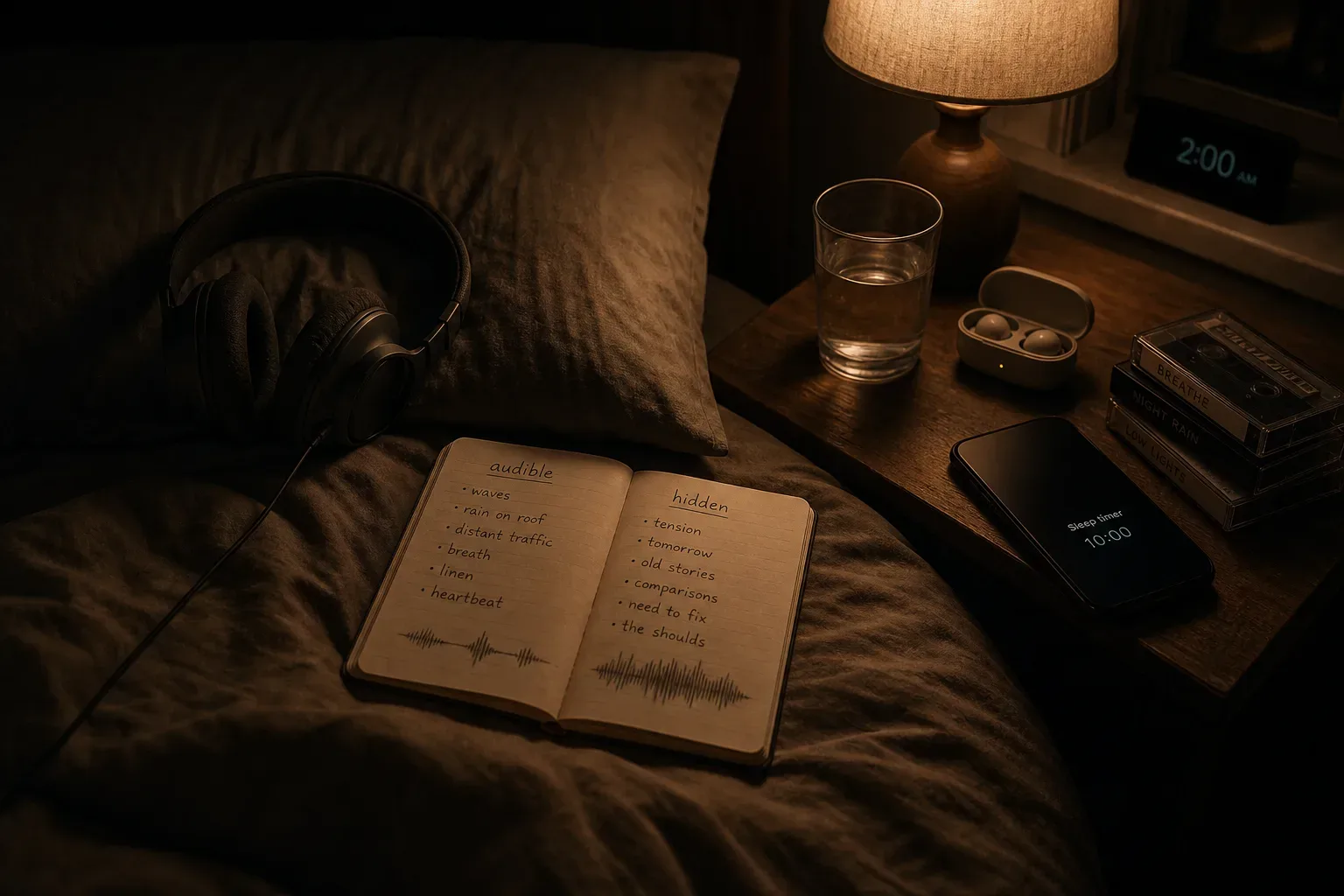
Affirmations vs subliminals is really a question of audibility: affirmations are words you can hear and choose; subliminals are words hidden below music, noise, or another track. For sleep audio, affirmations usually fit better when you want clarity, while subliminals fit better when hearing words keeps you awake.
What is the real difference between affirmations and subliminals?
The real difference is whether your conscious ear can hear the suggestion clearly.
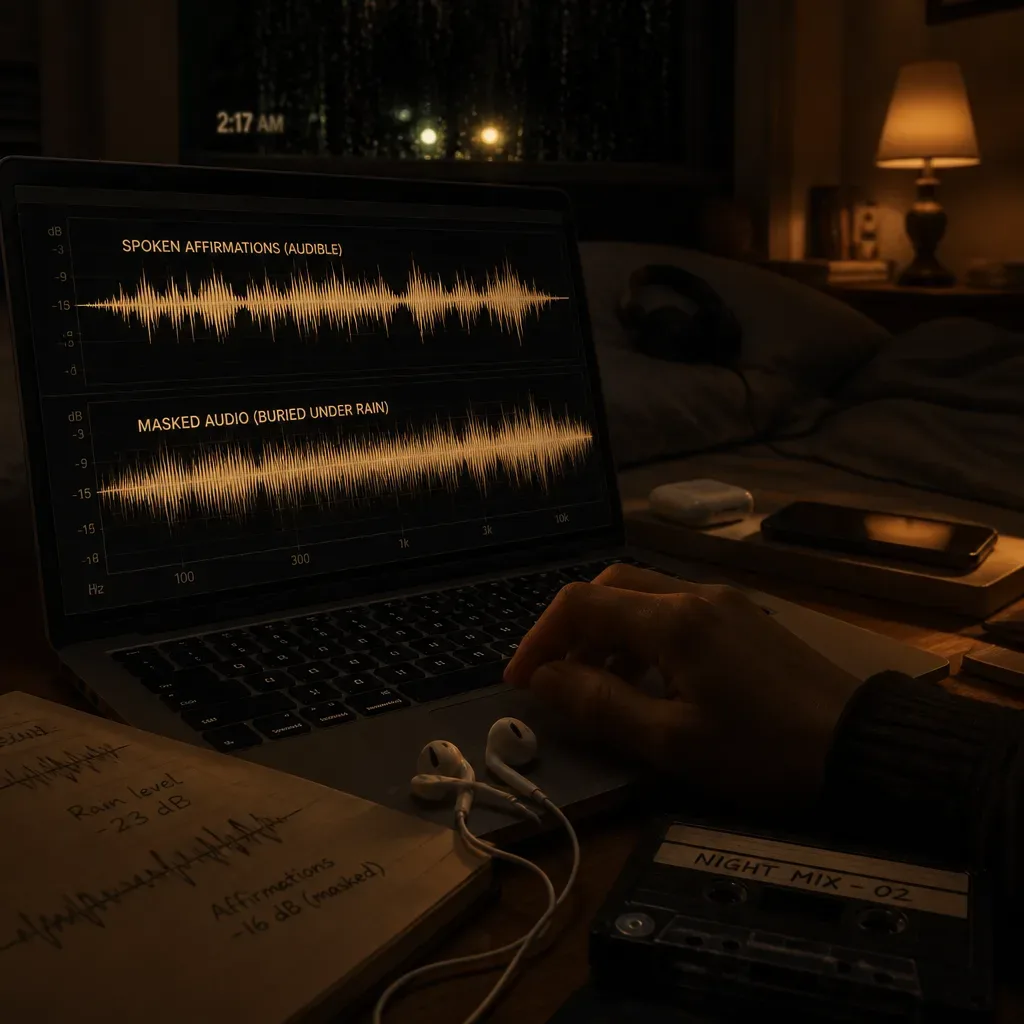
A sleep affirmation is audible language. You hear the sentence, and part of you can agree, resist, edit, or soften it. A subliminal is different by design. The words are masked under rain, pink noise, music, or another spoken layer so you cannot consciously track them. Our wider Subliminals pillar gives the full technical map, but the bedside version is simple: one asks for your attention, the other tries to slip beneath it.
That difference matters because sleep is already fragile. The American Academy of Sleep Medicine recommends at least 7 hours of sleep for most adults, and any audio practice has to serve that first. If a track makes you alert, argumentative, or curious, it is no longer sleep support. If a method costs you sleep, it costs more than it gives.
Here is the clean comparison:
| Feature | Sleep affirmations | Sleep subliminals |
|---|---|---|
| Word audibility | Clear and consciously heard | Hidden or heavily masked |
| Main strength | Choice, clarity, repetition | Low attention demand |
| Main risk | Words may keep you awake | Claims may outrun evidence |
| Best volume | Soft but intelligible | Soft masking sound |
| Best listener | Wants to choose the exact message | Wants fewer conscious words |
A useful line: a subliminal is an affirmation you can’t consciously hear. That’s the whole trick, and the whole problem. You may enjoy the quietness of the track, but you also give up inspection. With affirmations, you can reject a phrase before sleep. With subliminals, trust has to move from the sentence to the maker of the audio.
Which has better evidence: audible affirmations or hidden messages?
Audible affirmations have the cleaner practical case, while subliminal effects in research are real but usually small and short-lived.
The famous 1957 popcorn-and-Coca-Cola story is the first caution. Market researcher James Vicary claimed hidden cinema messages increased popcorn sales by 57.5% and Coca-Cola sales by 18.1%. He later admitted the study was not a proper study, and the stunt still shaped decades of folklore. That history does not disprove subliminal perception. It does remind you that marketing claims and laboratory findings are not the same thing.
In the lab, subliminal priming can shift tiny responses under controlled conditions. A 1996 meta-analysis by Greenwald, Draine, and Abrams found subliminal semantic activation effects, but they were limited and sensitive to timing. Karremans, Stroebe, and Claus reported in 2006 that subliminal priming for a drink brand worked mainly when participants were already thirsty. That is a narrow effect, not a blank check.
Affirmations sit in a different evidence bucket. Self-affirmation research, including work by Claude Steele and later health-behavior studies in the Journal of Personality and Social Psychology and Health Psychology, suggests that reflecting on valued identity can reduce defensiveness and support follow-through. It is not magic language. It is directed attention plus repetition plus a statement you can live with.
For sleep audio, that distinction matters. You are not trying to win a reaction-time task at 2:00 a.m. You are trying to let the nervous system stand down. Dr. Andrew Huberman often describes sleep as a state shaped by light, timing, temperature, and arousal. Audio fits inside that arousal question. The words have to lower the level in the room, not raise it.
Evidence is not an enemy of ritual. Evidence is how you keep the ritual honest. Subliminals may help through relaxation, expectation, and routine. Audible affirmations may help because you rehearse a chosen thought before sleep. Both can be useful. They are not equally proven for the claims people often attach to them.
Which one helps you fall asleep more easily?
The one that asks less of your attention while still feeling safe is usually better for falling asleep.
For some people, audible affirmations are calming because they replace mental noise with one soft thread. A phrase like “I can stop solving this tonight” gives the mind a place to land. The Sleep affirmations pillar is built around that exact use: short, believable sentences before sleep, repeated until they become familiar.
For others, audible words become a task. You start judging the voice. You wonder who wrote the script. You wait for the next sentence. In that case, subliminals or nonverbal sound may be gentler. The National Sleep Foundation has reported that many adults struggle with sleep quality at least several nights a week, and attention loops are one common reason bedtime audio backfires.
A simple bedtime test works better than arguing in theory:
- Choose one track, not a playlist of 12.
- Set a sleep timer for 15 to 25 minutes.
- Keep the volume lower than daytime listening.
- Use the same track for 7 nights.
- Each morning, note sleep onset, night waking, and mood in 2 lines.
By night 3, you often know whether the words soothe you or hook you. By night 7, you know whether the practice is something you want to repeat. Small studies of bedtime routines often show benefits within 1 to 2 weeks, especially when the cue is consistent and the room is dark.
Use the Sleep cycle calculator tool if you are trying to place audio at the beginning of a full sleep window rather than squeezing it into a too-short night. Audio cannot fix a 5-hour sleep budget. It can only soften the entrance.
The last ten minutes before sleep are suggestible. Choose what goes in.
When do subliminals fit better than affirmations?
Subliminals fit better when conscious language keeps you awake, but steady masked sound helps you stay low and quiet.
There are good reasons people keep subliminals. Some listeners do not want another voice in the room. Some find direct affirmations embarrassing. Some need a neutral rain bed with only a faint sense that a message is there. This is not irrational. Bedtime is intimate, and resistance matters. If a phrase makes you wince, your body heard that too.
Subliminals can also be useful when the content is simple and non-grandiose. A track built around sleep safety, rest, or calm is easier to defend than a 9-hour file promising wealth, beauty, revenge, or instant personality change. In priming research, effects depend on existing goals and states. The 2006 thirst study matters here: the cue worked best when the body already had a matching need.
Use subliminals more carefully when:
- the creator does not list the script or theme;
- the title promises dramatic change in 24 hours;
- the audio is harsh, loud, or full of sudden frequency shifts;
- you feel compelled to play it all night despite worse sleep;
- the comments become your evidence base.
Pew Research Center has repeatedly found that large shares of adults use online health or wellness information before consulting a professional. That habit makes script transparency important. You deserve to know what you are putting beside your pillow.
A fair rule is this: if you use subliminals, choose them as sleep audio first and suggestion second. Keep the claim small. Keep the volume low. Keep your morning notes honest. If you want a deeper technical read on masking, audibility, and claim-checking, return to the Subliminals pillar after you test one track for a week.
When do affirmations fit better than subliminals?
Affirmations fit better when you want consent, specificity, and a sentence you can remember in the morning.
The strength of an affirmation is not that it forces belief. It is that it lets you practice a sentence with your eyes open before you take it into sleep. “I am safe enough to rest” is different from “Everything is perfect.” One invites the body to soften. The other may trigger an argument. Believability is not a small detail; it is the doorway.
Research on implementation intentions by Peter Gollwitzer, going back to the 1990s, shows that specific if-then plans can improve follow-through. Sleep affirmations are not the same as if-then plans, but the lesson carries over: precise language beats vague hope. “When I notice tomorrow’s problem at bedtime, I write one line and return to my breath” gives the mind a usable script.
Affirmations also let you work with your own voice. Several small studies on self-referential processing show that personally relevant material is remembered more strongly than generic material. That does not mean a sentence changes your life overnight. It means your brain flags “mine” differently from “someone else’s.” At bedtime, that difference can matter.
Try these before sleep:
- “I don’t need to finish every thought tonight.”
- “I can leave tomorrow outside the bedroom.”
- “My body knows the next small step is rest.”
- “I can hear this and let it be enough.”
If you want a fuller library of language, use the Sleep affirmations pillar and edit any line that feels too large. A sentence you secretly reject is not an affirmation. It is a debate.
Affirmations are also easier to stop. If a phrase feels wrong, you hear it. You change it. That feedback loop is part of the safety of audible audio.
Where does the AYA Method sit between these two?
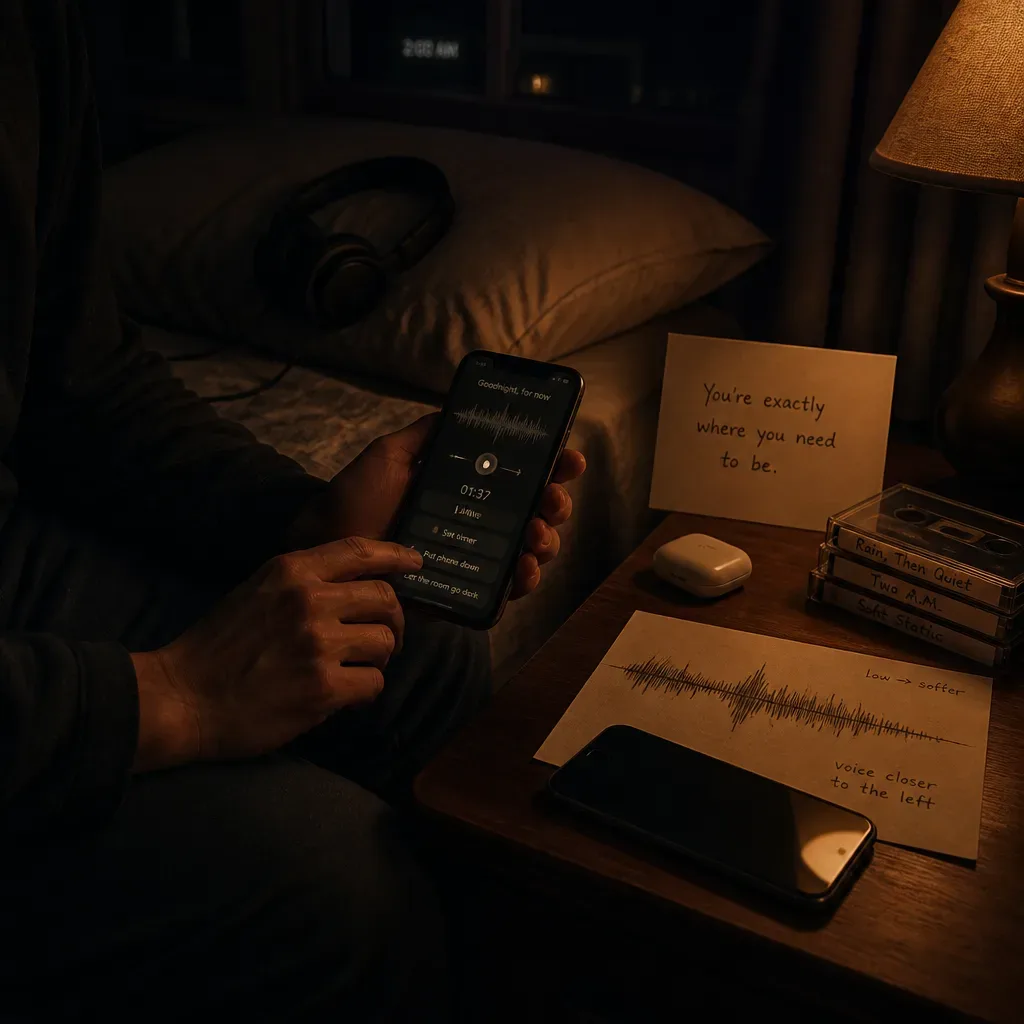
The AYA Method sits closer to affirmations because you hear every word, but it is more personal than a generic affirmation track.
The AYA Method is a daily audio manifestation practice. Each day you listen to a short personalized recording — your Dream-Self Moment — narrated from the version of you who has already manifested the life you intend. Listening is the practice. Repetition is the work. The audio is the method.
That difference is not cosmetic. A subliminal hides the words under sound and hopes your nonconscious mind takes them in. A generic affirmation track gives you audible words, but they may not sound like your life. The AYA Method makes the audio audible and personal. You can hear every word. The voice is yours in the sense that the content is built from your intake, your intended identity, and your phrasing.
There is a reason daily repetition matters. In behavior-change research, habit formation is often measured over weeks, not nights. A well-known 2009 study by Lally and colleagues found an average of 66 days for a new behavior to feel automatic, with wide variation across people. That number is not a promise. It is a reminder that repetition is the work, not a decoration.
The daily affirmation and Manifestation Board can support the practice, but they are not the method. The audio is the method. That is especially relevant at night, when reading, typing, and visual arranging may add light and effort. Listening asks less. You can place the recording last in the day, low and clear, and let it become a familiar cue.
Personal audio has one quiet advantage: you are less likely to resist a life described in your own words. Not every listener needs that. Some just need rain. Some need a simple sentence. But if you are comparing affirmations vs subliminals because you want audible suggestion without generic scripting, this is the middle path to test.
How should you choose tonight’s sleep audio?
Choose the format that protects sleep first, then choose the message you can honestly repeat.
Start with your actual problem. If your mind is loud and you want a clear handrail, use affirmations. If words make you alert, use a low subliminal or neutral sound. If you want personal language and can tolerate audible speech, try a short personalized recording through the AYA Method. If your bedtime is chaotic, fix timing before you fix audio.
Here is a practical chooser:
| Your night sounds like | Try first | Test length |
|---|---|---|
| “I need kind words to interrupt worry” | Audible affirmations | 7 nights |
| “Spoken words keep me awake” | Subliminal or neutral sound | 7 nights |
| “Generic scripts feel false” | Personalized audio | 14 nights |
| “I wake often from sound” | Short timer, then silence | 3 nights |
| “I am sleeping under 6 hours” | Schedule repair first | Start tonight |
The Centers for Disease Control and Prevention has reported that roughly 1 in 3 U.S. adults do not get enough sleep. That number matters because bedtime audio can become a workaround for an impossible schedule. If you need to be up at 5:30, playing affirmations until 1:00 is not devotion. It is sleep loss with a soundtrack.
Use this decision sequence:
- Set your wake time and count back 7.5 to 8.5 hours.
- Use the Sleep cycle calculator tool if you want a cleaner bedtime window.
- Pick one audio format for the week.
- Keep the volume low enough that you could ignore it.
- Stop any track that worsens sleep for 2 nights in a row.
If insomnia persists beyond basic sleep hygiene, talk with a qualified clinician. Audio can be a ritual, a cue, and a comfort. It is not a substitute for care when sleep is seriously impaired.
The quiet answer is this: affirmations are better when you want to hear and choose the words; subliminals are better when you need the words to get out of the way. Both should leave you with more sleep, not less.
Let the last voice of the night be one you do not have to fight.