subliminals
Subliminals While Studying: Focus Rules and Audio Swap
Use subliminals while studying without losing focus: volume rules, task matching, and a two-week audio swap to test what helps you study.
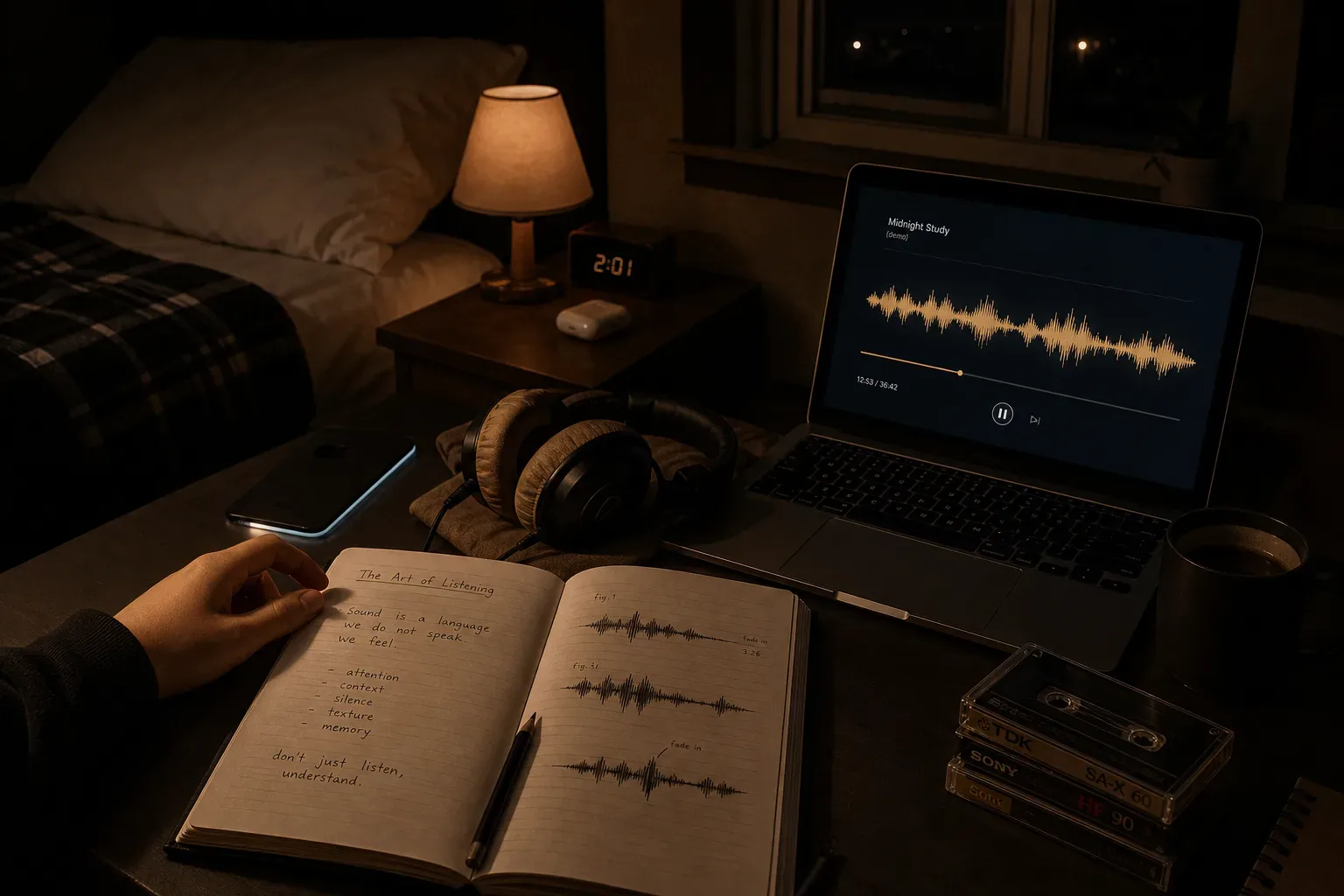
Subliminals while studying can be useful only when they do not compete with the task in front of you. Use them like background audio: low, simple, repeatable, and tested against silence or non-speech sound. If your score, recall, or output drops, swap them out.
Are subliminals while studying actually a good idea?
Subliminals while studying are a maybe, not a rule.
A subliminal is usually a spoken affirmation mixed below music, rain, brown noise, or another masking layer. You may not consciously hear the words, but the file still contains speech-shaped information. That matters because studying already asks a lot of working memory. Psychologist Nelson Cowan’s often-cited 2001 review put the focus of attention at about 4 chunks, not the old 7 plus or minus 2. When a task is hard, four slots disappear quickly.
The research on subliminal priming is real, but modest. In laboratory work, masked words or images can nudge reaction times or preferences under narrow conditions. That is not the same as proving a 3-hour YouTube track will improve calculus, anatomy, or legal reading. A quiet nudge is not a study plan. It is a small signal living beside your habits, sleep, and repetition.
So the first question is not whether subliminals are real. The first question is whether they are compatible with the task. Reading, writing, and coding use language. A hidden voice under the rain is still designed as language. Even when you cannot make out the words, your ear may still track rhythm, sibilance, or compression movement. I have opened enough files in a spectrum analyzer to say this plainly: sometimes there are voices under the waterfall, and sometimes there is nothing but waterfall.
If you want a wider primer before testing a track, start with our subliminals guide. Then come back to the desk with one clean rule: the study session is the measure. If the audio makes you feel serious but your recall is worse 24 hours later, the tape did not help you study.
The best study audio is not the one with the biggest promise. It is the one that leaves attention intact.
What focus rules keep subliminals from stealing bandwidth?
The safest rule is to make the audio boring enough that you stop checking it.
Start with volume. Your study subliminal should sit lower than ordinary music, closer to room tone than a playlist. If you catch yourself trying to hear the script, turn it down or turn it off. The World Health Organization has used 85 dBA for 8 hours as a common exposure reference for noise risk, but study audio does not need to live anywhere near that ceiling. Long headphone sessions are easier on the ear when they are quiet.
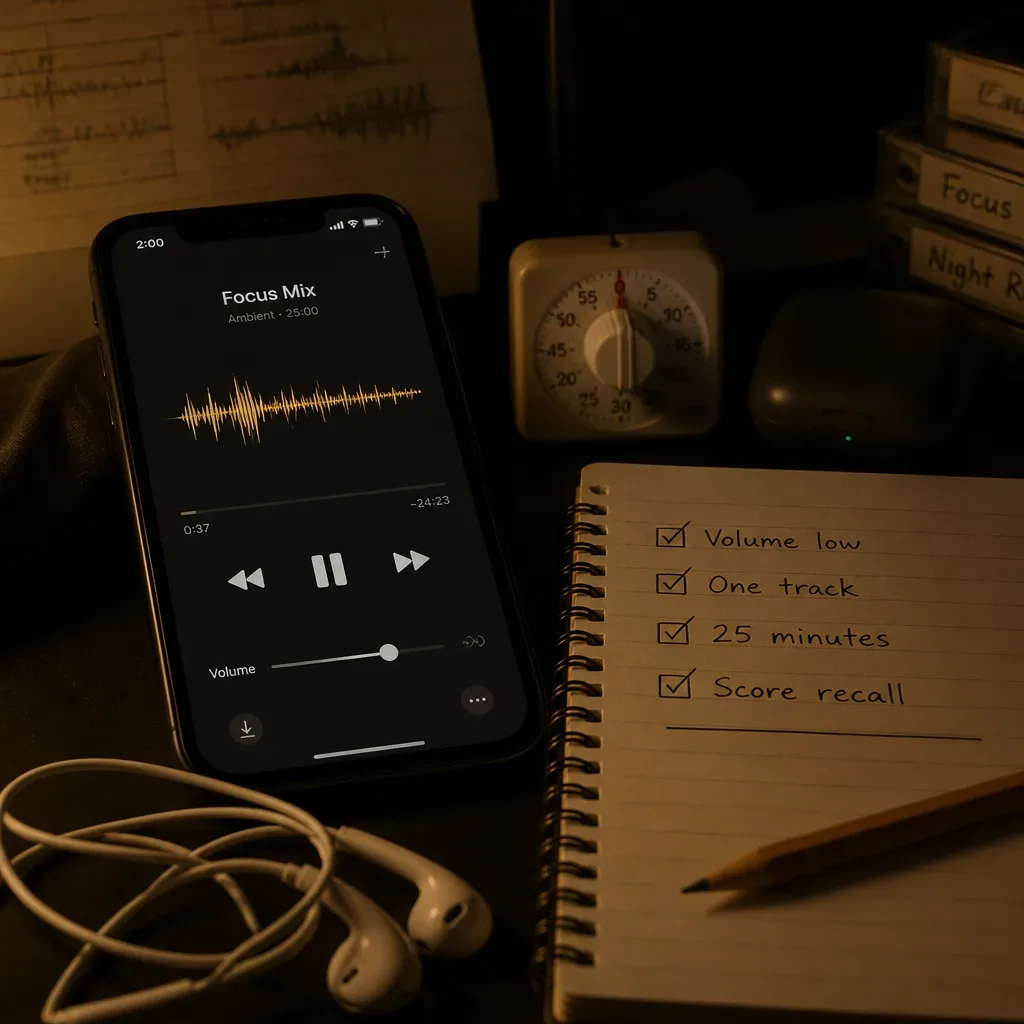
Use these rules for the first two weeks:
- One track only. Do not rotate 12 files and call it testing.
- No audible affirmations during reading. Save spoken lines for before sleep or breaks.
- Keep sessions short. Test 25 to 50 minutes, then stop and score the block.
- Match the task. Compare reading with reading, not reading with flashcards.
- Stay low. Background level means you can forget the audio is playing.
- Do not use new tracks on exam day. Novelty is attention tax.
That 25-minute block is not magic, but it is measurable. Francesco Cirillo’s Pomodoro Technique popularized 25-minute focus intervals in the late 1980s. Whether you use 25, 40, or 50 minutes, the point is containment. A fixed block lets you compare one condition with another without relying on a mood after the fact.
Headphones matter too. Consumer earbuds hype bass, clamp transients, and can blur a hidden vocal into a pumping wash. Laptop speakers may not reproduce very high content at all. If a creator claims a message lives at 17,500 Hz, remember that many adults cannot hear that high clearly, and many speakers will not play it cleanly. ISO 7029 hearing tables show age-related high-frequency loss is common, especially above 8 kHz.
Keep the setup plain:
- same headphones
- same desk
- same subject
- same time of day when possible
- same session length
- same note-taking method
Respect the listener’s ear, including your own. A track that needs loud volume to feel convincing is already asking too much.
Which tracks should you avoid during reading, math, or coding?
Avoid any track with speech movement when the study task also depends on language.
The classic problem is called the irrelevant speech effect. In experiments associated with Salamé and Baddeley in the 1980s, background speech disrupted short-term recall more than steady noise. You do not need to understand every word for speech-like sound to pull at sequencing. That is bad news for reading dense text, writing essays, learning vocabulary, or debugging code.
This does not mean all audio is harmful. Some people work well with steady noise because it masks household sound. A 2012 paper in the Journal of Consumer Research reported that moderate ambient noise, around 70 dB in their conditions, could support certain creative tasks better than low noise, though very loud noise hurt performance. That finding is not a license to blast affirmations. It is a reminder that type, level, and task all matter.
Use this table as a starting point:
| Study task | Better audio choice | Avoid during the block |
|---|---|---|
| Reading textbooks | Brown noise, rain, silence | Audible affirmations, lyric music, speech-heavy subliminals |
| Writing essays | Low instrumental loops | Whisper tracks, podcasts, language scripts |
| Math practice | Steady noise or simple beats | Tracks with sudden drops or voice movement |
| Coding | Brown noise, quiet instrumental music | Spoken-word layers, complex vocals |
| Flashcards | Silence or very low noise | Anything you keep checking |
| Reviewing notes | Soft instrumental audio | New subliminal files with unknown mix levels |
There is a second issue: compression. Many online subliminals are heavily compressed so the rain, music, and voice stay constantly loud. Compression can make a hidden vocal breathe against the masking sound. You may not hear words, but you hear motion. Motion is attention. At a mixing desk, I would rather hear a clearly labeled whisper than a mystery layer fighting a limiter.
If the track claims to be ultrasonic, be more skeptical, not less. A 17,500 Hz sine tone is not a carrier pigeon for wisdom. It is a high tone that your earbuds, your ears, and the platform’s audio processing may or may not preserve. AAC and Opus compression can also discard information depending on bitrate and encoder settings. If the method depends on a fragile frequency band, the delivery chain is already shaky.
A subliminal you cannot verify should not get prime seating during your hardest work.
How do you run a two-week audio swap without fooling yourself?
Run the swap like a small personal test, not a belief contest.
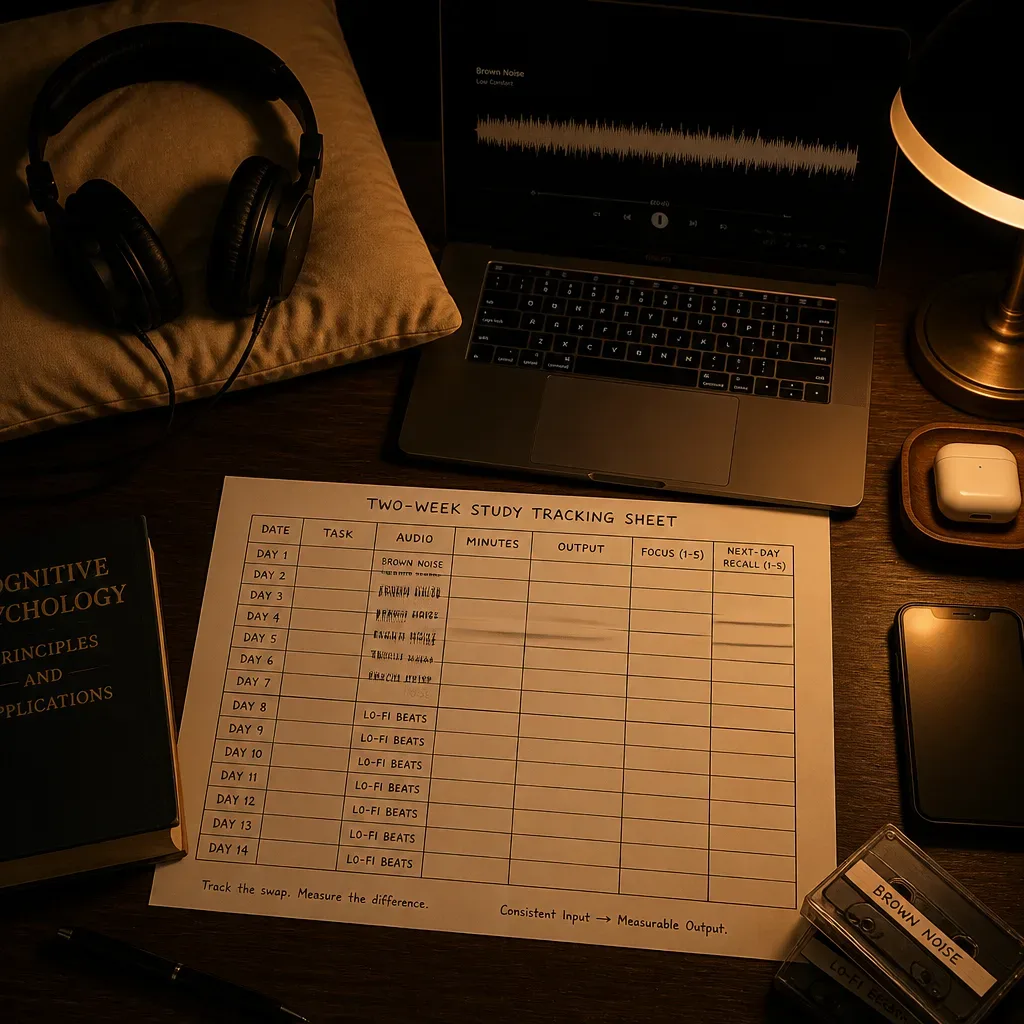
You need 10 study sessions over 14 days. That is enough to notice obvious friction without pretending you have a clinical trial. In behavioral self-tracking, repeated measures are more useful than one dramatic day. The Journal of Behavioral Medicine has published many small self-monitoring studies across habits and health behaviors; the shared lesson is simple: what you record tends to become clearer than what you remember.
Set up the swap like this:
- Days 1 to 3: baseline. Study without subliminals. Silence or your normal non-speech background is fine. Record the task, minutes, output, and recall.
- Days 4 to 6: subliminal condition. Use one file only. Keep volume low and session length fixed.
- Day 7: rest or normal study. Do not score this day unless your schedule demands it.
- Days 8 to 10: audio swap. Replace the subliminal with brown noise, rain, or simple instrumental sound.
- Days 11 to 14: repeat the better condition. Use the condition that gave steadier output, not the one that felt more exciting.
Score each session in two ways. First, use a 1 to 5 focus rating. Second, count output: pages read, problems completed, flashcards recalled, words drafted, or bugs fixed. Feeling focused is useful, but it can lie. A 2020 Pew Research Center report found that many adults use digital tools to manage learning and work, but tools become meaningful only when tied to behavior. Your audio is also a tool. Make it answer to the work.
Here is a simple score sheet:
| Date | Task | Audio | Minutes | Output | Focus 1-5 | Recall next day |
|---|---|---|---|---|---|---|
| Oct 31 | Biology reading | Silence | 40 | 9 pages | 4 | 6 of 8 concepts |
| Nov 2 | Biology reading | Subliminal rain | 40 | 7 pages | 3 | 4 of 8 concepts |
| Nov 5 | Biology reading | Brown noise | 40 | 10 pages | 4 | 7 of 8 concepts |
The next-day recall column is the one people skip, and it is often the one that tells the truth. Hermann Ebbinghaus described the forgetting curve in the 1880s, and modern memory research still treats delayed recall as different from immediate comfort. Studying is not just sitting near information. Studying is being able to return to it later.
If you also listen to sleep audio, keep that separate. Use the sleep cycle calculator to protect wake time and bedtime while you test. If a method costs you sleep, it costs more than it gives.
What should you use when study subliminals make focus worse?
Move intention audio away from the study block and use cleaner focus sound at the desk.
There are three common swaps. The first is silence, which is underrated and costs nothing. The second is steady masking sound: brown noise, rain, fan noise, or a low room tone. The third is simple instrumental music with little change over time. In a 2019 review on music and cognitive performance, researchers noted mixed findings because tempo, preference, arousal, and task difficulty all change the result. That is exactly why your own two-week score matters.
If you still want words, place them where words belong. Audible affirmations can sit before sleep, after study, or during a walk. They do not need to fight your textbook. Our sleep affirmations guide is a better fit if you want clear phrases at night instead of hidden speech during high-load work.
This is also where the AYA Method makes a cleaner distinction. The AYA Method is a daily audio manifestation practice. Each day you listen to a short personalized recording — your Dream-Self Moment — narrated from the version of you who has already manifested the life you intend. Listening is the practice. Repetition is the work. The audio is the method.
That difference matters technically. A subliminal hides the words under sound and asks you to trust the mix. The AYA Method makes the words audible and personal, so you know what entered the tape. It is not something I would place under a difficult reading block. I would place it when listening is the task, especially at night or during a quiet daily pause.
Use this swap if study subliminals are not helping:
- During study: brown noise, rain, silence, or simple instrumental audio.
- Before sleep: audible intention audio, calm spoken practice, or sleep affirmations.
- For subliminal curiosity: test one file at a time using the subliminals pillar as your reference point.
- For timing: protect sleep first with the sleep cycle calculator tool.
A hidden layer is not more serious because it is hidden. Sometimes clear words are the more honest engineering choice.
What should you expect by week two?
By week two, expect a practical answer, not a miracle.
You should know whether the subliminal track leaves your output stable, lowers it, or helps you begin. Beginning matters. If a low rain track gets you into the chair for 40 minutes, that is not nothing. But separate initiation from cognition. The file may help you start and still hurt reading speed. It may calm the room and still reduce recall. Your notes will show the split.
Look for small changes. A 5 to 10 percent difference in completed problems or recalled cards is more believable than a dramatic personal claim. In small habit studies, adherence often matters more than intensity; doing the repeatable thing wins over the perfect thing done twice. The same rule applies here. If the track makes the routine easier and does not damage recall, keep it. If it makes you foggy, move it to a different time.
There are also signs to stop. Stop if you raise the volume every session. Stop if you feel pressure to sleep less so you can listen more. Stop if the track includes medical claims, exam guarantees, or fear-based wording. No audio file should make you feel trapped at your own desk. If insomnia or anxiety is persistent, talk with a qualified professional; audio hygiene is not medical care.
The clean result may be boring: brown noise for study, audible words before sleep, and no mystery layer during hard work. Boring is allowed. A good mix does not need to announce itself. It lets the work stay in front.
Keep the sound low, and let the page answer.