subliminals
Appearance Subliminals: What Sleep Audio Can Do
Appearance subliminals may shape attention, mood, and habits, but sleep audio can't be promised to change bone, height, or genetics overnight.
Appearance subliminals are sleep audios that hide or lower affirmations about beauty, facial features, weight, skin, or body shape under music or noise. They may influence attention, mood, and habits around how you present yourself, but they can’t safely be claimed to change bone structure, height, or genetics while you sleep.
What are appearance subliminals, exactly?
Appearance subliminals are audio tracks built around hidden or barely audible statements about how you look.
Most tracks use music, rain, brown noise, or layered whispers, then place affirmations beneath the conscious listening level. The subject might be clear skin, facial symmetry, a smaller nose, longer lashes, a different body shape, or a more general sense of beauty. If you want the broader definition first, start with the Subliminals pillar, because the same mechanism is claimed whether the topic is money, confidence, study, or appearance.
The research base is much narrower than the YouTube titles. Subliminal perception is real in lab conditions. Kouider and Dehaene’s 2007 review describes how briefly presented unseen stimuli can be processed, especially when the task is simple and the timing is controlled. That does not mean a 9-hour beauty playlist can tell skin cells, cartilage, or fat distribution what to do.
The distinction matters. A subliminal can change what you notice before it changes anything you can measure. If a track repeats that your posture is relaxed and your face is soft, you may catch tension in your jaw the next day. If it repeats that you care for your skin, you may wash your face instead of falling into bed. Those are behavioral routes, not magic routes.
Appearance content is also emotionally loaded. In a 2023 Pew Research Center report, 46 percent of U.S. teens said social media made them feel worse about their body at least sometimes. That doesn’t make every appearance subliminal harmful, but it means the wording deserves more care than a study playlist.
The quieter the audio, the more honest the script needs to be.
Can appearance subliminals change your face or body while you sleep?
No reliable evidence shows that appearance subliminals can physically change your face, height, bone structure, eye color, or genetics during sleep.
This is the line to keep. Subliminal priming can affect choices in specific contexts, usually briefly. Karremans, Stroebe, and Claus found in 2006 that subliminally priming Lipton Ice increased choice of that drink, but mainly when participants were thirsty. The cue nudged a ready state. It did not create a new body.
Physical appearance is not one system. Skin hydration can change across a day. Facial puffiness can change after sleep, salt, alcohol, allergies, or crying. Posture can change how your neck, jaw, and waist look in a mirror. Weight changes require time and physiology. Bone structure does not shift because a masked sentence repeats under rain sounds.
That sounds severe, but it is kinder than false hope. If a creator claims visible facial reconstruction in 24 hours from subliminal audio, that claim is not supported by the priming literature. Greenwald, Spangenberg, Pratkanis, and Eskenazi tested commercial self-help tapes in 1991 and found no objective improvement tied to the tape category, though users often believed they improved when they thought they had received the right tape.
Belief is not worthless. Expectation can change attention, mood, and persistence. The placebo literature in medicine is large enough that researchers now study open-label placebos, including work by Kaptchuk and colleagues. But expectation is not the same as evidence for anatomical change.
Here is the clean version:
| Claim | What evidence can support | What it can’t support |
|---|---|---|
| I feel prettier after listening | Mood, attention, expectation, ritual | Proof of physical change |
| My posture looks better | Habit rehearsal, body awareness | Bone restructuring |
| My skin looks calmer | Better sleep, hydration, skincare consistency | Audio changing skin biology directly |
| My face shape changed overnight | Lighting, angle, fluid shifts, perception | Lasting skeletal change |
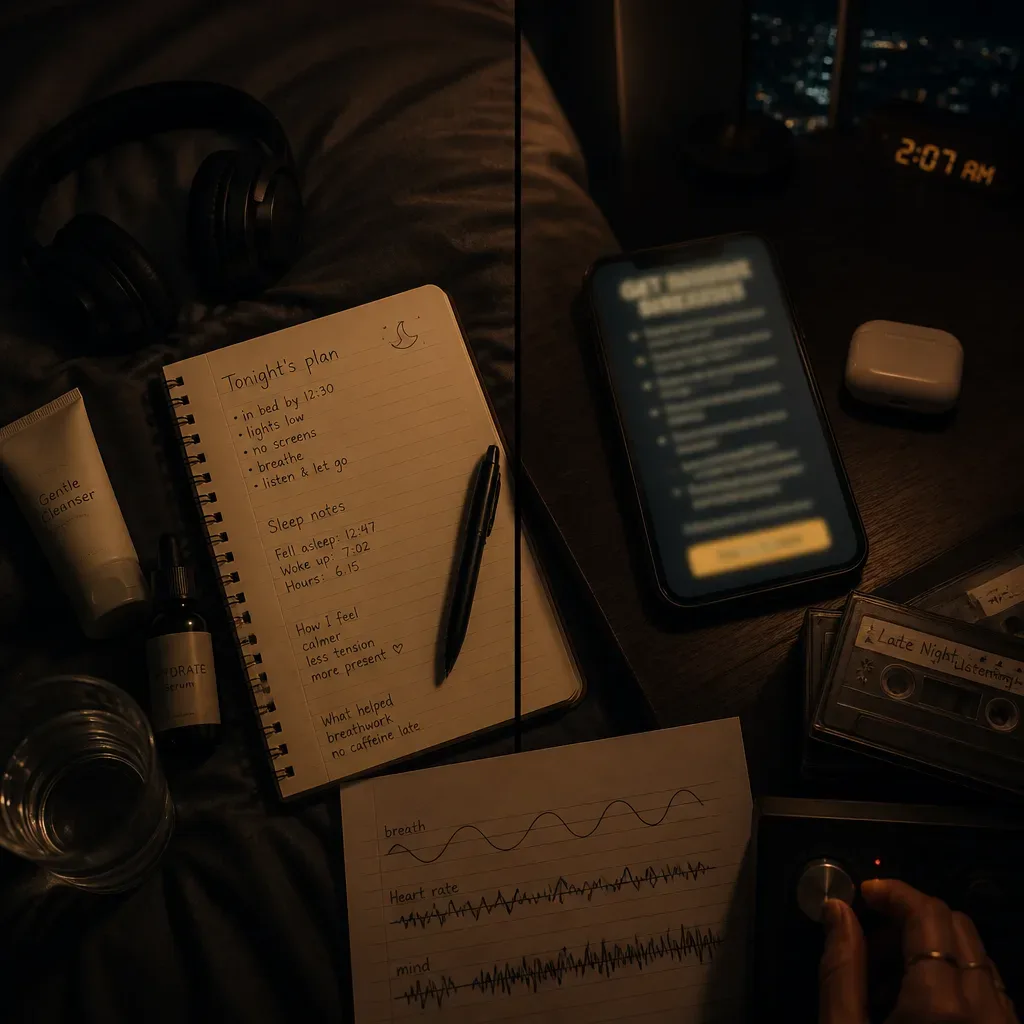
What can appearance subliminals realistically help with?
Appearance subliminals can help most when they support perception, routine, and self-treatment rather than promising new anatomy.
Think of the track as a nightly cue. A cue can point you toward small actions: washing your face, wearing sunscreen, drinking water, relaxing your shoulders, sleeping on time, or speaking to yourself with less cruelty. The Centers for Disease Control and Prevention notes that adults need 7 or more hours of sleep per night, and sleep loss can affect inflammation, mood, appetite, and decision-making. Better sleep won’t make a new jawline, but it can change how your face looks and how you meet the mirror.
The strongest case for this practice is not hidden messages. It is repetition before sleep. The last part of the evening is often where your mind repeats its own harsh script. A soft track can interrupt that loop. If the subliminal says, beneath the music, that you are allowed to care for your body without attacking it, the ritual may matter even if the masking is not the active ingredient.
The realistic benefits tend to fall into a few categories:
- Attention: you notice tension, posture, grooming, or picking habits sooner.
- Emotion: you approach the mirror with less panic.
- Consistency: you repeat simple care behaviors for 14 nights instead of 2.
- Sleep protection: you use audio as a boundary against scrolling.
- Self-talk: you hear fewer cruel sentences when the room gets quiet.
There are small studies on mental imagery and behavior showing that rehearsing a specific action can improve follow-through. Gollwitzer’s implementation intention research, published across many studies since the 1990s, shows that if-then plans can improve goal action. Appearance subliminals rarely use that structure, but you can choose tracks that do: If I see my reflection, I soften my jaw. If I get ready for bed, I care for my skin.
A nightly audio practice works best when it gives your hands something kinder to do in the morning.
How should you listen to appearance subliminals safely at night?
Listen in a way that protects sleep first: low volume, short sessions, clear wording when possible, and no checking ritual afterward.
Start with 20 to 45 minutes before sleep, not an all-night loop. The American Academy of Sleep Medicine’s adult recommendation is at least 7 hours per night, and sleep fragmentation can make mood and body image feel worse the next day. If audio wakes you, irritates you, or makes you dream tensely, shorten it or stop.
Use a volume you could ignore. If you can hear the music clearly but not strain for words, that is enough for a subliminal track. For audible tracks, the words should be soft and plain. Dr. Andrew Huberman often emphasizes stable sleep timing and light management before supplements or hacks; the same priority fits audio. Your track should serve your sleep schedule, not compete with it. The Sleep cycle calculator tool can help you choose a bedtime that doesn’t turn listening into a late-night bargain.
A simple 7-night test is better than a dramatic 90-day promise:
- Choose one track with non-cruel wording.
- Set a timer for 30 minutes.
- Put your phone face down and away from the pillow.
- Listen at a low, steady level.
- Do not check your face afterward.
- In the morning, note sleep quality from 1 to 5.
- After 7 nights, keep only what helped sleep or self-treatment.
The note matters. In psychology, self-report is imperfect, but it is not useless. A 1-to-5 rating over 7 nights gives you more information than one emotional mirror check at 1:00 a.m. If distress rises by 2 points or more, the audio is costing more than it gives.
If you already deal with insomnia, panic, eating restriction, or obsessive appearance checking, use extra caution. Sleep hygiene is not treatment. If sleep or body thoughts feel unmanageable, a qualified professional is the right next step.
Are appearance subliminals safe for body image?
They can be safe, but only when the content reduces obsession instead of feeding comparison.
The danger is not that a hidden sentence will take control of you. The danger is repetition of a narrow beauty standard at the exact hour when you are tired, suggestible, and alone with a screen. A 2022 review in Body Image reported consistent links between appearance-focused social media use and body dissatisfaction, especially when comparison is high. Audio can become part of the same pattern if it sends you back to checking, measuring, and searching.
Look at the promise in the title. Safe appearance subliminals usually sound ordinary: calm face, rested skin, gentle posture, I care for myself. Riskier ones promise a celebrity face, extreme body changes, instant weight loss, or permanent physical edits without action. The more exact and anatomical the promise, the less honest it usually is.
A good appearance track should leave you more at home in your body, not more suspicious of it. This is where audible content has an advantage. With Sleep affirmations pillar, you can hear every sentence and reject any line that turns care into punishment. With subliminals, you may need to read the posted script, if one exists. If no script exists, that is a reasonable reason to skip the track.
Use this quick filter:
| Keep listening if… | Stop listening if… |
|---|---|
| You sleep the same or better | You delay sleep to find better results |
| You feel calmer in the mirror | You check mirrors more often |
| The wording supports care | The wording insults your current body |
| The creator shares the script | The creator hides the script and promises drastic change |
Neville Goddard wrote about assuming the feeling of a wish fulfilled, and many listeners borrow that idea for sleep. Fine. But assumption should not become surveillance. You don’t need to inspect your face every morning to prove you listened correctly.
Are audible sleep affirmations or the AYA Method a better fit?
Audible sleep affirmations and personalized audio are often a better fit when you want clarity, consent, and a practice you can repeat without guessing.
A subliminal hides the words. That’s the whole trick, and the whole problem. If the script is loving and modest, hidden delivery may feel soothing. If the script is harsh, exaggerated, or body-shaming, the same hidden delivery keeps you from noticing what you are rehearsing. Supraliminal cues, meaning cues you can consciously hear or see, often perform better in applied self-help because you can understand and act on them.
The AYA Method is a daily audio manifestation practice. Each day you listen to a short personalized recording — your Dream-Self Moment — narrated from the version of you who has already manifested the life you intend. Listening is the practice. Repetition is the work. The audio is the method.
For appearance concerns, that difference is practical. Instead of a hidden sentence claiming a new face, a personalized recording can describe how you move through tomorrow: you rest, you dress without spiraling, you care for your skin, you meet your reflection without bargaining. The daily affirmation and Manifestation Board can support the practice, but the audio is the method.
This is not an argument that all subliminals are useless. It is an argument for knowing what you are feeding the night. In Greenwald’s 1991 tape study, people’s beliefs about which tape they had mattered. In sleep routines, that belief can become ritual. Ritual helps when it is clean, repeatable, and not built on fear.
If you prefer hidden audio, keep it transparent in another way: read the script first. If you prefer audible audio, keep it low and simple. Either way, the point is not to win an argument online. The point is to hear something at night that you can live with in daylight. You can compare both practices through the Subliminals pillar and the Sleep affirmations pillar before choosing.
The best night audio doesn’t make you chase a new body. It helps you stop treating the current one like an enemy.
What should you expect by week two?
By week two, expect changes in sleep rhythm, self-talk, and small care behaviors before you expect visible appearance changes.
Fourteen nights is long enough to notice patterns and short enough to avoid turning the practice into a belief test. Many habit studies find early consistency matters more than intensity. Phillippa Lally and colleagues reported in 2009 that habit formation took a median of 66 days, with wide variation from 18 to 254 days. So by week two, you are not looking for a finished result. You are looking for a direction.
Track the right things. Do not measure your face daily. Do not weigh yourself because a subliminal title promised a new body. Do not compare screenshots under different lighting. Instead, write down sleep quality, mirror distress, skincare consistency, posture awareness, and whether you checked results. Those measures are closer to what audio can plausibly affect.
A useful week-two review can be this plain:
| Question | Good sign | Warning sign |
|---|---|---|
| Did I sleep at least 7 hours most nights? | Yes, or closer than before | No, the audio kept me up |
| Did I check my appearance less? | Fewer checks | More checks |
| Did I care for my body more gently? | Small steady actions | Punishment or restriction |
| Did the track feel honest? | Calm and believable | Grand claims or fear |
If the practice helps you sleep and softens your self-talk, it may be worth keeping. If it makes you scan your face for evidence, let it go. Appearance subliminals are not a moral test. You are allowed to stop using anything that makes the room feel less safe.
For bedtime structure, pair the audio with a real sleep window using the Sleep cycle calculator tool. If you want words you can hear, move toward audible sleep affirmations or a personal recording. The night is suggestible, but it is also simple: lower the volume, choose the words, and protect the sleep.
Let the last thing you hear be something you don’t have to recover from in the morning.