subliminals
Bad Subliminals: 9 Red Flags Before You Press Play
Bad subliminals can hide unclear words, harsh claims, and sleep-disrupting audio. Learn 9 red flags to check before you press play tonight.
Bad subliminals are tracks you cannot reasonably trust: unclear scripts, extreme promises, harsh sound design, hidden pressure, or instructions that cost you sleep. Before you press play, check the words, the claim, the creator, the volume, and your own body’s response. If any part feels coercive, skip it.
What makes a subliminal bad before you even hear it?
A subliminal becomes risky when it asks for trust while giving you too little information.
A subliminal is usually an affirmation mixed below conscious hearing, often under music, rain, brown noise, or layered whispers. That is the whole trick, and the whole problem. The research base on subliminal priming is real but modest: controlled studies have found short-term effects on attention or choice, while large online claims often go far beyond those findings. A 2006 review in Current Directions in Psychological Science described priming effects as context-sensitive, not magic.
That difference matters at night. Before sleep, you are tired, less analytical, and more willing to repeat what feels soothing. Sleep researchers often describe the first stage of sleep as light and unstable; the American Academy of Sleep Medicine divides sleep into N1, N2, N3, and REM, with N1 acting as the thin border where outside sound can still enter awareness. The last ten minutes before sleep are suggestible. Choose what goes in.
Bad subliminals tend to share one pattern: they replace consent with mystery. They ask you to listen for 21, 30, or 90 days, but they do not show the script. They promise results by a specific date, but they do not define the method. They tell you not to question the audio, which is a strange thing for any trustworthy practice to ask.
A track that asks for your trust should give you its words.
Here are the 9 red flags this guide will use:
- No transcript or affirmation list.
- Claims of guaranteed, overnight, or medical results.
- Instructions to listen all night despite poor sleep.
- Fear-based warnings if you stop listening.
- Painfully loud, distorted, or startling audio.
- Anonymous creators with no method notes.
- Hidden negative wording or aggressive phrasing.
- Body-changing promises aimed at insecurity.
- Comments that report anxiety, headaches, or sleep loss without creator response.
If you want a broader map of the category, keep the Subliminals pillar open while you vet a track. It helps separate ordinary subliminal audio from claims that should stay out of your ears.
Which missing details are red flags?
Missing details are red flags when they stop you from giving informed consent.
The first missing detail is the script. If the creator says the words are secret because secrecy makes them work better, be careful. In clinical hypnosis and guided relaxation, scripts are often reviewed, adapted, or at least described before use. Even in research on suggestion, the wording matters. A sentence like I am safe in my own body is not the same as I cannot fail, I must change, or I hate my old self.
The second missing detail is volume. Safe sleep audio should sit low enough that you can ignore it. The World Health Organization’s 2018 environmental noise guidelines note that night noise can affect sleep, and many sleep clinicians suggest keeping bedroom sound steady and quiet. A track with sudden volume jumps, sharp whispers, or piercing frequencies is asking your nervous system to guard the room.
The third missing detail is authorship. You do not need a creator to have a PhD, but you do need some sign of care: a description, a transcript, a recording note, a content warning, or a way to contact them. YouTube has reported more than 500 hours of video uploaded per minute in recent years. That scale means a beautiful thumbnail tells you almost nothing.
| Red flag | Why it matters | Safer sign |
|---|---|---|
| No script | You cannot approve the message | Full affirmation list |
| Secret formula | It blocks consent | Clear method notes |
| Loud mix | It can disturb sleep | Low, steady audio |
| Anonymous upload | No accountability | Named creator or site |
| Fixed deadline | Raises pressure | Gentle repetition |
A trustworthy subliminal does not need to hide its ethics. It can say what it is trying to do, what it is not trying to do, and how you should stop if it does not suit you.
What claims should make you stop immediately?
Stop when a subliminal promises guaranteed results, medical changes, body changes, or control over another person.
The claim is often louder than the audio. Bad subliminals use deadlines because deadlines create urgency: listen once and wake up different, change your face in 24 hours, make someone text you tonight, cure anxiety while you sleep. Those lines may sound common online, but common is not the same as careful. The U.S. Federal Trade Commission has long treated health and body claims as needing evidence, and sleep audio is not exempt from basic honesty just because it is pretty.
Medical claims are the cleanest no. If a subliminal says it treats depression, trauma, chronic pain, eating disorders, or insomnia, step away. Audio can support relaxation, and relaxation can be useful, but it is not a substitute for care. If insomnia lasts or affects daily life, speak with a qualified clinician.
Control claims are another no. A track that says it can make a specific person love you, obey you, or return to you is not a healthy night practice. Neville Goddard wrote often about assumption and inner speech, and many listeners borrow his language, but even generous readings of manifestation traditions do not require hidden audio aimed at another person’s will. Your sleep should not become a rehearsal for possession.
Body-change claims deserve special caution because they often speak directly to shame. Teen listeners are part of this audience; Pew Research Center reported in 2023 that YouTube is used by 93% of U.S. teens. That means any public subliminal promising a smaller waist, different bones, or a new eye color is probably reaching people who are still forming a relationship with their bodies.
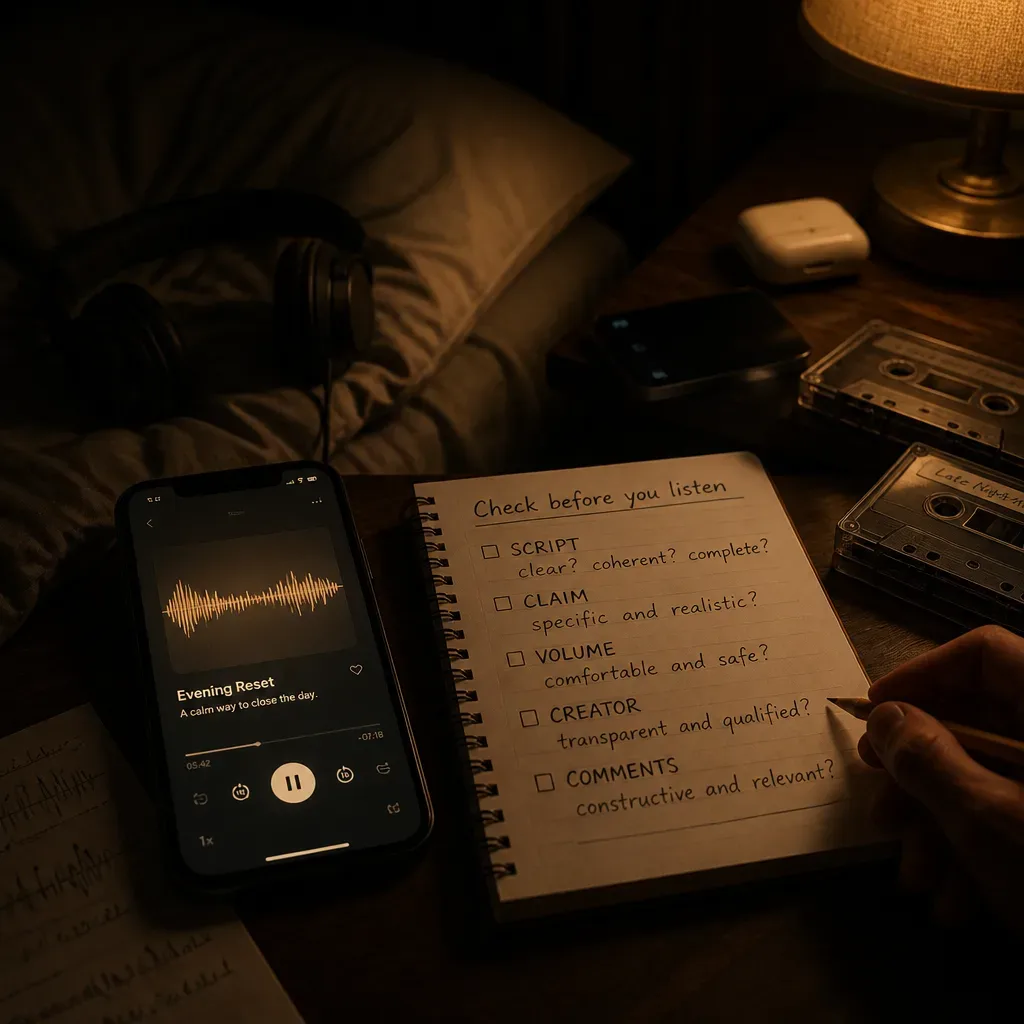
Use this simple rule: the more dramatic the promise, the more ordinary the evidence should be. If the evidence is only comments, screenshots, and pressure to believe harder, do not bring it to bed.
Can bad subliminals disturb sleep even if the words are harmless?
Yes, bad subliminals can disturb sleep through sound design, timing, volume, and repetition alone.
The words may be fine and the track may still be wrong for night. Your sleeping brain keeps listening for threat. That is why a quiet fan can disappear while a small unfamiliar noise wakes you. A 90-minute sleep cycle is a useful rough guide, though individual cycles vary; if audio wakes you between cycles or during lighter N1 and N2 sleep, the cost can show up as grogginess, irritability, or dread the next night.
All-night looping is the usual problem. Some creators tell you that more hours means faster results, but sleep is not an empty storage room for affirmations. Dr. Andrew Huberman has often noted, in public sleep education, that consistent timing, light exposure, and sleep quality are basic levers for mental and physical functioning. A track that keeps you half-alert for eight hours is competing with the very state it claims to use.
Volume is the next problem. If you can hear the hidden whispers clearly enough to decode them, the track is not really subliminal. If you turn the track up to force the message in, you may make the masking audio too loud. A practical night range is simple: set the volume low enough that you can still hear your own breathing and would not need to raise your voice to speak over it.
Watch for these body signs during week one:
- You wake more than usual.
- You feel tense when the track starts.
- You keep checking whether it is working.
- You wake with a headache after louder mixes.
- You feel afraid to skip a night.
If a method costs you sleep, it costs more than it gives.
Use the Sleep cycle calculator tool if you are trying to place audio before a realistic bedtime instead of letting a playlist run until morning. Put the practice before sleep, not across the whole night.
How can you vet a subliminal in five quiet minutes?
You can vet a subliminal quickly by checking the script, claim, sound, creator, and your own first response.
Do it in daylight if you can. Night makes everything feel more persuasive. A small 2018 study line of work on sleep and emotional regulation suggests poor sleep can increase next-day reactivity, and you do not need a lab to know that 1 a.m. is not the best hour for judgment. Give the track five minutes when you are awake enough to say yes or no.
Here is the five-minute check:
- Read the description. Look for a full affirmation list, not just aesthetic words.
- Search the claim. If it promises a fixed result in 24 hours, close it.
- Sample the audio at low volume. Listen for harsh peaks, sudden sounds, or unease.
- Check the creator. Look for method notes, age warnings, and contact details.
- Read the newest comments. One headache comment is not proof, but repeated sleep-loss comments matter.
- Notice your body. If your chest tightens before you even begin, respect that.
A good track survives ordinary questions. A bad one needs you tired, hurried, and afraid of missing out.
Compare the track with audible practices too. Sleep affirmations pillar explains how plain spoken sentences work before bed. Audible affirmations are not automatically better, but they are easier to approve because you can hear the exact language. If you want hidden audio, you should be even more strict, not less.
Keep a short log for the first 7 nights. Rate sleep from 1 to 5, note wake-ups, and write one sentence about mood the next morning. That is not clinical data, but it is better than guessing. If the track is useful, your life should feel quieter, not more monitored.
What should you choose instead of bad subliminals?
Choose audio with clear words, gentle pacing, modest claims, and a stopping point you control.
For some people, that will still be a subliminal. Fair enough. Look for transparent creators, posted scripts, soft masking sound, and claims limited to rehearsal: confidence, calm self-talk, study focus, or a kinder inner voice. In behavioral research, repetition and implementation intentions have better support than hidden-word certainty; Peter Gollwitzer’s work on if-then planning, for example, has been cited for decades because repeated cues can shape action without pretending to bypass consent.
For others, audible sleep audio will be better. A spoken affirmation, sleep hypnosis script, or body scan gives your mind something simple to follow as it drops. The boring script often beats the dramatic one because the nervous system does not need theater at midnight. It needs safety, rhythm, and a sentence it can return to without bracing.
This is also where the AYA Method sits close to the topic. The AYA Method is a daily audio manifestation practice. Each day you listen to a short personalized recording — your Dream-Self Moment — narrated from the version of you who has already manifested the life you intend. Listening is the practice. Repetition is the work. The audio is the method.
The difference is simple: with the AYA Method, you can hear every word, and the voice is yours. That does not make it a medical tool, and it does not mean one night changes everything. It means the practice removes the main trust problem found in bad subliminals. You are not guessing what the sentence says. You are returning to a chosen script.
A daily affirmation or Manifestation Board can support that practice, but they are complements. The audio is the method. If you already use sleep affirmations, you will recognize the value of repetition before sleep; if you use subliminals, you may notice how different it feels when the words are no longer hidden.
What should you do if a subliminal already made you uneasy?
Stop the track, return to plain sleep hygiene, and do not treat fear as proof that the audio worked.
This part needs to be said softly. Many listeners get frightened after a bad subliminal because comment sections teach them to interpret every headache, dream, or mood shift as a sign. But ordinary causes exist. You may have slept badly. The track may have been too loud. You may have read alarming comments at midnight. The nocebo effect, where negative expectations can create real discomfort, is documented in medical literature; expectation is not fake just because it begins in thought.
For the next two nights, remove suggestion audio. Use rain, a fan, silence, or a familiar relaxation recording with no hidden layer. Keep caffeine within your usual limits; the FDA notes that about 400 mg per day is an upper amount not generally associated with dangerous effects for many adults, but sensitivity varies, and late caffeine can still disturb sleep. Keep the fix boring.
If you want a reset script, use something plain:
- I choose what I listen to.
- I can stop any audio that does not suit me.
- My sleep does not need to prove anything.
- Tonight can be simple.
The safest subliminal is the one you can turn off without fear.
If worry keeps returning, talk to someone grounded: a friend, therapist, doctor, or sleep professional. Do not ask a comment section to diagnose you. You are allowed to leave a practice because it feels wrong, even if other people praise it.
Tonight, let the words be few, clear, and yours.