subliminals
Binaural Beats vs Subliminals: Which Sleep Audio Fits?
Binaural beats vs subliminals for sleep: compare sound, evidence, volume, timing, and when each bedtime audio practice makes more sense.
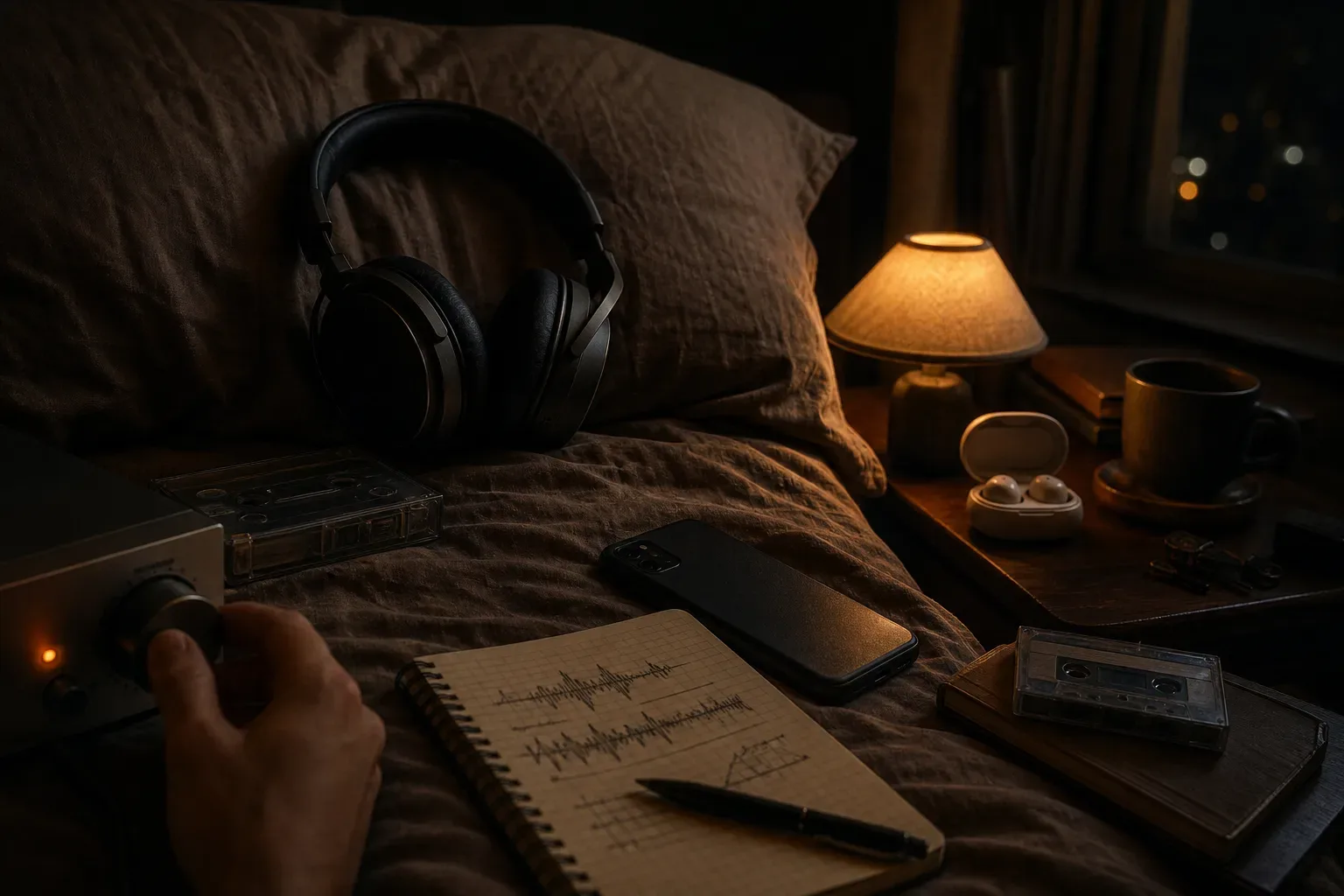
Binaural beats vs subliminals comes down to what you want the audio to do: guide your nervous system with rhythm, or repeat a message near the edge of awareness. For sleep, binaural beats are simpler sound design. Subliminals are language practice. Both can help, but neither should cost you rest.
What is the real difference between binaural beats and subliminals?
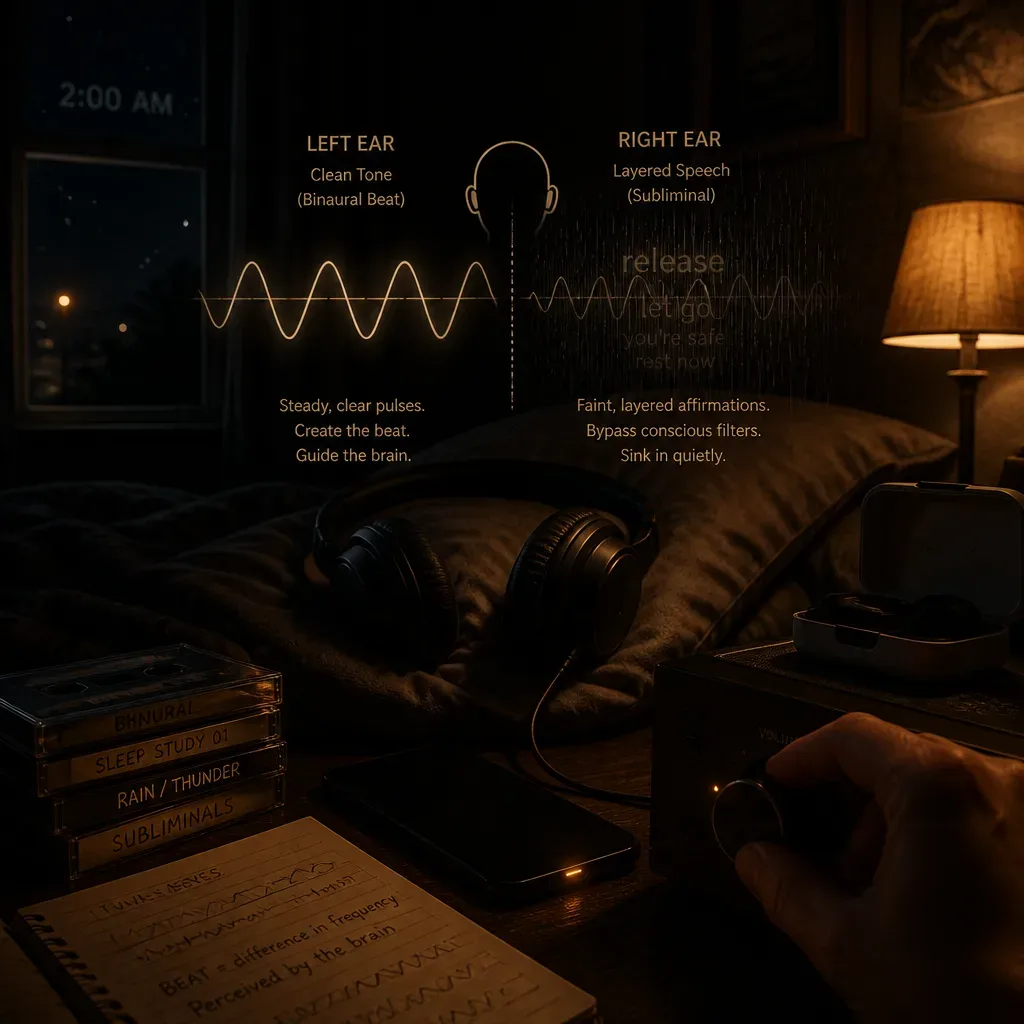
Binaural beats use two tones to create a perceived rhythm, while subliminals hide or soften words under sound.
A binaural beat is made when each ear hears a slightly different frequency. If your left ear hears 200 Hz and your right ear hears 210 Hz, you may perceive a 10 Hz beat. Heinrich Wilhelm Dove described the effect in 1839, and modern labs still use this basic setup. Headphones matter because the two ears need separate signals.
A subliminal is different. It is speech or a message placed below conscious recognition, often under rain, music, brown noise, or another mask. I define it more fully in the Subliminals pillar, but the plain version is this: a subliminal is an affirmation you can’t clearly hear. That’s the whole trick, and the whole problem.
A binaural beat asks your brain to follow a rhythm; a subliminal asks your mind to keep company with words it barely hears. One is mostly timing and frequency. The other is language and suggestion. That difference matters at 11:40 p.m., when your attention is thin and your body is already negotiating with sleep.
Here is the clean comparison:
| Feature | Binaural beats | Subliminals |
|---|---|---|
| Main ingredient | Two tones, one per ear | Masked or very quiet speech |
| Usually needs headphones | Yes | Not always |
| Best bedtime use | Steady focus, wind-down sound | Repeated intention, identity rehearsal |
| Evidence type | Auditory entrainment studies, mixed results | Subliminal priming studies, modest effects |
| Main risk | Annoying tone, headphone discomfort | Unclear claims, too-loud masking |
The best sleep audio is the one you can repeat without bargaining with the night.
What does the evidence actually say?
The evidence for both is real but modest, and it doesn’t support the biggest claims you may see in playlists.
For binaural beats, a useful reference is the 2019 meta-analysis by Garcia-Argibay, Santed, and Reales in Psychological Research. It reviewed 22 studies and found that binaural beats had small to moderate effects on memory, attention, anxiety, and pain perception, with results depending on frequency, duration, and when the beats were played. That is interesting. It is not a guarantee that a 528 Hz thumbnail will fix your sleep.
For subliminals, the science is older and narrower. Greenwald, Spangenberg, Pratkanis, and Eskenazi published a well-known 1991 study on subliminal self-help tapes. People often reported improvement, but the label on the tape shaped the report more than the actual content did. In plain language: expectation mattered. The hidden message itself did not carry the result in the clean way sellers claimed.
That does not mean subliminals are useless. Karremans, Stroebe, and Claus showed in 2006 that subliminal brand priming could influence drink choice, but mainly when people were already thirsty. Context mattered. Need mattered. The effect was not a remote control. Hidden words can be soothing, but hidden evidence shouldn’t be.
Sleep research adds another boundary. The American Academy of Sleep Medicine recommends 7 or more hours of sleep for most adults, and the National Sleep Foundation usually names 7 to 9 hours as the adult range. If your audio practice shortens that window, the practice is taking from the very thing it claims to serve. If a method costs you sleep, it costs more than it gives.
Expectation is not fake; it is part of how ritual gets into behavior. The honest question is not only, did the hidden stimulus work? It is also, did the nightly repeatable cue help you settle, choose better thoughts, and stay off the bright phone for 20 minutes?
Which one fits sleep better at night?
Binaural beats usually fit sleep better when you want less language, while subliminals fit when you want a phrase repeated without active effort.
At night, your brain is not a productivity machine. It is trying to lower arousal. A 2020 review in Frontiers in Human Neuroscience noted that auditory stimulation can influence brain activity, but results vary by protocol and person. That variability matters. One listener relaxes with a 6 Hz theta beat. Another hears the same pulsing tone and gets irritated by minute 3.
Subliminals have a different bedtime problem. If the words are truly inaudible, you may wonder whether anything is happening. If the words are too audible, you may start listening for grammar, tone, and meaning. That mental checking can keep you awake. The last ten minutes before sleep are suggestible. Choose what goes in.
For sleep, I would sort the choice by the job you need done:
- Choose binaural beats if you want a neutral sound bed with no message to follow.
- Choose subliminals if you want repeated language but don’t want to consciously recite it.
- Choose audible sleep affirmations if you want to hear the words clearly and decide whether you accept them.
- Choose silence if every track makes you monitor your body too closely.
If you use either format, start with 20 to 30 minutes, not 8 hours. A sleep cycle averages about 90 minutes, and you can plan your bedtime around that with the Sleep cycle calculator tool. Audio should support the window you already need, not become another thing to manage.
I am careful with insomnia language here. If sleeplessness is persistent, severe, or tied to distress, get support from a qualified clinician. Bedtime audio is sleep hygiene, not medical care.
How should you choose if your goal is affirmations or manifestation?
If your goal is language, identity, or manifestation practice, audible personal audio is clearer than either hidden speech or abstract beats.
Subliminals sit close to affirmations because both depend on repeated words. The difference is whether you can hear and evaluate them. I keep returning to that point because consent matters, even when the speaker is you. You can read the longer guide to sleep affirmations if you want a bedtime version that keeps the words plain.
This is where the AYA Method is useful to compare fairly. The AYA Method is a daily audio manifestation practice. Each day you listen to a short personalized recording — your Dream-Self Moment — narrated from the version of you who has already manifested the life you intend. Listening is the practice. Repetition is the work. The audio is the method.
That is not the same as a subliminal. You can hear every word. The recording is personal. The practice does not rely on sneaking a message past awareness. The daily affirmation and Manifestation Board can complement it, but they are not the pillars. The listening is the thing you return to.
Here is a practical way to decide:
- If you want no words, choose binaural beats or simple noise.
- If you want hidden words, choose subliminals and keep the claims modest.
- If you want clear words before sleep, choose audible affirmations or a personal recording.
- If you want a daily manifestation practice built around audio, choose the AYA format and listen consistently.
Joe Dispenza, Neville Goddard, and many modern teachers place heavy weight on rehearsal before sleep. The research language would be more cautious: repeated cues can shape attention, expectation, and behavior over time. Both sentences can sit in the same room without fighting.
What should your bedtime audio setup sound like?
Your setup should be quiet, short, repeatable, and boring enough that your body trusts it.
Start with volume. The World Health Organization has warned that regular exposure above 80 to 85 dB can put hearing at risk, especially with headphones. Sleep audio should be far lower than commuting audio. If you can hear your room, your breath, or a door click, the track is more likely to stay in a sleep-safe range.
Second, decide whether headphones are worth it. Classic binaural beats need headphones because each ear receives a different tone. Subliminals do not always need them, though headphones can make the masking more consistent. Many people remove headphones during the night. If that wakes you at 2:13 a.m., the method is creating a new problem.
Third, keep the timing modest for the first 7 nights. Play the track for 20 to 45 minutes. Notice sleep onset, morning grogginess, dreams, and whether you dread pressing play. Dr. Andrew Huberman often talks about light, temperature, and timing as levers for sleep; audio belongs beneath those basics, not above them.
A simple 7-night test works better than guessing:
| Night range | What to test | What to notice |
|---|---|---|
| Nights 1 to 3 | Binaural beat or neutral sound | Does the tone calm you or annoy you? |
| Nights 4 to 6 | Subliminal or soft affirmations | Do words make you settle or think harder? |
| Night 7 | Silence or your preferred track | Which condition gave you the least friction? |
You can also read about sleep hypnosis if you prefer a guided voice rather than hidden speech or tones. A guided track gives the mind a handrail. A subliminal gives it a shadow. A binaural beat gives it a pulse.
When should you avoid or stop either one?
Stop any sleep audio that makes you alert, anxious, dependent, or short on sleep.
This is the part many playlists skip. A track can be beautiful and still be wrong for your nervous system. If you start checking whether the subliminal is working, counting beats, chasing tingles, or restarting the audio after every waking, the practice has become a task. Sleep does not like tasks.
There are also practical safety limits. Do not use sleep headphones in a way that blocks alarms you need to hear. Do not play tones loudly to make them feel more effective. Do not use a track with frightening phrases, aggressive masking, sudden volume changes, or claims that make you feel broken without it. The U.S. Centers for Disease Control and Prevention notes that about 1 in 3 adults report not getting enough sleep. That number is already high; your audio should not add pressure.
Be extra cautious if you have tinnitus, seizure history, panic symptoms, or sound sensitivity. The evidence base for binaural beats in those cases is not strong enough for casual promises. Ask a clinician if you are unsure. The same goes for severe insomnia, trauma-linked sleep fear, or nights when you feel unsafe in your body.
A good sleep practice makes the next right action easier. It does not demand loyalty. If a subliminal helps for 2 weeks and then starts to feel noisy, pause it. If binaural beats work only on Sunday nights, use them on Sunday nights. Consistency is useful, but obedience is not required.
So which sleep audio fits you tonight?
Choose binaural beats for rhythm, subliminals for hidden language, and audible personal audio when you want to hear exactly what you are practicing.
If your mind is full of words, a wordless binaural or brown-noise track may be kinder. If your room feels too quiet and your thoughts get sharp, a soft masked subliminal may give you a small ritual to lean on. If you are working with belief, identity, or manifestation, I would rather you hear the words clearly than hope a hidden message is doing secret work.
The difference is not only technical. It is ethical and practical. You deserve to know what you are listening to before sleep. You also deserve to keep the small rituals that genuinely help, even when the lab effect is smaller than the playlist title suggests.
A final rule helps: run any track through the morning test. After 7 nights, ask 3 questions. Did I fall asleep with less struggle? Did I wake with less resentment? Did I keep enough hours in bed? If the answer is yes, the audio fits for now. If the answer is no, change the track, shorten the timer, or return to silence.
For a broader map of hidden-message listening, start again with the Subliminals pillar. For clear spoken words, use sleep affirmations. For timing, use the sleep calculator. For personal daily audio, keep the AYA Method in its proper place: listening first, repetition daily, the voice yours.
Let the last sound of the night be one you do not have to chase.