subliminals
Confidence Subliminals: Build 3-Minute Audio
Learn how confidence subliminals work, how they differ from audible Dream-Self audio, and how to build a clear 3-minute track for night listening.
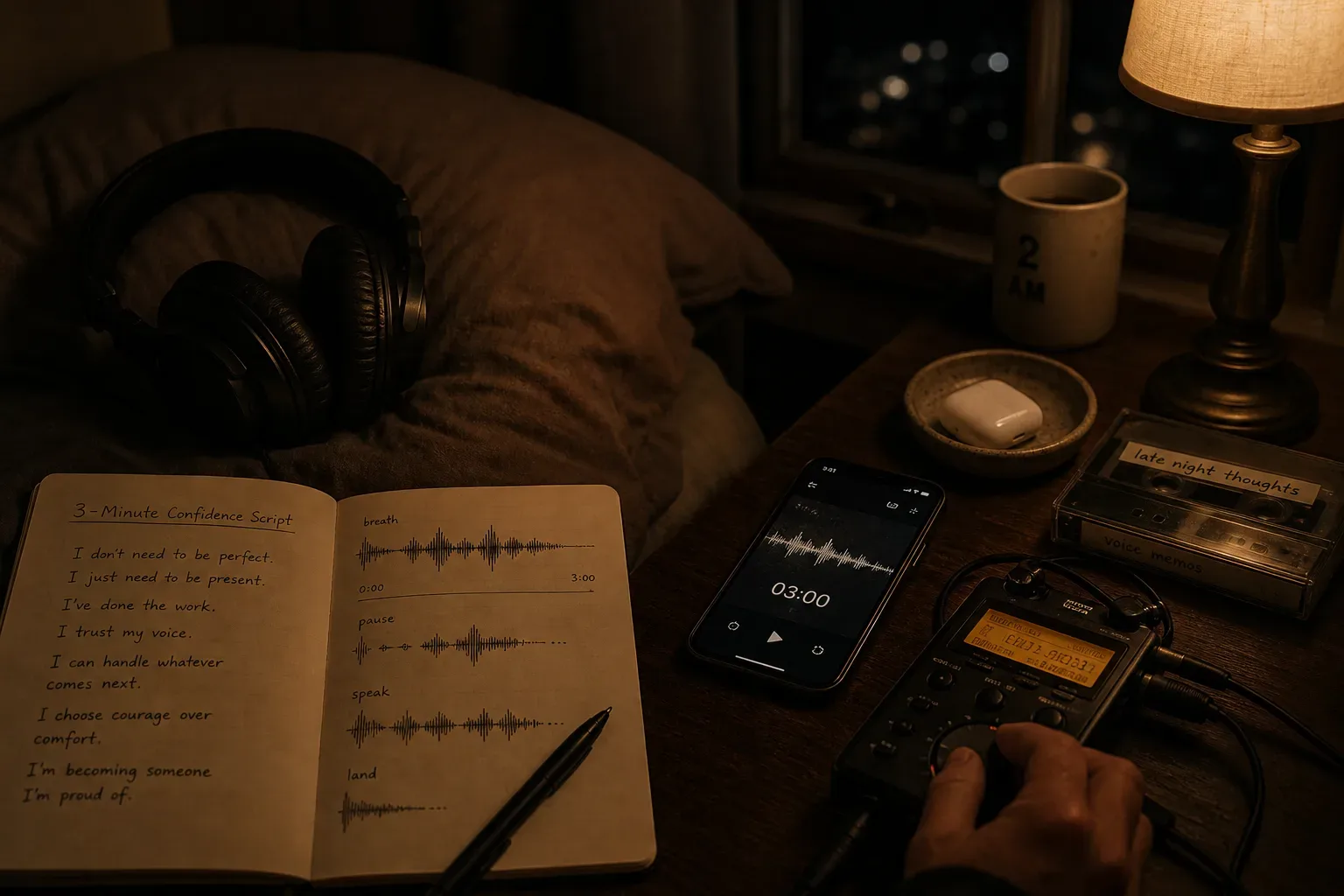
Confidence subliminals are audio tracks that repeat confidence-based statements beneath sound, often too low to hear clearly. To build a better 3-minute version, write one specific Dream-Self scene, record it in your own voice, keep the words audible, and listen nightly at a low volume for 14 days.
What are confidence subliminals actually doing?
Confidence subliminals are trying to pair repeated self-belief language with a relaxed listening state, usually by hiding the words under music, rain, or noise.
The audio trick is simple. A producer records a spoken script, lowers it by 15 to 35 dB, then places a louder bed over it. Sometimes the voice is still faintly there. Sometimes a spectrum analyzer shows no usable speech at all. A subliminal is an affirmation you cannot consciously hear; that is the whole trick, and the whole problem.
The research nearby is real but modest. Psychological priming studies show that cues can shape attention and behavior under certain conditions, yet the large replication debates of the 2010s made careful researchers much more cautious. A YouTube title claiming overnight confidence is not the same thing as a controlled study with a measured outcome.
Sleep matters here because the last minutes before bed are already full of repetition. The National Sleep Foundation often describes adult sleep need as 7 to 9 hours, and most sleep cycles run close to 90 minutes. If a track helps you settle without stealing sleep, it may be useful as a ritual. If it keeps you checking results at 2:13 a.m., it has already cost too much.
For a deeper technical map of hidden-audio claims, start with the Subliminals pillar. My bias as an engineer is plain: respect the listener’s ear, and label what is on the tape. Hidden words can be artful. Hidden claims need better receipts.
What should a 3-minute Dream-Self confidence track include?
A good 3-minute track should include one scene, one voice, one emotional posture, and no more than a few repeated phrases.
Three minutes is 180 seconds. At a slow bedtime pace of 90 to 120 words per minute, that gives you about 270 to 360 words. That is not enough room for every goal you have. It is enough room for one clean rehearsal: walking into a meeting, making eye contact, asking a direct question, or ending a conversation without apologizing three times.
This is where I prefer audible Dream-Self audio over a traditional masked subliminal. The AYA Method is a daily audio manifestation practice. Each day you listen to a short personalized recording — your Dream-Self Moment — narrated from the version of you who has already manifested the life you intend. Listening is the practice. Repetition is the work. The audio is the method.
That definition matters because your daily affirmation and Manifestation Board can support the practice, but they are not the core. The core is hearing the recording. In a confidence track, the audible voice gives you quality control: you know whether the script is kind, believable, and specific.
| Track part | Length | Purpose |
|---|---|---|
| Opening breath cue | 10 seconds | Tell the body it is safe to listen |
| Dream-Self scene | 90 seconds | Place confidence in one ordinary moment |
| Repeated lines | 45 seconds | Let 2 or 3 phrases return softly |
| Closing cue | 35 seconds | Leave the mind with a simple instruction |
The best confidence line is not loud. It is repeatable. If you cannot hear yourself saying it on a Tuesday afternoon, it probably does not belong in your night audio.
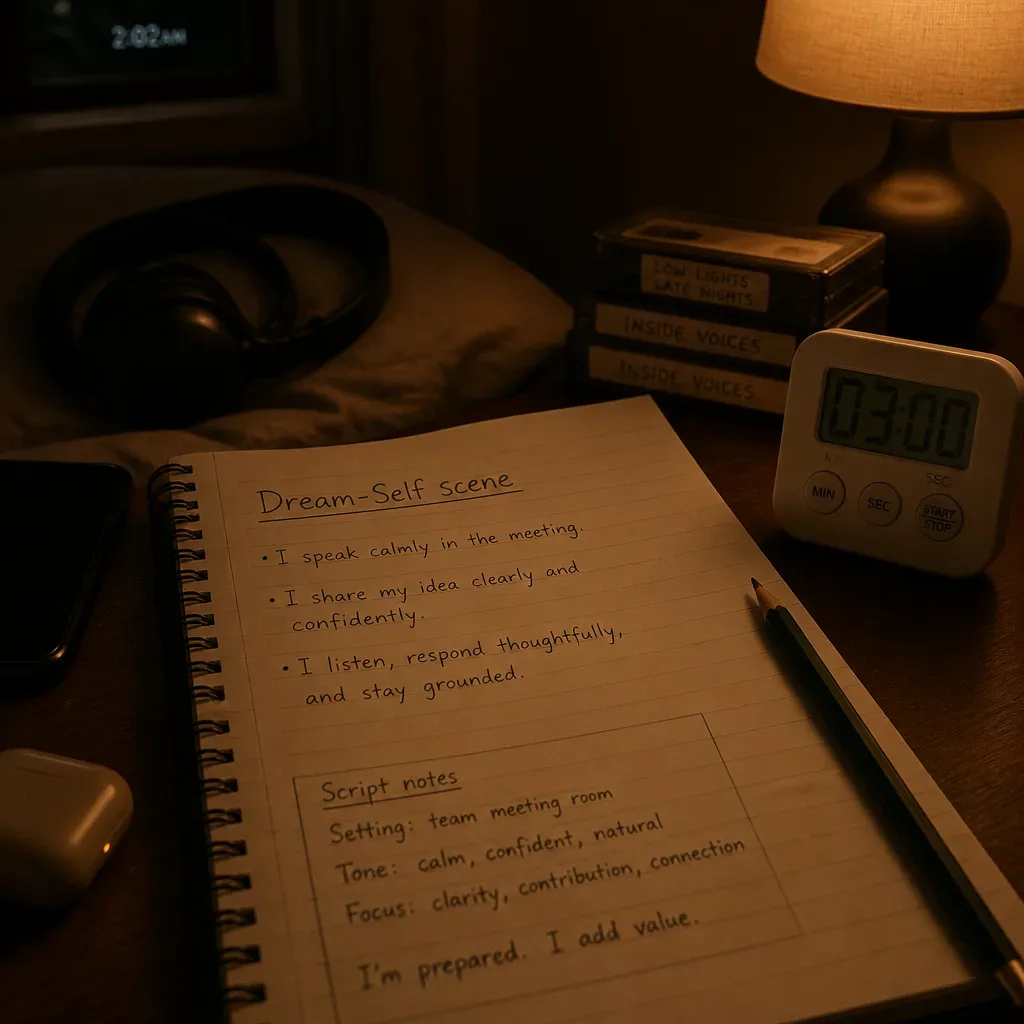
How do you write the script so it does not sound fake?
Write the script as a specific present-tense scene, using plain words you would not be embarrassed to hear twice a day.
Start with behavior before belief. Instead of writing, I am fearless, write, I pause before I answer, and my voice stays even. The second line gives your nervous system an action. It is smaller, but it is more usable. Wood, Perunovic, and Lee reported in Psychological Science in 2009 that very positive self-statements could make some low self-esteem participants feel worse, which is a useful warning for anyone writing confidence copy at midnight.
Use this 6-step script draft:
- Name the scene in one sentence: I am standing at the doorway before the meeting.
- Add one body cue: My shoulders drop, and my jaw loosens.
- Add one behavior: I speak at my normal pace.
- Add one boundary: I do not rush to soften every sentence.
- Add one proof from real life: I have handled hard conversations before.
- End with a line you can carry: I can be calm and still be clear.
Keep the grammar close. First person works because you are recording for yourself. Second person can work if your own voice saying you feels more tender than I. Try both for 20 seconds, then keep the one that your body resists less.
For comparison, Sleep affirmations pillar covers the broader practice of spoken lines before bed. Confidence subliminals sit next to that practice, but a Dream-Self script is more like a short scene than a list of slogans. A scene gives the mind somewhere to stand.
How do you record and mix it without burying the words?
Record close, speak slowly, and mix the background at least 10 dB quieter than the voice if you want a usable sleep track.
Your phone is fine. Put it on a folded shirt, switch off fans if you can, and sit 6 to 10 inches from the microphone. Most phone mics get harsh when you speak too close, especially on p and s sounds. Do one full take even if you stumble. Then record a second take. Two takes often beat 20 because your voice stays human.
Here is the basic engineering chain I use for a simple confidence audio:
- Trim long silences and mouth clicks only when they distract.
- Use gentle noise reduction if the room hum is obvious.
- Add light compression, around 2:1, if the quiet words vanish.
- Roll off low rumble below about 80 Hz.
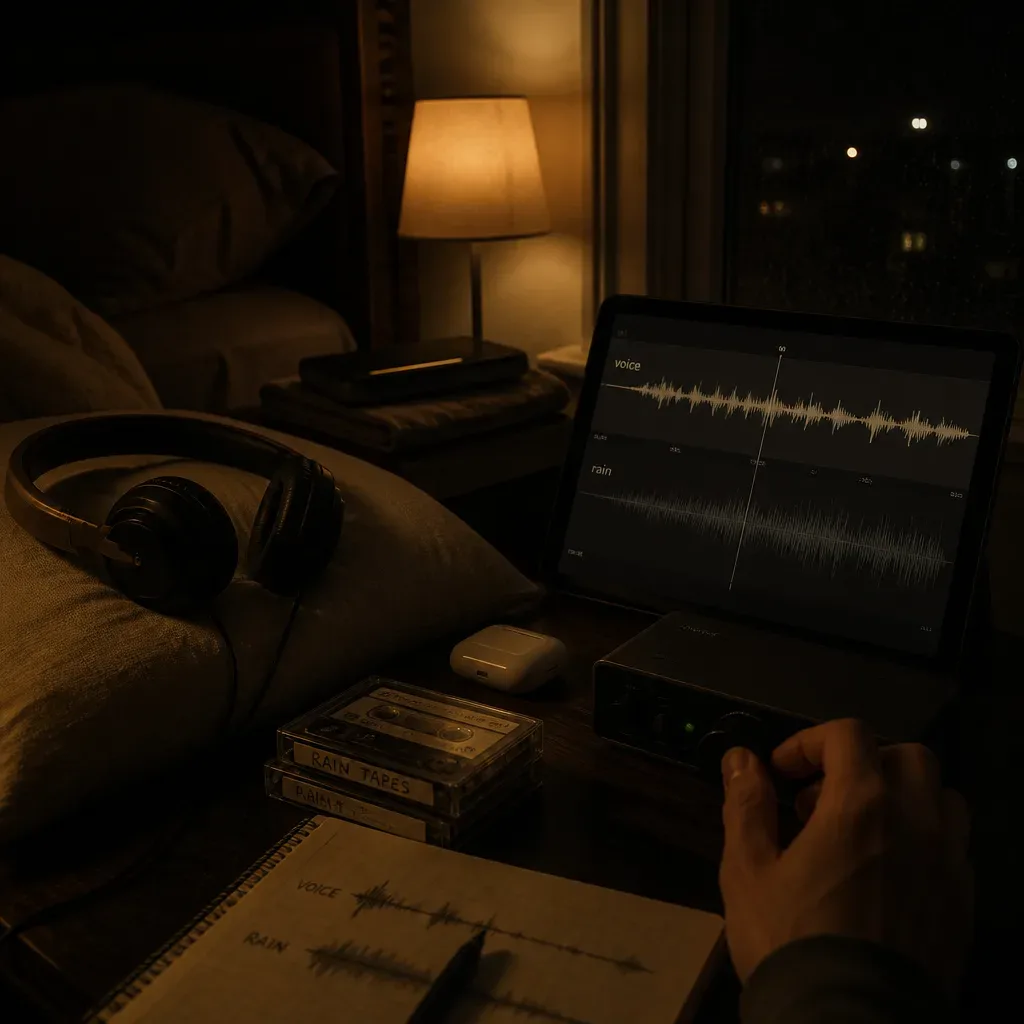
- Keep rain, brown noise, or music below the voice, not on top of it.
- Export as WAV if you are archiving, or high-quality AAC or MP3 for phone playback.
Do not chase ultrasonic tricks. Many adults cannot hear much above 16 kHz to 18 kHz, and many consumer speakers barely reproduce clean audio there. A claim about 17,500 Hz confidence messages should make you ask two questions: can the speaker play it, and can the ear use it? Often the answer to at least one is no.
Volume is the quiet safety issue. The World Health Organization has warned about unsafe listening levels, and its safe listening guidance often uses 80 dB for 40 hours per week as a reference point for adults. Bedtime tracks should sit far below anything that feels loud. If you use earbuds, keep one ear free or use a pillow speaker, especially if pressure or cables disturb sleep.
Quiet audio is not weak audio. It is audio that knows its job.
When should you listen, and for how many nights?
Listen once at night, low enough to ignore, for 14 nights before you decide whether to rewrite the track.
The last 10 minutes before sleep are suggestible because they are repetitive, dim, and low-friction. That does not make them magical. It makes them worth protecting. Play the track after your alarm is set, lights are low, and the room is already doing most of the work. If you need help timing bedtime, the Sleep cycle calculator tool can help you plan around 90-minute cycles instead of guessing.
A simple 14-night test is long enough to notice patterns and short enough that you will not over-edit forever. Habit research by Lally and colleagues in the European Journal of Social Psychology in 2009 found that automaticity varied widely, from 18 to 254 days depending on the behavior. So two weeks is not a promise. It is a clean listening window.
Use this small tracking method:
| Night | What to note in 20 seconds |
|---|---|
| 1 to 3 | Did the volume disturb sleep? |
| 4 to 7 | Which line did you remember in the morning? |
| 8 to 11 | Did one behavior show up during the day? |
| 12 to 14 | Does the script still feel honest? |
If the track makes you alert, move it earlier by 20 minutes. If it makes you sad or tense, change the wording. If insomnia is persistent or worsening, speak with a qualified clinician. A method that costs you sleep costs more than it gives.
How do confidence subliminals compare with audible Dream-Self audio?
Subliminals hide the words to lower resistance, while audible Dream-Self audio lets you inspect and repeat the words on purpose.
Both formats use repetition. Both can be paired with rain, music, or silence. Both often live in the same nighttime slot. The difference is consent at the level of the sentence. With an audible track, you can catch a phrase that feels false, too grand, or too sharp. With a masked subliminal, you are trusting the maker, the mix, and the platform compression.
Compression matters. YouTube, TikTok, and streaming platforms change uploaded audio through loudness normalization and codecs. A voice tucked barely under rain can smear, pump, or disappear after upload. In studio terms, a hidden layer that survives export may not survive distribution. That is one reason I would rather give you a clear 3-minute file than a mystery file with a dramatic title.
Use this comparison before you choose:
| Format | Best use | Main risk |
|---|---|---|
| Masked confidence subliminal | Low-attention listening under sound | You may not know what is spoken |
| Audible sleep affirmation | Simple repeated statements | Can feel flat or generic |
| Dream-Self audio | A personal scene in your own voice | Requires honest writing and recording |
If you still like subliminals, keep them. Just choose makers who publish scripts, label frequencies, and avoid medical claims. The Subliminals pillar is a good place to check the terms, and the Sleep affirmations pillar can help if you decide you want the words above the waterline.
What should you expect by week two?
By week two, expect the track to feel familiar and one or two lines to become easier to recall during ordinary moments.
That is the honest target. Not instant confidence. Not a new personality by Friday. Familiarity is useful because the brain spends less effort rejecting a sentence it has heard 14 times in the same calm setting. In small studies on mental rehearsal and implementation intentions, specific cues often work better than broad wishes; the classic Gollwitzer work on if-then planning dates back to the 1990s and still shows up because specificity helps.
Watch for practical signs. You may notice that you breathe before answering. You may stop apologizing before every request. You may hear one line from the track while reaching for your phone before a call. These are small, but small is where a confidence practice can actually live.
Also watch for mismatch. If a line makes you flinch every night, edit it. If the music is too bright, replace it with room tone. If the voice sounds like a performance, record again after brushing your teeth, when you are less tempted to act. Your nervous system is not impressed by theater. It listens for safety, repetition, and proof.
Here is the quiet rule I use when checking a confidence track: if the sentence would shame you on a bad day, cut it. Confidence grows better around language you can return to, not language that scolds you for being human.
Play it low, and let the night keep score.