sleep hypnosis affirmations
Deep Sleep Affirmations: 3-Minute Dream-Self Audio
Deep sleep affirmations work best when they are brief, audible, personal, and repeated nightly. Make a 3-minute Dream-Self audio.
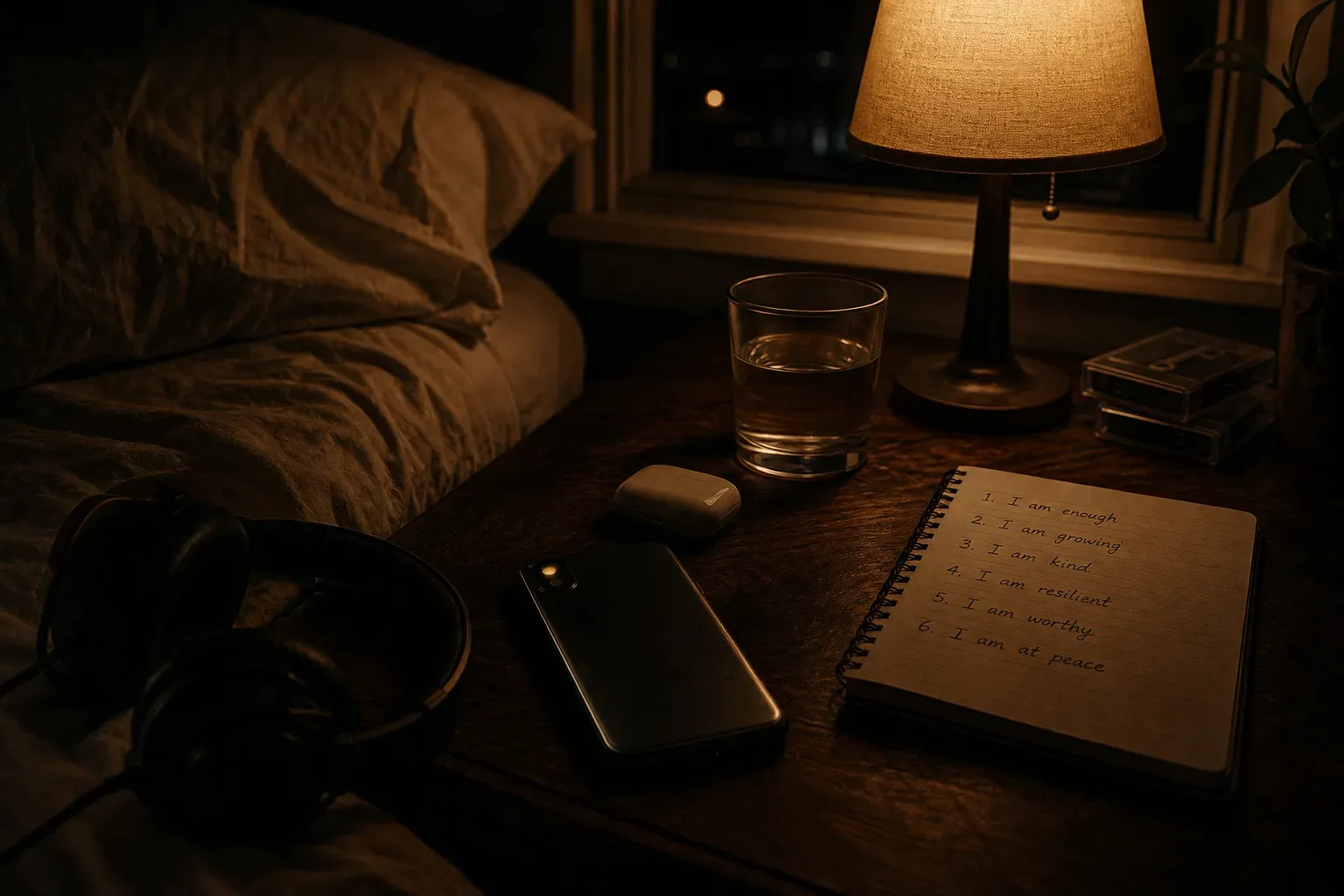
Deep sleep affirmations are short, calm statements you listen to before sleep so your mind rehearses a chosen way of speaking to itself. A 3-minute Dream-Self audio works best when it is audible, personal, slow, and repeated nightly. It should support sleep first, not compete with it.
What makes deep sleep affirmations different from daytime affirmations?
Deep sleep affirmations are designed for the drowsy border before sleep, so they need fewer words, softer pacing, and less emotional pressure than daytime affirmations.
At noon, you can read a sentence and debate it. At night, debate is expensive. The National Sleep Foundation often describes normal sleep latency as roughly 10 to 20 minutes for many adults; that small window is enough time for a script to soothe you or stir you up. Before sleep, the best sentence is not the most dramatic one. It is the one your nervous system can hear without flinching.
That is why deep sleep affirmations should sound ordinary. “I am safe enough to rest” is usually better than “Everything in my life is perfect.” The first line gives the body somewhere to land. The second line may start an argument at 12:07 a.m. A sleep affirmation fails when it asks your tired mind to perform certainty.
There is some science behind the timing, but it should be held carefully. Research on sleep, memory, and cueing suggests the sleeping brain does process sound in limited ways, especially when sound is familiar or emotionally relevant. The claim that a random YouTube track can install a new identity overnight is not what the research says. The research is quieter than that. It says repetition, association, and timing matter.
For more background on spoken phrases at night, the Sleep affirmations pillar explains the basic practice. If you are comparing audible affirmations with hidden messages, the Subliminals pillar is the honest starting point: subliminals may be interesting, but if you cannot hear the words, you cannot edit the meaning.
Use this rule tonight: one topic, six lines, three minutes. Adults are commonly advised by the American Academy of Sleep Medicine to get at least 7 hours of sleep; your affirmation practice should protect those hours, not turn bedtime into a project.
How do you write a 3-minute Dream-Self script?
You write it by choosing one intention, speaking from the version of you who already lives it, and keeping every line believable enough for a tired body.
A Dream-Self script is not a speech. It is a small recording from the future self you are practicing toward. The voice is calm because the moment has already happened. The words do not beg. They describe. A good 3-minute script contains about 300 to 390 spoken words if you speak slowly, but most people need fewer because pauses are part of the medicine.
Here is a simple structure:
- Name the night: “Tonight, I let the day end.”
- Name the body: “My jaw softens. My shoulders drop.”
- Name the identity: “I keep promises to myself in quiet ways.”
- Name tomorrow lightly: “Tomorrow, I move with steadiness.”
- Repeat the core line three times.
- Close with permission to sleep.
The AYA Method is a daily audio manifestation practice. Each day you listen to a short personalized recording — your Dream-Self Moment — narrated from the version of you who has already manifested the life you intend. Listening is the practice. Repetition is the work. The audio is the method. You can read more about the AYA Method if you want the fuller structure. The daily affirmation and Manifestation Board can support it, but the audio is the method.
Keep the lines close to your real language. If you would never say “I radiate unstoppable success” during the day, do not whisper it to yourself at night. In behavior research, implementation intentions are often phrased as simple if-then plans; a 2006 meta-analysis by Gollwitzer and Sheeran found meaningful effects across 94 studies. The useful lesson for bedtime is plainness. Specific words are easier to repeat.
Try these sentence frames:
- “I am learning to…”
- “It is safe enough to…”
- “I return to…”
- “I can do the next small thing…”
- “My sleeping mind can rest with…”
The sentence you can believe at 1 percent is stronger than the sentence you reject at 100 percent.
How should you record deep sleep affirmations so they do not keep you awake?
Record them slower, lower, and simpler than your daytime voice, with small pauses that let the body settle.
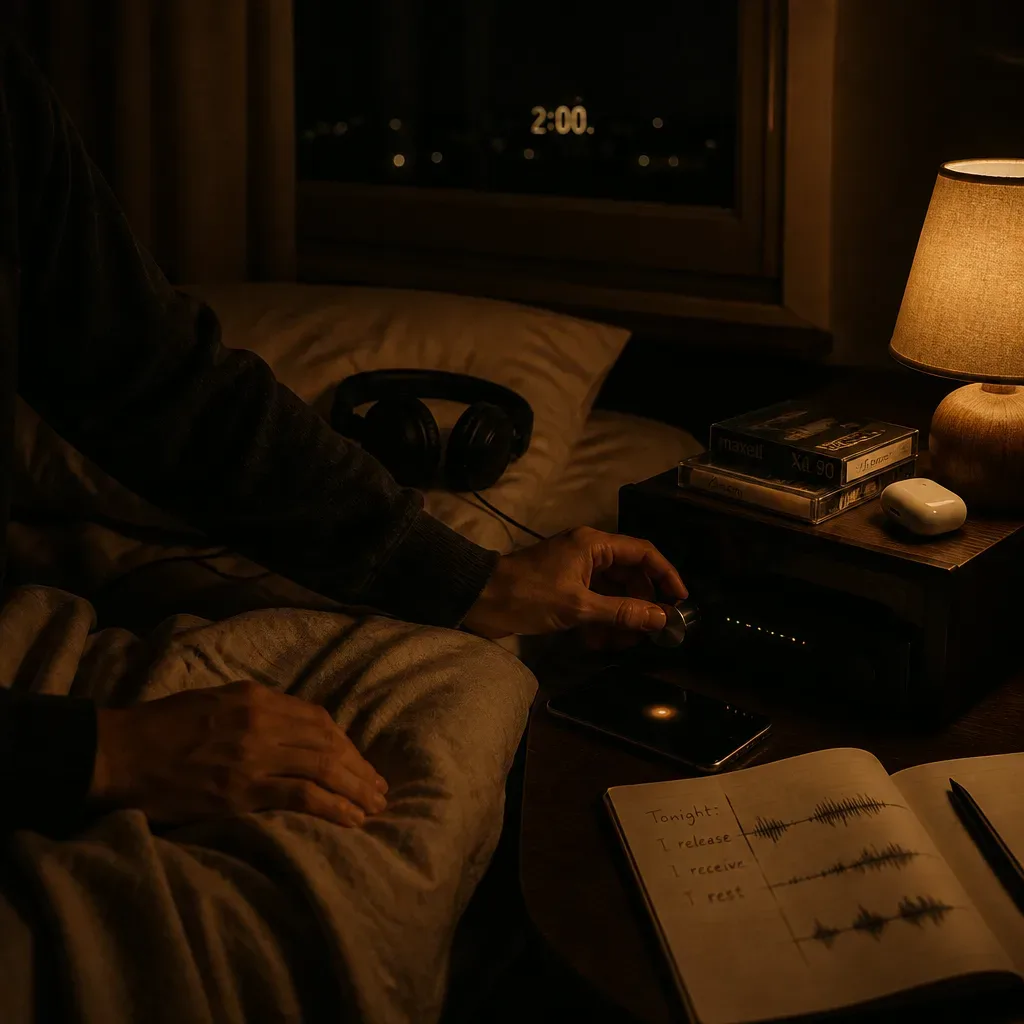
Most people speak too quickly when they record the first take. Aim for about 100 to 130 words per minute, slower than ordinary conversation. Many audiobook narrators speak near 150 words per minute; sleep audio usually needs more space. If you feel ridiculous, you are probably close. The nervous system you are addressing is already halfway down the stairs.
Use a phone voice memo app. Sit on the bed or in a chair. Hold the phone about 6 to 10 inches from your mouth and turn away slightly so breath sounds do not hit the microphone. You do not need studio sound. You need a voice that feels safe to meet in the dark.
Record in three parts. First, 20 seconds of settling. Second, the affirmation body. Third, 20 to 30 seconds of fading permission: “You do not have to keep listening. You can sleep now.” That last line matters. If the script keeps asking for attention, it has forgotten its job.
A simple recording table helps:
| Element | Good choice | Avoid |
|---|---|---|
| Length | 3 minutes | 30-minute first drafts |
| Voice | Soft and audible | Whispering so hard it hisses |
| Music | None or very low | Lyrics, sudden swells, ads |
| Pace | 100–130 words per minute | Normal meeting voice |
| Ending | Permission to sleep | A sharp loop back to the start |
If you add music, keep it steady. Sudden changes in volume can wake you, and consumer audio platforms sometimes normalize loudness in ways you do not control. For sleep, boring is a feature. Dr. Andrew Huberman has often emphasized regular light and sleep timing as stronger levers than exotic tricks; your audio should sit inside good sleep hygiene, not replace it.
If you are prone to insomnia or panic at night, make the script even plainer. And if sleeplessness is persistent or distressing, it is worth speaking with a qualified clinician. No affirmation track should be asked to do clinical work.
When should you play the audio, and for how long?
Play the audio in the last few minutes before sleep, once, at a low volume, for 14 nights before you decide whether it helps.
The last ten minutes before sleep are suggestible. Choose what goes in. That does not mean the mind is helpless. It means attention is softer, sensory input narrows, and repeated words can become familiar. Familiarity is not magic, but it is not nothing.
Start after your ordinary wind-down. If you track sleep timing, the Sleep cycle calculator tool can help you choose a bedtime that gives you enough room for full cycles. A common sleep cycle estimate is about 90 minutes, though real cycles vary from person to person and across the night. Do not cut sleep short to fit a practice. If a method costs you sleep, it costs more than it gives.
Try this 14-night plan:
- Nights 1–3: Listen once and notice whether any line irritates you.
- Nights 4–7: Keep the same script and stop editing.
- Nights 8–10: Notice morning self-talk, not just sleep onset.
- Nights 11–14: Decide whether to keep, soften, or replace the recording.
By week two, expect subtle signals. You may catch the core line during the day. You may stop bracing when the recording starts. You may feel bored by it. Bored can be good here. Repetition often stops feeling special before it starts feeling true.
Volume matters more than people think. Set it just above the threshold of easy hearing. If your brain strains to catch the words, it may stay alert. If the words are too loud, they become an event. The middle is small and personal. Night practice works best when it feels like a return, not a performance.
You can use the same script for longer than 14 nights if it still feels clean. Habit formation research varies widely; a frequently cited 2009 study by Lally and colleagues found an average of 66 days for a new behavior to become automatic, with a wide range. Sleep affirmations are not the same as drinking water after breakfast, but the principle holds: repetition needs time.
What should your Dream-Self audio say if you want deeper rest?
It should say what helps your body stop guarding, not what flatters the ego.
For deeper rest, write toward safety, completion, and return. The nervous system does not relax because it has been impressed. It relaxes when it receives fewer threats. That is why sleep scripts often use body cues: jaw, hands, belly, breath, pillow, weight. These words point attention downward, away from planning.
Here is a short sample you can adapt:
Tonight, I let the day be done. I do not need to solve anything in bed. My body knows how to move toward sleep. My breath can be quiet. My face can soften. I am becoming someone who rests without earning it first. Tomorrow can meet me after I have slept. For now, I return to the pillow. I return to the dark. I return to myself.
Notice what is absent. There is no demand for perfect calm. There is no promise that tomorrow will be flawless. In 2023, the American Psychological Association reported that many adults describe stress as affecting their daily functioning; a nighttime script should not pretend stress is fake. It should give stress a smaller chair.
If your goal is confidence, keep it just as grounded:
- “I speak to myself with more patience.”
- “I can take one honest step tomorrow.”
- “I do not need to finish my whole life tonight.”
- “I trust small repetition.”
The Sleep affirmations pillar has more examples, but do not collect too many. A large library can become another way to avoid choosing. One clean script repeated for two weeks is more useful than 40 saved tracks you never finish.
The boring script often outperforms the dramatic one because the body does not have to defend itself against it.
Are deep sleep affirmations, subliminals, and sleep hypnosis the same thing?
No, they overlap, but they differ in whether you can hear the words, how the script is structured, and how much guidance is involved.
Deep sleep affirmations are usually direct statements repeated before sleep. Subliminals place the words below conscious hearing or mask them under sound. Sleep hypnosis uses induction, pacing, suggestion, and often a return or sleep ending. They can all be gentle. They can all be overclaimed. The difference is not only style; it is consent. Audible words let you know what you are practicing.
A subliminal is an affirmation you cannot consciously hear. That is the whole trick, and the whole problem. If you enjoy them, choose creators who publish the full script. The Subliminals pillar goes deeper into the evidence and the gaps. Priming research is real and modest; anonymous claims about instant physical changes are not the same as peer-reviewed findings.
Sleep hypnosis has a longer clinical history, especially for relaxation and pain support, but it is not a bedtime miracle. Reviews in journals such as the International Journal of Clinical and Experimental Hypnosis have found promise in some areas, while also noting mixed study quality. For everyday sleep scripts, the safest takeaway is practical: use a calm induction, avoid fear-based lines, and never make sleep feel like a test.
Here is the clean comparison:
| Practice | Can you hear the words? | Best use | Main caution |
|---|---|---|---|
| Deep sleep affirmations | Yes | Repeating a chosen self-talk pattern | Too much intensity |
| Subliminals | Not clearly | Background listening, if script is known | Unknown wording |
| Sleep hypnosis | Yes | Relaxation with guided pacing | Dependence on long tracks |
| Dream-Self audio | Yes | Personal identity rehearsal before sleep | Making it too grand |
If you want a fuller guided style, start with our sleep hypnosis overview and keep the same rule: sleep comes first. A method that makes you check, compare, and restart at midnight is not helping, even if the idea is beautiful.
How do you know whether your 3-minute audio is working?
You know it is working when your relationship to the words softens and your sleep remains protected.
Do not measure success by whether you fall asleep before the first minute. That may happen, but it is not the only sign. Better signs are quieter. You stop arguing with one sentence. You remember the line during a hard moment. You feel less need to search for a new track every night. The practice begins to feel like brushing your teeth: plain, repeatable, yours.
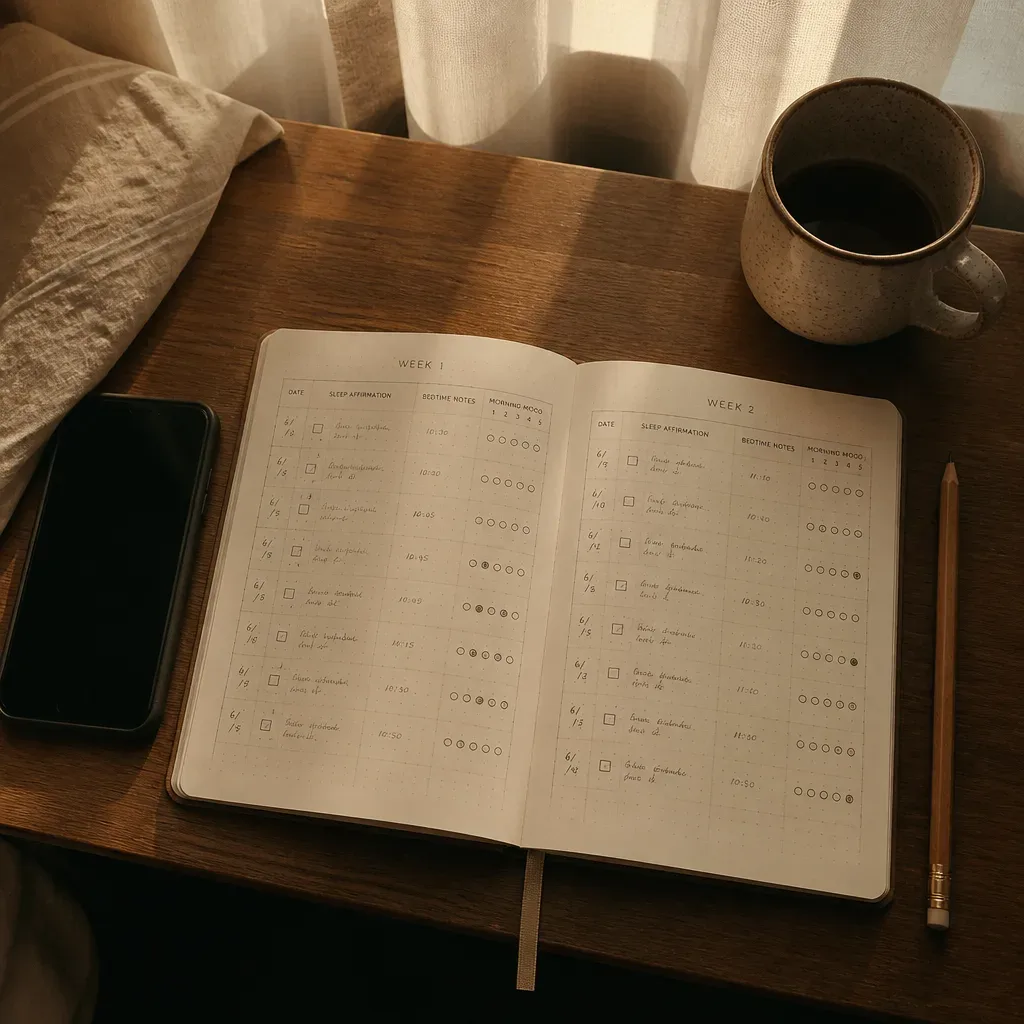
Track three numbers for 14 days: bedtime, approximate time to sleep, and morning mood from 1 to 5. Keep it simple. Consumer sleep trackers can be useful for patterns, but they are not perfect measures of sleep stages. In sleep labs, staging uses EEG and other signals; a ring or watch is estimating from movement and heart data. Your notes still matter.
Use this quick review after two weeks:
- Did the audio make bedtime easier to start?
- Did any line create pressure or sadness?
- Did you keep the volume low enough?
- Did you sleep at least as well as before?
- Did the core sentence appear during the day?
If the answer is mostly yes, keep the recording for another 2 to 4 weeks. If the answer is mixed, edit one line only. If the answer is no, stop and write a gentler script. The point is not loyalty to a recording. The point is a better last voice before sleep.
You can also pair the practice with timing. Use the Sleep cycle calculator tool when planning wake time, then give your audio a fixed place in the routine. Cue-based habits are easier to repeat; the cue can be lights out, phone face down, one play, sleep.
What you hear while you sleep shapes you most when you choose it while awake.
Low volume. Same words. Back to the pillow.