sleep hypnosis affirmations
Hypnagogic State: A Sleepy Window for Dream-Self Audio
Learn what the hypnagogic state is, why it may feel suggestible, and how to use Dream-Self audio gently before sleep without harming rest.
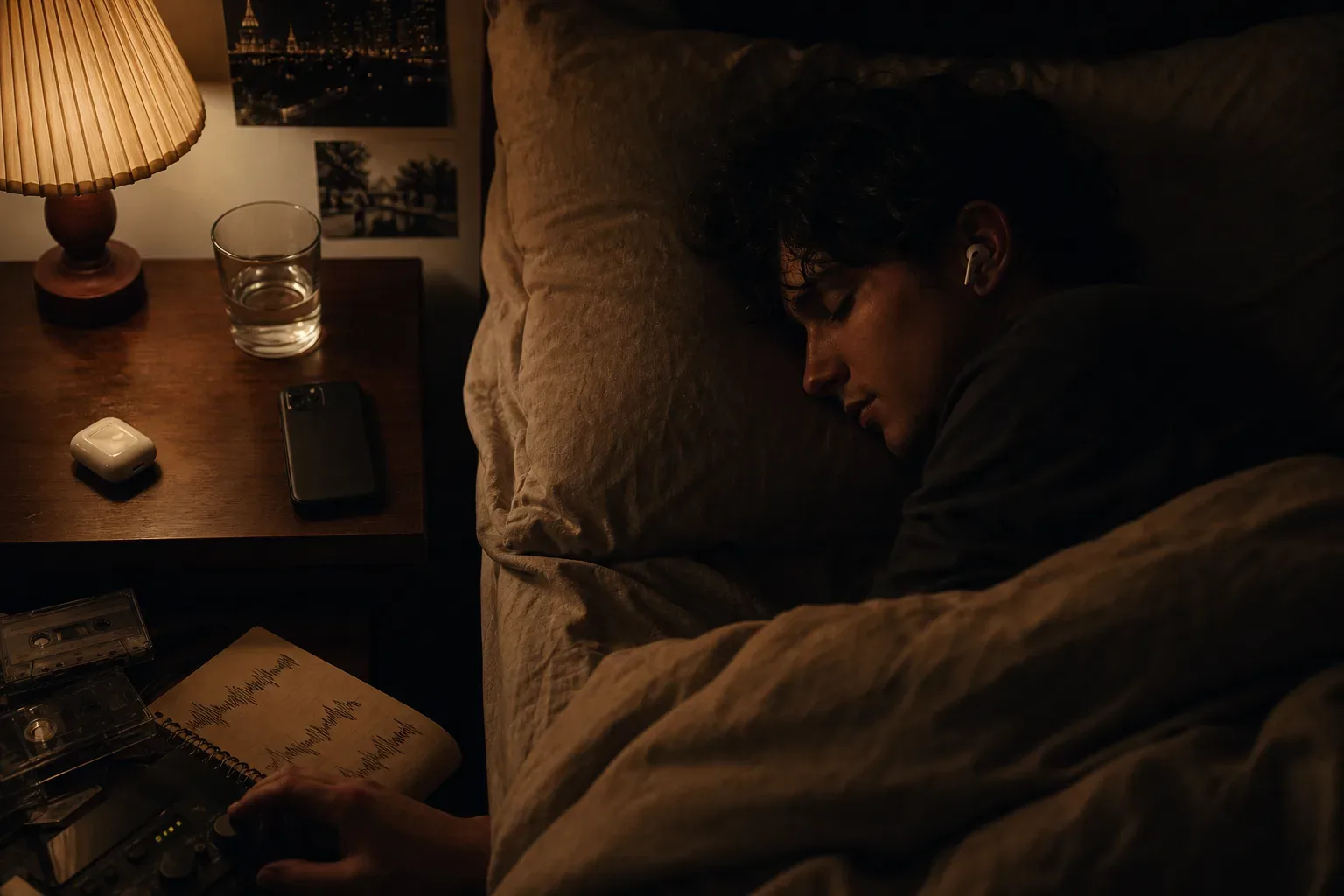
The hypnagogic state is the drowsy threshold between waking and sleep, when attention loosens and images, phrases, and body sensations can feel unusually vivid. It may be a useful window for Dream-Self audio because you’re still able to hear words, but less busy with daytime resistance.
What is the hypnagogic state, exactly?
The hypnagogic state is the sleep-onset transition where waking thought thins and early sleep begins.
Sleep medicine usually places this doorway near stage N1, the lightest stage of non-REM sleep. The American Academy of Sleep Medicine scoring manual describes N1 as the point where alpha rhythms fade and lower-frequency activity begins to appear. In plain language: your mind hasn’t fully gone offline, but it’s stopped gripping the room as tightly.
You might hear a phrase repeat, see a face for half a second, feel your foot drop, or notice a tiny dream starting before you know you’re asleep. Hypnic jerks are common here; Cleveland Clinic notes that up to 70% of people report them at some point. That twitch isn’t a sign that anything has gone wrong. It’s often just the body crossing the line awkwardly.
This state is usually brief. Many sleep education sources place normal sleep onset around 10 to 20 minutes, though N1 itself may take only a small slice of total sleep, often around 5% in healthy adults. That’s why hypnagogia can feel rare if you’re not paying attention. It’s a narrow bridge, not a room you can rent for the night.
The hypnagogic state isn’t a portal you force open. It’s a soft minute you learn not to scare away.
For audio practice, the important detail is simple: you’re suggestible enough to feel words differently, but awake enough to choose what plays. That makes this window interesting for sleep affirmations, hypnosis-style recordings, and personalized Dream-Self audio.
Why do words feel different before sleep?
Words feel different before sleep because your attention is narrower, your self-monitoring is lower, and your brain is shifting its rhythm.
During ordinary waking hours, you edit yourself constantly. You compare, object, plan, and remember. Before sleep, that editor gets tired. Electroencephalography studies often describe a move from relaxed alpha activity, roughly 8 to 12 Hz, toward theta activity, roughly 4 to 8 Hz, as drowsiness deepens. Those numbers don’t make the state mystical. They just point to a measurable change in how awake attention is organized.
This is why a sentence that feels ordinary at 2 p.m. can feel intimate at 11:47 p.m. A line like I handle my morning with steadiness might not impress you in daylight. In bed, spoken softly and repeated for seven nights, it can become easier to rehearse. Repetition matters here. A 2012 review in the Journal of Behavioral Medicine found that mental practice can support behavior when paired with real-world action, though effects vary by study design.
The evidence on suggestion is honest and modest. Priming research shows that cues can influence later perception or choices in small ways, but many famous social priming claims did not replicate cleanly in the 2010s replication wave. That matters. A YouTube title promising guaranteed overnight change isn’t the same thing as research on memory, expectancy, or attention.
Still, modest doesn’t mean meaningless. Brushing your teeth for two minutes isn’t dramatic either, but repetition shapes a life. A sleep phrase repeated at the same low volume each night can become a familiar track for attention to return to.
Is the hypnagogic state actually suggestible?
The hypnagogic state appears to be suggestible in a limited, practical sense, but it doesn’t make you helpless.
Researchers have been curious about this edge for more than a century. The psychologist Andreas Mavromatis wrote a full study of hypnagogia in 1987, treating it as a normal altered state rather than a defect. More recently, MIT Media Lab researcher Adam Haar Horowitz and colleagues used the Dormio device to cue dream content during sleep onset; in a 2020 Consciousness and Cognition paper, they reported that targeted prompts could influence hypnagogic dream reports in some participants.
That kind of finding is fascinating, but it’s specific. It doesn’t prove that any sentence played during sleep becomes belief. It suggests that timed cues near sleep onset can enter the material your mind is already forming. There’s a difference between influence and control. A voice can give your mind a thread. It can’t guarantee what you weave from it.
If you use the hypnagogic state for manifestation audio, treat it like rehearsal. In sports psychology, imagery practice is often studied as an addition to physical training, not a replacement. Meta-analyses on mental imagery, including work summarized in the early 2000s by researchers such as Driskell, Copper, and Moran, generally show benefits that depend on skill, repetition, and pairing with action.
Here’s the quieter truth: the sleepy mind may accept tone before it accepts logic. That’s why harsh audio before bed can linger. It’s also why a kind, precise recording can feel stabilizing.
Useful hypnagogic cues tend to be:
- Short enough to finish before you’re annoyed
- Audible enough that you don’t strain
- Specific to one identity, scene, or behavior
- Calm in pacing, with pauses longer than daytime speech
- Repeated for at least 7 to 14 nights before you judge it
How does Dream-Self audio fit into this window?
Dream-Self audio fits the hypnagogic window best when it’s short, audible, personal, and repeated at the same point in your night.
The AYA Method is a daily audio manifestation practice. Each day you listen to a short personalized recording — your Dream-Self Moment — narrated from the version of you who has already manifested the life you intend. Listening is the practice. Repetition is the work. The audio is the method.
That definition matters because it separates Dream-Self audio from two nearby practices. A subliminal usually hides affirmations under music or noise; subliminals can feel soothing, but by design you can’t consciously check every word. Dream-Self audio is different. You hear it. You know the wording. Your consent stays awake even as your body gets sleepy.
Neville Goddard, writing in the 1940s and 1950s, often pointed to the state akin to sleep as a place to rehearse the feeling of a wish fulfilled. Joe Dispenza uses different language and a more modern neuroscience frame, though his claims are debated. You don’t need to accept every metaphysical claim to use the practical core: the last minutes before sleep are a good time to repeat the identity you want to practice.
A Dream-Self Moment should sound like you, not like a stranger selling certainty. If your recording says, I never feel fear, your body may argue. If it says, I notice fear and still send the message, there’s less to fight. Specific, believable lines age better than grand lines.
| Audio type | Can you hear the words? | Best use before sleep | Main caution |
|---|---|---|---|
| Dream-Self audio | Yes | Personal identity rehearsal | Keep it short and calm |
| Sleep affirmations | Usually | Repeated supportive phrases | Avoid vague scripts |
| Subliminals | Not clearly | Background comfort | You can’t easily audit wording |
| Sleep hypnosis | Yes | Guided relaxation and suggestion | Too much narration can keep you awake |
The best sleep audio doesn’t overpower your mind. It gives your mind a place to rest.
How should you listen without ruining your sleep?
Listen in a way that protects sleep first: low volume, short duration, stable timing, and no checking after you press play.
The American Academy of Sleep Medicine and the Sleep Research Society recommend adults get 7 or more hours of sleep per night. That number is not decorative. If your audio practice cuts into it, the practice is failing its first test. Manifestation work can wait. Sleep debt collects interest quickly.
A simple order works better than a complicated ritual:
- Set your wake time first, then use the sleep cycle calculator to choose a bedtime that gives you enough room.
- Put your phone on Do Not Disturb before the audio starts.
- Play 3 to 8 minutes of Dream-Self audio or affirmations.
- Keep volume at a soft conversation level, not a whisper you chase.
- When it ends, don’t replay it to get the perfect feeling.
- If you’re still awake after about 20 minutes, drop the method and return to ordinary sleep hygiene.
That 20-minute guideline appears often in cognitive behavioral therapy for insomnia materials: if you’re awake and frustrated, staying in bed rehearsing frustration can train the wrong association. For chronic insomnia, one plain rule applies: talk with a qualified clinician rather than trying to solve it with audio.
Headphones are optional. Wired earbuds can be uncomfortable. Over-ear headphones can heat you up. A pillow speaker or low phone speaker across the room may be enough. The goal is not immersion. The goal is a clean last input.
If you’re sensitive to sound, silence after the recording may be better than looping. Many people in shifting and subliminal communities report leaving tracks on all night, but anecdote isn’t sleep science. Night-long audio can fragment rest for some listeners, especially if there are volume changes. Try one week with a timer before you try a loop.
What should a hypnagogic script actually say?
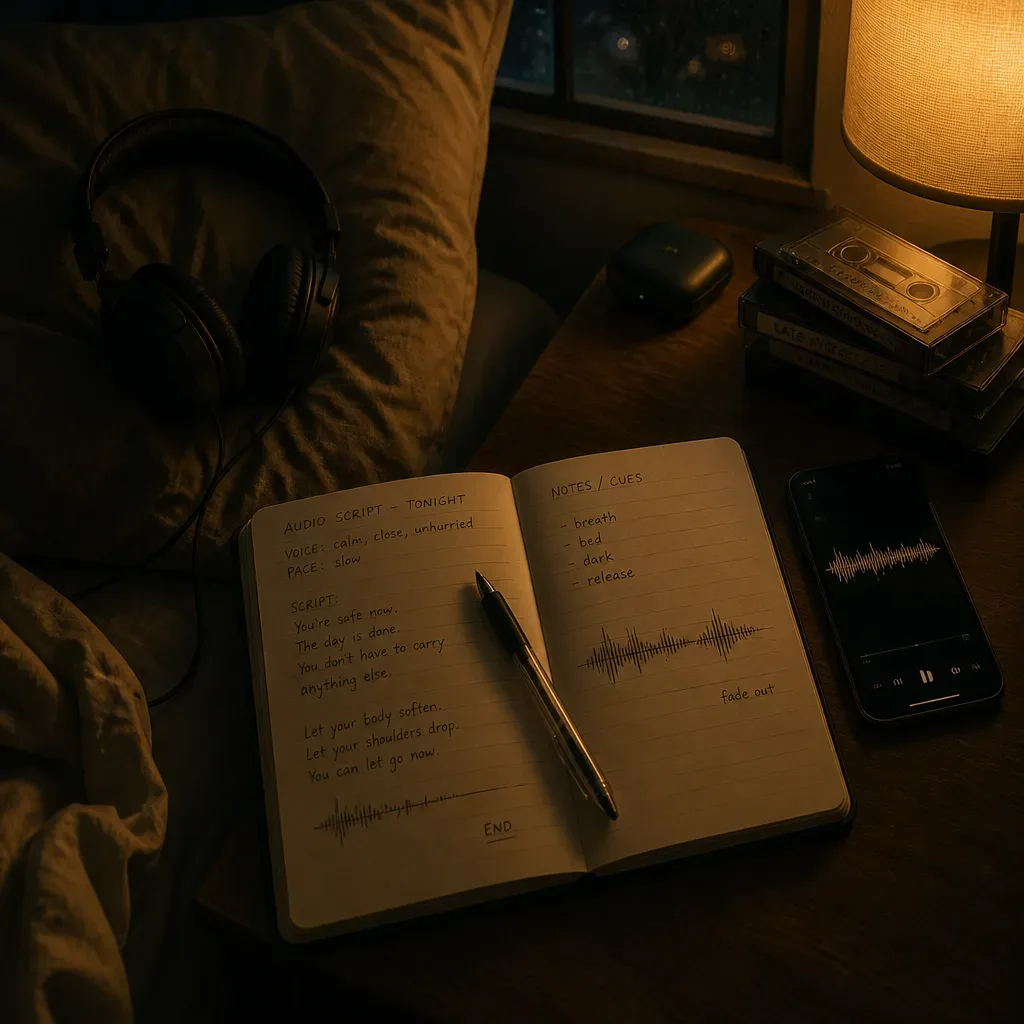
A good hypnagogic script says one clear thing in language your sleepy mind doesn’t need to debate.
You’re not writing a legal document. You’re giving the edge of sleep a phrase it can carry. In the shifting community, scripts often become long files with names, rooms, powers, friendships, rules, safeties, and return words. I understand the pleasure of that. I also know how quickly a script can become homework at 1:13 a.m. A script should be a pleasure, not a second job.
For Dream-Self audio, choose fewer details. Cognitive load matters; working memory is commonly described as holding about 4 chunks of information, based on Nelson Cowan’s influential 2001 review, not the older 7-item myth many people learned. Before sleep, use even less. One scene, one identity, one emotional texture.
Try this frame:
- One present-tense identity: I’m the person who answers calmly.
- One sensory cue: My shoulders drop when I open the message.
- One ordinary proof: I send the draft before lunch.
- One return line: I can be steady without forcing it.
Notice the scale. The lines are not trying to solve your whole life by morning. They’re rehearsing a self you can meet tomorrow. The hypnagogic state likes small doors.
For sleep affirmations, the same rule holds. A phrase such as I’m safe to rest may help if your body believes it enough to soften. A phrase such as Everything is perfect now may make your mind list counterevidence. Your nervous system has taste. Respect it.
How is this different from subliminals, hypnosis, and shifting methods?
It differs by audibility, consent, structure, and what the practice asks from your sleep.
Subliminals hide or mask the words. That can feel comforting because you don’t have to think. It also creates the central problem: you can’t easily know what you’re hearing. A subliminal is an affirmation you can’t consciously hear. That’s the whole trick, and the whole problem. If you use them, choose creators you trust, keep volume safe, and read any listed affirmations before listening. The Subliminals pillar covers that tradeoff in more detail.
Sleep hypnosis usually keeps the words audible and guides you through relaxation, imagery, and suggestion. Clinical hypnosis has research behind it for some uses, including pain and anxiety support, but app-store sleep hypnosis is not the same as clinical care. A 2018 review in the International Journal of Clinical and Experimental Hypnosis noted promising findings across areas, while also pointing to study quality differences. Translation: useful for some people, not a guarantee.
Shifting methods are community-built. The Raven Method, Julia Method, pillow method, and ADHD-friendly methods borrow pieces from meditation, scripting, autosuggestion, counting, and fandom imagination. That cultural creativity is real. So is the risk of turning bedtime into a performance. If a method costs you sleep, it costs more than it gives.
Dream-Self audio sits closest to audible affirmation practice. It doesn’t require you to count to 100 without moving. It doesn’t ask you to stay awake until something happens. It asks you to listen daily, including last thing at night if that suits your sleep. The daily affirmation and Manifestation Board can complement it, but the audio is the method.
One more distinction matters: Dream-Self audio can be edited when it starts to feel wrong. Your future-facing words should mature with you. Folklore grows fast online, but your bedtime doesn’t need to obey every new rule.
What should you expect after one or two weeks?
After one or two weeks, expect familiarity, not fireworks: the words may feel easier to hear, remember, and act from.
Seven nights is enough to notice whether an audio is soothing or irritating. Fourteen nights is a better test of whether the language is sticking. Habit researchers often cite a 2009 European Journal of Social Psychology study by Phillippa Lally and colleagues, which found habit formation took a median of 66 days in that sample, with wide variation. So no, one week won’t install a whole new self. It can tell you whether the practice fits your nervous system.
Track ordinary signs instead of chasing dramatic ones. Did you fall asleep within your usual range? Did the phrase come back during the day? Did you make one choice that matched the recording? Did you feel more pressured, or less? Those questions are more useful than asking whether the hypnagogic state worked perfectly.
A small tracking note can help:
| Night | Sleep onset felt | Audio reaction | One daytime echo |
|---|---|---|---|
| 1 | Restless / neutral / easy | Too loud / fine / soothing | Phrase remembered? |
| 7 | Restless / neutral / easy | Change needed? | Any matching action? |
| 14 | Restless / neutral / easy | Keep or rewrite? | What became easier? |
Keep the record brief. If tracking becomes another reason to stare at your phone, stop tracking. Paper beside the bed is kinder.
The hypnagogic state is not a vending machine. It’s more like damp clay: impressions may take, but only if you don’t keep poking them.
If you want a wider structure for nightly listening, the AYA Method gives you the daily audio container. If you want to compare it with more traditional night phrases, start with the Sleep affirmations pillar. If your bedtime itself is unstable, fix the clock first with the sleep cycle calculator. The order is boring and correct: sleep, then suggestion, then meaning.
Let the last voice of the night be one you’d trust in the dark.