sleep hypnosis affirmations
Sleep Hypnosis for Overthinking: 3-Minute Audio
Use sleep hypnosis for overthinking with a quiet 3-minute Dream-Self audio: what to record, when to listen, how loud, and what to expect by week two.
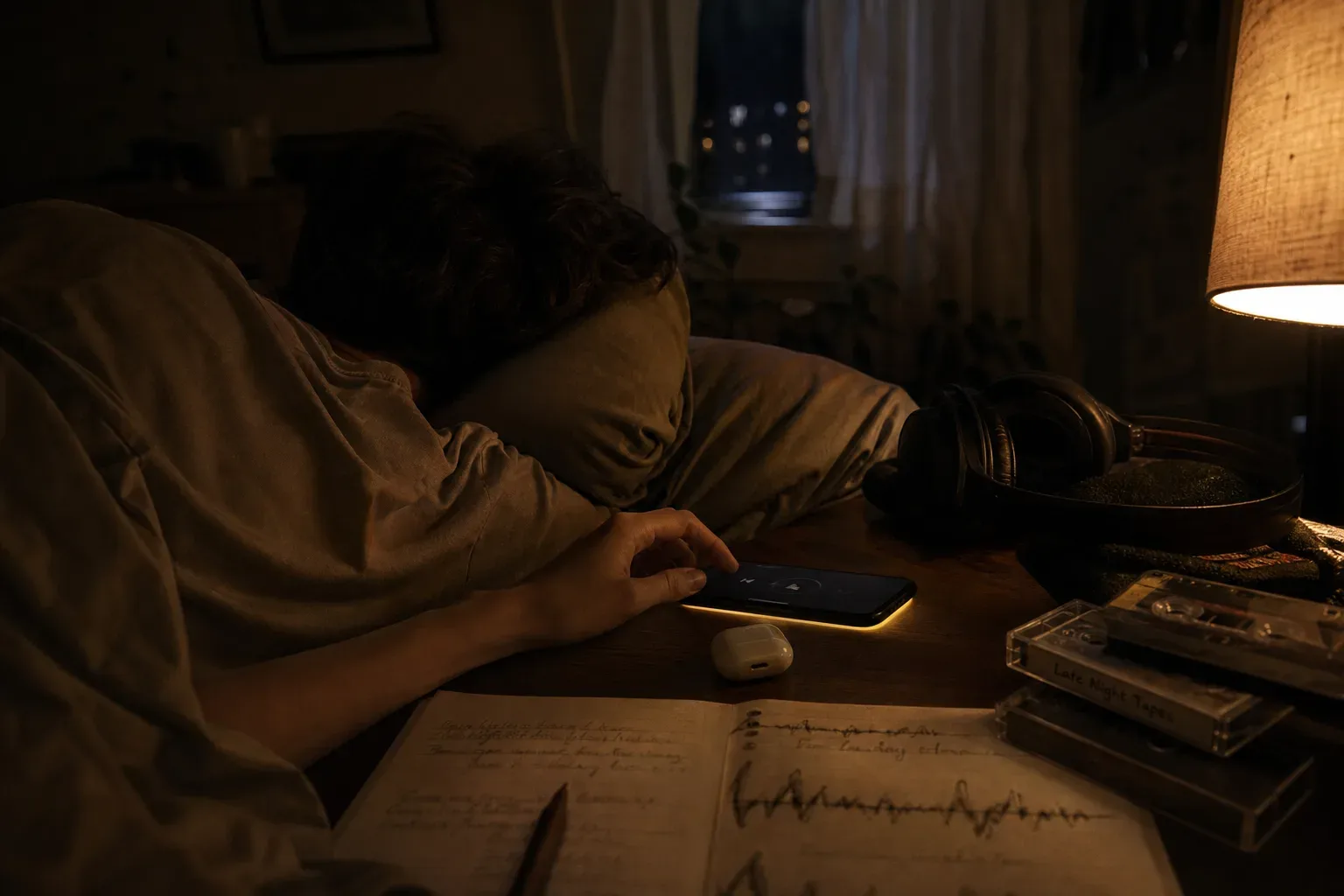
Sleep hypnosis for overthinking is a short, spoken audio practice used before sleep to slow repetitive thought and give the mind one simple script to follow. A 3-minute Dream-Self audio works because it is brief enough to repeat nightly, clear enough to remember, and soft enough to meet you at the drowsy edge.
What is sleep hypnosis for overthinking?
Sleep hypnosis for overthinking is guided verbal attention, timed for the minutes when your analytical mind is less guarded.
It is not mind control. It is not a promise that one recording will erase anxiety. In clinical hypnotherapy, hypnosis is usually described as focused attention paired with increased response to suggestion. The American Psychological Association has described hypnosis in similar terms since its Division 30 definition work, and the key phrase is focused attention. Overthinking is scattered attention. Sleep hypnosis gives it a narrow rail.
Overthinking at night is often called cognitive arousal in sleep research. Allison Harvey’s cognitive model of insomnia, published in 2002, placed worry, monitoring, and misperception at the center of why some people cannot fall asleep even when they are tired. The numbers are not small: population studies commonly find that about 30 percent of adults report some insomnia symptoms in a given year, while chronic insomnia is closer to 10 percent. If your mind gets louder when the room gets quiet, you are not unusual.
A 3-minute Dream-Self audio is a sleep hypnosis recording that speaks from the version of you who has already moved through the loop you keep rehearsing. It does not argue with the loop. It replaces it with one believable scene, one body cue, and one repeated sentence. The boring script often works better than the dramatic one because the nervous system does not need a speech at midnight. It needs a handrail.
If you already use sleep affirmations, this is the neighboring practice. Affirmations give the sentence. Hypnosis gives the pacing, the breath, the lowered effort, and the moment before sleep.
Why keep the audio to exactly 3 minutes?
Three minutes is long enough to guide attention and short enough that your tired mind will not start managing the practice.
At a slow bedtime pace of 80 to 100 words per minute, 3 minutes gives you 240 to 300 words. That is enough for three parts: settle the body, name the direction, and repeat a Dream-Self image. Longer recordings can be useful, but overthinkers often turn long audio into another decision: should I finish it, skip ahead, restart, change the voice, find a better one. The practice fails when it becomes research.
Cognitive load matters here. Psychologist Nelson Cowan’s 2001 review argued that working memory may hold about 4 chunks at once, not the old 7-item myth most people learned. At night, when fatigue reduces patience, fewer moving parts help. A 3-minute audio asks the mind to hold one scene, not a whole plan.
The last 10 minutes before sleep are suggestible. Choose what goes in. That does not mean the brain becomes magical at bedtime. It means sleep onset is a state of reduced external checking, looser association, and lower resistance to repetition. Hypnagogic imagery has been studied for more than a century, and modern sleep labs still mark Stage N1 as a light, unstable border. That border is exactly where a soft sentence can become easier to accept.
This is also why hidden-audio claims need care. A subliminal is an affirmation you cannot consciously hear; that is the trick and the problem. Priming research is real but modest. YouTube promises are often much larger than the evidence. With audible hypnosis, you can hear what you are practicing. Your consent stays awake even while your body gets heavy.
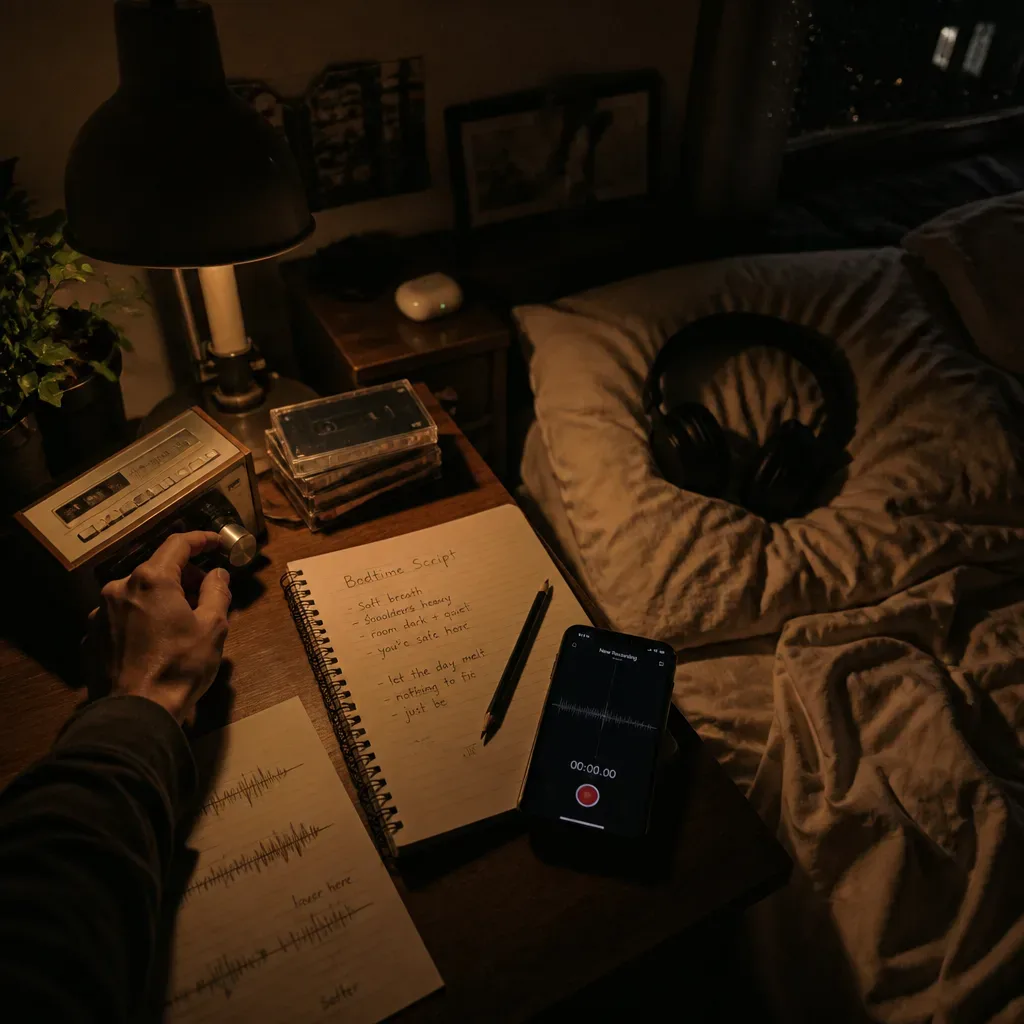
How do you make a 3-minute Dream-Self audio?
You make it by writing one calm future-self moment, recording it slowly in your own voice, and playing it once before sleep.
Use the audio as the method, not as decoration. In the AYA Method, the definition is plain: The AYA Method is a daily audio manifestation practice. Each day you listen to a short personalized recording — your Dream-Self Moment — narrated from the version of you who has already manifested the life you intend. Listening is the practice. Repetition is the work. The audio is the method. The same principle fits a bedtime recording for overthinking because the voice is yours and the words are fully audible.
Here is a simple structure that takes about 10 minutes to create and 3 minutes to hear:
- Name the loop in one line. Use plain language: I replay conversations, I plan tomorrow, or I scan for mistakes.
- Choose one Dream-Self scene. Pick a small believable scene, such as turning off the lamp after writing tomorrow’s first task.
- Write 240 to 300 words. Keep sentences short. Use present tense. Avoid grand claims.
- Record at 80 to 100 words per minute. Most normal speech is closer to 140 to 160 words per minute, so slow down more than feels natural.
- Listen for 14 nights. Two weeks is long enough to notice friction, but not so long that you confuse practice with perfection.
A script can be this plain:
I am in bed now.
There is nothing to solve in this minute.
My jaw can soften.
My shoulders can drop one small degree.
I have already written down what needs tomorrow.
My future self knows the next right action.
Tonight I do not rehearse fear.
I rehearse trust in one small step.
The thought may pass through.
I do not have to follow it.
I return to the breath.
I return to the bed.
I return to sleep.
Do not try to sound like a hypnotist. A clinical voice is not a special accent. It is timing, repetition, and permission. If your recording sounds ordinary, good. Ordinary is easy to believe at night.
When should you listen, and how loud should it be?
Listen once in the last 10 minutes before sleep, at a volume low enough that the words feel nearby but not demanding.
Start after hygiene, after your phone is down, and after any planning is on paper. The National Sleep Foundation recommends 7 to 9 hours of sleep for most adults aged 18 to 64, but many people protect the number while neglecting the entry. Bedtime audio should be part of the entry, not a way to stretch the night thinner. If you use the sleep cycle calculator, set the wake time first, then place the 3-minute audio before your intended sleep time.
Volume is personal, but a useful target is speech that would not wake someone through a closed door. Many phone speakers at 20 to 35 percent volume are enough in a quiet bedroom. If you use earbuds, keep them lower. The World Health Organization has warned about unsafe listening levels above 85 dB over long periods; your sleep audio should be nowhere near that. You are not trying to be impressed by the sound. You are trying to stop checking for threat.
| Bedtime choice | Better for overthinking | Why it helps |
|---|---|---|
| 3-minute personal audio | Yes | Low decision load and familiar wording |
| 45-minute random video | Sometimes | May soothe, but can invite searching |
| Hidden affirmations under music | Mixed | You cannot check the sentence |
| Silence only | Sometimes | Good if quiet feels safe |
| News, work, or comments | No | Adds fresh material to rehearse |
Keep the same file for at least 14 nights. Changing the recording every evening trains the mind to hunt. Repetition is not dull when the nervous system is tired; repetition is the signal that nothing new must be solved.
What should you expect by week two?
By week two, expect familiarity, slightly faster settling, and kinder self-talk, not a perfect mind.
The first 3 nights may feel awkward. That is normal. Your voice may sound strange because most people hear their recorded voice through bone conduction mismatch; the voice in your head is not the same as the voice from a speaker. Stay with it. In clinical practice, I have seen clients soften once the recording stops sounding like a performance and starts sounding like a cue.
By nights 7 to 14, track only two measures: how long you think it took to settle, and how harsh the morning self-talk feels on a 1 to 5 scale. Do not use a 12-field spreadsheet. Overthinking loves complicated tracking. In habit research, Lally and colleagues reported in 2009 that automaticity took a median of 66 days, with wide variation. That does not mean you need 66 nights to feel any benefit. It means repetition becomes less effortful over time.
You may notice these small shifts:
- You reach for the audio before scrolling.
- The first sentence starts to cue your shoulders to drop.
- You stop arguing with every thought and return sooner.
- Your morning memory of the night is less dramatic.
- You become more selective about what you hear before sleep.
There is a useful caution from self-affirmation research. A 2009 study by Joanne Wood and colleagues found that very positive self-statements could make some low-self-esteem participants feel worse. The lesson for sleep is simple: do not record sentences your body rejects. Say, I can take one step tomorrow, before you say, I am completely free of worry. Believability beats intensity.
If you want the lighter sentence-based version, the sleep affirmations pillar is a good companion. If you want the words beneath music, read the Subliminals pillar with care and keep your expectations modest.
How is this different from subliminals, affirmations, or sleep meditation?
The difference is that sleep hypnosis uses audible suggestion, slow pacing, and a directed trance-like focus before sleep.
Subliminals hide or mask the words. Affirmations repeat a sentence. Sleep meditation often returns attention to breath, body, or sound. Sleep hypnosis can include all three, but it has a particular shape: it narrows attention, lowers effort, and offers specific suggestions when the listener is receptive. For an overthinking mind, that specificity matters. A vague calm track may soothe the body. A precise Dream-Self audio gives the thinking mind a new job.
Here is the honest comparison:
| Practice | You hear the words | Best use | Main caution |
|---|---|---|---|
| Sleep hypnosis | Yes | Overthinking, rehearsal, bedtime cues | Do not make claims too big |
| Sleep affirmations | Yes | Repeated self-talk | Keep sentences believable |
| Subliminal audio | Usually no | Background repetition | Evidence is often overstated |
| Sleep meditation | Usually yes | Body settling and attention | May feel too open-ended for planners |
| Dream-Self audio | Yes | Personal future-self rehearsal | Needs your own words to work best |
Andrew Huberman has often discussed non-sleep deep rest as a way to train relaxation, and research on yoga nidra and relaxation protocols suggests the body can learn downshifting through repeated cues. Still, sleep hypnosis for overthinking is not treatment for panic, trauma, or chronic insomnia. If you are awake most nights, or your sleep problem lasts at least 3 nights a week for 3 months, speak with a qualified professional. Good audio supports care. It does not replace it.
The cleanest rule is this: if a method costs you sleep, it costs more than it gives. Do not stay up testing five files. Do not chase the perfect voice. Do not turn bedtime into a laboratory. Record one short script, listen once, and let the night take the rest.
The mind does not need to be conquered before sleep. It needs something quieter to repeat.
Tonight, let the last voice you hear be kind and yours.