sleep hypnosis affirmations
Sleep Hypnosis for Manifesting: 7-Night Routine
Sleep hypnosis for manifesting can be a quiet nightly audio ritual. Use this 7-night Dream-Self routine without sacrificing sleep.
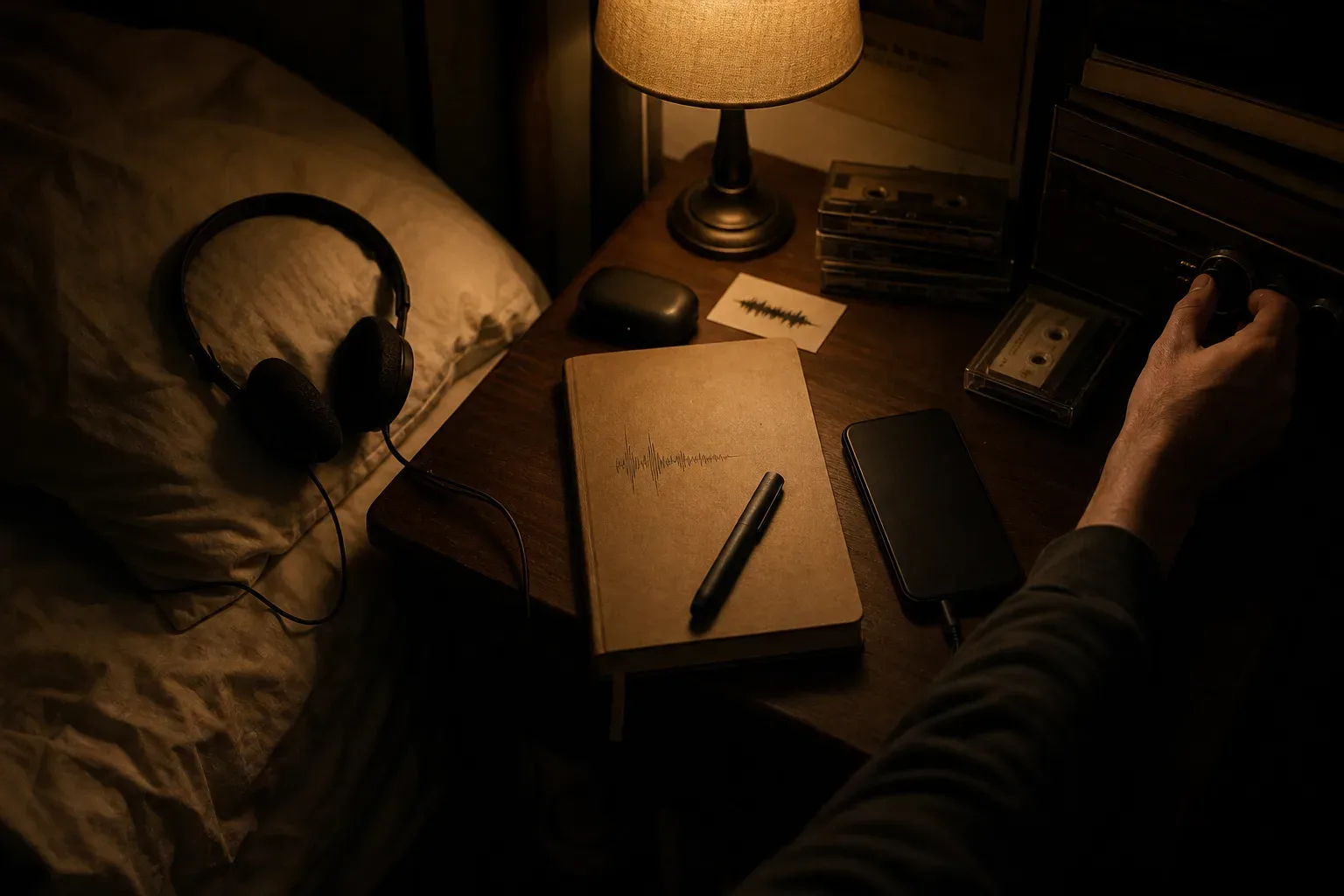
Sleep hypnosis for manifesting is a bedtime audio practice that uses relaxation, suggestion, and repeated future-self wording while you fall asleep. The point is not to force sleep or make supernatural promises. The point is to choose the last voice you hear, repeat it for 7 nights, and notice what changes.
What is sleep hypnosis for manifesting, really?
Sleep hypnosis for manifesting is audible suggestion before sleep, paired with a clear intention and a relaxed body.
A useful sleep hypnosis track has three parts: a downshift, a script, and an exit. The downshift may be 3 to 5 minutes of breathing cues or body relaxation. The script may be 5 to 12 minutes of first-person wording. The exit either fades out or gives your body permission to sleep. If the track is 45 minutes and keeps changing music, voices, or promises, it may be more stimulating than helpful.
The evidence is mixed but not empty. Hypnosis has clinical research behind it for pain, anxiety, and some sleep concerns, though results vary by person and study design. Self-affirmation research is also modest: a 2015 meta-analysis by Epton and colleagues found that self-affirmation can help health behavior change, but the effect is not a blank check for every online claim. Priming is real and usually small. YouTube certainty is not the same as a controlled study.
Manifesting language adds a different frame. Neville Goddard used imaginal scenes before sleep. Joe Dispenza teaches rehearsed future states. Dr. Andrew Huberman often separates relaxation tools, such as NSDR, from sleep itself. You can borrow the nightly rehearsal without pretending that every claim has equal evidence.
This is where the AYA Method sits close to the practice: the AYA Method is a daily audio manifestation practice. Each day you listen to a short personalized recording, your Dream-Self Moment, narrated from the version of you who has already manifested the life you intend. Listening is the practice. Repetition is the work. The audio is the method.
A hidden message asks you to trust the file. A clear voice lets you consent to every word.
If you already use sleep affirmations, think of this routine as a more structured version: same quiet night, clearer arc, fewer random lines.
How do you prepare the audio before night one?
You prepare by choosing one intention, writing a short Dream-Self script, and making the recording boring enough to sleep through.
Start with one intention for 7 nights. Not five. Not a whole life repair list. One. The National Sleep Foundation often describes normal sleep latency as roughly 10 to 20 minutes; your script has to fit inside that window without competing with sleep. If you tend to fall asleep in 6 minutes, use a shorter track. If you are awake for 30 minutes most nights, do not fill all 30 with words. Silence is part of good audio.
Use this simple format for a 120 to 180 word script:
- Name the present safety: I am in bed, the day is done.
- Name the Dream-Self scene: I wake as someone who keeps this promise.
- Name 3 specific behaviors: what you say, choose, start, stop, or notice.
- Name the emotional tone: calm, steady, patient, honest.
- Return to sleep: I can rest now; this is enough for tonight.
For the recording, use a phone if that is what you have. Hold it 6 to 10 inches from your mouth, speak slower than normal, and leave one full second between sentences. If you mix music under it, keep the voice easy to hear. The point is not to hide the message. If you want hidden-word audio, read the Subliminals pillar first so you know what is actually being claimed.
Here is a practical setup table:
| Element | Good setting | Why it matters |
|---|---|---|
| Track length | 15 to 20 minutes | Fits a normal sleep-onset window |
| Voice level | Clearly audible, very low | Consent depends on hearing the words |
| Music | Steady, no sudden peaks | Sudden changes can wake you |
| Script length | 120 to 180 words | Repetition works better than clutter |
| Routine length | 7 nights | Long enough to notice patterns |
Your sleep track should feel like a lamp dimming, not a podcast asking you to keep up.
What happens on nights 1 and 2?
Nights 1 and 2 are for calibration, not big interpretation.
On night 1, listen once at bedtime and do less than you want to do. That is the discipline. Do not stack three hypnosis tracks, two subliminals, and a 60-minute lecture. The American Academy of Sleep Medicine recommends adults get at least 7 hours of sleep per night; any manifesting routine that cuts into that is too expensive. Put the track on when lights are already low, screens are away, and your room is cool enough for sleep.
Before you press play, write one line in a notebook: Tonight I am practicing hearing this clearly. That is enough. If you use the Sleep cycle calculator tool, set your wake time first, then count backward to protect a realistic bedtime. Audio should fit inside the night you actually have, not the night you wish you had.
On night 2, change only the volume or the ending. If the voice felt too loud, lower it. If the music pulled your attention, remove it. If you woke when the file ended, add a 2-minute fade or use a player with a sleep timer. Audio engineering is mostly subtraction. The cleaner the file, the easier it is to trust.
Morning notes should be tiny:
- Did I fall asleep faster, slower, or about the same?
- Did any line irritate me?
- Did I remember one phrase on waking?
- Did I take one small action that matched the script?
One remembered sentence can be enough evidence to keep going. Not proof. Evidence.
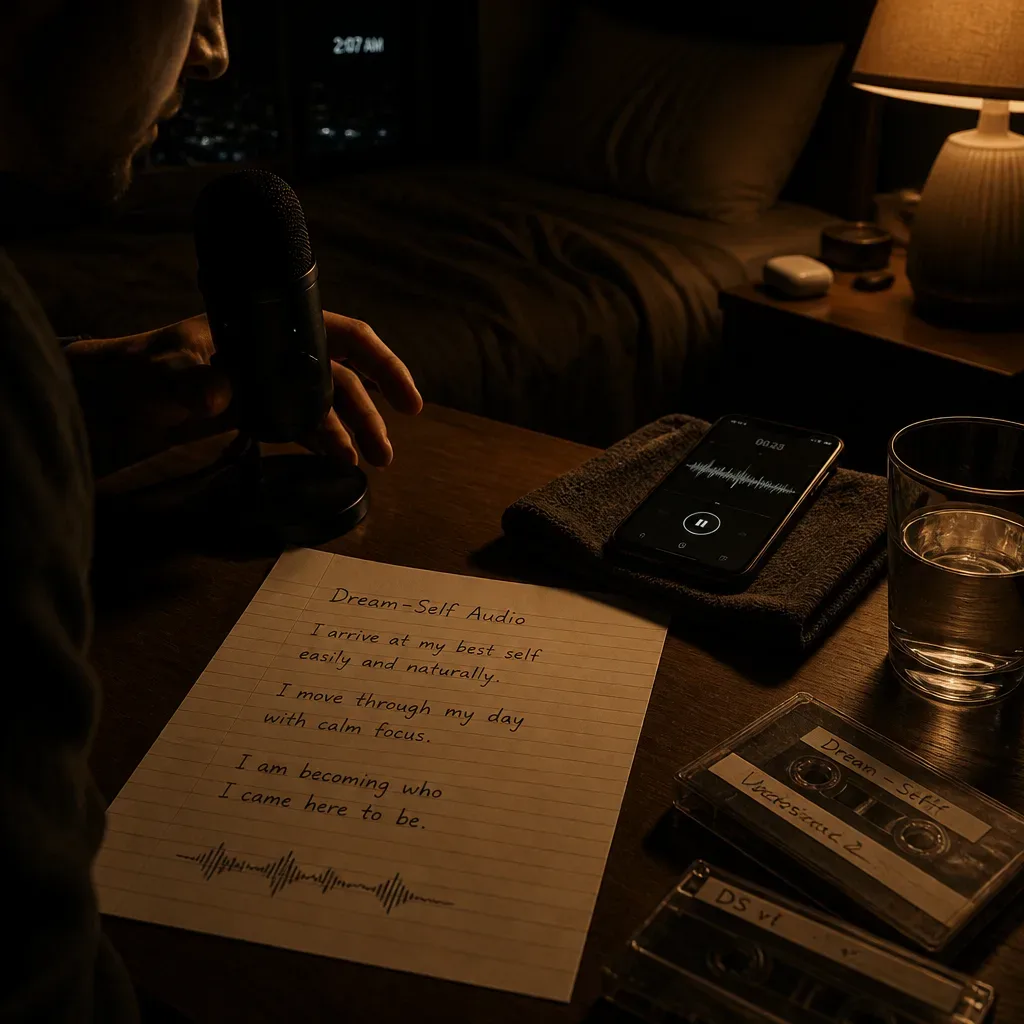
How do nights 3 and 4 deepen the Dream-Self script?
Nights 3 and 4 deepen the practice by making the words more specific while keeping the audio familiar.
By night 3, you know whether the track is sleep-safe. If it has not disturbed your rest, make one script edit. Replace vague lines with observable ones. I am confident is less useful than I answer the first email before 10. I am loved is less grounded than I speak softly when I want to defend myself. The brain can rehearse a scene more easily when the scene has handles.
Sleep cycles run about 90 minutes on average, though real nights vary. You are not trying to aim suggestions at a magic stage with stopwatch precision. The better target is the last 10 minutes before sleep, when the day is loosening and your attention is less guarded. That period is not a secret portal. It is simply a quiet doorway.
On night 4, keep the same wording and listen for resistance. Resistance is useful data. If a line makes your body tense, ask whether it is too grand, too soon, or not yours. A script that your nervous system rejects every night will become noise. Change I never doubt myself to I return to the next honest step. Change Everything is solved to I know what to do first.
This is also where audible hypnosis differs from many subliminal habits. With sleep affirmations, you can hear the phrase and decide whether it belongs in your room. With buried audio, you may like the sound but not know the script. Respect for the listener begins with a label and a clear voice.
A sentence you can believe at 11:42 p.m. is worth more than a grand claim you fight until morning.
What should you listen for on nights 5 and 6?
On nights 5 and 6, listen for carryover into the next day rather than for strange signs at night.
By the fifth night, repetition starts to show itself in small ways. You may hear a line while brushing your teeth. You may pause before an old habit. You may feel annoyed by the practice and still do the next right thing. That is normal. In behavior research, repetition and context matter; the popular 21-day habit rule is too neat, while a 2009 study by Lally and colleagues found habit formation varied widely, with an average around 66 days. Seven nights is a test, not a full identity change.
Use night 5 for one small action link. Add a line that points to tomorrow morning: When I wake, I do the first 5 minutes before I check my phone. Keep it practical. Manifesting talk gets cleaner when it names behavior. If the dream self never enters the calendar, the script stays decorative.
On night 6, reduce effort. Do not analyze the file in bed. Do not ask whether it is working while it plays. That question wakes the mind. Press play, hear the first few lines, and let the rest become familiar. If you are still awake after the track ends and feel alert, stop using repeat. A looping voice can turn into company for rumination.
For people who like community methods such as shifting scripts, the same rule applies: warmth is fine, sleep loss is not. If a method costs you sleep, it costs more than it gives.
The best night practice is quiet enough to survive an ordinary Tuesday.
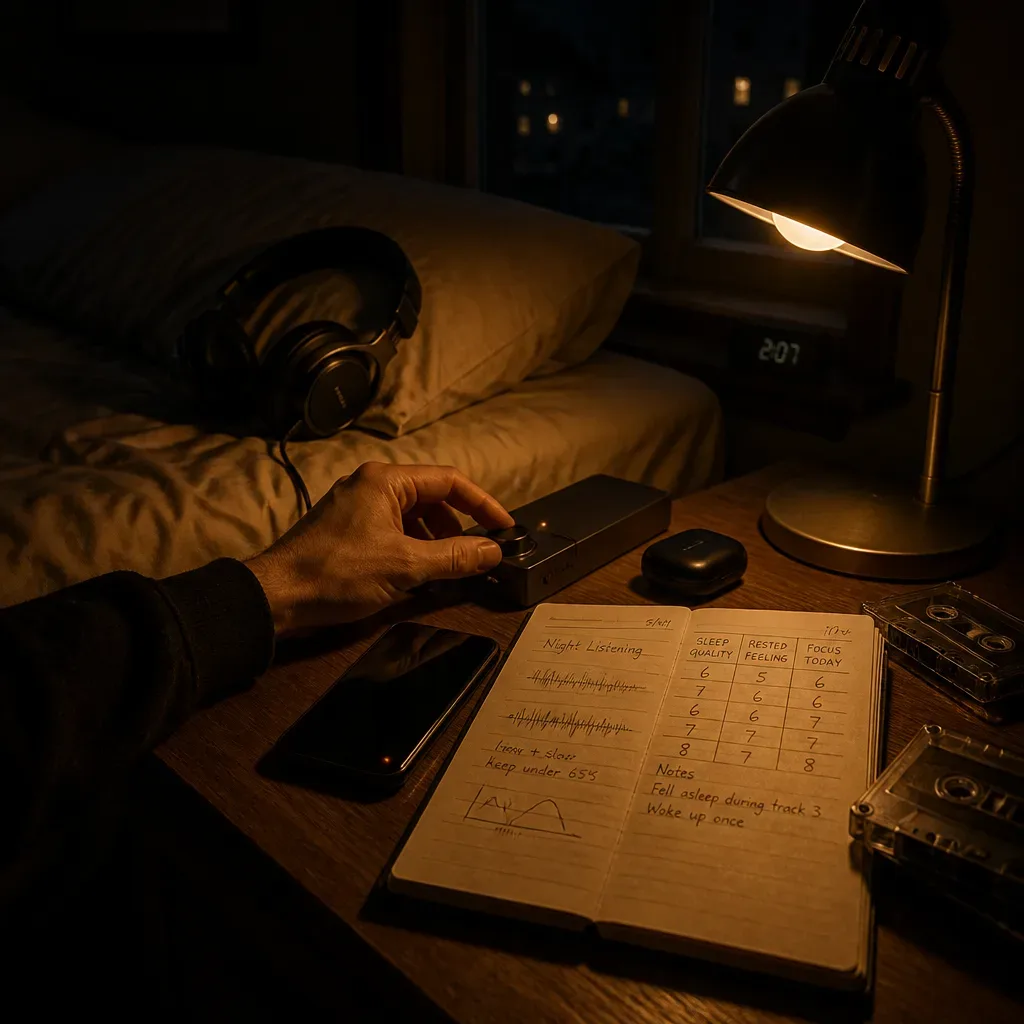
How do you finish night 7 and measure what changed?
You finish by listening one last time, then measuring sleep safety, script recall, and one real-world behavior.
Night 7 should not be a ceremony that keeps you awake. Keep the same bedtime, same volume, same track length. The Centers for Disease Control and Prevention has reported that about 1 in 3 U.S. adults do not get enough sleep. That number matters because many self-improvement practices quietly become sleep theft. Your routine passes only if it leaves your night intact.
The next morning, review the week with three plain scores from 0 to 2:
- Sleep safety: 0 means worse sleep, 1 means mixed, 2 means no harm or better rest.
- Word recall: 0 means no phrases stayed, 1 means one phrase stayed, 2 means several lines felt familiar.
- Day action: 0 means no related action, 1 means one tiny action, 2 means repeated action on at least 2 days.
A total of 5 or 6 means the routine is worth continuing with small edits. A total of 3 or 4 means shorten it or rewrite the script. A total of 0 to 2 means stop and return to basic sleep hygiene. If insomnia is ongoing or distressing, speak with a qualified clinician rather than trying to solve it with audio.
You can also compare this routine with the AYA Method if you want a more personal daily audio practice. The key difference is that the Dream-Self Moment is made for you and repeated as the core practice. The daily affirmation and Manifestation Board can support it, but the listening is the method.
Measurement does not make the practice cold. It makes it honest.
What should you avoid during a 7-night hypnosis routine?
Avoid anything that hides the script from you, raises arousal, or makes sleep feel like a performance review.
First, avoid unclear audio claims. If a track says it contains ultrasonic affirmations at 17,500 Hz, be cautious. Many adults cannot hear that high clearly, many phone speakers do not reproduce it well, and lossy compression can change what survives in the file. That does not mean every high-frequency track is fake. It means the claim deserves a spectrum view and a readable script. The Subliminals pillar is a better place to sort hidden-audio claims than a comment section at 1 a.m.
Second, avoid emotional spikes. Some hypnosis tracks use cinematic rises, sudden bells, or urgent commands. Those can be interesting in headphones at noon and terrible at bedtime. The World Health Organization night-noise guideline points to 40 dB outside as a protective target for sleep environments; personal audio is different, but the principle is useful: quieter is usually safer at night.
Third, avoid rewriting your intention every day. Novelty feels productive, but repetition is the point. Your mind needs enough sameness to recognize the path. Change one line if needed. Do not rebuild the whole room.
Fourth, avoid treating dreams as commands. Dreams can be emotionally useful, but they are not instructions you have to obey. If a dream disturbs you, write it down in daylight and return to ordinary care: food, movement, messages answered, rest protected.
Use this checklist before each night:
- The words are audible.
- The volume is low.
- The track is under 20 minutes.
- The intention is one sentence.
- The practice does not delay bedtime.
- I am allowed to stop if my sleep gets worse.
The last ten minutes before sleep are suggestible. Choose what goes in.
Keep the volume low enough that your sleep stays yours.