subliminals
Height Subliminals: Honest Claims and an Audio Swap
Height subliminals can shape attention and self-talk, but they can't promise bone growth. Here's the honest claim and a safer audio swap.

Height subliminals are audio tracks that hide or soften affirmations about getting taller under music, noise, or ambience. The honest answer is narrow: they may influence attention, posture, and self-talk, but there’s no solid evidence that subliminals can lengthen bones or reopen growth plates.
What are height subliminals actually claiming?
Height subliminals claim that repeated hidden affirmations can make you taller, usually by influencing the subconscious mind during sleep or relaxed listening.
Most height tracks use layered whispers, sped-up sentences, rain sound, music, or brown noise. The spoken lines often say things like your legs are growing, your spine is lengthening, or your ideal height is already yours. The listener may not consciously hear the words. That’s the defining feature of a subliminal: the message is below clear awareness, or at least hard to separate from the sound.
A subliminal is not the same as a normal affirmation. With sleep affirmations, you hear the sentence and consent to it in plain language. With subliminals, you often trust the maker, the title, the comments, and the community around the track. That trust is part of the practice. It’s also where the claim becomes hard to check.
The research base on subliminal priming is real but modest. In psychology, subliminal cues have shown short-term effects on attention, preference, or behavior under controlled conditions. A 2006 review in Current Directions in Psychological Science described subliminal priming as measurable, but context-dependent and usually brief. That is a long way from changing adult skeletal height.
A subliminal can nudge attention. It shouldn’t be asked to do the work of cartilage, hormones, and bone.
The height corner of YouTube and TikTok often turns a small research idea into a big promise. You may see comment sections reporting 2 inches in a week, 10 centimeters in a month, or overnight growth spurts. Treat those as stories, not measurements. Phone cameras distort angles, posture changes can look dramatic, and many people who listen are teenagers who may still be naturally growing.
Can height subliminals make you taller?
There is no good evidence that height subliminals can make a person physically taller after normal growth has ended.
Height is influenced by genetics, nutrition, hormones, sleep, health, and timing. The Centers for Disease Control and Prevention growth charts track height across childhood and adolescence because growth follows measurable patterns over years, not because a single practice can force it on command. In most people, long bones stop growing when growth plates close after puberty. That closure is a biological process, not a belief issue.
This matters because many height subliminal claims are aimed at people who are insecure, young, or both. If you’re 14, you may grow more because you’re 14, not because a track worked. If you’re 24, a subliminal is not likely to change the length of your femurs. It may change how upright you stand, whether you stretch before bed, or how often you compare yourself to other people. Those are still meaningful, but they need honest names.
There are small, real height changes during a normal day. NASA has reported that astronauts can be up to about 3 percent taller in microgravity because spinal discs aren’t compressed the same way. On Earth, many people are slightly taller in the morning than at night because discs rehydrate during sleep and compress during waking hours. That variation is usually measured in millimeters or around 1 centimeter, not permanent inches.
A careful answer also leaves room for medical reality. Some children and teens have growth concerns that deserve evaluation. Endocrine issues, delayed puberty, nutrition, and chronic illness can all affect height. If you’re worried about growth, pain, puberty, or sudden changes, a clinician is the right person to ask.
The problem isn’t wanting to feel taller. The problem is giving a hidden audio file a job it cannot prove it can do.
Why do height subliminals still feel persuasive at night?
Height subliminals feel persuasive because sleep-adjacent listening lowers resistance, repeats a simple identity cue, and gives the mind a nightly ritual.
The last part of the day is a strange doorway. You’re tired, less defended, and more likely to absorb tone. Dr. Andrew Huberman often describes sleep as a period when the nervous system consolidates learning, especially what was emotionally tagged during the day. That doesn’t mean any sentence before sleep becomes physical fact. It means repetition near sleep can matter for memory, attention, and the story you return to.
There is also the community effect. When 500 comments say a track worked, the file starts to feel less like audio and more like proof. Pew Research Center reported in 2023 that 95 percent of U.S. teens use YouTube, and TikTok sits close behind for many young people. That means body-change folklore can travel fast, especially when it comes wrapped in screenshots, countdowns, and before-after clips.
Height subliminals also use a clean feedback loop. You listen, you check the mirror, you stand straighter, you notice your legs, you measure again. Attention makes the body feel different. In body-image research, repeated checking is associated with greater dissatisfaction, even when the body hasn’t changed. The ritual may soothe for one night and then ask for more proof the next morning.
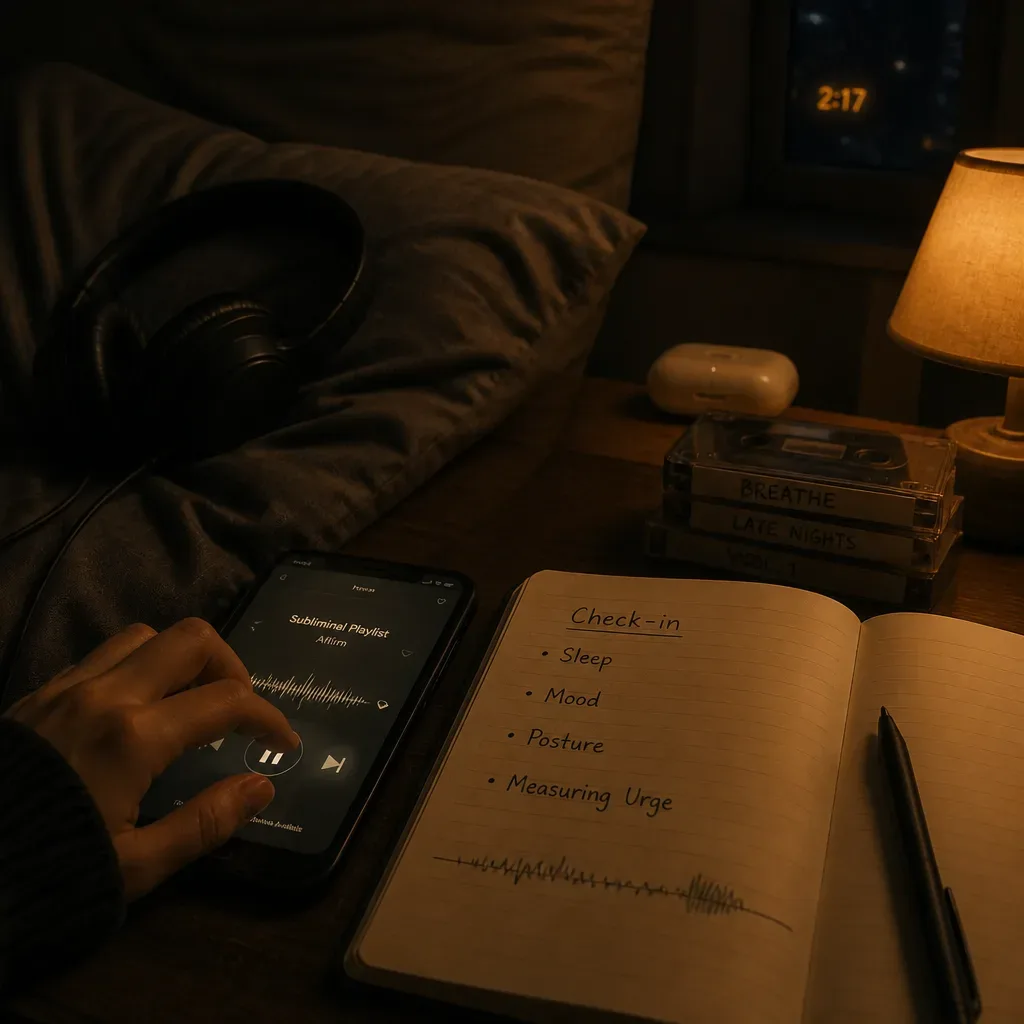
If a track helps you relax and stop insulting your body, that’s useful. If it makes you measure your height twice a day, avoid photos, or panic when nothing changes, the practice has tilted. Sleep practices should make the morning gentler, not turn it into a courtroom.
If the audio makes you kinder, keep listening carefully. If it makes you check, bargain, and lose sleep, the cost is already visible.
What can you listen for instead of height change?
You can listen for posture, presence, body neutrality, clothing confidence, and social ease instead of demanding literal height change.
This is where the swap gets practical. Instead of hiding claims you can’t verify, use audible words you can stand behind. A good height-related audio doesn’t need to say your bones are growing. It can say you stand with room in your chest, you stop shrinking in photos, you choose clothes that fit your actual body, and you speak without apologizing for your size.
The the AYA Method is a daily audio manifestation practice. Each day you listen to a short personalized recording — your Dream-Self Moment — narrated from the version of you who has already manifested the life you intend. Listening is the practice. Repetition is the work. The audio is the method.
The difference is consent and specificity. A subliminal hides the words under sound and hopes they land. A Dream-Self audio lets you hear every word. If the sentence is wrong, you remove it. If it makes you tense, you soften it. If it sounds like a stranger, you rewrite it until it sounds like you on a steady day.
Here’s the cleaner target:
- Not taller at any cost, but more at home in your frame.
- Not hidden commands, but audible rehearsal.
- Not compulsive measuring, but one nightly listen.
- Not a borrowed body ideal, but a version of you who stops folding inward.
You can still like height subliminals. You don’t have to sneer at what comforted you. But if a claim needs your body to break biology, it may be kinder to change the claim.
How do you make a Dream-Self audio swap for height subliminals?
Make the swap by replacing bone-growth claims with audible, body-respecting lines you can repeat every night without feeding obsession.
Start with a short script, about 120 to 180 words. That’s usually 60 to 90 seconds when spoken slowly. Keep it boring enough to sleep beside. The point isn’t to perform a dramatic monologue. The point is to give your mind a repeatable place to land before sleep.
Use this order:
- Name the felt issue without insult. Say, I used to shrink myself in rooms, not I hated being short.
- Move into the Dream-Self Moment. Speak from the version of you who stands, dresses, and relates differently.
- Use body-neutral details. Mention posture, shoulders, breath, clothes, eye contact, and ease.
- Keep the claim believable. Don’t promise inches. Promise practice.
- End with sleep. Tell yourself the night can do its quiet work and that you don’t need to check anything now.
A useful line sounds like this: I stand as if I don’t need permission to take up my exact amount of space. Another might be: My clothes are chosen for the body I have, not the body I punish myself for not having.
If you want to keep using subliminals, keep them low-risk. Use files from creators who share the affirmations, avoid extreme titles, and don’t play 8 hours of stacked tracks if they disturb your sleep. The sleep cycle calculator can help you choose a wake time that protects full cycles, which are often estimated around 90 minutes each.
A simple comparison helps:
| Practice | What you hear | Honest target | Main risk |
|---|---|---|---|
| Height subliminal | Hidden or unclear affirmations | Attention and self-talk | Unrealistic body promises |
| Sleep affirmation | Clear repeated sentences | Mood and belief rehearsal | Repetition that feels false |
| Dream-Self audio | Your audible future-self scene | Identity practice and behavior cues | Overwriting it until it stops sounding yours |
The safer sentence is the one your waking mind can agree to and your sleepy mind can rest inside.
What should you expect after two weeks?
After two weeks, expect subtle changes in attention and behavior, not a guaranteed change in measured height.
Fourteen nights is enough to learn whether an audio practice fits your sleep. It is not enough time to prove a biological height claim. Use a small tracker with 3 or 4 markers: sleep quality, urge to measure, posture awareness, and mood on waking. If you’re using sleep affirmations or Dream-Self audio, also note whether the words still feel kind in daylight.
A two-week check might look like this:
| Marker | Good sign | Stop sign |
|---|---|---|
| Sleep | You fall asleep within your usual window | You stay awake replaying the track |
| Body image | You check less | You measure more |
| Posture | You notice standing straighter | You feel tense and monitored |
| Mood | Mornings feel quieter | Mornings feel like a test |
In sleep hygiene guidance, consistency matters more than elaborate routines. The American Academy of Sleep Medicine recommends adults get at least 7 hours of sleep per night, while teens need 8 to 10 hours. If a method cuts into those numbers, it isn’t helping enough to justify the loss.
By week two, a useful swap may show up in small ways. You stop hunching in group photos. You buy trousers based on fit, not punishment. You don’t open the measuring app before breakfast. These are not lesser outcomes. For many people, they’re the actual relief they wanted from height subliminals in the first place.
If you also come from the reality shifting side of sleep practice, the same rule applies: if a method costs you sleep, it costs more than it gives.
When should you stop using height subliminals?
Stop using height subliminals when they disturb sleep, increase body checking, or make your real body feel like a failed draft.
The clearest sign is sleep loss. If you keep restarting the track, stacking playlists, or waking to check results, the audio has moved from comfort to compulsion. Another sign is secrecy. If you feel embarrassed by how many hours you’re listening, or you’re hiding the practice because you know it has taken over, listen to that signal.
Body checking is another line. Measuring once a month at the same time of day is different from measuring every morning and night. Research on body dysmorphic symptoms often notes repetitive checking as a maintaining behavior. You don’t need a diagnosis to take the pattern seriously. If the practice makes the mirror louder, step away.
Choose audio that helps you return to yourself. The broader subliminals guide is useful if you want to understand how hidden-message audio works without turning every file into a promise. Keep your volume low, your claims plain, and your sleep protected.
If height worry is intense, persistent, or tied to eating, panic, depression, or avoiding people, talk with a qualified mental health professional or medical clinician. That sentence is not a dismissal. It’s care with a door handle.
The night can hold a kinder voice than the one that tells you to become someone else before morning.