subliminals
How Long Do Subliminals Take? A 7-Night Test
Wondering how long do subliminals take? Use this honest 7-night audio test to notice sleep, repetition, volume, and early signs without overclaiming.
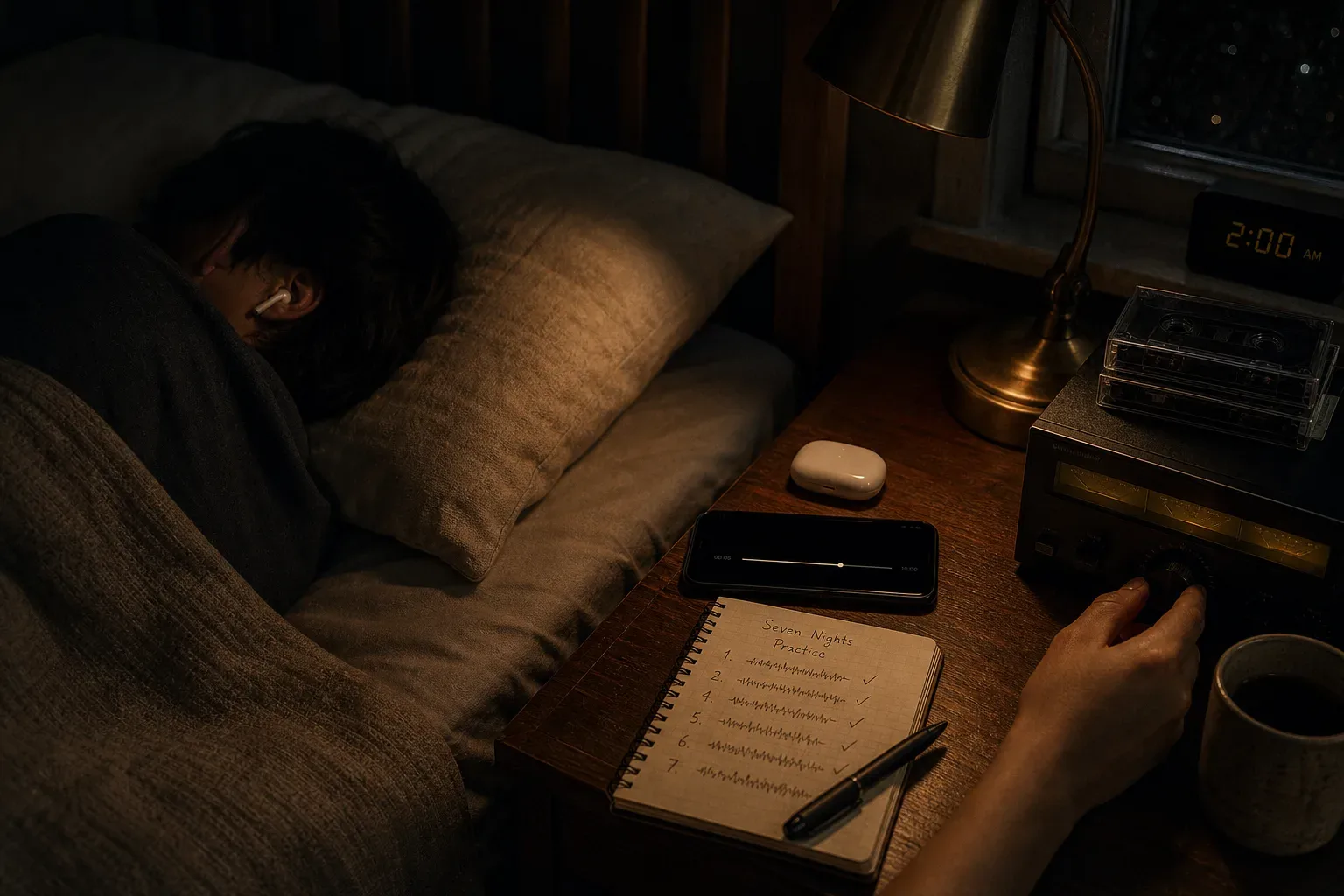
Subliminals usually take 7 to 30 nights before you can honestly notice whether anything is shifting, and the first signs are small. Use a 7-night test to track sleep quality, mood, recall, and behavior instead of chasing instant proof. If the audio disturbs sleep, stop or change it.
How long do subliminals take before you notice anything?
Most people need at least a week to notice anything reliable, and 30 nights is a fairer test for a repeated audio habit.
The honest answer is boring, which is why I trust it more. One night tells you mostly about novelty. Three nights tells you whether the track annoys you. Seven nights begins to show whether your body accepts the routine. In behavior-change research, repeated cues matter because they reduce friction; a 2009 study in the European Journal of Social Psychology found habit formation varied widely, with an average of 66 days for a new behavior to feel automatic. Subliminal audio is not the same as brushing your teeth, but repetition is still the working part.
A subliminal is an affirmation you cannot consciously hear. That is the whole trick, and the whole problem. If you cannot hear the words, you cannot easily audit them. You are relying on the maker, the mix, and your own response over time. The priming literature does show that brief cues can nudge perception or response in modest ways, but the strongest claims online are not the same thing as peer-reviewed evidence.
I would put the timeline this way: 7 nights for tolerance, 14 nights for early patterns, 30 nights for a fair decision. In my own sleep notes, the practices that survived were rarely dramatic by night two. They were quieter. I stopped resisting bedtime. I woke with a phrase in my head. I made one slightly better choice before breakfast.
A practice that only works when you monitor it every hour is not a sleep practice yet.
Use the first week as a clean test, not a verdict on your whole life. You are asking one narrow question: does this specific audio, played this way, make my nights or mornings measurably better?
What should you track during a 7-night subliminal test?
Track sleep, repetition, mood, and one behavior, because feelings alone are too easy to rewrite in the morning.
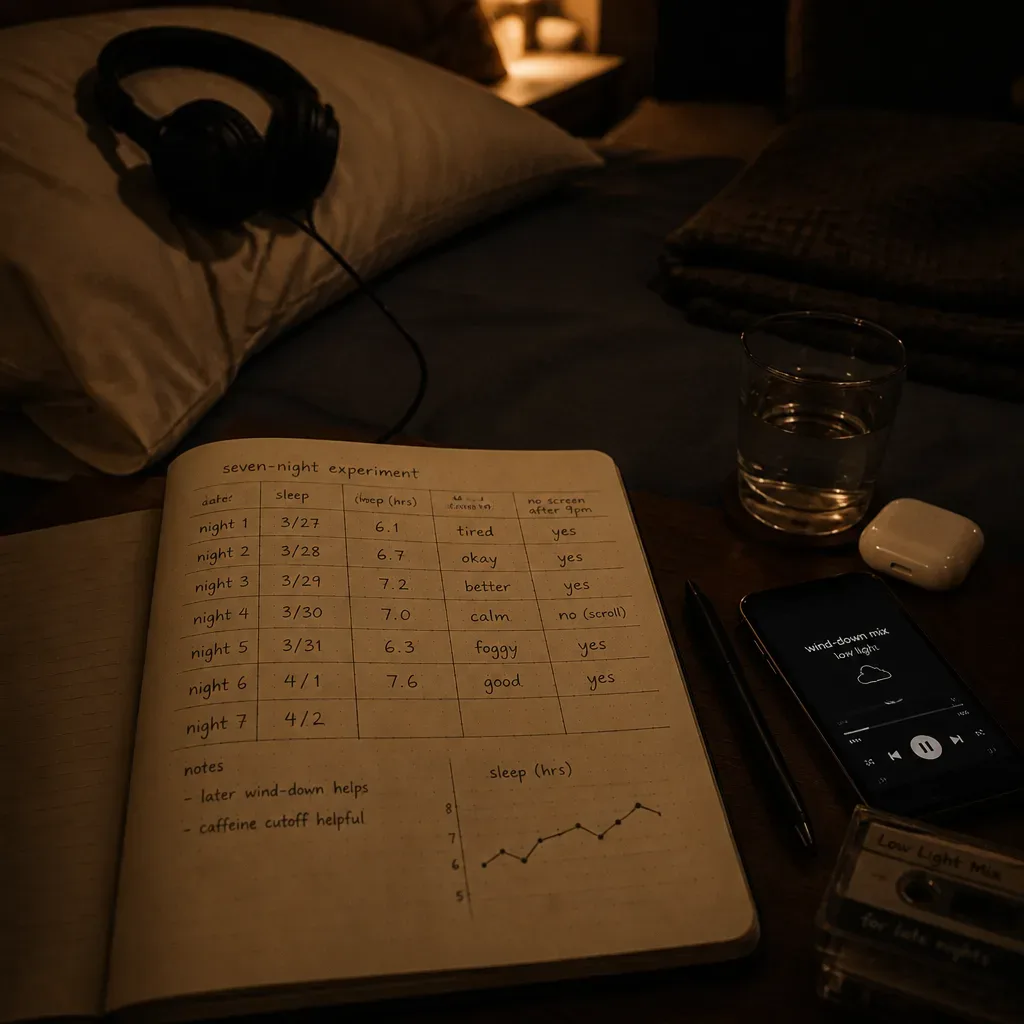
Keep the test small. I like four numbers and one sentence. The numbers are bedtime resistance from 1 to 5, sleep quality from 1 to 5, morning mood from 1 to 5, and whether you completed one target behavior. The sentence is simply what you noticed. The National Sleep Foundation often gives 7 to 9 hours as the adult sleep range, but your test should focus less on perfection and more on whether the audio helps you protect the hours you actually have.
Here is the clean version:
- Choose one subliminal track and do not change it for 7 nights.
- Play it at the same point in your routine, ideally during the last 10 to 30 minutes before sleep.
- Keep the volume low enough that it does not wake you or make you strain.
- Write the same five-line note each morning.
- Decide only after night 7 whether to continue, adjust, or stop.
Do not track ten outcomes. If your track is for confidence, choose one real behavior, such as speaking once in a meeting, sending one message, or standing by one boundary. If your track is for study, choose one action, such as starting a 25-minute session. A subliminal that claims to change everything gives you nothing clean to measure.
A simple table keeps the week honest:
| Night | Sleep quality 1-5 | Morning mood 1-5 | Target behavior done? | One note |
|---|---|---|---|---|
| 1 | Yes / No | |||
| 2 | Yes / No | |||
| 3 | Yes / No | |||
| 4 | Yes / No | |||
| 5 | Yes / No | |||
| 6 | Yes / No | |||
| 7 | Yes / No |
If you already use sleep affirmations, keep them separate for this week or you will not know which audio is doing what. Clean tests are kind to your future self.
Can subliminals work while you sleep, or only before sleep?
Subliminals may influence you around sleep, but the most dependable window is usually before sleep rather than deep sleep.
The last minutes before sleep are suggestible because attention is loosening but not gone. You can still hear tone, rhythm, and repeated phrases. Once sleep deepens, processing changes. Sleep researchers have found that the brain can respond to certain sounds during sleep, and targeted memory reactivation studies use cues such as tones or odors to strengthen previously learned material. That is not the same as learning a complex new self-concept from hidden words overnight.
This distinction matters. If someone says a subliminal will rewrite your beliefs while you do nothing, be careful. If someone says repeated audio may shape attention, expectation, and behavior over time, that is more reasonable. Dr. Andrew Huberman often talks about sleep as a state with distinct stages, not a single blank block. Audio that fits light sleep may still disturb deep sleep if it is too loud, too variable, or too emotionally loaded.
I prefer placing subliminals before sleep, then letting the track fade or loop very quietly. If I wake at 3 a.m. because a voice or frequency change pulled me up, the test has already failed for that night. Sleep is not a side effect of the method. Sleep is the floor under it.
For timing, use your actual bedtime instead of guessing. The sleep cycle calculator can help you plan a wake time around roughly 90-minute cycles, but do not make it another thing to obsess over. The point is to give your nervous system fewer surprises.
What signs mean a subliminal is starting to work?
The earliest signs are usually subtle changes in attention, choice, and emotional charge, not a sudden new life.
A good sign is remembering the theme without forcing it. You may notice a calmer response to the same old trigger. You may choose the target behavior one more time than usual. You may feel less embarrassed by the desire itself. In small studies on self-affirmation, such as work published in the Journal of Personality and Social Psychology, brief values-based reflection has been linked with reduced defensiveness under stress. That is not proof that hidden audio changes your future, but it does support the idea that repeated self-relevant language can matter.
Here are signs worth counting:
- You fall asleep with less negotiation.
- You wake with one phrase, image, or intention still present.
- You take a small action connected to the track within 24 hours.
- You feel less resistance around the subject.
- You stop needing to replay the track during the day to feel safe.
Be careful with signs that require you to ignore reality. If your sleep score drops from 4 to 2 for four nights, do not call that a purge. If you become anxious when you skip one listen, the audio is starting to act like a rule, not support. A quiet practice should make the day a little easier to enter.
The subliminals pillar goes deeper on what subliminals are and why the evidence is mixed. The short version is this: priming is real and modest; online certainty is often louder than the research. Your body does not care how many comments said it worked. It cares whether you slept.
The first sign is often not belief. It is less argument with the next right action.
When should you stop, change, or keep going?
Stop if the audio worsens sleep, change it if the test is unclear, and keep going only when the signal is gentle but consistent.
A 7-night test gives you three possible outcomes. First, the track helps: sleep is the same or better, mood is steady, and the target behavior appears more often. Continue for another 14 to 23 nights. Second, the track is neutral: no sleep harm, no clear benefit. You can either test it for 30 nights or choose a clearer practice. Third, the track hurts: more waking, headaches, dread, or compulsive checking. Stop. If insomnia is ongoing or severe, speak with a qualified professional; audio habits are not medical care.
Use this decision guide after night 7:
| Result after 7 nights | What it means | What to do next |
|---|---|---|
| Better sleep, small behavior shift | Good early signal | Continue to 30 nights |
| Same sleep, no behavior shift | Unclear | Adjust volume or script |
| Worse sleep for 2 nights | Cost is too high | Stop or switch format |
| Anxiety when not listening | Too much dependence | Take a break |
A common mistake is changing the track every night because the title promises faster results. That makes the test useless. Another mistake is raising the volume to make the subliminal work harder. Your sleeping body is not a locked door. It does not need to be forced open.
If you want a more transparent audio practice, this is where the AYA Method differs from subliminals. The AYA Method is a daily audio manifestation practice. Each day you listen to a short personalized recording - your Dream-Self Moment - narrated from the version of you who has already manifested the life you intend. Listening is the practice. Repetition is the work. The audio is the method. The daily affirmation and Manifestation Board can support the ritual, but they are not the center of it.
Hidden words can feel safe. Heard words can be checked, questioned, and chosen.
Are subliminals faster than audible affirmations or the AYA Method?
Subliminals are not reliably faster; they are simply less conscious, which can feel easier at first.
Speed depends on what you mean by work. If you mean feeling soothed, a soft subliminal can work on night one because sound changes the room. If you mean changing a repeated behavior, you need more time. Audible affirmations and personal recordings may feel more confronting, but they give you one advantage: you know exactly what you are hearing. That matters. A 2022 Pew Research Center report found that 35 percent of U.S. adults had used a health app, which says something plain about modern self-tracking: people want feedback, not mystery.
Here is the practical comparison:
| Practice | What you hear | Best use | Main risk |
|---|---|---|---|
| Subliminals | Words hidden under sound | Low-friction repetition | You cannot audit the script |
| Sleep affirmations | Clear repeated statements | Calming the last minutes before sleep | Phrases may feel fake |
| AYA Method | Personal Dream-Self Moment | Daily identity rehearsal through audio | Requires honest input |
| Sleep hypnosis | Guided voice and imagery | Relaxation and narrowing attention | Too much talking can wake you |
If direct affirmations make your mind argue, a subliminal may be a softer doorway. If hidden messages make you uneasy, use audible audio. There is no prize for choosing the most mysterious format. The practice you can repeat calmly for 30 nights beats the one you defend loudly for two.
For a cleaner audible option at bedtime, read the sleep affirmations pillar and notice how different it feels when the words are available to you. If you still prefer hidden audio, stay with it, but keep the test honest.
How do you run the 7-night test without fooling yourself?
You reduce self-deception by keeping one track, one volume, one target behavior, and one morning note for the full week.
The mind is a generous editor after midnight. It will turn one good morning into proof and one bad night into a crisis. That is why the test needs edges. Before night one, write down the track title, the reason you chose it, the volume setting, and the target behavior. If the track is 8 hours long, note whether you will loop it all night or use a 30-minute fade. The more you decide before sleep, the less you negotiate in the dark.
Use this short protocol:
- Pick a topic narrow enough to measure, such as calm study, easier sleep, or speaking with less hesitation.
- Choose one audio source you trust. If the creator will not show or describe the affirmations, note that risk.
- Set a volume that lets you sleep. Lower is usually better than clever.
- Listen for 7 nights in a row, unless sleep worsens clearly.
- Score the morning within 10 minutes of waking.
- Decide on day 8, not at 1 a.m.
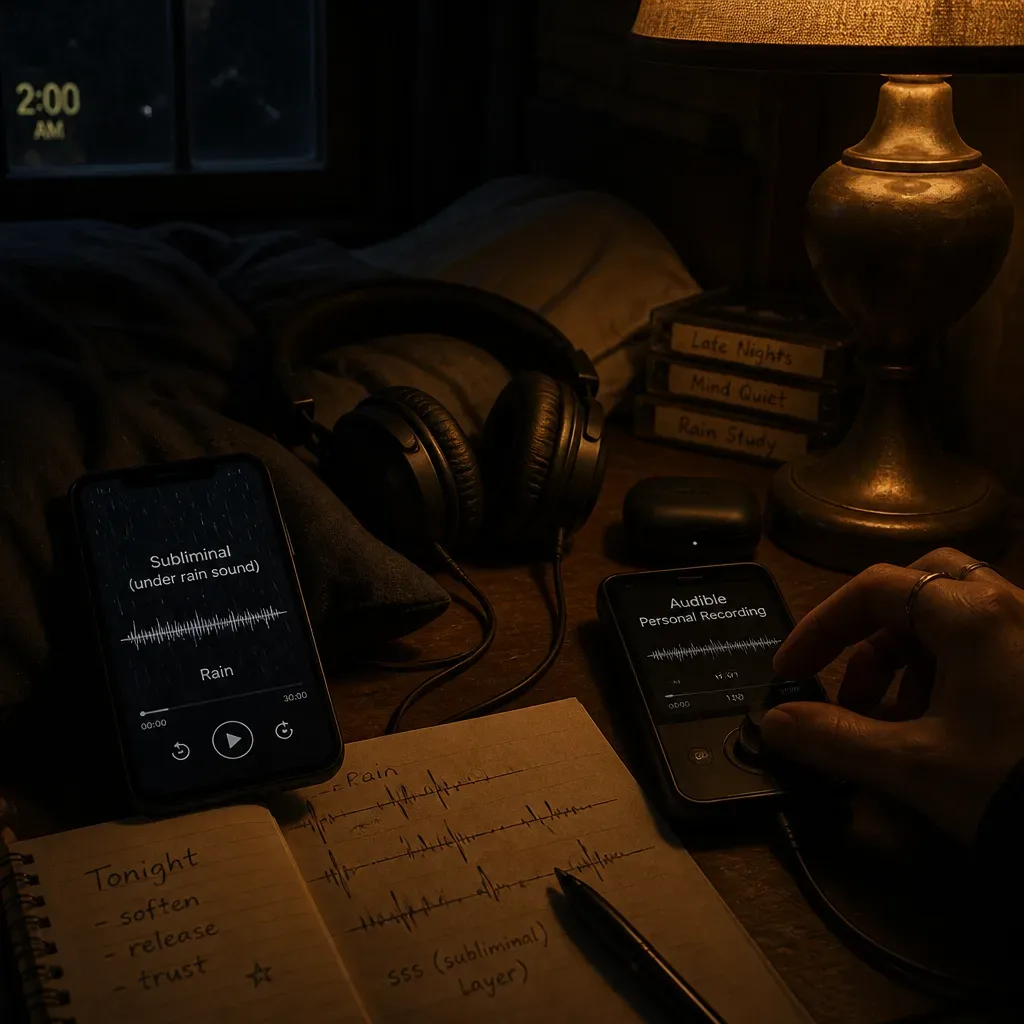
You can add one control week if you like. Seven nights with the subliminal, then seven nights with neutral rain noise, using the same tracking table. It is not a laboratory study, but it is better than memory. The Princeton Engineering Anomalies Research program is often cited in manifestation spaces, but even its controversial data was statistical and long-range, not a license to skip clean observation.
Also watch for confirmation loops. If you spend two hours reading comments after each listen, you are testing community suggestion as much as the track. That may still affect you, but name it correctly. What you hear while you sleep shapes you; what you read before sleep does too.
For people comparing methods, the AYA Method is useful because it removes the hidden-script problem. For people who love subliminals, the subliminals guide can help you choose safer, calmer audio. For timing your night around a real wake-up, use the sleep cycle calculator once, then put the phone down.
The cleanest test is the one your morning self can understand in under one minute.
Play it low, write it down, and let sleep stay in charge.