sleep science
How Much Sleep Do You Need Before Dream-Self Audio?
How much sleep you need by age, why short audio shouldn't steal rest, and how to place Dream-Self listening inside a quiet night routine.
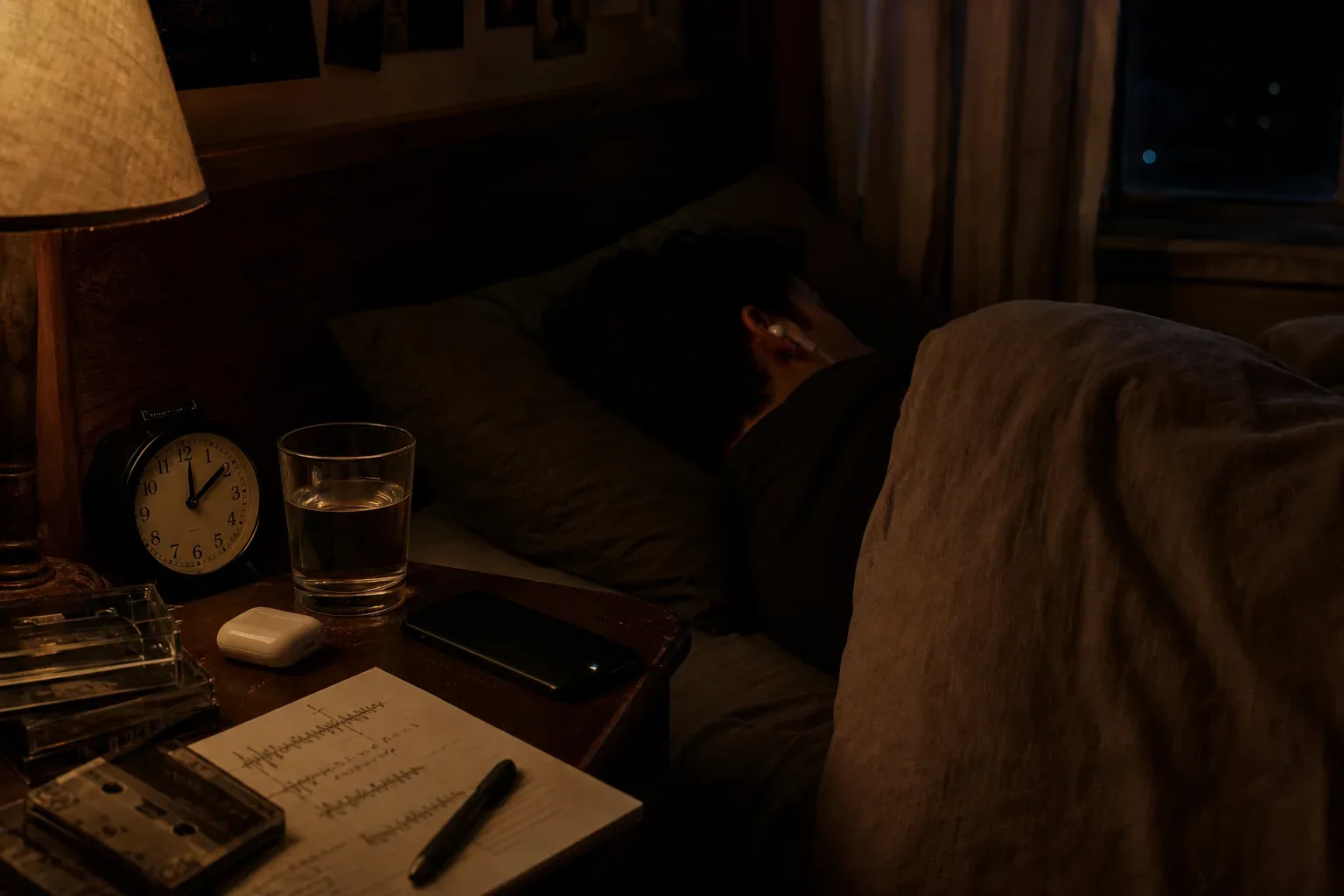
Most adults need at least 7 hours of sleep, and Dream-Self audio shouldn’t reduce that number. Treat the audio as part of your wind-down, not as a substitute for rest. If your recording is 6 minutes long, begin 6 minutes earlier, set it to stop, and let sleep stay first.
How much sleep do adults actually need?
Most healthy adults need 7 or more hours of sleep per night, with many people doing better around 8 to 9 hours.
The American Academy of Sleep Medicine and the Sleep Research Society published a consensus recommendation in 2015: adults should sleep 7 or more hours regularly for best health. The CDC repeats the same baseline for adults aged 18 to 60. That isn’t a moral rule. It’s a floor. Your body may ask for more after a week of poor sleep, a cold, grief, late caffeine, hard training, or several nights cut short by work.
The National Sleep Foundation’s age ranges are useful because they show how sleep need changes: teenagers usually need 8 to 10 hours, school-age children 9 to 12, and adults 7 to 9. Older adults are often listed at 7 to 8 hours, though sleep may become more fragmented with age. A number isn’t the whole story, but it gives you a quiet boundary.
If you want a practical way to count backward, use the Sleep cycle calculator tool. It works with the common 90-minute sleep cycle estimate, not because every cycle is exactly 90 minutes, but because planning in cycles is better than guessing at midnight.
Sleep is not the thing you fit around the practice. The practice fits around sleep.
A simple test helps: if you wake without an alarm on free mornings and feel steady by hour 2, your sleep window may be close. If you need 3 alarms, 300 mg of caffeine, and a second wind at 11 p.m., your number may be too low.
Does Dream-Self audio change how much sleep you need?
Dream-Self audio doesn’t reduce your biological sleep need, so the minutes you listen have to be added before sleep, not taken from sleep.
The AYA Method is a daily audio manifestation practice. Each day you listen to a short personalized recording, your Dream-Self Moment, narrated from the version of you who has already manifested the life you intend. Listening is the practice. Repetition is the work. The audio is the method. You can read the full practice as the AYA Method, but for sleep timing the rule is simple: keep the audio inside the pre-sleep margin.
If your bedtime is 11:00 and your wake time is 6:30, you have a 7.5-hour window. Add an 8-minute recording without moving bedtime, and your possible sleep drops to 7 hours and 22 minutes. Do that every night for 7 nights and you’ve removed 56 minutes from the week. That doesn’t sound dramatic, which is exactly why it happens.
Your brain doesn’t care whether the stolen minutes were used for scrolling, worry, or a beautiful sentence. Lost sleep is still lost sleep.
A better placement looks like this:
- Choose your target sleep window first, such as 7.5 or 8 hours.
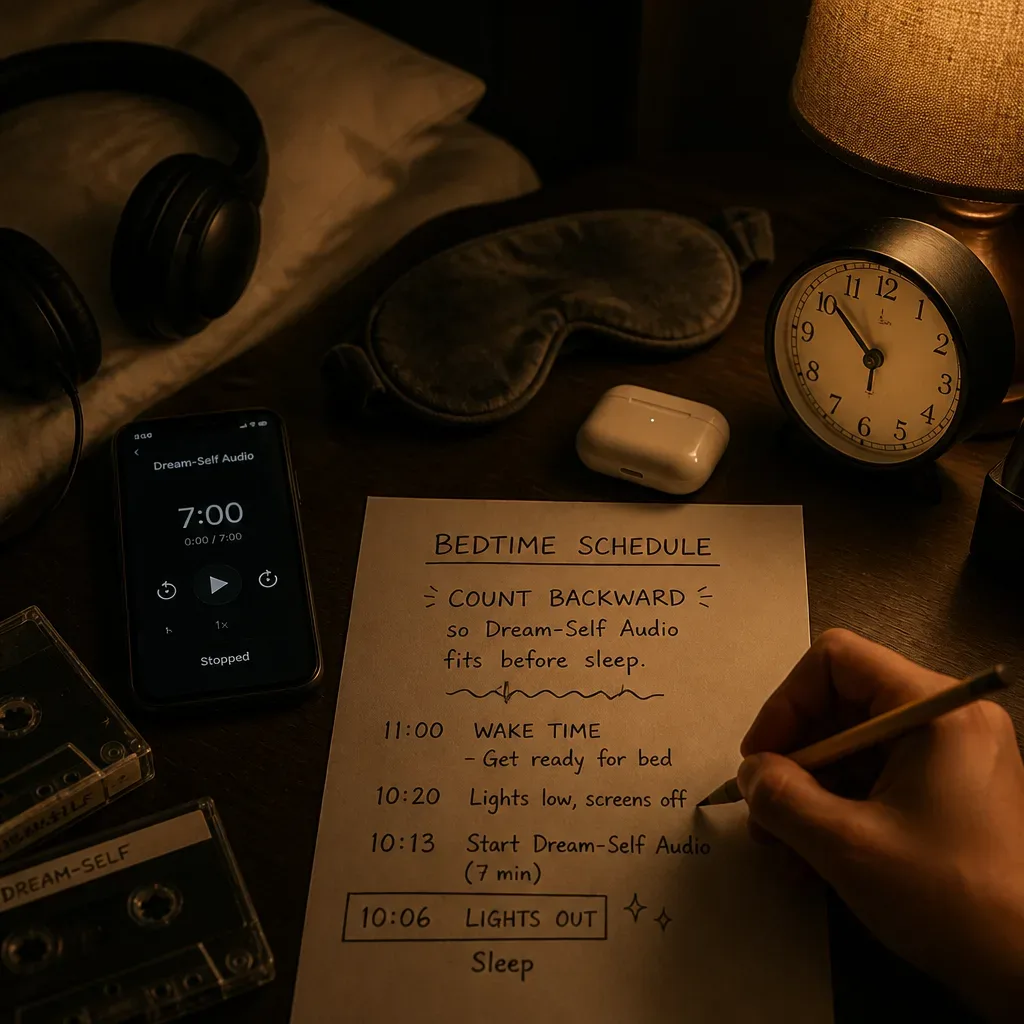
- Count backward from wake time.
- Add 5 to 10 minutes for audio before that sleep window.
- Set the recording to stop automatically.
- Keep the volume low enough that you don’t chase the words.
Small studies on pre-sleep suggestion and imagery are mixed, but repetition before sleep is plausible because the hypnagogic state reduces ordinary effort. Plausible isn’t the same as proven. It just means the practice deserves a clean test, not a shorter night.
When should you play audio so it doesn’t cost you rest?
Play audio during the last 5 to 10 minutes before sleep, or earlier in the evening if listening makes you alert.
The last part matters. Some people hear a personalized recording and soften. Others start evaluating every phrase. If you’re editing the script in your head, you’re not winding down. Dr. Andrew Huberman often points out that sleep timing depends on consistent cues: light, temperature, caffeine timing, and routine. Audio can become one of those cues, but only if it stays predictable.
A 2020 study in the journal Sleep Medicine Reviews reported that consistent sleep schedules are linked with better sleep and health outcomes, though causality is complicated. Your audio habit should support that consistency. Same chair, same side of the bed, same track length, same stopping point. Boring is useful here.
Here is a quiet placement table:
| If this is true | Place the audio here | Why |
|---|---|---|
| You fall asleep easily | Last 5 minutes in bed | It becomes a soft cue |
| You get curious and alert | 30 to 60 minutes before bed | It won’t steal sleep onset |
| You wake during tracks | Use a shorter file | Fewer sound changes at night |
| You strain to hear words | Slightly lower or simplify | Effort keeps the mind lit |
| You share a bed | Use one earbud or a pillow speaker | Less disturbance for both people |
For most sleepers, 5 minutes is enough. If you’re using sleep affirmations, the same timing applies. Short, repeated, familiar. The aim isn’t to flood the night with language. The aim is to choose the last words you hear on purpose.
What volume is low enough for sleep listening?
The right volume is audible without effort, but quiet enough that you could ignore it.
I like the 2-test rule. First, play the track at the lowest level where you can understand ordinary sentences while lying still. Second, turn it down one small step. If you tense your forehead to hear, it’s too low. If the voice feels like a person standing in the room, it’s too high.
The World Health Organization’s 2018 environmental noise guidance notes that nighttime noise can disturb sleep, and many sleep labs use arousal thresholds to measure brief awakenings. You don’t need lab equipment to apply that lesson. Sudden volume shifts, bright music, hard consonants, and ads are the common offenders. A track can have kind words and still be badly built for sleep.
A subliminal is different because the affirmation is hidden under sound. That’s the whole trick, and the whole problem. The priming literature is real but modest; it doesn’t support most big claims made on video platforms. If you’re comparing formats, the Subliminals pillar lays out the difference between masked words, audible suggestion, and belief practice without treating listeners like fools.
Use these audio settings when sleep is the priority:
- No autoplay queue after the track ends.
- No sudden bell, chime, or music swell.
- No ads, spoken intro, or creator reminder.
- A timer that stops within 5 to 10 minutes.
- One familiar recording for at least 7 nights before judging.
The sleeping mind doesn’t need more content. It needs fewer surprises.
If you use headphones, keep safety and comfort plain. One soft earbud is often better than two. Over-ear headphones can press the jaw or neck. If a device makes you wake to adjust it, the device is part of the problem.
How do you know if you’re sleeping enough while adding audio?
You know by tracking sleep pressure, daytime steadiness, and how often you need to recover on weekends.
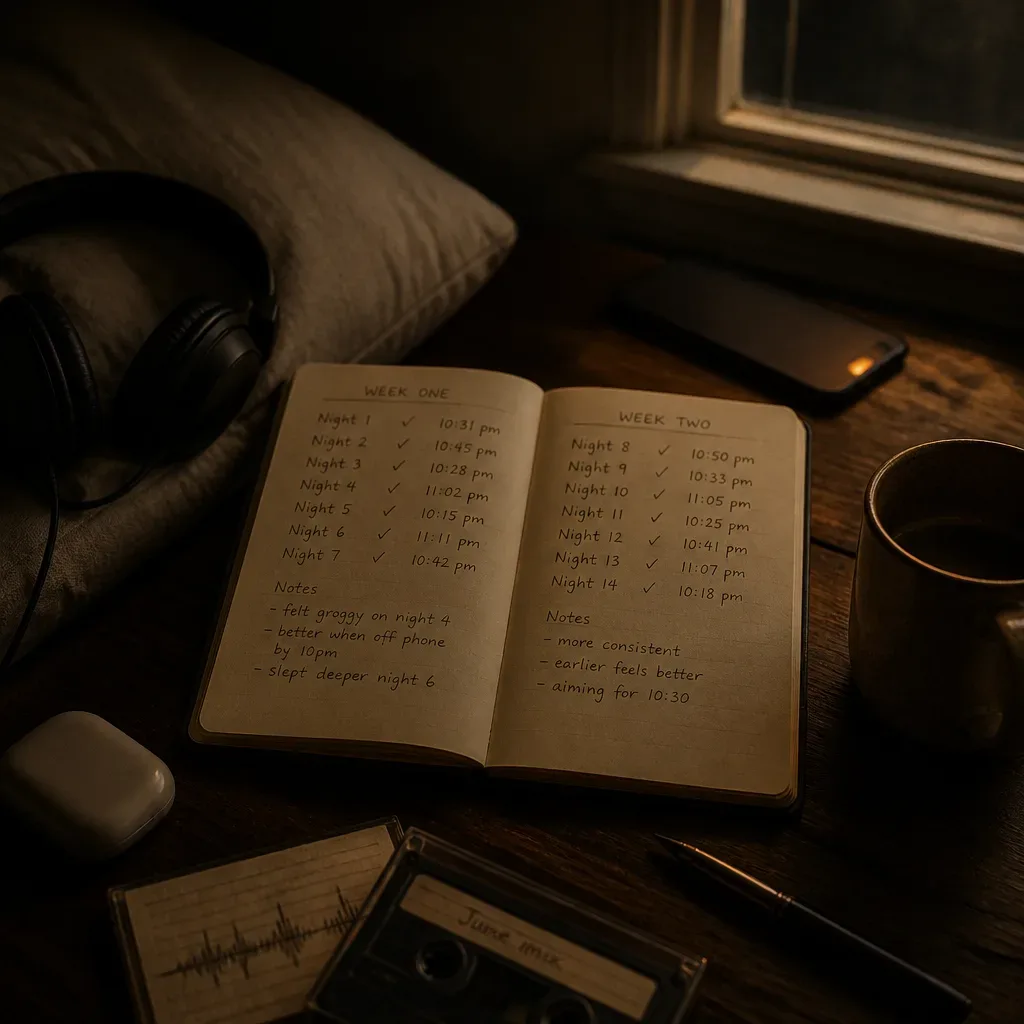
You don’t need a wearable, though a wearable can help if you don’t worship it. Track 4 things for 14 nights: bedtime, estimated sleep onset, wake time, and how you feel 2 hours after waking. The 2-hour mark matters because sleep inertia can make almost anyone feel dull during the first 20 to 60 minutes, especially after waking from deep sleep.
A simple paper log often beats a complicated app because you can see the pattern without getting anxious about a score. The American Academy of Sleep Medicine uses sleep diaries in clinical settings for a reason: timing, regularity, and perception matter. If your audio nights show later sleep onset by 20 minutes or more, move the recording earlier.
Try this 14-night check:
- Nights 1 to 7: keep your normal sleep routine with no bedtime audio.
- Nights 8 to 14: add your Dream-Self audio, but begin it 5 to 10 minutes earlier than your usual lights-out.
- Compare wake time, night waking, and morning steadiness.
- Keep it only if sleep is the same or better.
This is not a clinical trial. It’s a respectful self-check. Many published sleep studies use much larger samples and controlled conditions, while your bedroom has laundry, messages, neighbors, and a body with a history. Still, 14 nights gives you more information than one excited evening.
The honest result may be: this works better after dinner than at bedtime. That’s not failure. The audio is still the method in the AYA Method; bedtime is only one possible listening window.
What should you avoid after midnight?
Avoid anything that raises effort, emotion, brightness, or choice when your body is trying to descend.
This is where good practices go wrong. You open a new track at 12:14 a.m. You read comments to see if it worked for other people. You compare sleep affirmations with subliminals. You change the script. You search how much sleep you can survive on. Suddenly the practice has become research, and research is not sleep.
Pew Research Center has reported for years that phone ownership is nearly universal among adults in the United States, and bedside phone use is common even when people know it hurts sleep. Blue light isn’t the only issue. Choice is stimulating. Social proof is stimulating. A new voice is stimulating. Your nervous system reads novelty as something to stay awake for.
If you’re awake after midnight, keep the rule narrow:
- No new audio.
- No comment sections.
- No volume experiments.
- No script editing.
- No checking tomorrow’s calendar unless it’s truly needed.
A night routine fails when it asks the tired mind to keep making decisions.
If you can’t sleep after about 20 minutes, many CBT-I protocols suggest getting out of bed briefly and doing something quiet in dim light until sleepy. That advice is often used for insomnia, and it should be guided by a professional when sleep problems are persistent. For ordinary restless nights, the spirit is helpful: don’t turn the bed into a place where you practice frustration.
What’s the cleanest way to combine enough sleep and daily audio?
Set your sleep window first, then attach one short audio practice to the edge of it.
Here is the clean version I give people because it removes negotiation. Pick a wake time you can keep 5 to 6 days per week. Choose a sleep duration that matches your age and your real body, usually 7.5 to 8.5 hours for adults. Count backward. Then place your Dream-Self audio before that line, not after it.
For example, if you wake at 6:45 and want 8 hours in bed, lights-out is 10:45. If your recording is 7 minutes, start listening at 10:38. If you also need teeth, water, and the dog, those happen before 10:38. This is plain. Plain works.
You can keep a daily affirmation or Manifestation Board nearby if they help you choose the words, but they are complements. The listening is the practice. In the same way, a recipe card isn’t dinner, and a calendar isn’t rest. The audio has to be heard, repeated, and kept small enough that you’ll return to it tomorrow.
If you’re still unsure, use the Sleep cycle calculator tool once, write your start time on paper, and stop calculating. Your night doesn’t need 9 tabs open. It needs one soft sentence, heard at the right time, and enough hours left for the body to do what only sleep can do.
Leave the recording at the edge of sleep, then let the night have the rest.