sleep science
Best Time to Wake Up: Plan Audio Around Sleep Cycles
Find the best time to wake up by counting sleep cycles, setting night audio wisely, and protecting the last quiet minutes before sleep.
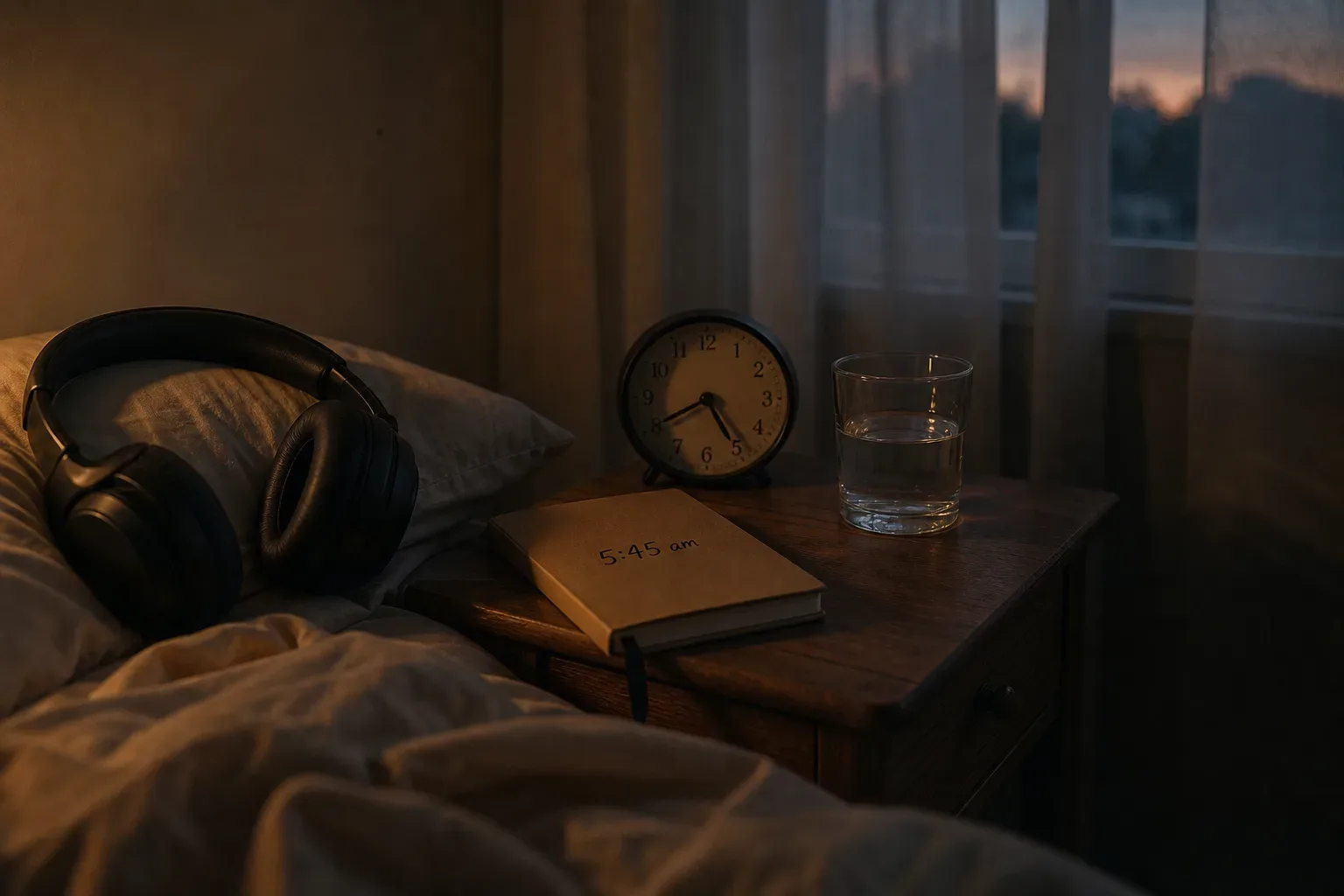
The best time to wake up is the time that lets you finish a sleep cycle instead of being pulled out of deep sleep. For most adults, plan around 7.5 or 9 hours in bed, add 10 to 20 minutes to fall asleep, and place your night audio before sleep, not across fragile morning REM.
What is the best time to wake up if you use night audio?
The best time to wake up is a consistent time that lands near the end of a sleep cycle and still gives you at least 7 hours of sleep.
Sleep is not one flat state. Adults cycle through lighter non-REM sleep, deeper slow-wave sleep, and REM sleep several times each night. A full cycle is often described as 90 minutes, though real cycles can range from about 70 to 110 minutes. The American Academy of Sleep Medicine says most adults need 7 or more hours per night. That makes 7.5 hours, or 5 rough cycles, a useful minimum target for planning.
Night audio changes the math because it adds one more event to the evening. A spoken track can help you stop rehearsing the day, but it can also keep you alert if the voice is too bright, the volume is too high, or the subject asks too much of you. The last ten minutes before sleep are suggestible. Choose what goes in.
If your alarm is fixed at 6:30 a.m., count backward. Nine hours in bed points to 9:30 p.m. Seven and a half hours points to 11:00 p.m. If you normally take 15 minutes to fall asleep, start the audio 15 to 30 minutes before the cycle clock begins. That small buffer matters. In sleep diaries, sleep onset latency is one of the first numbers clinicians ask for because it changes the whole night.
A simple starting rule is this: set the wake time first, then protect the first fall-asleep window. If a method costs you sleep, it costs more than it gives.
How do sleep cycles change the way you set an alarm?
Sleep cycles matter because waking during lighter sleep usually feels cleaner than waking from slow-wave sleep.
The first third of the night holds more deep non-REM sleep. The last third holds more REM sleep and lighter transitions. That is one reason a 4:30 a.m. alarm can feel brutal after a late bedtime. You may be interrupting either a deep-sleep rebound or a REM-rich stretch, depending on timing. In lab sleep staging, slow-wave sleep is highest earlier in the night, while REM periods lengthen toward morning.
This is where a calculator helps, not because it knows your brain, but because it stops you from guessing. Try the Sleep cycle calculator tool with two options: one based on 7.5 hours and one based on 9 hours. Then test the one you can actually keep for 7 mornings. One night is weather. Seven nights is a pattern.
Here is a plain way to count backward:
| Needed wake time | 7.5 hours asleep | 9 hours asleep | Add fall-asleep buffer |
|---|---|---|---|
| 5:30 a.m. | 10:00 p.m. | 8:30 p.m. | 10 to 20 minutes |
| 6:30 a.m. | 11:00 p.m. | 9:30 p.m. | 10 to 20 minutes |
| 7:00 a.m. | 11:30 p.m. | 10:00 p.m. | 10 to 20 minutes |
| 8:00 a.m. | 12:30 a.m. | 11:00 p.m. | 10 to 20 minutes |
The table is not a moral test. It is a listening plan. If the 9-hour option is not realistic, take the 7.5-hour option seriously and make the audio short. The CDC has reported that about 1 in 3 U.S. adults do not get enough sleep. A beautiful bedtime routine does not fix a schedule that is 90 minutes short every night.
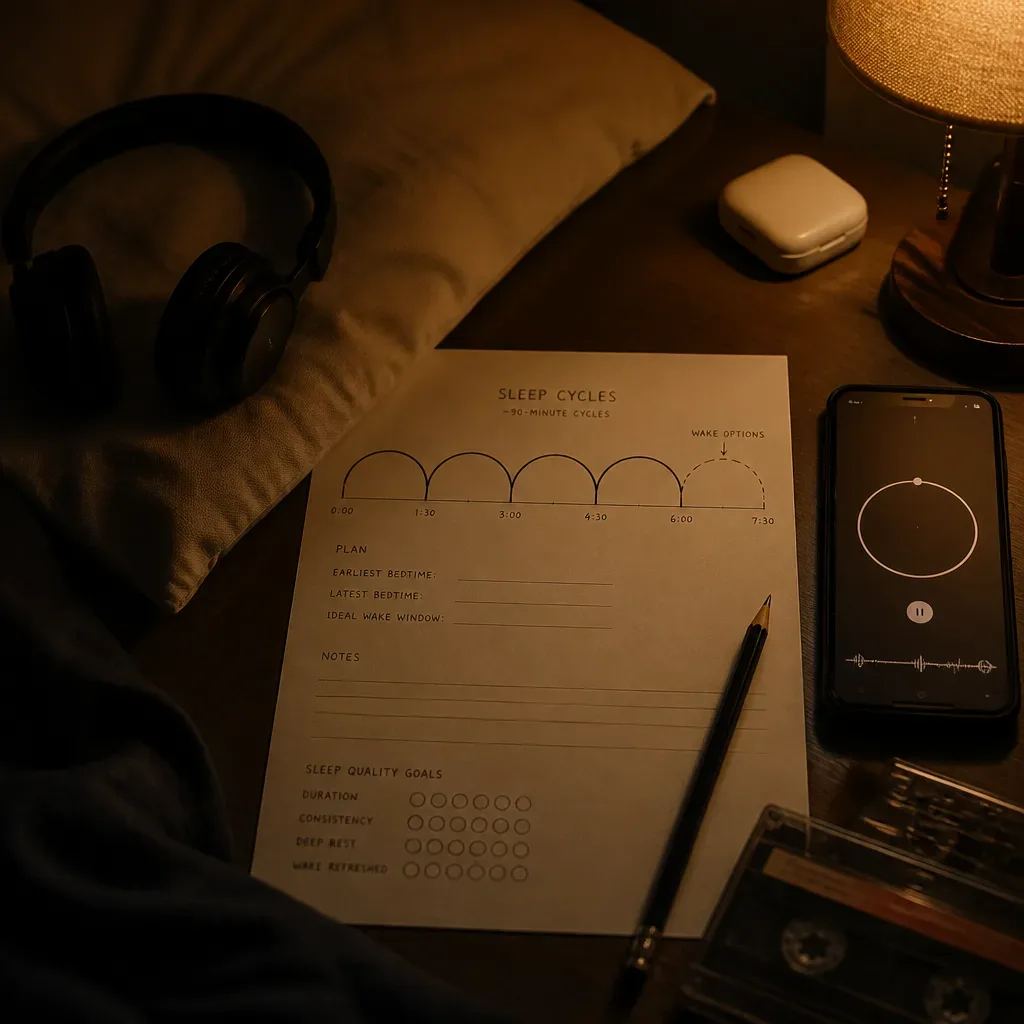
When should you play affirmations, subliminals, or sleep hypnosis?
Play spoken night audio in the first 10 to 30 minutes after getting into bed, low enough that you could ignore it.
This applies whether you use Sleep affirmations, a hypnosis-style induction, or a quiet personal recording. The purpose is to give attention one soft track to follow while the body moves toward sleep. In cognitive behavioral therapy for insomnia, stimulus control often asks people to reduce arousing behavior in bed. Audio can support that if it replaces scrolling, checking messages, or solving tomorrow at midnight.
Subliminals are different. A subliminal is an affirmation you cannot consciously hear. That is the whole trick, and the whole problem. Research on priming and nonconscious cues is real but modest; it does not support most giant claims made in video titles. If you use them, keep the sleep rule first: the sound bed should be stable, quiet, and boring enough not to wake you. For a deeper comparison, keep the Subliminals pillar close.
Use this order for a week:
- Put your phone face down or across the room.
- Start the audio before you feel desperate to sleep.
- Set volume at the lowest clear level, often below 30 percent on a phone speaker.
- Use a 20 to 30 minute timer unless you have tested all-night playback.
- If you wake during the track, shorten it the next night.
A useful track does not need to impress you. It needs to let you stop negotiating with the dark. If you have insomnia that lasts longer than basic sleep hygiene can explain, talk with a qualified clinician.
How do you build a wake-up plan around the AYA Method?
Use the AYA Method as a short daily listening practice before sleep, then let your sleep cycles stay in charge of the alarm.
The AYA Method is a daily audio manifestation practice. Each day you listen to a short personalized recording, your Dream-Self Moment, narrated from the version of you who has already manifested the life you intend. Listening is the practice. Repetition is the work. The audio is the method.
That definition matters because audible, personal speech asks something different from your attention than a masked subliminal does. You can hear every word. The voice and wording are yours. For night use, that means you do not need a long playlist. You need a repeatable placement: last thing before sleep, inside a wake plan that still gives you full cycles. The daily affirmation and Manifestation Board can complement the practice, but the listening is the center.
Here is a 15-minute setup that keeps the night simple:
- Pick tomorrow’s wake time first.
- Count backward 7.5 or 9 hours, plus your usual sleep-onset buffer.
- Start your Dream-Self Moment after lights are low.
- Listen once, or repeat only if the recording is brief and calming.
- Stop the audio with a timer before it becomes background noise you fight.
Dr. Andrew Huberman often points listeners back to consistent wake time and morning light because circadian timing responds strongly to repetition. The National Institute of General Medical Sciences describes circadian rhythms as roughly 24-hour cycles influenced by light and behavior. Your audio can become one of those behaviors, a cue that says: this day is closed.
Should you leave audio on all night?
Leave audio on all night only if it is steady, low, comfortable, and your morning notes show you wake well.
Some people like overnight sound. White noise, pink noise, rain, and low music can mask traffic or household interruptions. A 2017 Frontiers in Human Neuroscience study on pink noise and older adults found improved deep sleep markers under specific lab conditions, though that does not mean every sound app improves sleep. Speech is more complicated than noise because language can pull attention back online.
If your audio contains affirmations or hypnosis, all-night playback may catch you during brief awakenings. That can feel comforting. It can also fragment sleep if the voice changes volume, ads appear, or the content becomes emotionally charged. The American Academy of Sleep Medicine notes that adults typically wake briefly many times without remembering. You do not want your phone turning each micro-waking into a listening session.
Test it cleanly before you decide. Keep the same bedtime and wake time for 7 nights. Use overnight audio for 3 nights, then a timer for 3 nights, with one plain quiet night if you can. Track only four things: estimated sleep onset, remembered awakenings, dream intensity, and morning heaviness from 1 to 5. You are not trying to prove a belief. You are trying to hear what your sleep is telling you.
For most listeners, I prefer this compromise: spoken audio at bedtime, nonverbal sound after that if needed. It protects the practice without letting the practice take the whole night.
What should you expect by week two?
By week two, you should expect clearer timing signals, not a perfect morning or a new personality.
The first three nights are often noisy data. You may sleep better because the routine feels cared for. You may sleep worse because you are monitoring yourself. Both are common. In behavioral sleep medicine, 2 weeks of diary data is often more useful than a single wearable score because patterns need time to separate from mood, caffeine, illness, and late meals.
By days 7 to 14, look for small signs. You may start feeling sleepy near the same time. You may wake 5 to 15 minutes before the alarm once or twice. You may notice which audio topics settle you and which ones make your mind start planning. A practice that works at night usually feels less like effort over time.
Keep these checks honest:
- If you wake heavy, try moving bedtime earlier by one 90-minute cycle.
- If you lie awake listening, shorten the track to under 15 minutes.
- If you wake at 3 a.m. with the words in your head, use a timer.
- If you sleep well but dislike the content, change the words, not the whole routine.
- If weekend wake times drift by more than 2 hours, Monday will argue with you.
Pew Research Center has reported that large shares of adults keep phones near the bed, and sleep researchers have repeatedly linked late-night screen use with shorter sleep. Your night audio should not become another reason to handle the phone. Download it, queue it, dim it, and leave it alone.
The best routine is not the one with the most features. It is the one quiet enough to repeat when you are tired.
How can you choose the best time to wake up tonight?
Choose tonight’s wake time by fixing tomorrow morning first, counting backward in cycles, and placing one short audio session before sleep.
Use this quick plan. It takes less than 15 minutes, which is short enough to do when you are already in pajamas.
- Write the real wake time. Not the hopeful one. The one that gets you out the door.
- Choose 9 hours in bed if you can. Choose 7.5 hours if you cannot.
- Add 10 to 20 minutes for falling asleep. Add more only if your diary shows you need it.
- Set your audio to start when lights go low, not after an hour of scrolling.
- Set a timer for spoken audio. Let silence or steady nonverbal sound carry the rest.
- Check the morning feeling before you check the phone.
If you want a starting point, use the Sleep cycle calculator tool, then pair it with one practice page rather than ten open tabs. You can read the basics of sleep affirmations, compare them with subliminals, or use the AYA Method if you want audible, personal words instead of masked ones.
The hard part is not the counting. The hard part is respecting the answer when the clock gives it to you. A 6:00 a.m. alarm and a 12:45 a.m. bedtime is not a sleep-cycle plan. It is a debt with a ringtone.
Set the voice low, and let morning arrive without a fight.