subliminals
How to Listen to Subliminals: Volume, Timing, Swap
Learn how to listen to subliminals at night: safe volume, best timing, repeat length, and when to swap hidden audio for an audible recording.
To learn how to listen to subliminals, keep the audio low, choose one trusted track, play it for 10 to 30 minutes before sleep, and repeat it for about 14 nights before judging. If hidden words make you uneasy, swap to an audible recording you can hear and consent to.
What counts as listening to subliminals correctly?
Listening correctly means making the practice quiet, consistent, and safe enough that sleep still comes first.
A subliminal is usually an affirmation track where the words sit below music, rain, brown noise, or another mask. You may hear rhythm, texture, or a faint voice, but you can’t consciously make out the sentences. That’s the whole trick, and also the reason to be careful. If you can’t hear the words, you’re trusting the maker, the mix, and the description.
The evidence is modest. Subliminal priming has been studied for decades, including classic lexical decision work by Meyer and Schvaneveldt in 1971 and later social-priming debates. The finding that matters here is narrow: unseen or barely heard cues can influence very short-term responses under controlled conditions. That is not the same as a YouTube title promising a new face in 24 hours.
A famous self-help tape study by Anthony Greenwald and colleagues, published in Psychological Science in 1991, found that commercially labeled subliminal tapes did not improve memory or self-esteem beyond expectation effects. People often believed they improved when they thought they had the right tape. That doesn’t make your nightly ritual worthless. It means the honest claim is smaller: repetition, expectation, bedtime attention, and mood may matter more than hidden wording alone.
Use this simple standard: if the audio helps you return to the same intention without stealing sleep, it’s doing something useful. If it makes you anxious, compulsive, or awake at 2 a.m., it’s too expensive.
A method that costs you sleep costs more than it gives.
For background on hidden affirmation audio, read the Subliminals pillar. If your track is closer to spoken phrases you can hear, the Sleep affirmations pillar is the better map.
What volume should subliminals be at during sleep?
The best volume is the lowest setting that keeps the masking sound audible without pulling your attention.
For most people, that means the audio feels like part of the room, not the main event. If the rain loop, music, or whisper makes you listen for it, lower it. If you’re using speakers, start around the lowest 10 to 20% of your device range and adjust for the room. If you’re using earbuds or headphones, be more conservative because the sound sits close to the ear.
The World Health Organization has warned that unsafe listening habits put more than 1 billion young people at risk of hearing damage, mostly through loud personal audio and noisy venues. Many consumer hearing guides use the rough 60/60 rule: no more than 60% volume for no more than 60 minutes at a time. That rule wasn’t written for subliminals, but it’s a useful ceiling. Night listening should usually be much softer than that.
There’s another reason to keep it low: sleep is fragile. The American Academy of Sleep Medicine recommends adults get at least 7 hours of sleep on a regular basis. A track that makes you wake often, turn over, or check whether it’s working is working against the one biological condition that supports memory, mood, and attention.
Try this 5-step volume check:
- Play the track while sitting in bed.
- Set it lower than you think you need.
- Turn your head away from the speaker or lie in your normal position.
- Notice whether your body softens or starts monitoring the sound.
- Reduce the volume again if you feel pulled toward it.
| Listening setup | Better starting point | Watch for |
|---|---|---|
| Phone speaker beside bed | 10 to 20% volume | Tinny sound, sudden ads, bright screen |
| Small room speaker | Very low room tone | Bass vibration, looping clicks |
| Wired earbuds | Below casual music level | Ear pressure, cable discomfort |
| Sleep headband | Lowest clear setting | Heat, pressure, waking after cycles |
Quiet is not a weaker version of the practice. Quiet is the condition that lets the practice repeat.
When should you listen: before sleep, during sleep, or after waking?
Start before sleep, because it’s easier to keep consistent and easier to stop if the audio disturbs you.
The last 10 to 30 minutes before sleep are useful because you’re already reducing input. Lights go down, speech slows, and the mind has fewer tasks. Sleep researchers often describe normal sleep latency as roughly 10 to 20 minutes for many adults, though it varies. That window is long enough for repetition without turning the whole night into a listening test.
Overnight playback sounds tempting because it promises 6 to 8 hours of exposure. The problem is that more minutes are not automatically better. Sleep moves through cycles of about 90 minutes, with lighter and deeper stages shifting across the night. Audio that seems soft at 11 p.m. can feel intrusive during a lighter sleep stage at 4 a.m.
Dr. Andrew Huberman often talks about the importance of light, temperature, and timing for sleep regulation. Audio is part of that timing environment too. If you use sound every night, make it predictable: same track, same volume, same shutoff. Your nervous system likes fewer surprises at bedtime.
A good timing plan looks like this:
- Nights 1 to 3: 10 minutes before sleep, no overnight playback.
- Nights 4 to 7: 20 minutes before sleep if sleep remains steady.
- Nights 8 to 14: 20 to 30 minutes, with a timer that stops the track.
- After 14 nights: decide from notes, not from hope.
If you want to plan the bedtime itself, use the Sleep cycle calculator tool to choose a wake time and work backward. The track should fit inside your sleep plan, not replace it.
The last ten minutes before sleep are suggestible. Choose what goes in.
Morning listening can help if your subliminal is for focus or confidence. Keep it short, around 5 to 15 minutes, and pair it with one real action. Hidden audio without behavior becomes background. Behavior gives the sentence somewhere to land.
How long should you repeat one subliminal before judging it?
Give one subliminal about 14 nights before you decide whether it belongs in your routine.
Fourteen nights is not a magic number. It’s a practical minimum. It covers two full weeks, enough to include workdays, off-days, and at least one night when your sleep is imperfect for reasons that have nothing to do with the track. It also prevents the common pattern of switching audio every night because a title promises faster results.
Behavior-change research is clear that repetition matters, but not on a fixed 21-day myth. A 2009 study by Phillippa Lally and colleagues in the European Journal of Social Psychology found habit automaticity took a median of 66 days, with a wide range from 18 to 254 days depending on the behavior. Subliminal listening is simpler than building a gym habit, but the lesson holds: one night is not a signal.
Track only what you’ll actually write down. A three-line note is enough:
- Track name and topic
- Minutes listened and volume setting
- Sleep quality, mood, or one behavior you noticed the next day
Avoid measuring impossible things. Don’t ask, “Did my whole self change?” Ask, “Did I fall asleep easily?” “Did I avoid the old spiral once?” “Did I speak to myself more kindly after waking?” The smaller question is more honest, and usually more useful.
Here’s a simple decision table after 14 nights:
| What you notice | What to do next |
|---|---|
| Sleep is steady and the topic still feels right | Continue another 14 nights |
| You like the sound but doubt the hidden words | Find a transparent script or make your own |
| You feel tense, obsessive, or awake | Stop the track |
| Nothing changes, but sleep is fine | Keep only if the ritual feels worth it |
One more test: would you still use the track if nobody online had praised it? If the answer is no, you may be attached to the claim, not the sound.
How do you choose a subliminal you can trust?
Choose a subliminal by treating the creator, wording, mix, and claims as part of the safety check.
Start with the description. A trustworthy creator tells you the topic, the general wording, the length, and whether the affirmations are sped up, layered, or reversed. You don’t need every sentence printed, though printed scripts are better. You do need enough information to say yes with your whole attention.
Be cautious with extreme claims. If a track promises medical results, dramatic body changes in hours, or control over another person, step away. The U.S. Federal Trade Commission has long challenged deceptive health and self-improvement claims, and the same common-sense standard applies here: extraordinary promises need evidence. A comment section is not evidence.
Sound quality matters too. Listen once during the day before using it at night. Check for sudden volume spikes, harsh frequencies, ads, glitches, or spoken interruptions. Many platforms normalize loudness differently, and one unexpected ad can wake you hard. If possible, use downloaded or ad-free audio and set a sleep timer.
A reliable subliminal usually has these signs:
- A clear topic rather than twenty unrelated goals
- A calm mix without abrupt changes
- A description that names the intention plainly
- No fear-based warnings about “detox,” “purging,” or punishment
- No pressure to listen for unsafe lengths
- No claim that you must ignore medical care
This is also where the AYA Method becomes relevant. The AYA Method is a daily audio manifestation practice. Each day you listen to a short personalized recording — your Dream-Self Moment — narrated from the version of you who has already manifested the life you intend. Listening is the practice. Repetition is the work. The audio is the method.
The difference is simple: a subliminal hides the words under sound and asks for trust; the AYA Method makes the words audible and personal. You can hear every sentence. The voice is yours, or made from your own intake. That doesn’t make subliminals bad. It just changes the consent level.
When should you swap subliminals for audible audio?
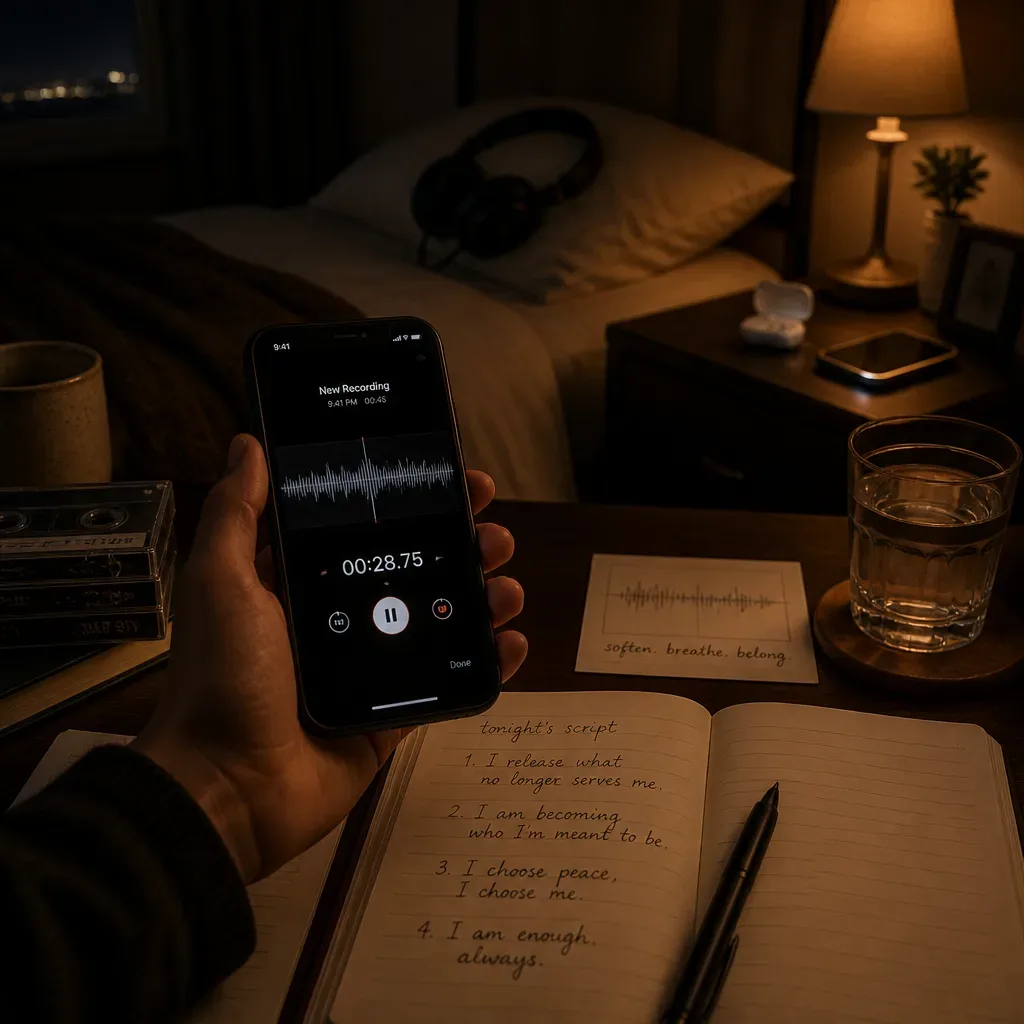
Swap to audible audio when you want to hear the exact words, use your own voice, or stop guessing what the track is doing.
I came to recorded self-audio before I had a name for it. In 2019, I read a 90-second script into my phone, played it on repeat before sleep, and hated the sound of my own recorded voice for about a week. Then it became ordinary. Then it became useful. The sentence lands differently when the speaker is you.
There’s a technical reason this helps: audible speech removes ambiguity. You don’t have to wonder whether the words are safe, whether they contradict your values, or whether the creator hid something strange in the mix. You can revise one line. You can delete one claim. You can record again when the old goal no longer feels like yours.
Research on self-referential processing gives this some support. Studies going back to Rogers, Kuiper, and Kirker in 1977 found that information related to the self is often remembered better than information processed in other ways. That doesn’t prove manifestation claims. It does explain why “I speak calmly in the meeting” in your own voice may feel different from a stranger whispering under rain.
Use this audible swap if:
- You keep checking subliminal comments for reassurance.
- You feel uneasy about not knowing the script.
- You want a practice built from your own words.
- You’re using sleep audio mainly for identity rehearsal.
- You want to combine night listening with a morning action.
Your recording can be short. Sixty to 120 seconds is enough. Keep it present-tense, believable, and specific. If a sentence makes your body argue, soften it. “I never feel fear” is brittle. “I return to my breath before I speak” is something you can practice tomorrow.
If you still like hidden audio, you don’t have to choose forever. Use subliminals for texture and audible recordings for clarity. The honest practice is the one you can repeat without bargaining with yourself.
For spoken night scripts, compare your track with the Sleep affirmations pillar. For hidden-word basics and formats, return to the Subliminals pillar.
What should you expect by week two?
By week two, expect steadier repetition, clearer preferences, and small behavior signals rather than dramatic proof.
The first few nights are mostly calibration. You learn whether the track annoys you, whether the loop has a click, whether the voice texture bothers you, and whether your room setup works. That is not wasted time. Technical friction is the reason many night practices fail before they become practices.
By nights 7 to 14, you should know three things: whether the volume is right, whether the timing protects sleep, and whether the topic still feels worth hearing. You may also notice ordinary shifts: you remember the intention at breakfast, pause before a habit, or choose one action that matches the script. Those are not fireworks. They’re data.
The National Sleep Foundation has noted that healthy adults often wake briefly during the night without remembering it. If your subliminal makes those wakings longer or more alert, count that. A practice can feel pleasant and still be bad for your sleep. If insomnia lasts for weeks or affects daytime safety, talk with a qualified professional.
Here’s a quiet week-two review:
- Did I sleep at least as well as usual on most nights?
- Did the audio feel safer or more irritating over time?
- Did I take one small action related to the topic?
- Did I become more calm, or more compulsive?
- Would I recommend this exact track to someone I care about?
Hidden words are not automatically deeper words.
If the answer is mostly yes, continue another two weeks. If the answer is mixed, lower the volume, shorten the session, or switch to audible self-recording. If the answer is no, stop. Stopping is not failure. It’s listening.
Use the Sleep cycle calculator tool again if the practice has drifted into late nights. Use the AYA Method if what you really want is a daily audible recording that names the self you’re practicing toward. Keep sleep affirmations close if hearing the words matters more than hiding them.
Put the track low, set the timer, and let the night stay yours.