subliminals
Money Subliminals: Build a 3-Minute Dream-Self Audio
Money subliminals can be too vague to use well. Learn how to make a short Dream-Self audio about money that is audible, calm, and repeatable.
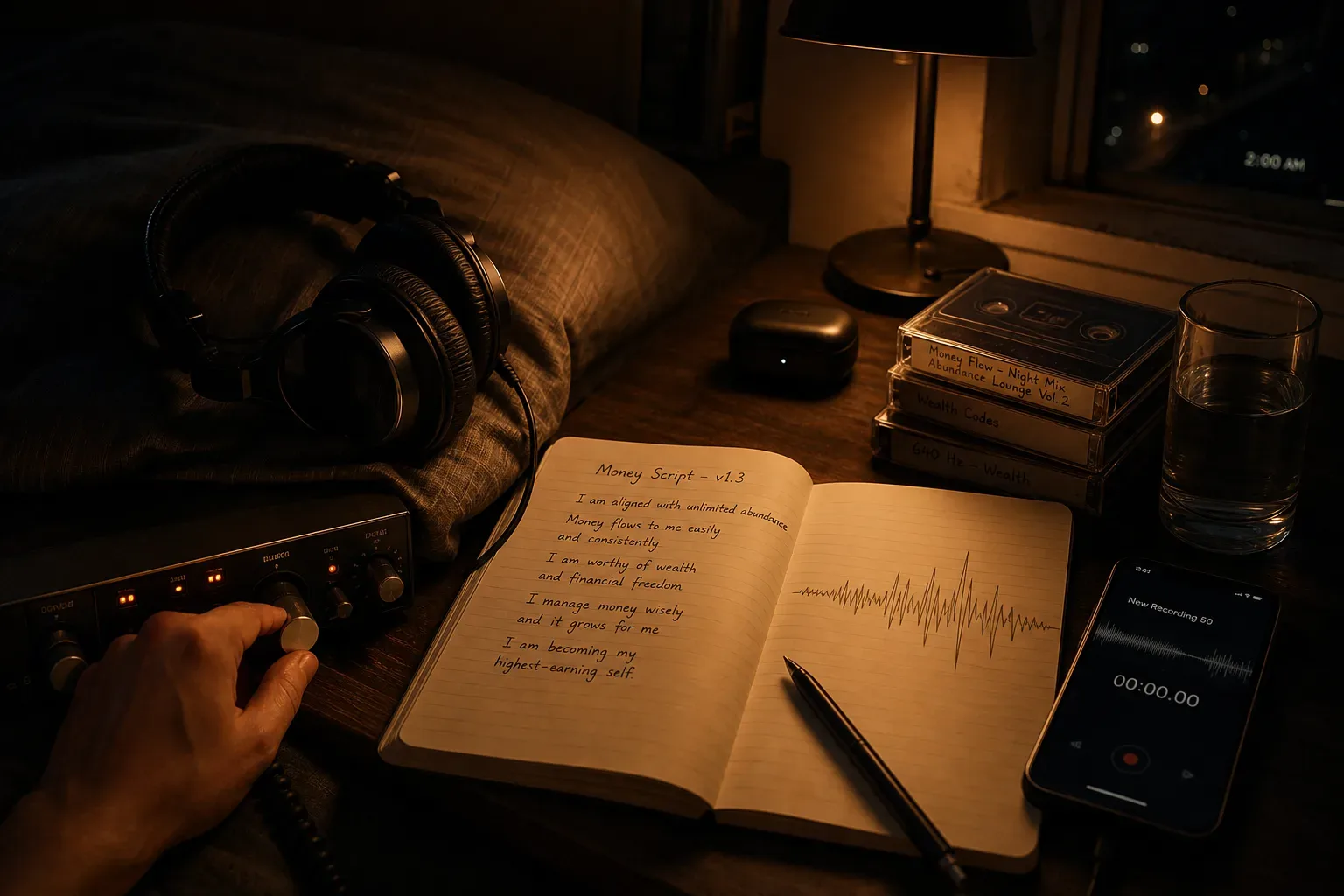
Money subliminals are audio tracks that repeat money-related suggestions, often below conscious hearing. A 3-minute Dream-Self audio does the same nightly repetition without hiding the words: you write a believable money scene, record it in your own voice, and listen before sleep for 14 nights.
What are money subliminals really doing?
Money subliminals are best understood as repeated cues, not as proof that hidden audio can directly change your bank account.
A subliminal is an affirmation you can’t consciously hear. That’s the whole trick, and also the whole problem. In older lab research, subliminal priming could briefly affect word recognition or preference under controlled conditions, but those effects were usually small and short-lived. A 1992 review in Psychological Bulletin by Greenwald and colleagues found that self-help subliminal tapes did not produce the sweeping results advertised at the time.
The internet version is much louder in its claims. A money track might promise sudden payments, debt removal, or a new identity by morning. That is not what the research says. The useful part of the practice is simpler: you repeat a sentence often enough that it becomes easier to notice, rehearse, and act from. “The sentence you repeat at night becomes the sentence you reach for under stress.”
For money, that matters because money stress is bodily. A 2023 American Psychological Association report found that money was a significant source of stress for 65% of U.S. adults. When you’re tense, you may avoid opening the banking app, delay an invoice, or say yes to work that should be priced higher. A calm audio can give you a rehearsed alternative.
If you want the broader background, read the Subliminals pillar before you build your own track. It explains the difference between masked audio, affirmations, hypnosis, and expectation. The quiet rule here is plain: don’t ask hidden words to do what only repeated behavior can do.
A money audio is not a spell. It is a rehearsal you can hear.
Why choose a Dream-Self audio instead of hidden money subliminals?
Choose a Dream-Self audio because you can hear every word, edit every claim, and keep the practice personal.
The AYA Method is a daily audio manifestation practice. Each day you listen to a short personalized recording — your Dream-Self Moment — narrated from the version of you who has already manifested the life you intend. Listening is the practice. Repetition is the work. The audio is the method. You can read the full practice here: the AYA Method.
That distinction matters for money. A hidden subliminal asks you to trust a stranger’s script. An audible Dream-Self recording asks you to become precise. Precision is kinder to the nervous system than fantasy. If you record, “I open my accounts every Friday at 9,” your body knows what that means. If you record, “Money floods me endlessly,” your body may simply tighten.
Dr. Andrew Huberman has often described sleep onset and non-sleep deep rest as windows where the brain is more receptive to state shifts, though not magically programmable. Clinical hypnosis research is also modest but real. A 2019 review in the International Journal of Clinical and Experimental Hypnosis found hypnosis can help with some stress and pain outcomes, especially when practiced repeatedly. The common thread is not force. It is repetition while attention is softened.
Here is the clean comparison:
| Practice | Can you hear the words? | Main risk | Best use |
|---|---|---|---|
| Classic money subliminals | Usually no | You can’t check the script | Background repetition |
| Sleep affirmations | Yes | Too many generic lines | Simple nightly self-talk |
| Dream-Self audio | Yes | Overwriting it with fantasy | Personal future rehearsal |
You can pair this with Sleep affirmations pillar if you like spoken lines before bed. Just keep the order clear. The audio is the method. A daily affirmation can support it, but it is not the center.
How do you write a believable money script in 5 minutes?
Write one concrete future scene, then add 5 present-tense lines that describe steady money behavior.
Start with a scene that could happen within 30 to 90 days. The scene should be small enough to believe and specific enough to feel. You are not trying to impress the night. You are giving it a clean instruction. In hypnotherapy, I would rather hear one plain sentence that lands than 20 dramatic lines that make the jaw clench.
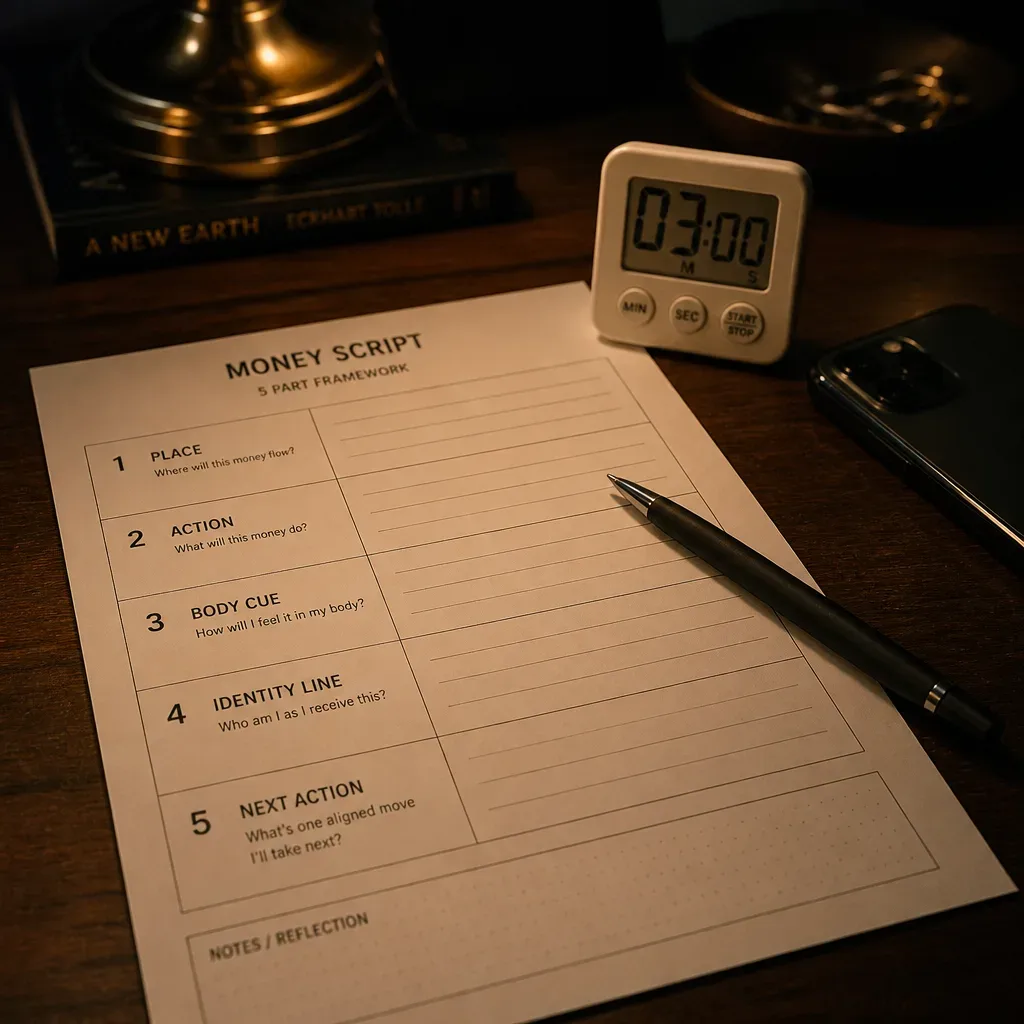
Use this 5-part structure:
- Place: Where are you in the scene?
- Action: What are you doing with money?
- Body cue: What feels calm or steady?
- Identity line: What kind of person are you being?
- Next action: What do you do tomorrow?
A 3-minute recording at a slow sleep pace is usually 300 to 450 words. Normal conversation often runs near 150 words per minute; sleep audio often works better around 110 to 130. That gives your mind enough space to follow without effort. It also keeps the practice short enough to repeat for 14 nights.
Try lines like these:
- “I check my money without flinching.”
- “I send the invoice before I distract myself.”
- “I let enough be enough for tonight.”
- “I price my work with a steady voice.”
- “I notice the next clean step.”
Avoid lines that depend on denial. If you have debt, don’t record, “I have no debt,” if your body immediately argues. Record, “I look at the number, breathe, and take one honest step.” Neville Goddard wrote often about assuming the feeling of the wish fulfilled; the usable part here is not pretending. It is choosing the felt posture you can return to.
What exact 3-minute money audio can you record tonight?
Record a slow first-person script that sounds like you after money has become less frightening and more orderly.
Here is a starter script. Change the details. Your own nouns matter. If the word “wealth” feels theatrical, don’t use it. If the word “safe” feels true, keep it. “The best money script is boring enough to repeat and specific enough to change Tuesday.”
A 3-minute Dream-Self money script
I am here at the end of the day. The room is quiet. My phone is face down. My body is allowed to soften now.
I see myself tomorrow opening my money without rushing away. I look at the numbers. I breathe once before I decide what they mean. I do not turn a number into a verdict on my worth.
I am becoming someone who can stay present with money. I send the message. I send the invoice. I ask the clear question. I choose the cleaner price. I let the answer arrive without chasing it all night.
There is a calm version of me who already knows how to handle this. That version does not panic at a bill. That version does not hide from a balance. That version takes one next step and then rests.
Tomorrow I do one useful thing. I check one account. I send one note. I move one payment. I write one number down. Small honest steps count because I repeat them.
Money is allowed to be practical. Money is allowed to be spoken about plainly. Money is allowed to be part of my life without owning my whole mind.
For tonight, enough has been done. I can sleep. I can return tomorrow with a steadier voice.
Read it once out loud before recording. If one sentence makes you roll your eyes, remove it. In clinical sessions, I often edit scripts by body response: swallowing, jaw tension, shallow breath. These small cues are not mystical. They are feedback. The Journal of Behavioral Medicine has published multiple studies linking stress, body awareness, and health behavior, and money choices often sit in that same stress loop.
Record in one take if you can. A little room sound is fine. Perfection keeps people editing instead of listening. Put the phone 6 to 10 inches from your mouth, speak low, and leave 2 seconds after important sentences. If you want background sound, choose steady brown noise or soft room tone, not a track with sudden highs.
How should you listen before sleep without hurting sleep?
Listen once at low volume during the last 3 to 10 minutes before sleep, then let the night become quiet.
Sleep is not a side issue. If a method costs you sleep, it costs more than it gives. The American Academy of Sleep Medicine recommends regular timing, a dark room, and reducing disruption near bedtime. Audio can help if it settles you. It can hurt if it keeps your attention scanning for meaning.
Use this simple listening setup:
- Put the recording in a playlist by itself.
- Set the volume so every word is audible, then lower it by one notch.
- Lie down in your usual sleep position.
- Listen once without repeating it.
- Let the device stop or fade to silence.
If you fall asleep before the end, that is not failure. The last minutes before sleep are suggestible because attention loosens. Hypnagogia, the transition into sleep, can include drifting images, body heaviness, and softened logic. Sleep researchers often place sleep onset within minutes of stage N1, the lightest stage, which is easy to disturb. So keep the recording calm and short.
You can use the Sleep cycle calculator tool to choose a bedtime that gives you enough full cycles. Most adults need at least 7 hours of sleep, according to the CDC, and many need closer to 8. A 3-minute audio is not worth turning a 7-hour night into a 5-hour one.
If you prefer masked tracks, keep them gentle and check the creator. The Subliminals pillar has a safety section on volume, ads, and exaggerated claims. The safest money audio is one you can stop without feeling afraid you ruined something.
What should you notice by week two?
By week two, look for changes in avoidance, tone, and follow-through, not sudden proof from outside.
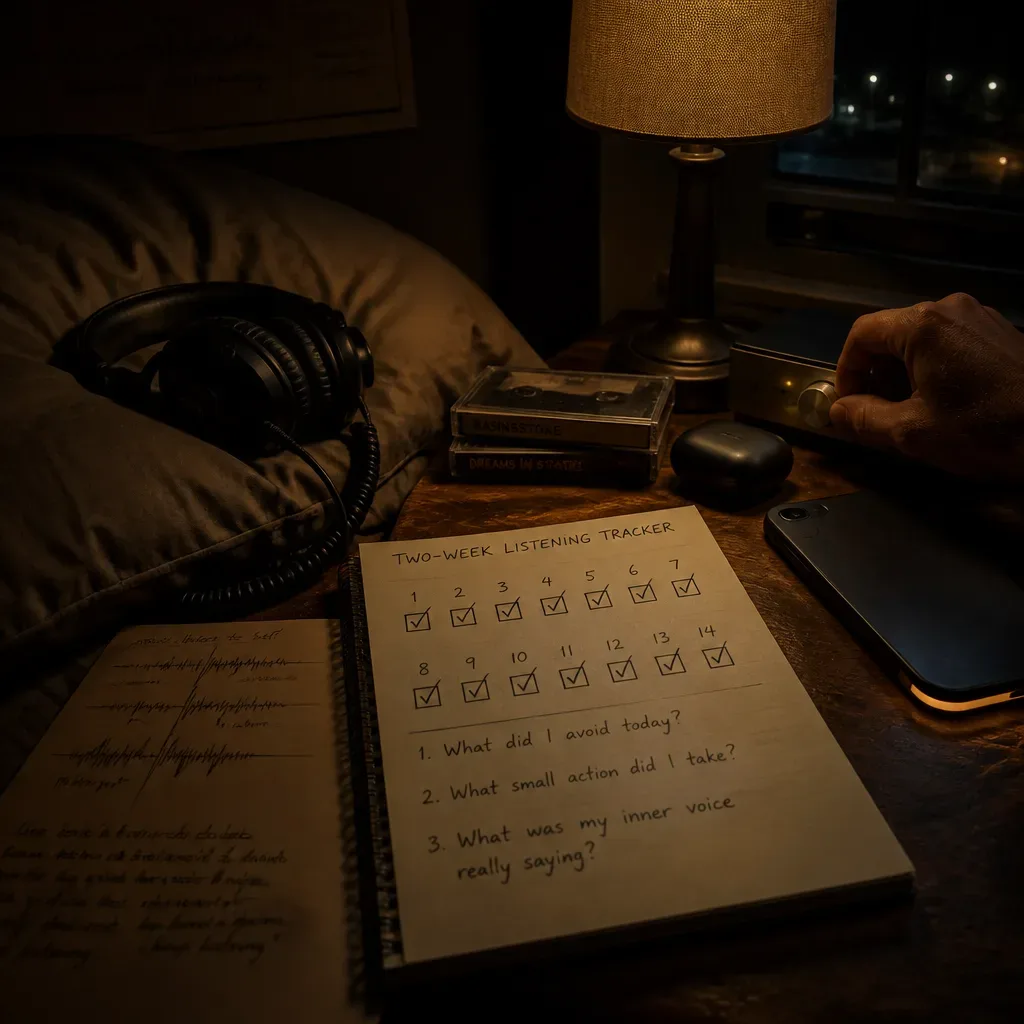
Fourteen nights is a useful first test because it is long enough to repeat the cue and short enough to review honestly. In habit research, automaticity often takes longer than 2 weeks; a 2009 study by Lally and colleagues in the European Journal of Social Psychology found a wide range, with an average near 66 days for habits to become more automatic. So don’t expect a complete shift by day 14. Expect signals.
Track 3 things in a note:
- Did I avoid money less this week?
- Did I take one concrete action?
- Did my inner voice sound less cruel after checking numbers?
That third question matters. Harsh self-talk is expensive. It burns the attention you need for decisions. “Money shame makes the smallest task feel like a verdict.” A good audio does not flatter you. It returns you to workable speech.
You may notice one practical change first: opening the banking app sooner, sending an invoice with less delay, or asking about payment terms without overexplaining. Those are not small. A 2022 survey from the Financial Health Network reported that only about 31% of Americans were financially healthy across spending, saving, borrowing, and planning measures. Many people are not trying to become flashy. They are trying to stop freezing.
If nothing changes by 14 nights, edit the script. Make it less grand and more behavioral. Replace “I receive more money every day” with “I notice paid work and answer it cleanly.” Replace “I am rich” with “I choose the next useful number.” If the audio makes you anxious, stop using it. Insomnia, panic, compulsive checking, or severe money distress deserves support from a qualified professional.
How do you keep money subliminals honest and useful?
Keep the practice honest by making the audio audible, behavior-linked, and easy to repeat.
There is nothing wrong with wanting money to feel less frightening. There is also nothing helpful about pretending that a track can replace skill, timing, help, or structural reality. Pew Research Center reported in 2024 that many adults still name inflation and household costs as major worries. A private audio cannot fix rent prices. It can help you meet your own next step with less collapse.
Use these guardrails when you revise:
| If your line says | Try this instead |
|---|---|
| “Money comes without effort” | “I notice the clean next action” |
| “I never worry about money” | “I breathe before I decide” |
| “I am rich now” | “I handle money with steadier hands” |
| “All debt disappears” | “I face one number and choose one step” |
If you want spoken practice beyond money, Sleep affirmations pillar can help you understand why short lines work better at night than long speeches. If you want a personal recording that stays central rather than hidden, return to the AYA Method and keep listening as the daily act. Audio first. Complements second.
There is a quiet standard I use with clients: after listening, you should feel more capable of doing one ordinary thing. Not charged. Not dazzled. More able. That is enough for a night practice.
Record the line you can believe, and let it meet you softly before sleep.