reality shifting
Pillow Method Shifting: A Sleep-Safe Audio Version
A sleep-safe pillow method shifting guide using low bedtime audio, clear intent, and honest sleep hygiene so the practice doesn't cost you rest.
Pillow method shifting is a bedtime practice where you sleep with an intention, script, or symbol near your pillow. A sleep-safe audio version uses a short spoken recording instead of mental strain: you listen softly, repeat the same words nightly, and let sleep remain the main outcome.
What is pillow method shifting, really?
Pillow method shifting is a sleep-adjacent intention ritual, not a reason to fight sleep.
The usual version is simple: you write a desired-reality script, affirmation, name, or scene on paper, place it under your pillow, and go to sleep with that idea near you. In shifting communities, that paper becomes a cue. It says, quietly, “this is what I’m returning to tonight.” The practice is popular because it asks for almost no equipment: one page, one bed, one night. A 2023 Pew Research Center report found that about 95% of U.S. teens have access to a smartphone, which helps explain why methods now travel through short videos, playlists, and notes apps as much as notebooks.
The audio version keeps the same cue but changes the medium. Instead of trying to hold a scene in your head until you drift off, you hear a short recording that carries the words for you. That matters because attention gets thin at night. The American Academy of Sleep Medicine says adults should get 7 or more hours of sleep per night; any shifting method that steals an hour from that is already too expensive.
A sleep-safe version has three rules:
- The script is short enough to relax you.
- The audio is quiet enough to forget.
- The method ends when sleep arrives.
A method that costs you sleep costs more than it gives. That’s the line I don’t soften, because I’ve written enough nighttime words to know how easily a practice can become a test. You are not failing if you fall asleep before the track ends. In this version, falling asleep is the point.
If you want a broader map of nighttime suggestion practices, read the Subliminals pillar next. A subliminal hides the words under sound. Pillow method shifting usually keeps the intention conscious. This guide stays on the conscious side because, before sleep, clear words tend to be kinder than hidden ones.
Why make the pillow method an audio practice?
Audio lowers the effort because the voice holds the intention when your mind gets tired.
The traditional pillow method asks you to write, visualize, and maintain focus at the edge of sleep. That can feel lovely on a calm night and impossible on a tense one. Audio gives you a rail to follow. You don’t have to remember the exact script. You don’t have to keep checking whether you’re “doing it right.” You press play, listen low, and let the same words repeat.
There is modest science behind the timing, though not proof of shifting claims. Sleep researchers have studied targeted memory reactivation, where sounds linked to learning are played during sleep. A 2013 study in Nature Neuroscience by Oudiette and Paller found that cues during sleep could influence later memory-related behavior. That’s not the same as entering a desired reality. It does suggest that repeated cues near sleep can matter to memory and attention.
Bedtime also changes how language lands. Dr. Andrew Huberman has often discussed the value of lowering arousal before sleep, including breathing and non-sleep deep rest style practices. Again, this doesn’t prove pillow method shifting. It does support a practical point: a calm nervous system sleeps better than a monitored one. Quiet audio can help if it reduces effort. It can hurt if it makes you alert.
Here is the clean comparison:
| Version | What you use | Best for | Sleep risk |
|---|---|---|---|
| Paper under pillow | Script or note | Simple ritual, tactile cue | Low, unless you obsess over wording |
| Mental repetition | Silent affirmations | No devices | Medium, if it turns into effort |
| Audio version | Short spoken track | Tired nights, steady focus | Low to medium, depending on volume and length |
| Long playlist | Hours of layered audio | Background sound lovers | Higher, especially with headphones |
The voice should do less than you think. The best sleep audio doesn’t grab you. It gives you somewhere soft to place your attention, then gets out of the way.
How do you write a shifting script that won’t keep you awake?
Write a script that sounds believable at 2 a.m., not impressive at noon.
Long scripts are tempting. You may want details about your desired reality, your room, your appearance, your relationships, your first scene, your safety words, and every sign you’ll notice. Some of that belongs in a daytime notebook. Bedtime needs fewer words. Sleep onset usually takes 10 to 20 minutes for many healthy adults, according to common clinical sleep guidance; if your script takes 15 minutes to read, you’ve used the whole window on effort.
Use one scene, one feeling, and one anchor. The scene is where you intend to arrive. The feeling is how your body knows it’s safe. The anchor is the phrase you’ll repeat. For example: “I wake in my desired room. I know where I am. I feel calm, held, and familiar.” That is enough. The mind can return to a small doorway more easily than a crowded hallway.
I like this 5-line format:
- Ground: “I’m safe in my bed, and my body can sleep.”
- Name the intent: “Tonight I return to my desired reality.”
- Name the scene: “I wake in my room and recognize it easily.”
- Name the feeling: “It feels calm, familiar, and mine.”
- Release: “I don’t have to force anything. Sleep can take me now.”
That last line matters. It keeps the practice from becoming a performance. In affirmation writing, a sentence that your body rejects is just noise with better marketing. If “I shift instantly” makes you tense, don’t use it. Try “I let the scene come closer as I rest.” Slightly modest words often work better because you don’t have to argue with them.
For more bedtime wording, the Sleep affirmations pillar has examples you can adapt. Keep your final pillow method shifting script under 100 words for the first 7 nights. You can always write the longer version tomorrow, in daylight, when sleep isn’t waiting.
How do you record the sleep-safe audio version?
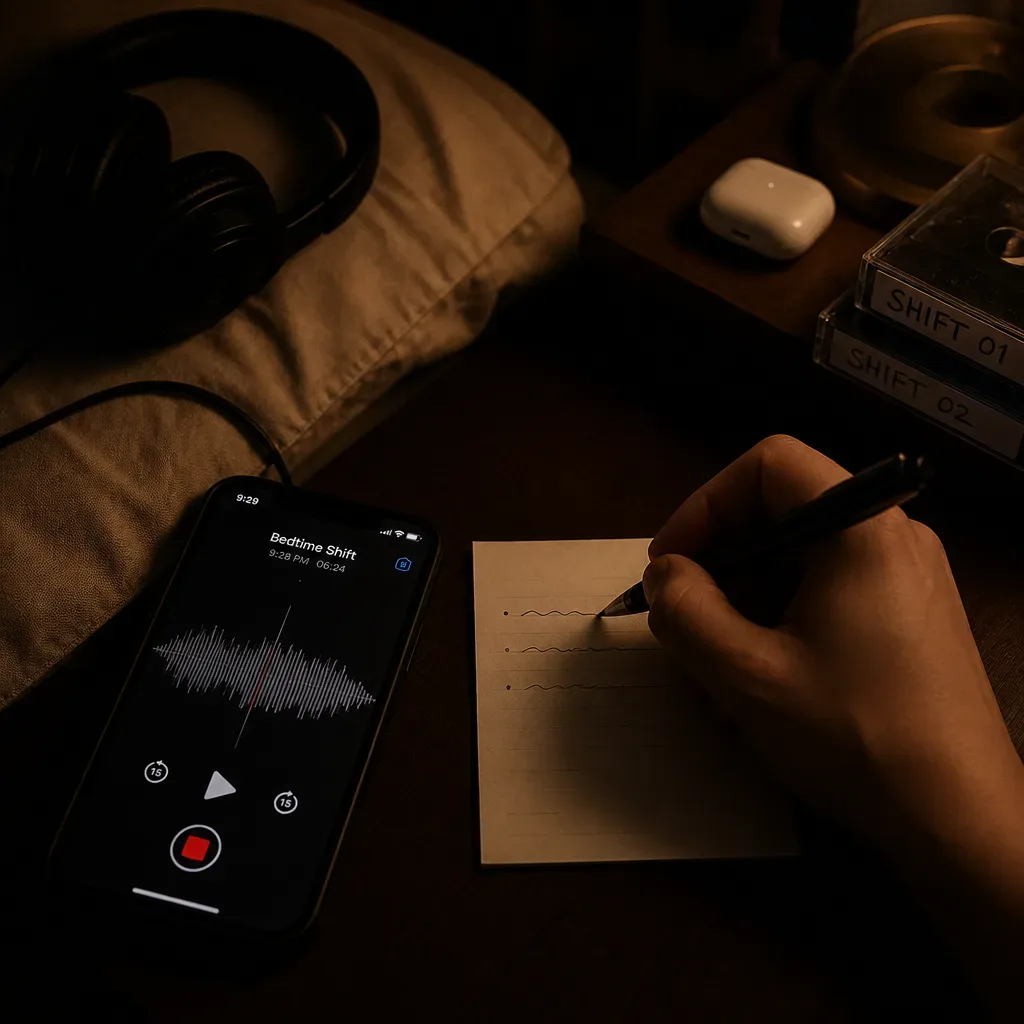
Record 2 to 5 minutes in your own voice, at a pace slow enough to breathe with.
Your phone’s voice memo app is enough. You don’t need binaural beats, layered rain, or studio sound. Use a room that doesn’t echo much. Hold the phone about 6 to 10 inches from your mouth. Speak softer than a podcast voice, but clearer than a whisper. If you whisper too much, consonants get scratchy, and scratchy audio can keep you alert.
Use this simple structure for the recording:
- Thirty seconds of grounding. Say where you are: “I’m in bed. The room is quiet. My body knows how to sleep.”
- One minute of the script. Read your 5-line version slowly.
- One minute of repetition. Repeat only the anchor phrase 4 to 8 times.
- Thirty seconds of release. Say: “I can stop trying now. Sleep is allowed.”
- Optional silence. Add 30 to 60 seconds of quiet room tone if your app allows it.
Keep the volume low. The World Health Organization has estimated that over 1 billion young people may be at risk of hearing loss from unsafe listening practices, mostly from loud personal audio and noisy venues. Your pillow method audio should sit far below that kind of listening. If you use earbuds, choose sleep-safe ones and set a timer. Better yet, play it softly from a bedside speaker.
This is also where the AYA Method sits close by: The AYA Method is a daily audio manifestation practice. Each day you listen to a short personalized recording — your Dream-Self Moment — narrated from the version of you who has already manifested the life you intend. Listening is the practice. Repetition is the work. The audio is the method. The difference is clarity and personalization: with AYA, you can hear every word, and the recording is built as a daily practice, not a hidden track.
Use that principle here. Don’t bury the words. Don’t make the audio mysterious. If the sentence matters, let yourself hear it.
When should you play it, and for how many nights?
Play it once during your normal wind-down, then repeat the same version for 7 nights before editing.
The safest timing is boring, which is why it works. Get into bed when you actually intend to sleep. Set your alarm first. Put your phone face down or across the room if you can still hear it. Start the audio. Let it play once, or set a timer for 10 to 15 minutes if you loop it. The Sleep cycle calculator tool can help you choose a bedtime that protects full sleep cycles instead of turning the method into a late-night experiment.
Seven nights is long enough to notice patterns without constantly changing the cue. In habit research, repetition in the same context matters; a 2009 study in the European Journal of Social Psychology found that automaticity took a median of 66 days to form, with wide variation. You don’t need 66 days before you adjust a script, but you do need more than one impatient night.
Track only three things in the morning:
- Did I sleep enough?
- Did the audio calm me or wake me?
- Did I remember any dreams, feelings, or scenes?
Do not grade yourself on whether you shifted. That turns the pillow into a scoreboard. A quiet practice works better when the morning review is light. If you wake disappointed, write one neutral sentence: “I practiced, and I slept.” That counts.
If sleep gets worse for more than 3 nights, stop the audio and return to paper only. If insomnia is ongoing or affecting your days, talk with a qualified clinician. A shifting method belongs beneath sleep, not above it.
What should you expect by week two?
By week two, expect familiarity first: easier recall of the script, clearer dreams for some people, and less effort around the ritual.
Online posts often promise immediate signs. I won’t. The honest outcome after 7 to 14 nights is usually subtler. You may notice that the anchor phrase comes to mind faster. You may remember more dream fragments because you’re paying attention in the morning. You may feel calmer because the bedtime routine has fewer decisions. None of that proves a shift. It does mean the cue is becoming familiar.
Dream recall itself varies. Sleep studies often show that awakenings from REM sleep produce more dream reports than awakenings from non-REM sleep, and REM periods get longer in the second half of the night. That means a 4 a.m. waking may produce more memory than a midnight one. It doesn’t mean the 4 a.m. dream is more valid. It means sleep architecture has timing.
Use this week-two check instead of chasing signs:
| Signal | Good adjustment | What to avoid |
|---|---|---|
| You fall asleep faster | Keep the same audio | Adding more layers because it worked |
| You feel alert after playing it | Shorten the track | Raising volume or trying harder |
| You wake often | Stop looping | Sleeping with hours of audio |
| You dislike your own wording | Edit one line only | Rewriting the whole script nightly |
| You feel pressure | Add release lines | Counting every sensation as proof |
If you like structured scripting, you can pair this with a daytime draft from a guide like shifting scripts, then keep only the smallest bedtime version under your pillow. Daytime can hold detail. Night needs mercy.
One good sentence repeated for a week is stronger than twenty perfect sentences rewritten every night. Choose the sentence you can believe when you’re tired. That is the one most likely to stay.
What makes this version safer than common pillow method advice?
This version protects sleep by limiting length, volume, checking, and emotional pressure.
The risky part of pillow method shifting is rarely the paper. It’s the way people begin to monitor themselves: Was that twitch a sign? Did I hear something? Did I ruin it by moving? Monitoring raises arousal. Higher arousal makes sleep harder. Cognitive behavioral therapy for insomnia often targets this exact loop: bed becomes a place of effort, and effort trains wakefulness. You don’t need a diagnosis to respect that mechanism.
Use these boundaries:
- No all-night headphones unless they’re designed for sleep and kept very low.
- No scripts that frighten you or make you feel trapped.
- No staying awake to finish a method.
- No comparing your results to a stranger’s 30-second video.
- No changing sleep position if pain or breathing gets worse.
The Princeton Engineering Anomalies Research program is sometimes mentioned in manifestation spaces because it studied intention and random systems for decades. Its results remain debated, and they don’t validate specific shifting methods. That distinction matters. Honest practice doesn’t need inflated evidence. You can care about a ritual without pretending every citation says more than it says.
If you also use subliminal audio, keep it separate at first. The Subliminals pillar explains why hidden affirmations are hard to evaluate: you can’t easily check the words, the volume, or the claims. For pillow method shifting, audible is cleaner. Audible means editable. Editable means yours.
Here is the 20-minute version to use tonight:
- Spend 5 minutes writing your 5-line script.
- Spend 3 minutes recording it once, slowly.
- Spend 2 minutes setting volume, timer, and phone placement.
- Spend 10 minutes listening in bed with eyes closed.
- Let sleep interrupt whenever it wants.
The last ten minutes before sleep are suggestible. Choose what goes in.
Keep the words low, and let the room take them.