sleep hypnosis affirmations
Self Love Sleep Affirmations Into Dream-Self Audio
Use self love sleep affirmations to make a 3-minute Dream-Self audio track: write 10 honest lines, record softly, and listen before sleep.
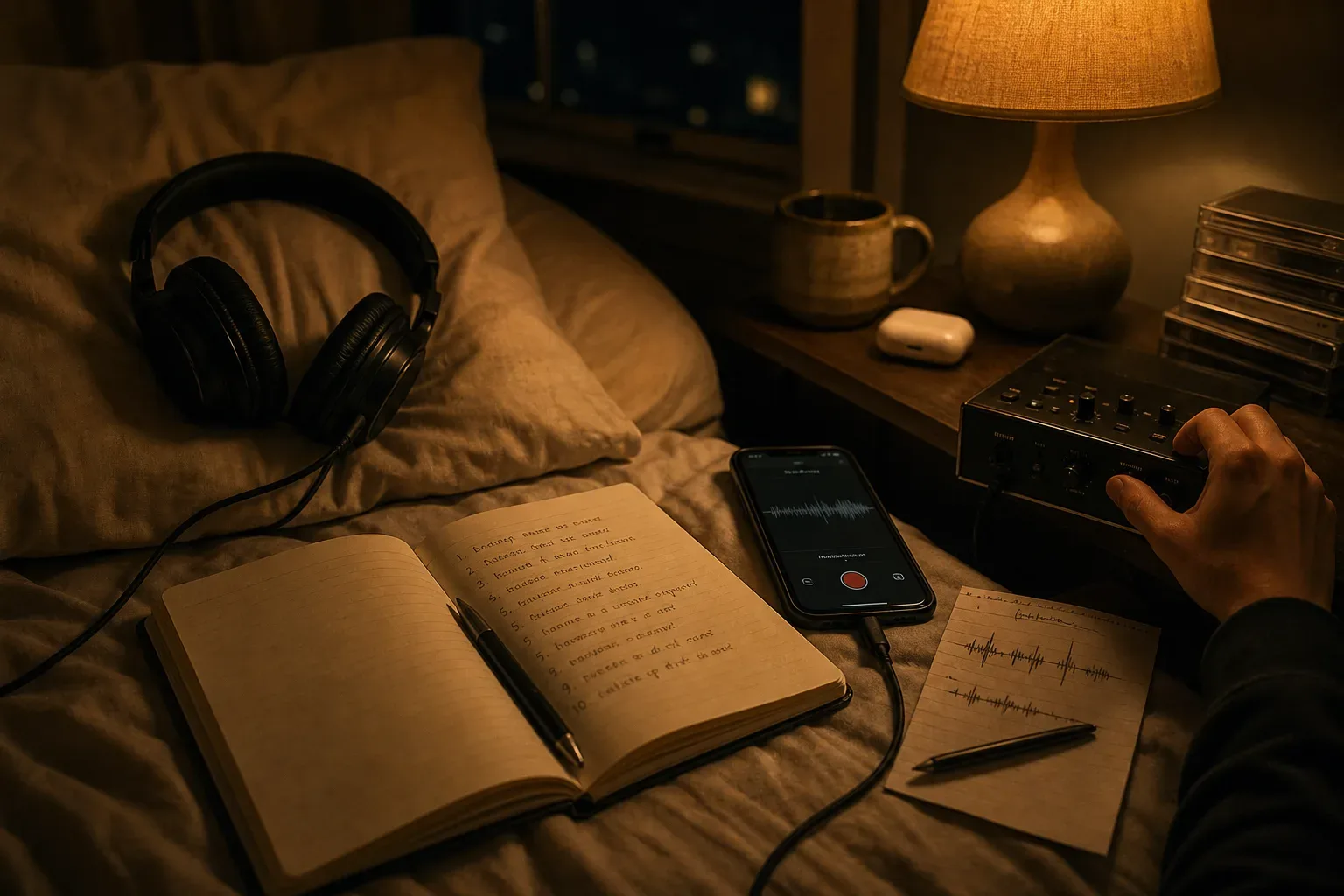
Self love sleep affirmations are short, believable statements you listen to before sleep so your last rehearsed thoughts are kinder than the day’s noise. To turn 10 lines into Dream-Self audio, write them plainly, record them in your own low voice, add silence, and play the track nightly for 7 to 14 days.
What makes self love sleep affirmations different at night?
Night makes self love sleep affirmations different because the mind is tired, quieter, and less interested in debate.
During the day, a sentence like “I speak to myself with care” has to compete with email, mirrors, memory, and other people’s tone. At night, it has fewer rivals. The National Sleep Foundation often describes a normal sleep latency as about 10 to 20 minutes for healthy adults, which gives you a small window before sleep where language can become the last clear input.
That doesn’t mean the words bypass your judgment or force a new belief. The honest version is smaller and more useful. Repetition before sleep can act like rehearsal. Cognitive psychology has studied priming for decades, and the effects are usually modest, context-dependent, and easier to show in small tasks than in sweeping life claims. The YouTube promise is often too large. The nightly ritual may still be worth keeping.
A sleep affirmation is audible by design. You hear it. You can reject it. You can edit it. That is one reason I prefer spoken tracks for self-love work over mystery audio. A subliminal is an affirmation you can’t consciously hear, which is the trick and also the problem. If you want that technical comparison, read the Subliminals pillar before you hide anything under rain.
For sleep, self-love needs to be gentle enough not to start a courtroom in your head. “I love every part of myself completely” may be too wide if your body says no. “I can speak to myself with less cruelty tonight” may land. The softer line is often the stronger one because you can actually repeat it.
A believable sentence repeated nightly beats a perfect sentence your nervous system refuses.
How do you write 10 lines that don’t sound fake?
You write better sleep affirmations by making them short, specific, present-tense, and slightly easier than your current self-talk.
Start with one theme. Don’t ask 10 lines to fix your whole relationship with yourself. Pick self-trust, body kindness, rest, receiving care, or forgiving a mistake. In behavior-change research, smaller cues tend to survive longer than broad resolutions; BJ Fogg’s Tiny Habits work, for example, is built around reducing the size of the action until it can repeat. Your audio should use the same mercy.
Use this 10-line structure if the blank page gets loud:
- One line naming safety: “I am allowed to be gentle with myself.”
- Two lines about the body: “My body does not need my insults.”
- Two lines about inner speech: “I notice my tone and soften it.”
- Two lines about receiving: “I can let care reach me.”
- Two lines about repair: “I can make mistakes and stay with myself.”
- One closing line: “Tonight, I return to myself quietly.”
Keep each line under 12 words. Ten lines at 8 to 12 words each gives you roughly 80 to 120 words. At a slow sleep pace of about 90 to 120 spoken words per minute, that is a clean 1-minute recording before pauses. Add 3 to 5 seconds after each line, and the track becomes closer to 2 minutes, which is long enough to settle and short enough not to become work.
Here are useful line tests:
- Can I say this without rolling my eyes?
- Does it describe a practice, not a fantasy?
- Is it kind without being syrupy?
- Would I say this to someone I love at 2 a.m.?
- Does the sentence leave room for a hard day?
A good self-love affirmation doesn’t pretend pain was never there. It gives you a different voice to practice after pain has spoken.
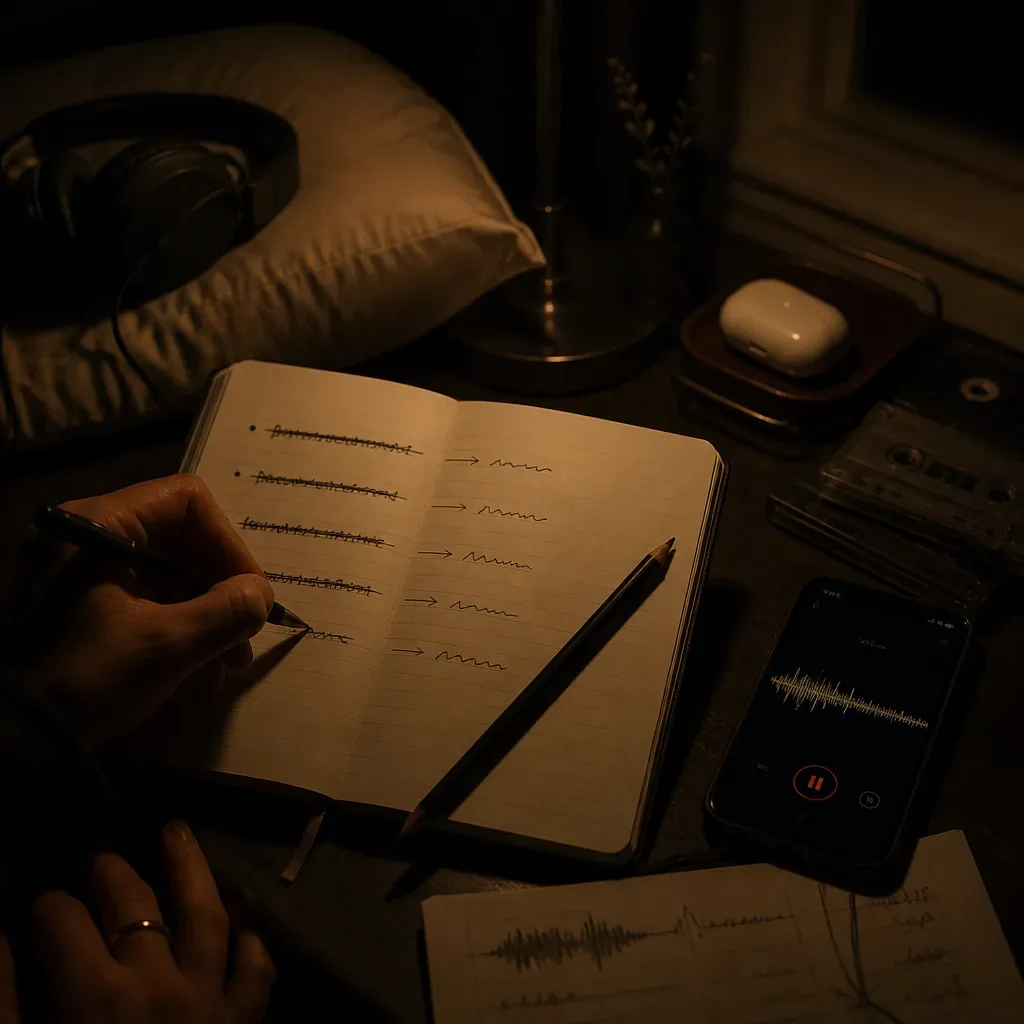
How do you turn those lines into Dream-Self audio?
You turn 10 lines into Dream-Self audio by making the speaker a future version of you who talks in ordinary, lived detail.
This is where the practice can become more personal than a list. The AYA Method is a daily audio manifestation practice. Each day you listen to a short personalized recording — your Dream-Self Moment — narrated from the version of you who has already manifested the life you intend. Listening is the practice. Repetition is the work. The audio is the method.
For this self-love track, your 10 affirmations become the bones. The Dream-Self voice adds context. Instead of “I speak to myself kindly,” you might record: “I notice it now. When I make a small mistake, I don’t turn on myself. I pause, breathe once, and speak like I’m staying.” That is still an affirmation, but it has behavior inside it.
Use a simple script shape:
| Part | Length | Purpose | Example |
|---|---|---|---|
| Opening | 10 seconds | Settle the ear | “It’s night. You don’t have to perform now.” |
| Dream-Self note | 60 to 90 seconds | Speak from lived self-love | “You talk to yourself differently now.” |
| Ten lines | 60 to 120 seconds | Repeat the core phrases | “I stay with myself.” |
| Closing | 10 seconds | Let sleep take over | “Nothing else needs to be solved tonight.” |
The difference between a generic affirmation track and Dream-Self audio is ownership. Generic audio says nice things at you. Dream-Self audio sounds like your own life has started speaking back.
You can also compare this with the broader Sleep affirmations pillar, especially if you want scripts for calm, confidence, or grief. For self-love, stay close to ordinary moments: the mirror, the text you didn’t get, the meeting where you stumbled, the way you speak to your body when you’re tired. Specificity is what keeps the audio from floating away.
What is the simplest way to record it on your phone?
The simplest recording setup is your phone, a quiet room, a soft surface, and a voice level you could use without waking someone.
You do not need studio gear. Modern phones record speech clearly enough for a sleep practice, especially at close range. Sit 6 to 10 inches from the microphone. Angle the phone slightly off your mouth so breath doesn’t hit the capsule. Put a blanket, curtain, or pillow nearby to reduce hard reflections. In audio terms, you’re lowering room sound before it reaches the mic, which matters more than any app preset.
Record when the house is quiet. Turn off fans if they rattle. Put the phone on airplane mode. Read slower than feels normal. A typical audiobook pace is often around 150 words per minute; for sleep, try closer to 90 to 110. Leave 3 seconds between lines. Silence is not wasted space. Silence is where the sentence lands.
A clean phone recording workflow:
- Open Voice Memos or any simple recorder.
- Record 10 seconds of room tone before speaking.
- Read the Dream-Self script once without stopping.
- If you stumble, pause for 3 seconds and restart the sentence.
- Trim only the loud mistakes, not every breath.
- Export as an audio file and listen once on the device you use in bed.
Do not over-process your voice. Heavy noise reduction can make speech watery. Strong compression can bring up mouth clicks and room hiss. If you add background sound, keep it lower than the voice. A good rule is this: if you can’t understand every word at bedtime volume, the mix is not honest.
If you use earbuds, keep the volume low. The World Health Organization has warned about unsafe listening levels, especially over long sessions, and sleep audio can run longer than you intended. Use a timer. Your ears are not a sacrifice bowl.
When should you listen, and for how many nights?
Listen during the last 10 to 20 minutes before sleep, then repeat the same track for at least 7 nights before judging it.
The last part matters. People change sleep audio too quickly. One track for Monday, another for Tuesday, a third because the thumbnail looked softer. Repetition is part of the signal. In habit research, automaticity can take weeks rather than days; a 2009 study in the European Journal of Social Psychology found a wide range, with an average of 66 days for a new behavior to feel automatic. Your affirmation track doesn’t need 66 days before it helps, but it does need enough nights to become familiar.
Use a tiny listening plan:
- Nights 1 to 3: notice whether the wording irritates you.
- Nights 4 to 7: notice whether one line follows you into the next day.
- Nights 8 to 14: revise only the lines that now feel false or stale.
- After 14 nights: keep, re-record, or write a new 10-line set.
If you track sleep, don’t turn the practice into a performance review. You can use the Sleep cycle calculator tool to choose a sensible bedtime or wake time around roughly 90-minute sleep cycles, but the tool is a guide, not a judge. Adults are generally advised by the American Academy of Sleep Medicine and Sleep Research Society to get 7 or more hours per night. Protect that first.
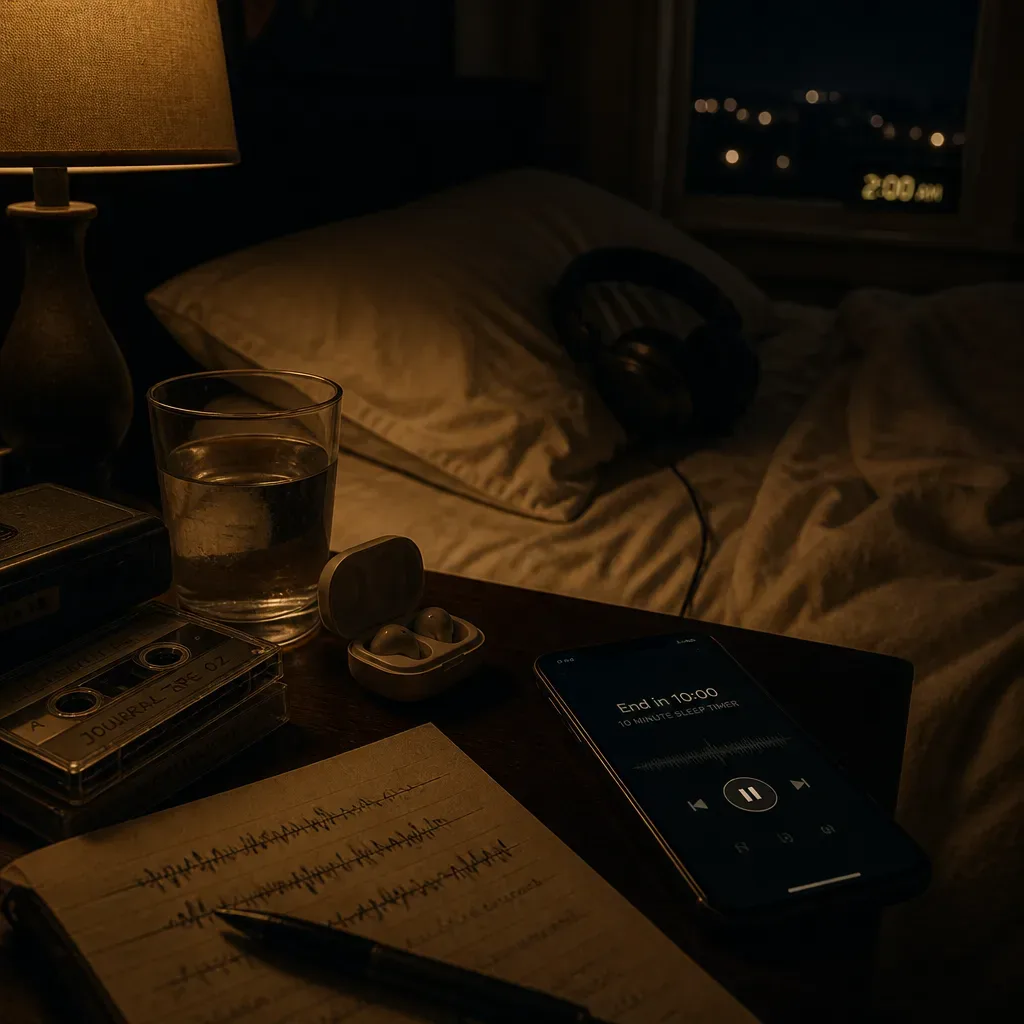
If the audio keeps you awake, shorten it. If the words make you cry, lower the intensity. If you have ongoing insomnia, panic at night, or trauma symptoms that worsen in bed, speak with a qualified professional. A sleep practice should not ask you to pay with sleep.
How do you keep the track honest instead of turning it into a performance?
You keep the track honest by labeling what it is: a nightly rehearsal of kinder self-talk, not proof that you’re fixed.
This matters because self-love language can get theatrical fast. The voice becomes too sweet. The claims get too large. The track starts sounding like it was written for a stranger with perfect lighting. Bring it back to what you can hear at midnight. “I am learning to stop attacking myself” may be more useful than “I adore myself fully.” One is a practice. The other may be a costume.
As an audio engineer, I also care about consent in the sound. Label your files clearly. If there are hidden layers, say so. If there are no hidden layers, say so. If you use a rain bed from a free library, note it. This is why I often send readers to the Subliminals pillar before they download anonymous tracks. You deserve to know what you fell asleep to.
Here is a simple honesty checklist:
| Question | Keep it if | Change it if |
|---|---|---|
| Can I hear every word? | The voice is clear at low volume | The music buries the script |
| Do I believe 60 percent of it? | The line feels reachable | The line starts an argument |
| Is it kind to my body? | It reduces attack | It demands constant approval |
| Does it protect sleep? | It ends or fades gently | It loops all night and wakes me |
The 60 percent rule is not science; it is a practical threshold. If a line feels at least slightly true, repetition can deepen the groove. If it feels completely false, your mind may spend the whole night cross-examining it.
Respect the listener’s ear, even when the listener is you.
For a broader base of scripts and timing, keep the Sleep affirmations pillar nearby. For a more personal daily audio structure, return to the AYA Method when you want the whole recording to speak from your Dream-Self, not just repeat lines.
What should you expect by week two?
By week two, expect familiarity, a few remembered phrases, and small changes in tone, not a new personality.
That is the clean promise. You may catch one line during the day: “My body does not need my insults.” You may pause before calling yourself stupid. You may notice that the track feels boring, which is not failure. Familiar audio can become a cue. In sleep hygiene, cues matter because the brain learns associations through repetition; stimulus control therapy for insomnia, for example, is built on strengthening bed as a cue for sleep rather than struggle.
Keep your measures small. After 14 nights, answer these 5 questions in a note app:
- Which line did I remember without trying?
- Which line annoyed me?
- Did the track delay sleep, shorten sleep, or help me settle?
- Did I speak to myself differently once during the day?
- What one line should I remove before the next version?
If nothing changes, that is information. Shorten the track to 90 seconds. Use fewer claims. Record closer to your natural speaking voice. Some people don’t like listening to themselves at first; that discomfort often softens after 3 to 5 plays, but not always. You can use a trusted voice if yours keeps pulling you out of rest.
Self-love audio is not a verdict on your worth. It is a small repeated environment for your last thoughts. The practice works best when it stays ordinary: clear words, low volume, enough nights, no pressure to become radiant by morning.
Put the kind sentence on low, and let the room stay dark.