sleep hypnosis affirmations
Sleep Affirmations for Anxiety: 3-Minute Audio
Use sleep affirmations for anxiety as a 3-minute Dream-Self audio before bed: what to say, how loud to play it, and what to expect.
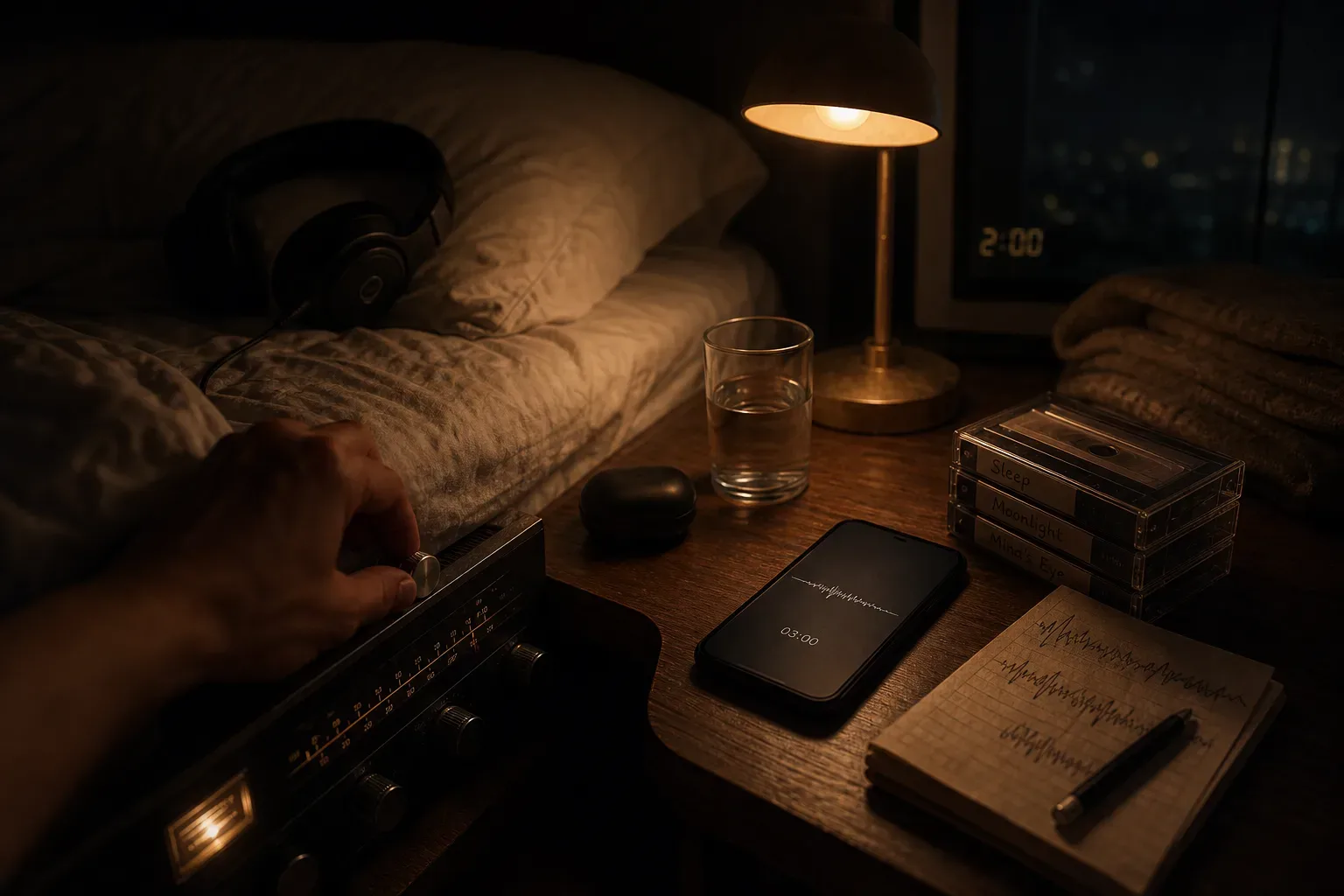
Sleep affirmations for anxiety are short, believable sentences you listen to before sleep so your attention has something steadier than worry to repeat. A 3-minute Dream-Self audio works best when it’s audible, personal, low in volume, and used nightly for at least 7 to 14 days.
What are sleep affirmations for anxiety, really?
Sleep affirmations for anxiety are not spells. They’re practiced sentences, placed at the time of night when your mind is tired enough to stop arguing quite so loudly.
An anxious mind repeats too. It rehearses tomorrow’s mistake, the unpaid bill, the strange sensation in the chest, the message that didn’t come back. Cognitive models of worry often describe it as repetitive verbal thought, and some estimates suggest generalized anxiety disorder affects about 3% of adults in a given year in the United States, according to the National Institute of Mental Health. Bedtime is where that repetition often gets louder because there’s less external noise to compete with it.
A sleep affirmation gives the mind a different sentence to return to. Good lines are not grand. They sound like: “I can meet this moment one breath at a time,” or “The bed can hold my body while my mind slows down.” If your affirmation makes you roll your eyes, it’s too far away from what you believe tonight.
This is why the Sleep affirmations pillar treats affirmations as a listening practice, not a motivational slogan. Before sleep, the sentence needs to be soft enough to enter and plain enough to repeat. In clinical hypnotherapy, I’ve seen the boring script outperform the dramatic one for the same reason a lullaby works better than a speech.
A bedtime affirmation should not ask you to become fearless. It should give your fear less to hold.
Research is cautious here. Self-affirmation studies, including work reviewed in the Journal of Behavioral Medicine, suggest affirming valued identity can reduce stress responses in some settings. That doesn’t prove every YouTube anxiety track works. It does suggest repeated self-directed language can matter, especially when paired with relaxation and routine.
Why use a 3-minute Dream-Self audio before bed?
A 3-minute recording is long enough to settle attention and short enough that anxiety doesn’t turn the practice into another task.
At a slow bedtime pace, three minutes gives you about 300 to 390 spoken words. That’s plenty. In hypnosis training, many practitioners aim for roughly 100 to 130 words per minute when the nervous system is tired. Faster than that can sound like instruction. Slower than that gives the body room to answer.
The Dream-Self format adds one useful detail: the voice speaks from the version of you who already knows how the next morning feels. Not a perfect future self. Not a shiny one. A believable one. It might say, “Tonight I don’t solve my whole life. I let the night do its small work.” That sentence gives anxiety a boundary.
Here is the clean distinction. The AYA Method is a daily audio manifestation practice. Each day you listen to a short personalized recording — your Dream-Self Moment — narrated from the version of you who has already manifested the life you intend. Listening is the practice. Repetition is the work. The audio is the method.
That matters because anxiety often distrusts generic reassurance. A personal recording can use your actual fear, your actual words, and your actual threshold for belief. In small clinical and coaching settings, personalization is often the difference between a sentence that lands and a sentence the mind rejects within 2 seconds.
A 3-minute audio also respects sleep pressure. The American Academy of Sleep Medicine recommends adults get at least 7 hours of sleep per night. If a method steals 45 minutes from that, it’s charging too much. If a method costs you sleep, it costs more than it gives.
How do you write anxiety affirmations your body believes?
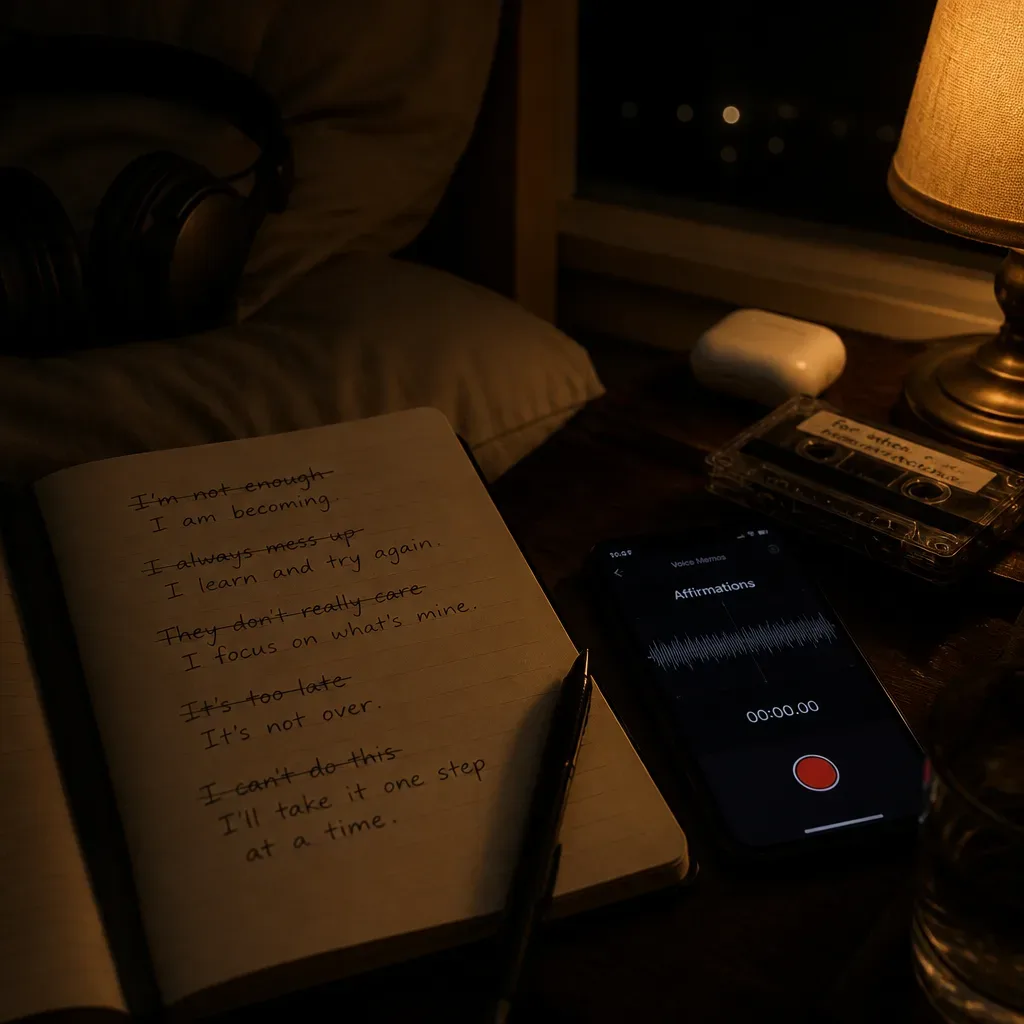
You write believable lines by making them specific, modest, sensory, and close to what you can accept tonight.
Start with the pattern, not the wish. “I want to stop feeling anxious” is too broad. “My chest tightens when I turn off the light” is usable. “I dread tomorrow’s meeting” is usable. A 2023 American Psychological Association stress report found many adults named money, health, and the future as major stressors. Anxiety likes large categories. Your script needs smaller handles.
Use this 5-step writing process:
- Name one bedtime loop in 7 words or fewer.
- Write one body-based sentence about safety.
- Write one thought-based sentence about not solving everything now.
- Write one morning-based sentence from your Dream-Self.
- Repeat the 3 strongest lines twice, with pauses.
Here’s the difference between wording that triggers argument and wording that invites cooperation:
| Anxious line to avoid | Better sleep affirmation |
|---|---|
| I have no anxiety at all. | Anxiety can be here while my body rests. |
| Tomorrow will be perfect. | Tomorrow can be met one step at a time. |
| I must fall asleep now. | I don’t have to force sleep to rest. |
| Nothing bad will happen. | Right now, I am in bed and breathing. |
The word “can” is useful. So is “right now.” They lower the demand. In acceptance-based therapies, willingness and present-moment attention are used because fighting internal states often increases arousal. You don’t need therapy language in your recording, but the principle helps.
A good 3-minute script may include only 12 to 18 sentences. That’s not a flaw. Repetition is the point. Anxiety has already heard its favorite lines thousands of times. Your calmer sentence deserves more than one pass.
The mind believes repeated worry because it hears it often. Give steadier words the same courtesy.
How should you record and play the audio?
Record the audio in a low, ordinary voice, then play it just loud enough to understand without needing to listen hard.
Use your phone if that’s what you have. A studio microphone is not required. What matters more is pacing, distance, and the absence of sharp sound. Keep the phone about 6 to 10 inches from your mouth, sit under soft fabric if the room echoes, and record when your breathing is already steady. If you record while activated, your voice may carry that urgency into bed.
Here’s a simple recording structure for 3 minutes:
- 20 seconds: one settling line and two slow breaths.
- 60 seconds: body safety lines.
- 60 seconds: thought release lines.
- 40 seconds: Dream-Self morning lines.
- 20 seconds: repeated closing sentence.
Volume matters. For sleep audio, aim for “barely clear,” not immersive. The World Health Organization has noted that nighttime noise above roughly 40 decibels can disturb sleep for some people. You don’t need to measure your phone. Use the test: if the audio would bother someone beside you, it’s probably too loud.
If you’re comparing this with hidden-message tracks, read the Subliminals pillar first. A subliminal is an affirmation you can’t consciously hear. That’s the whole trick, and the whole problem. For anxiety, I prefer audible words because consent matters at night. You should know what is entering the room.
Use headphones only if they don’t make you monitor the sound. Many people sleep better with a small speaker at the bedside or one earbud removed. If you use wireless earbuds, set a timer and keep the volume low. The goal is not to flood the mind. The goal is to give it one quiet rail to follow.
What should you expect after 7 to 14 nights?
By week two, expect small changes in your response to anxiety, not a guarantee that anxiety disappears.
The first 3 nights can feel awkward. You may notice resistance to your own voice. That’s normal. In my practice, clients often needed 4 to 6 listens before a recorded suggestion stopped feeling like a performance and started feeling like part of the room. Repetition makes the audio less novel, and novelty is not always restful.
After 7 nights, look for signs that are easy to miss:
- You argue with worry for less time.
- You notice the first anxious loop sooner.
- Your exhale lengthens during one familiar sentence.
- You stop checking the clock as often.
- You remember one line during the day without trying.
Sleep itself may shift unevenly. One night may be better, the next worse. Normal adult sleep cycles run about 90 minutes, and waking briefly between cycles is common. If you want to time your bedtime more gently, use the Sleep cycle calculator tool so the affirmation practice fits your sleep window instead of squeezing it.
There is also a difference between calming and sedating. A good affirmation track may not knock you out. It may reduce the second layer of suffering, the fear about fear. That still counts. In CBT-I research, reducing sleep effort and conditioned arousal is often central to better sleep over time.
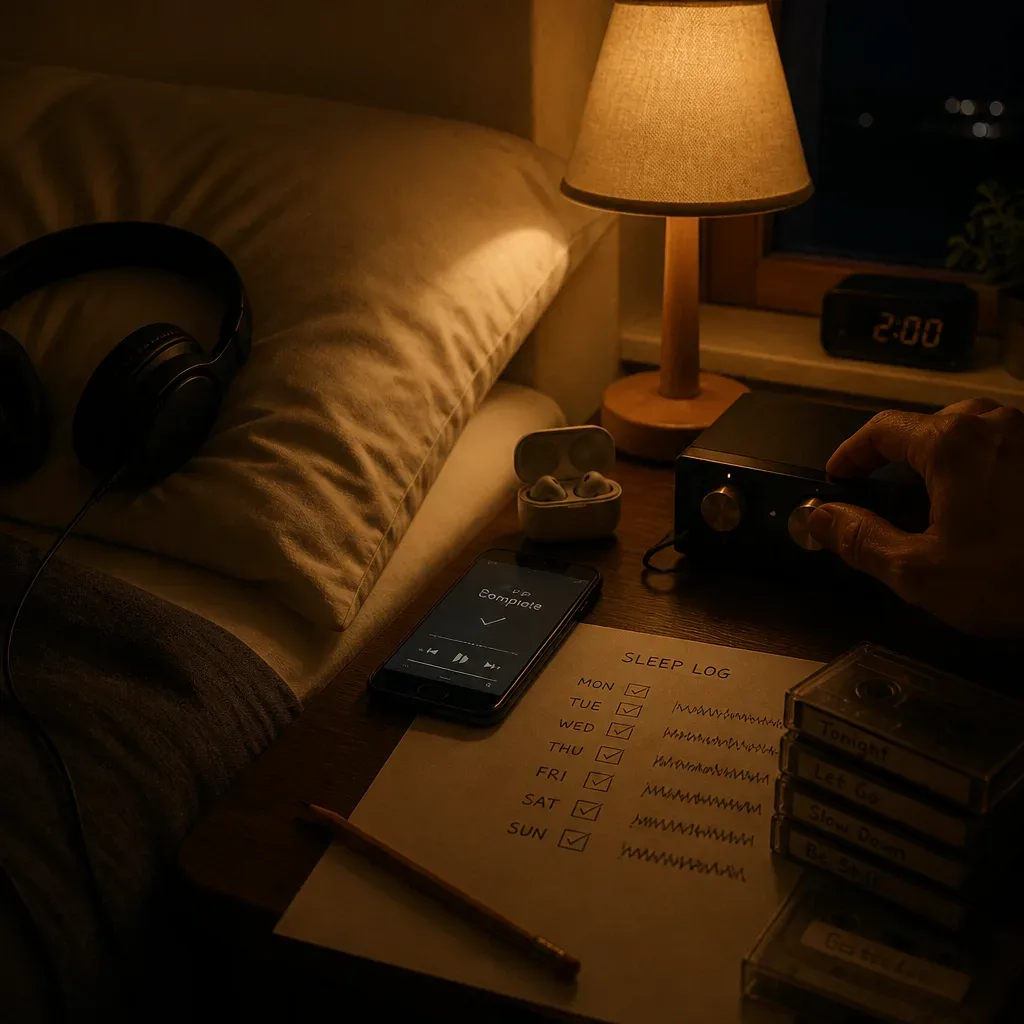
Keep a tiny note, not a full sleep diary if that makes you obsessive. Use three marks: listened, anxiety before, anxiety after. A 0 to 10 scale is enough. If your numbers move from 8 to 6 over 2 weeks, that’s useful. If nothing shifts, rewrite the script.
What should you avoid saying in anxiety affirmations?
Avoid absolute promises, forced positivity, medical claims, and any sentence that makes your nervous system feel corrected.
Anxiety is already sensitive to threat. If your recording says, “I am completely safe and nothing can hurt me,” the mind may scan for exceptions. If it finds one, the script loses trust. Use grounded truth instead. “In this moment, I am in my bed.” “My feet are under the blanket.” “I can let the next thought pass without answering it.” These are harder for anxiety to debate.
Avoid time pressure too. “I fall asleep immediately” can create performance anxiety. The National Sleep Foundation has long noted that many adults take around 10 to 20 minutes to fall asleep under normal conditions, though this varies. Your audio should make wakefulness less frightening, not turn sleep onset into a test.
Also avoid using affirmations to bypass real care. If your anxiety includes panic attacks, trauma memories, compulsions, or weeks of severe insomnia, a bedtime recording can be supportive, but it shouldn’t stand alone. Insomnia beyond basic sleep hygiene deserves a plain conversation with a qualified professional.
Here are safer replacements:
| Avoid | Say instead |
|---|---|
| I never worry. | Worry can soften for a few breaths. |
| I control every thought. | I can choose the next sentence I hear. |
| My anxiety is gone. | My body can rest with some uncertainty. |
| I must sleep now. | Rest is allowed before sleep arrives. |
The sentence that helps at midnight is usually smaller than the sentence you admire at noon.
This is also where audible audio has an ethical advantage. You can hear the line and change it. If a phrase tightens your throat or makes you brace, remove it. Your body gets a vote.
How do you make this a nightly practice without making sleep harder?
Attach the audio to the last 3 minutes before sleep and keep the rest of the routine boring.
The order matters. Put screens away first, lower the room light, use the bathroom, set the alarm, then play the recording. If you play affirmations while still answering messages, the nervous system receives mixed instructions. Pew Research Center has reported that large majorities of adults keep smartphones close, and many people check them near bedtime. Your audio needs a clean edge.
Use this nightly sequence:
- Set tomorrow’s alarm before the recording starts.
- Place the phone face down or across the room.
- Get into your usual sleep position.
- Play the 3-minute Dream-Self audio once.
- If you’re still awake, let the final sentence repeat silently.
Don’t keep editing the script at midnight. Editing wakes the analytic mind. Make changes in daylight, ideally after 7 listens. Dr. Andrew Huberman often speaks about light, timing, and nervous system state as practical levers for sleep. You don’t need to follow every protocol to respect the basic idea: the brain takes cues seriously when they’re repeated at the same time.
If you like combining practices, keep the hierarchy clear. The audio is the method. A written daily affirmation can prepare the sentence. A Manifestation Board can remind you what matters. But at night, listening does the work. That’s why the AYA Method guide puts the Dream-Self Moment at the center.
You can also pair the track with a longer sleep hypnosis session once or twice a week, but don’t stack 90 minutes of content because you’re afraid silence will return. Silence will return. The practice is learning that silence doesn’t have to be empty.
Lower the volume. Let the sentence be simple. Come back tomorrow night.
The last words you hear don’t need to be many; they need to be yours.