sleep science
Sleep Calculator: Fit Dream-Self Audio Into Bedtime
Use a sleep calculator to place a 3-minute Dream-Self audio before bed without cutting sleep, rushing your routine, or missing sleep cycles.
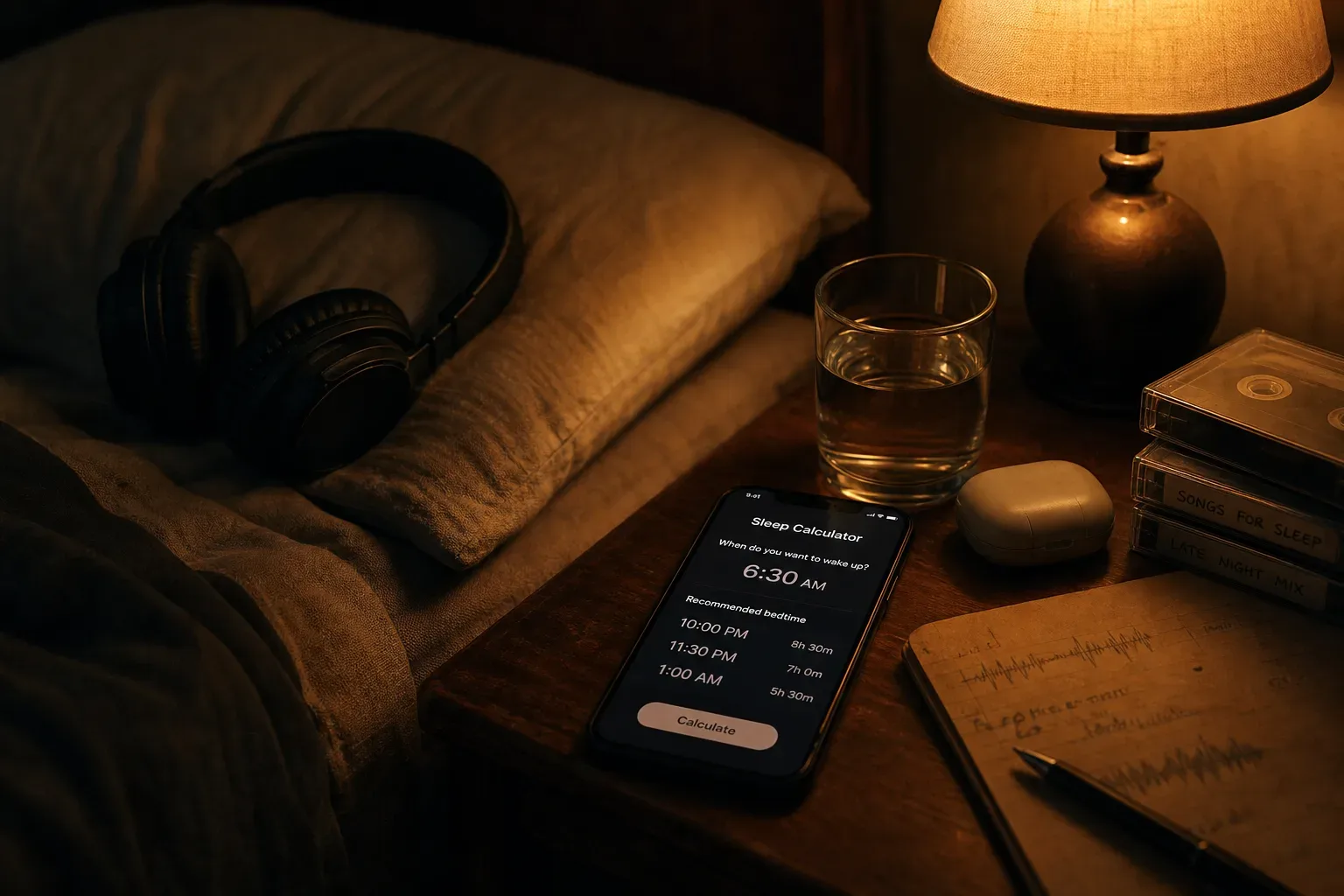
A sleep calculator helps you place a 3-minute Dream-Self audio at the end of bedtime without stealing sleep. Choose your wake time, work backward through full sleep cycles, add a small wind-down buffer, then listen once. The practice should fit the night, not make the night smaller.
What does a sleep calculator actually calculate?
A sleep calculator estimates bedtimes and wake times by grouping the night into sleep cycles, usually around 90 minutes each.
That 90-minute number is a useful average, not a promise. Normal adult sleep moves through lighter non-REM sleep, deeper non-REM sleep, and REM sleep several times a night. The National Sleep Foundation often describes a full sleep cycle as roughly 90 to 110 minutes, and lab studies show real nights vary by stress, alcohol, illness, light, and age. A calculator is a planning tool. It is not a sleep lab on your phone.
The practical value is simple: it stops you from treating bedtime as a guess. If you need to wake at 6:30 a.m., a calculator may suggest bedtimes near 9:00 p.m., 10:30 p.m., or midnight, depending on how many cycles you want. The Sleep cycle calculator tool gives you those options quickly, so you can choose the one your real life can bear.
Most adults need at least 7 hours of sleep per night, according to the American Academy of Sleep Medicine and Sleep Research Society consensus statement from 2015. Some people need more. A 3-minute audio is small enough to fit inside that recommendation, but only if you do not let it become a 30-minute phone ritual.
A good bedtime practice makes sleep easier to keep, not easier to postpone.
Use the calculator for the structure. Use your body for the final vote. If one suggested bedtime leaves you lying awake for 45 minutes, choose a later one and protect consistency. Sleep timing improves when the cue repeats.
Where should the 3-minute Dream-Self audio go in bedtime?
The 3-minute audio belongs after practical tasks and before sleep, when the room is quiet and you are no longer negotiating with the day.
Put bluntly, do not play it while brushing your teeth, answering a message, or standing under bright bathroom light. Those are mixed signals. The last few minutes before sleep are not magical in the laboratory sense, but they are behaviorally clean: fewer interruptions, lower speech, less movement, and more repetition. Dr. Andrew Huberman has often emphasized regular sleep-wake timing as one of the stronger levers for sleep stability; your audio should support that rhythm, not compete with it.
Here is the simple placement:
- Set your alarm.
- Put water, book, or glasses where they belong.
- Turn off overhead light.
- Get into bed.
- Play the 3-minute Dream-Self audio once.
- Stop touching the phone.
If you use the AYA Method, this distinction matters: The AYA Method is a daily audio manifestation practice. Each day you listen to a short personalized recording — your Dream-Self Moment — narrated from the version of you who has already manifested the life you intend. Listening is the practice. Repetition is the work. The audio is the method.
That means you do not need to build a shrine of tasks around it. The daily affirmation and Manifestation Board can support the practice, but they are complements. The audio is the part you return to. A 2022 Pew Research Center report found that 97% of U.S. adults owned a cellphone, which is exactly why bedtime phone boundaries matter. The tool that plays the audio is also the tool that can keep you awake.
How do you build an 8-minute routine around a 3-minute audio?
Build the routine by giving five minutes to sleep hygiene and three minutes to listening, then stop.
Eight minutes is short enough to repeat on a tired night. It also respects a known problem: bedtime routines often fail because they are designed for your best self, not your sleepy self. In behavioral research, smaller actions tend to repeat more reliably because the activation cost is lower. BJ Fogg’s behavior model is not sleep-specific, but its plain point applies here: make the desired behavior easy.
Use this table as a starting script:
| Minute | Action | Why it belongs there |
|---|---|---|
| 0:00 | Set alarm and enable Do Not Disturb | Removes the phone decision |
| 1:00 | Dim room, water, bathroom check | Reduces reasons to get up |
| 3:00 | Get into bed and start audio | Places words near sleep |
| 6:00 | Audio ends | No replay unless planned |
| 7:00 | Phone face down or away | Cuts the scroll loop |
| 8:00 | Eyes closed, normal breathing | Sleep gets the final word |
You can widen the routine to 12 or 15 minutes if you need more physical settling. But keep the audio itself at 3 minutes for at least 14 nights before editing it. In sleep research and clinical sleep hygiene, consistency is often more important than fine-tuning. The Centers for Disease Control and Prevention reports that about 1 in 3 U.S. adults do not get enough sleep. That is the background problem. Do not solve it by adding a large nighttime project.
A short audio practiced nightly beats a perfect audio played twice a month.
If you already listen to sleep affirmations, think of the Dream-Self audio as more personal and more specific. Sleep affirmations may use broad phrases such as “I am safe” or “I can rest.” Your Dream-Self Moment should sound like your own future voice, with details you recognize. Keep it audible. Keep it kind. Keep it done.
What time should you choose if you wake at a fixed hour?
Choose the latest calculator bedtime that still gives you at least 7 hours in bed, then place the audio immediately before that target.
Start with wake time because it is usually less flexible than bedtime. If work, children, school, caregiving, or a commute sets your morning, your night has to respect that fact. The Sleep cycle calculator tool can show several options, but the healthiest-looking option is not useful if you will not follow it.
For a 6:30 a.m. wake time, a rough calculator may point to 9:00 p.m., 10:30 p.m., midnight, or 1:30 a.m. as cycle-based targets. Only two of those protect adequate sleep for most adults. The American Academy of Sleep Medicine’s adult recommendation is 7 or more hours; a midnight bedtime with a 6:30 wake gives only 6.5 hours before you even count time to fall asleep.
A practical rule is to add a sleep-onset buffer. Many healthy adults take 10 to 20 minutes to fall asleep. The Pittsburgh Sleep Quality Index, a widely used research measure, treats sleep latency over 30 minutes as one marker worth noticing, though not a diagnosis by itself. If your calculator says 10:30 p.m., you may want lights down by 10:10 and audio at 10:17.
Here is a simple example:
- Wake time: 6:30 a.m.
- Desired sleep: 7.5 hours, or about five 90-minute cycles
- Target sleep onset: 11:00 p.m.
- Dream-Self audio: 10:54 to 10:57 p.m.
- Phone away: 10:58 p.m.
- Eyes closed: 11:00 p.m.
The clock is not there to make you rigid. It is there to make the promise measurable. If a method costs you sleep, it costs more than it gives.
How loud should the audio be, and should you use headphones?
Use the lowest volume that lets you hear every word clearly, and choose speakers over earbuds if earbuds make you uncomfortable or keep you alert.
This is where audible audio differs from subliminals. A subliminal is usually designed so the words sit below conscious detection, often under music, rain, or noise. The research on subliminal priming is real but modest. Meta-analytic work in psychology has found small, short-lived effects under controlled conditions, while big internet claims often jump far beyond the data. If you want the deeper evidence trail, start with the Subliminals pillar.
For a Dream-Self audio, clarity is the point. You are not trying to hide the sentence from yourself. You are rehearsing it at a time when the house is quiet and your attention is less scattered. Neville Goddard’s bedtime practice, often called the “state akin to sleep,” also centered the pre-sleep interval, though his claims were spiritual rather than laboratory claims. The honest modern version can borrow the timing without pretending the evidence says more than it says.
Volume should feel like a soft person speaking nearby. Occupational safety guidance from NIOSH warns that long exposure above 85 dBA can risk hearing damage; your 3-minute bedtime audio should be nowhere near that. If you use headphones, keep the level low and avoid sleeping with anything that irritates your ears or tangles around you.
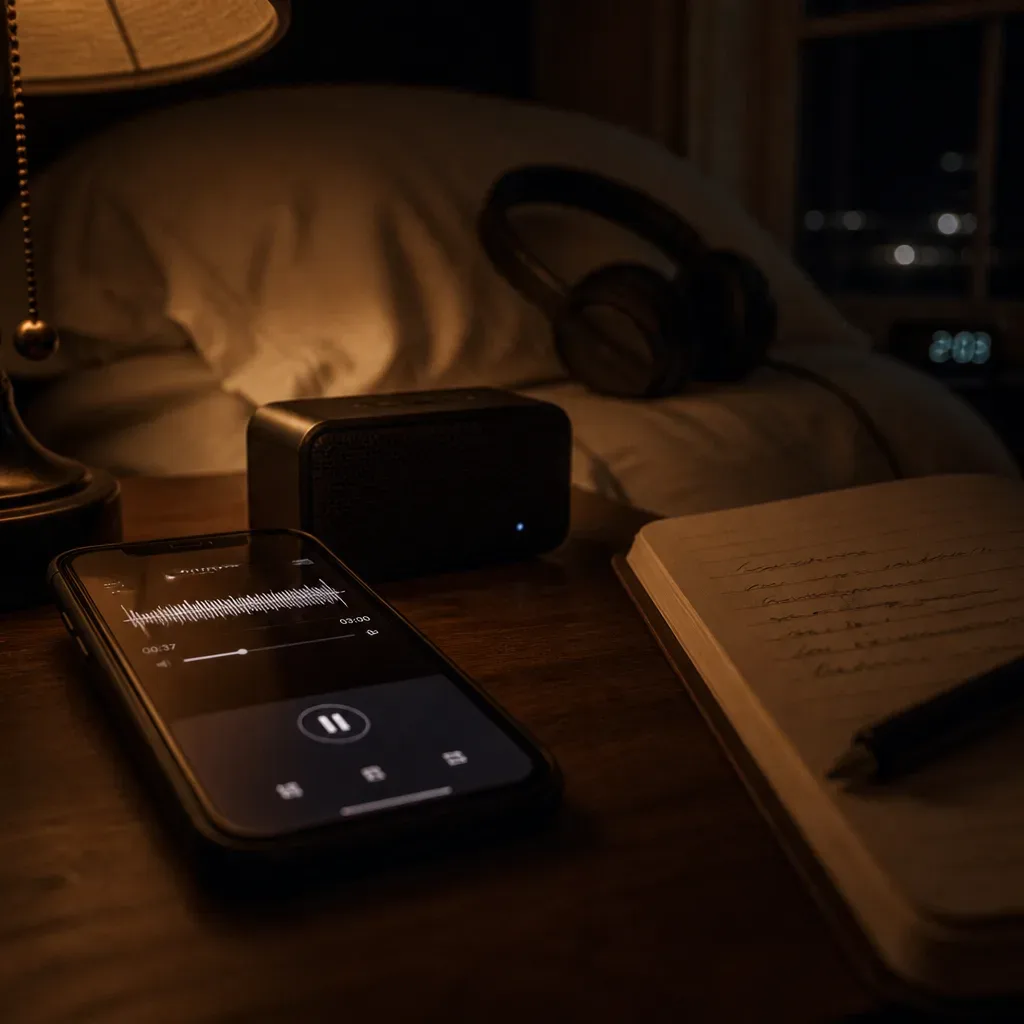
A quiet voice is still a voice. If you cannot hear the words, you are no longer doing this practice.
You may prefer:
- Phone speaker on a bedside table, screen down
- A small pillow speaker at very low volume
- One earbud only, removed after the audio
- No headphones if touch sensitivity wakes you up
Track the effect, not the aesthetic. If the setup helps you sleep on 5 of 7 nights, it is working well enough to keep. If it wakes you, simplify.
What should you expect after one or two weeks?
Expect familiarity first, easier recall second, and behavior changes only if the audio stays tied to real daily choices.
By night three, the recording may feel less novel. That is not failure. Repetition is how cues become ordinary enough to use. In memory research, spaced repetition consistently beats cramming for durable recall; the classic spacing effect has been studied for more than a century, with Ebbinghaus publishing early memory work in 1885. Your bedtime audio is not a study deck, but the principle rhymes: repeat a small cue often enough and it becomes easier to return to.
By week two, notice three things. First, do you resist bedtime less? Second, do the words come back during the day without forcing them? Third, do you make one small choice that matches the person in the recording? Joe Dispenza and other manifestation teachers often speak in larger claims than psychology can verify, but one grounded overlap is rehearsal: the mind tends to use repeated self-relevant material as a cue for attention.
Do not use dramatic mood as your only measure. A quiet practice may be doing its job precisely because it is not dramatic. In small studies of implementation intentions, people who form “if-then” plans often follow through more reliably than people who only set goals. Peter Gollwitzer’s work on implementation intentions has been cited thousands of times because the finding is practical: specify the cue, then repeat the response.
For this routine, the cue is bed. The response is one 3-minute listen. The measure is whether your sleep and your next day can live with it.
If insomnia is persistent, severe, or tied to distress, talk with a qualified health professional rather than trying to fix it with audio alone. Bedtime words can support sleep hygiene. They are not medical care.
How do you keep the practice honest without making it sterile?
Keep the calculator for timing, the audio for meaning, and your sleep as the boundary.
Honesty does not make the practice cold. It makes it safer to keep. You can say that subliminal perception research shows limited effects, that audible bedtime rehearsal is easier to verify, and that a personal recording may still matter because you repeat it. Those statements can sit in the same room. A mechanism does not have to be mystical to be meaningful.
Use this weekly check, preferably in the morning, not at midnight:
- Did I listen at least 5 nights this week?
- Did the audio delay sleep by more than 10 minutes?
- Did I keep the words audible and soft?
- Did I avoid replaying it as reassurance?
- Did one sentence affect a real choice today?
If the answer to number two is yes, adjust the timing. Move the audio earlier, shorten the wind-down, or use the calculator again. The Sleep cycle calculator tool is useful whenever your wake time changes by more than 30 minutes, which often happens with travel, school terms, new jobs, or caregiving.
The practice is not proved by how intensely you feel it at night. It is proved by whether you can return to it without paying for it in sleep.
You can also pair the Dream-Self audio with broader sleep affirmations on nights when you need simpler words, but keep the hierarchy clear. In AYA, the daily affirmation supports the listening. The Manifestation Board supports memory and direction. The audio remains the method.
The last ten minutes before sleep are small, so choose one voice and let the rest of the night be quiet.