sleep hypnosis affirmations
Sleep Hypnosis for Confidence: 10-Minute Script
Sleep hypnosis for confidence uses a calm bedtime script, slow audio, and repetition to rehearse steadier self-talk before sleep.
Sleep hypnosis for confidence is a short bedtime audio practice that uses relaxation, suggestion, and repetition to rehearse steadier self-talk while you’re drowsy. A 10-minute Dream-Self script works best when the words are audible, believable, and specific enough that your sleeping mind has something simple to return to.
What is sleep hypnosis for confidence, really?
Sleep hypnosis for confidence is guided suggestion played before sleep, when attention narrows and the body is already moving toward rest.
In clinical hypnosis, you’re not unconscious or under someone else’s control. You’re focused, relaxed, and more willing to try an idea for a few minutes. The American Psychological Association has described hypnosis as a state of focused attention and reduced peripheral awareness, often with increased responsiveness to suggestion. That definition matters because bedtime audio is not a trick. It’s a way of choosing the last words your mind hears clearly.
Confidence is not a mood you can force at midnight. It’s a pattern of prediction: I can speak, I can stay, I can recover, I can be seen and remain myself. Research on self-efficacy, especially Albert Bandura’s work beginning in the 1970s, links confidence with repeated mastery cues and believable rehearsal. The bedtime script borrows from that. It gives the mind a small, repeated picture of you acting with less collapse.
The last 10 minutes before sleep are not magic, but they are unusually quiet. Sleep onset often includes hypnagogic imagery, drifting attention, and fewer verbal objections. In small hypnosis studies, response varies widely; a 2016 review in the American Journal of Clinical Hypnosis notes that hypnotizability is stable for many adults, but not equal in everyone. That’s why the script should be modest. You’re not trying to become a different person tonight. You’re practicing a different inner sentence.
A good confidence script sounds boring on paper and useful in the dark. The nervous system trusts repetition more than drama.
Why use a Dream-Self script before sleep?
A Dream-Self script works because it gives confidence a scene, a voice, and a repeated identity cue before the mind lets go.
Dream-Self language means you write from the version of you who already behaves in the way you’re practicing. Not grand, not flawless, not theatrical. Just a future self who has already done the ordinary brave thing 20 times. If your scene is speaking in a meeting, the Dream-Self doesn’t say, I am adored by everyone. It says, I pause, I breathe, and I say the next clear sentence.
This is close to mental rehearsal. Sports psychology has used imagery rehearsal for decades, and meta-analyses generally find small to moderate benefits when imagery is combined with real practice. A 2012 review in the Journal of Mental Imagery reported that vivid, controllable imagery tends to work better than vague wishing. Bedtime adds a specific condition: you’re not training performance at full alertness; you’re softening the way you predict yourself.
The AYA Method is a daily audio manifestation practice. Each day you listen to a short personalized recording — your Dream-Self Moment — narrated from the version of you who has already manifested the life you intend. Listening is the practice. Repetition is the work. The audio is the method. You can read the full frame for the AYA Method, but the key distinction is simple: the words are fully audible, personal, and meant to be heard.
That differs from many subliminal tracks. A subliminal hides the words under sound, which can feel soothing but makes the actual suggestion hard to check. The research on priming is real and modest; the YouTube claims are often much larger than the evidence. If you want the technical difference, keep the subliminals guide nearby.
What you can hear, you can consent to. What you repeat, you begin to recognize as yours.
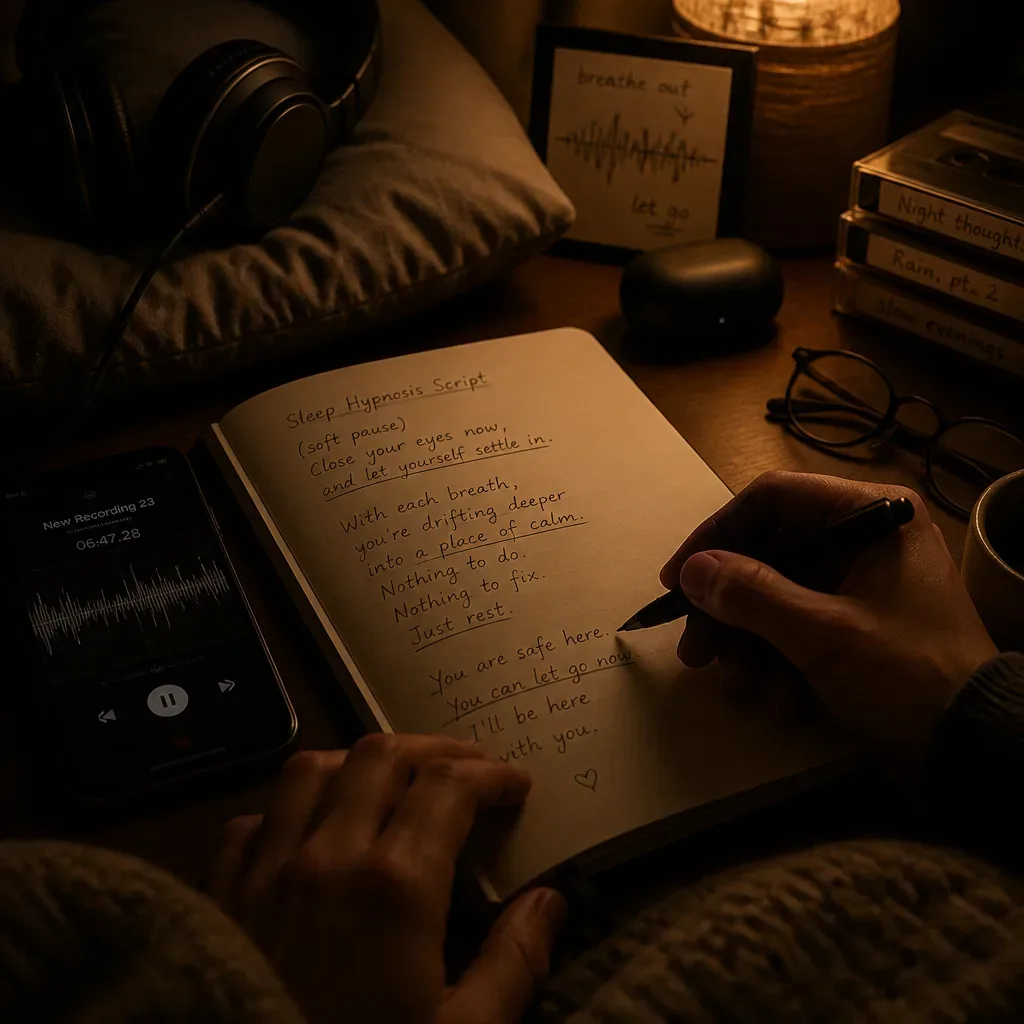
How do you write the 10-minute script?
Write the script in short present-tense lines that name one confidence scene, one body cue, and one next action.
Start with one target. Confidence is too wide to record well. Choose a moment you can recognize in real life: joining a call, asking for fair pay, posting your work, walking into a class, saying no without over-explaining. The more exact the scene, the less the mind has to invent at bedtime. The National Sleep Foundation often recommends a 30 to 60 minute wind-down; your 10-minute audio belongs near the end of that window, not after 40 minutes of scrolling.
Use this simple structure:
- Name safety in the room: I am in bed. The day is over.
- Slow the body: My jaw loosens. My shoulders drop.
- Enter one future scene: I see myself opening the meeting notes.
- Add a believable confidence cue: I speak one clear sentence at a time.
- Repeat a recovery line: If my voice shakes, I keep going.
- Close toward sleep: I don’t need to solve this now. I can rest.
Believability is not a small detail. In a 2009 study in Psychological Science, positive self-statements helped some people with high self-esteem but made some low self-esteem participants feel worse when the statements felt too false. That doesn’t mean affirmations fail. It means the sentence has to meet you where you are. I am calm forever is brittle. I can feel my feet and answer slowly is usable.
Here’s a compact script map:
| Minute | Purpose | Example line |
|---|---|---|
| 0–2 | Settle the body | The room is quiet enough. My breathing can slow. |
| 2–4 | Name the scene | I see tomorrow’s doorway, screen, or table. |
| 4–7 | Rehearse confidence | I take one pause and say what I mean. |
| 7–9 | Normalize nerves | Nerves can be present. They don’t lead. |
| 9–10 | Release into sleep | The practice is done for tonight. |
Keep the language plain. A sleepy mind does not need poetry. It needs a line it can carry without waking up.
What should the finished script sound like?
The finished script should sound like a calm person speaking slowly beside the bed, with enough silence for the body to answer.
Here is a 10-minute Dream-Self audio script you can record. Read it at 110 to 130 words per minute, slower than ordinary speech. Many audiobooks sit near 150 words per minute; bedtime suggestion usually needs more air. Leave 3 to 6 seconds after each sentence that feels important. If you use music, keep it quieter than the voice and free from sudden changes.
Begin script:
I am in bed now. The day is finished enough. I don’t have to rehearse every problem. My body can begin to rest.
My forehead softens. My jaw loosens. My tongue rests low in my mouth. My shoulders do not have to hold tomorrow tonight.
I breathe in quietly. I breathe out a little longer. I can feel the bed holding my weight. I can let the room be simple.
There is a version of me who handles the moment with more steadiness. Not perfectly. Steadily. I can hear that version clearly.
I see myself entering the situation. The room, the screen, the message, the doorway. I arrive with my breath still mine.
I do not rush to disappear. I do not rush to perform. I take one pause. I let my feet remind me that I am here.
When it is time to speak, I say one clear sentence. Then another, if another is needed. My voice can be low. My voice can be simple. It still counts.
If nerves rise, I do not treat them as danger. I notice warmth, tightness, movement. I keep my attention on the next small action.
I can be seen and remain myself. I can be heard and remain myself. I can make a request, answer a question, or take up space without apologizing for being there.
I have survived awkward moments before. I have recovered from pauses before. I have found words after silence before. My body knows recovery.
Tomorrow, I don’t need perfect confidence. I need one honest action. I can do one honest action.
The practice is complete for tonight. The mind can continue softly if it wants to. The body can sleep.
End script.
If you prefer classic bedtime phrasing, pair this with the basics in the sleep affirmations guide. If you track timing carefully, use the sleep cycle calculator so the audio doesn’t tempt you to push bedtime later than you can afford.
How should you record and listen at night?
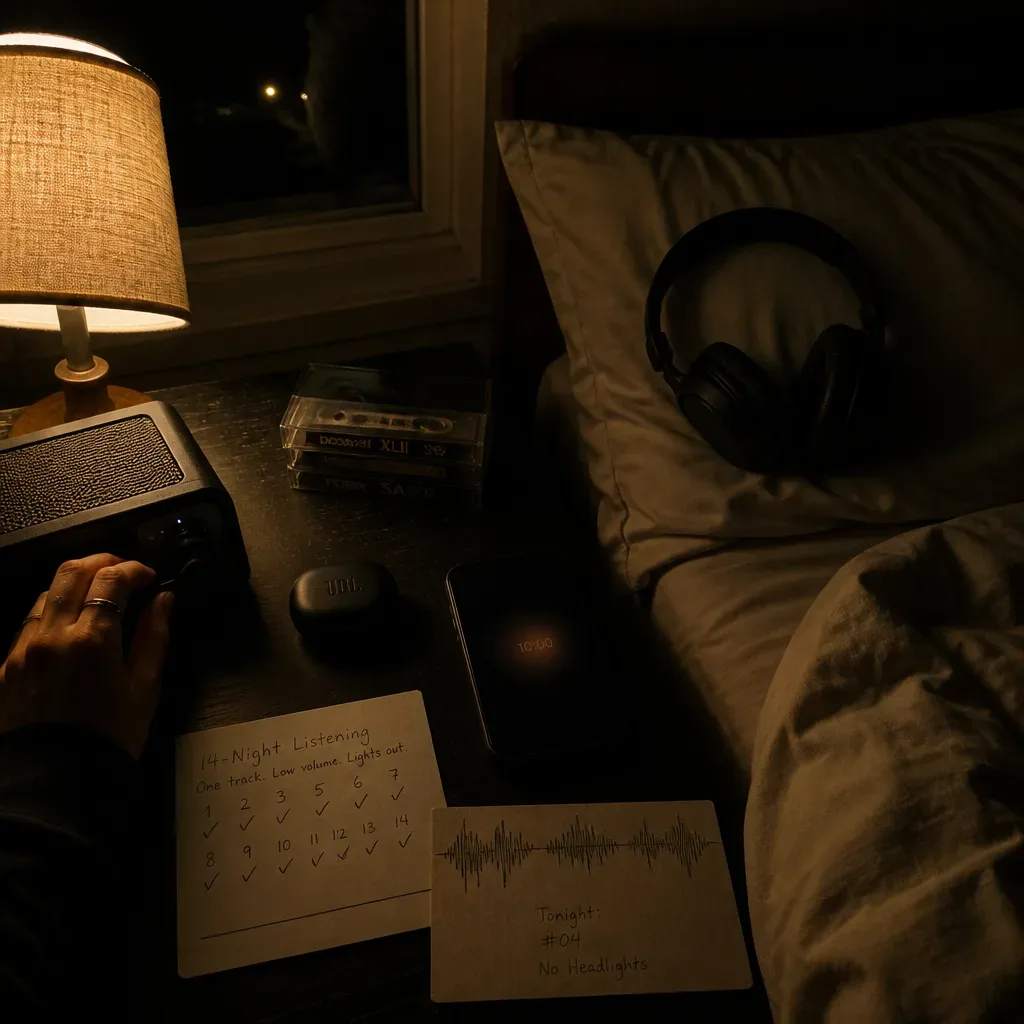
Record once, listen daily, and change nothing for 14 nights unless the audio disturbs your sleep.
Use your phone’s voice memo app if that’s what you have. You don’t need a studio microphone. You do need a quiet room, a steady pace, and a script that doesn’t make you cringe. Hold the phone 15 to 25 centimeters from your mouth, turn off notifications, and record in one take if possible. Tiny imperfections help the track feel human. A polished voice is less important than a trusted one.
Before recording, read the script aloud once during the day. Remove any line you’d argue with at 11:30 p.m. Then record at night or in a dim room, because your pacing will naturally slow. Dr. Andrew Huberman often notes that light exposure strongly affects circadian timing; for bedtime audio, that means don’t stare at a bright screen while setting it up. Queue it before lights out.
Use this listening routine:
- Play the track after hygiene, not while answering messages.
- Keep the volume low but understandable.
- Use a sleep timer if the app allows it.
- Listen on a speaker if earbuds make you alert or uncomfortable.
- Stop using any track that increases rumination for more than 2 nights.
The 14-night rule is practical, not sacred. Two weeks gives you enough repetitions to notice whether the sentence returns during the day. In habit research, automaticity can take far longer than 21 days; a 2009 European Journal of Social Psychology study found an average of 66 days for new behaviors to feel automatic. But bedtime audio can show small signs earlier: a pause before speaking, less apology, one steadier breath.
What should you expect by week two?
By week two, expect small changes in self-talk and recovery speed, not a total personality change.
The first few nights may feel awkward. Hearing your own voice can make you self-conscious. That usually softens with repetition. In clinical practice, I’d ask clients to track one observable behavior, not a general feeling. Did you answer one message without rewriting it 12 times? Did you stay in the conversation 30 seconds longer? Did you ask the question instead of swallowing it?
Confidence often shows up first as less avoidance. That is not glamorous, but it is measurable. Cognitive behavioral studies commonly track behavior because mood can lag behind action. A person may still feel nervous and still speak. That counts. A person may still blush and still set the boundary. That counts too.
Use a small tracking note in the morning:
| Morning note | Score 0–2 |
|---|---|
| I listened without fighting the audio | 0 1 2 |
| I remember one line from the script | 0 1 2 |
| I took one confident action yesterday | 0 1 2 |
| I slept within my usual sleep window | 0 1 2 |
The sleep line matters. A method that steals sleep will weaken the very confidence it claims to build. The CDC says adults generally need at least 7 hours of sleep per night. If your audio habit cuts that down, shorten the track, move it earlier, or stop. If insomnia is persistent, distressing, or tied to anxiety that feels unmanageable, speak with a qualified professional.
Confidence is not the absence of a shaking voice. Confidence is staying kind to yourself while the voice shakes.
How is this different from subliminals or ordinary affirmations?
This practice is different because the suggestion is audible, personal, timed for sleep, and attached to one real behavior.
Subliminals can be relaxing, and some listeners prefer them because there’s less conscious resistance. The honest problem is that you often can’t verify the script, volume balance, or repetition. Priming research does suggest that cues outside full awareness can influence later responses in modest ways, but replication debates in psychology have made careful wording necessary. A hidden message under rain sounds is not the same thing as clinical evidence for overnight confidence change.
Ordinary affirmations are more transparent. You can read them, choose them, and repeat them. Their weakness is often timing and tone. A noon affirmation shouted in a mirror may wake up the inner critic. A soft line before sleep may pass with less argument. That’s why sleep affirmations and sleep hypnosis overlap: both use repetition, but hypnosis adds pacing, relaxation, and guided attention.
Here is the practical difference:
| Practice | Can you hear the words? | Best use | Main caution |
|---|---|---|---|
| Subliminals | Usually no | Background comfort | You can’t easily consent to the exact script |
| Sleep affirmations | Yes | Repeating short beliefs | Lines may be too broad or false-feeling |
| Sleep hypnosis | Yes | Relaxed guided rehearsal | Bad pacing can keep you awake |
| Dream-Self audio | Yes | Personal future-self rehearsal | Needs honest, specific writing |
Joe Dispenza and Neville Goddard both shaped popular language around rehearsing a future self, though their claims go beyond what sleep science can prove. You don’t have to accept every metaphysical claim to use the useful part: the mind rehearses identity through repeated scenes. Keep the claim small enough to test.
The sentence that changes you is usually the one you can stand to repeat.
How can you make the script yours without making it too much?
Make it yours by changing the scene, the sensory details, and the recovery line while keeping the structure calm.
Personal does not mean overloaded. Don’t add every goal you have. Don’t ask one 10-minute track to fix public speaking, dating, money, family boundaries, and body image at once. Pick one confidence domain for 14 nights. If you want a broader practice later, record a separate track. The brain sorts better when the cue is clean.
Choose details you can feel: the cool edge of a laptop, the floor under your feet, the pause before you answer, the texture of your own voice. Sensory detail helps imagery. Studies on mental imagery often distinguish vividness from control; both matter. If the scene becomes too intense, step back. Say, I see the doorway from a safe distance. Then return to the breath.
Use this editing rule: every line should do one of four jobs.
- Settle the body.
- Name the scene.
- Rehearse the next action.
- Make recovery safe.
If a line doesn’t do one of those, cut it. The boring script often works because it doesn’t demand a performance from a tired mind. Your night practice should not become another place to fail.
For more structure, pair the audio with a single written sentence in the morning, but don’t confuse the support with the method. In the AYA Method, listening is the practice, repetition is the work, and the audio is the method. A daily affirmation or visual board can support the habit, but the voice in your ear is doing the nightly work.
Use the same script tonight. Let it be plain enough to believe.