sleep hypnosis affirmations
Sleep Hypnosis vs Meditation: Which Night Audio Fits You?
Sleep hypnosis vs meditation explained quietly: compare scripts, breath, evidence, safety, and which night audio is more likely to fit your sleep.
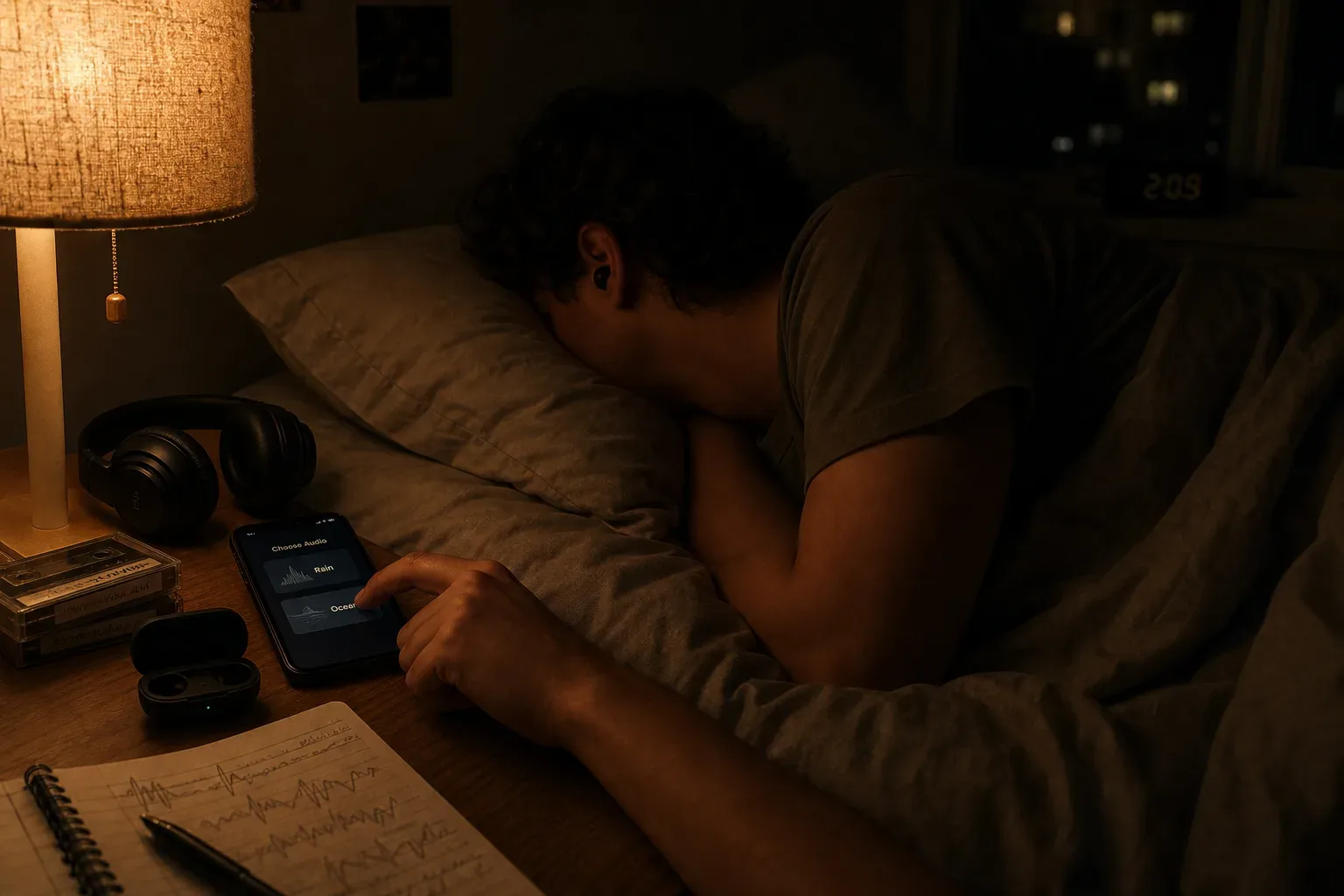
Sleep hypnosis vs meditation comes down to how you want the night voice to work. Sleep hypnosis guides you into a suggestible, relaxed state with a script. Meditation trains attention through breath, body, or awareness. Both can help sleep. The better fit is the one that lowers effort instead of giving you another task.
What is the real difference between sleep hypnosis and meditation?
Sleep hypnosis uses suggestion inside relaxation; meditation uses attention practice inside relaxation.
A sleep hypnosis track usually has a beginning, a descent, and a purpose. The guide may count down from 10, ask you to soften your jaw, and offer phrases like “your body knows how to rest.” That structure matters. In clinical hypnosis, the American Psychological Association describes hypnosis as focused attention with reduced peripheral awareness and increased response to suggestion. The key word is suggestion. You’re not absent. You’re listening in a narrower way.
Meditation doesn’t need suggestion. A basic sleep meditation may ask you to notice breathing, scan the body, or return to a sound. In mindfulness-based trials, the instruction is often to observe thoughts rather than replace them. A 2015 randomized clinical trial in JAMA Internal Medicine found that a mindfulness awareness program improved sleep quality in older adults compared with sleep hygiene education alone. That doesn’t mean every app track works. It means the mechanism has real, modest support.
Here’s the simplest split:
| Night audio type | Main tool | What you do | Best when |
|---|---|---|---|
| Sleep hypnosis | Suggestion | Follow the voice and allow imagery | You want direction |
| Sleep meditation | Attention | Return to breath, body, or sound | You want less narrative |
| Sleep affirmations | Repetition | Hear chosen statements before sleep | You want language rehearsed |
| Subliminals | Masked words | Listen without clear conscious words | You want minimal awareness |
If you’re comparing hypnosis to affirmations too, the Sleep affirmations pillar gives the cleaner definition. If you’re wondering about hidden-word audio, the Subliminals pillar is the better next read.
A night practice fails when it asks for a daytime level of effort. The last ten minutes before sleep are not a place to prove discipline. They’re a place to choose the input gently.
Which one has better evidence for sleep?
Meditation has broader sleep research, while hypnosis has narrower but credible support when used carefully.
The evidence for meditation is easier to find because mindfulness has been studied across stress, mood, pain, and sleep. A 2014 review in JAMA Internal Medicine looked at 47 trials with 3,515 participants and found moderate evidence that mindfulness meditation programs improved anxiety, depression, and pain, with smaller effects in other areas. Sleep isn’t the whole story there, but anxiety and rumination are often what keep people awake at 1:17 a.m.
For insomnia specifically, cognitive behavioral therapy for insomnia, or CBT-I, remains the first-line behavioral treatment in many clinical guidelines. That matters because neither hypnosis nor meditation should be sold as a cure. If you’ve had insomnia for weeks, if you’re scared of bed, or if sleep loss is affecting work, driving, or mood, speak with a qualified professional. Audio can be kind. It’s not a full clinic.
Hypnosis research is smaller. Reviews have found promise for sleep, pain, and anxiety, but study quality varies. In small studies, hypnotic suggestion has changed sleep-related outcomes, including slow-wave sleep in highly hypnotizable participants. A well-known 2014 study from researchers at the University of Zurich reported an increase in slow-wave sleep after hypnotic suggestion in young women who were highly suggestible. That’s interesting. It’s not a guarantee for a stranger’s YouTube track.
Meditation asks, “Can you return?” Hypnosis asks, “Can you receive?” Both are honest questions at night.
The claims you see online often outrun the research. A 30-minute hypnosis video promising instant deep sleep is not the same thing as a controlled protocol. A meditation track with 20 million plays isn’t proof either. Treat view counts as popularity, not evidence.
Which audio fits your nervous system tonight?
Choose sleep hypnosis if guidance calms you, and choose meditation if being directed makes you tense.
Some people hear a voice counting backward and feel their shoulders drop within 60 seconds. Others hear the same count and start monitoring whether it’s “working.” That second person may do better with a simple breath meditation, a body scan, or even quiet ambient sound with sparse words. The fit is practical, not moral. You’re not more advanced because you use meditation. You’re not more suggestible in a bad way because you like hypnosis.
Use this quick check before you press play:
- If you want someone to carry the structure, choose hypnosis.
- If you want fewer words, choose meditation.
- If you want identity language repeated clearly, choose affirmations.
- If you want almost no conscious language, read about subliminals first.
- If the track makes you try harder after 10 minutes, stop it.
The National Sleep Foundation often recommends a consistent wind-down period of 30 to 60 minutes. That window is a better place for night audio than the moment after you’ve already become irritated. Start while you still have some softness left in the evening.
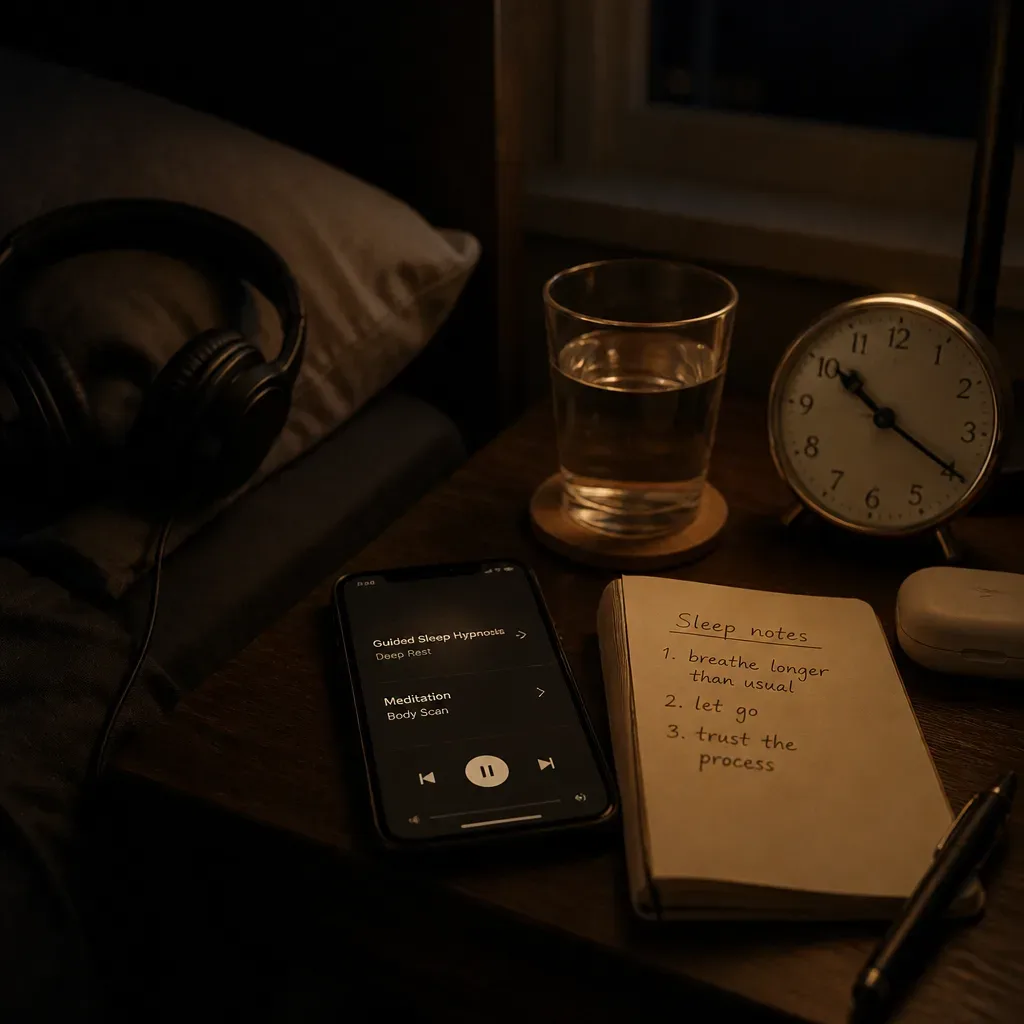
Volume matters more than people admit. If speech is loud enough to demand attention, your brain may keep checking it. Dr. Andrew Huberman has often emphasized morning light and consistent sleep timing when discussing sleep basics; those boring levers still matter more than any single track. Use the Sleep cycle calculator tool if you’re trying to place audio before a realistic bedtime instead of using it to fight a schedule you can’t keep.
A good night track doesn’t win your attention. It earns permission to fade.
When should you use sleep hypnosis instead of meditation?
Use sleep hypnosis when you want a guided descent, clear permission to rest, and suggestions that don’t require analysis.
Hypnosis is often a better fit when your thoughts feel crowded. A meditation instruction like “notice the thought and let it pass” can be too bare when you’re tired. A hypnosis script gives the mind something narrow to hold: stairs, numbers, a warm room, a repeated phrase. That isn’t weakness. Attention often needs a handrail at night.
Sleep hypnosis may also suit you if you respond well to imagery. Many scripts use sensory cues: heavier limbs, slower breathing, a dim hallway, a safe bed. Mental imagery has its own research base; sports psychology has used rehearsal and imagery for decades, though sleep hypnosis is a different application. The mechanism is plausible: attention, expectation, and relaxation work together.
Look for tracks with these qualities:
- A calm voice with no sudden music swell
- A script that allows sleep instead of demanding it
- A length between 15 and 45 minutes
- No fear-based suggestions
- No claims of medical treatment
- A fade-out or sleep-friendly ending
Avoid tracks that keep introducing new goals. A hypnosis recording for sleep shouldn’t also try to fix your career, change your face, repair every relationship, and make you wake at 5 a.m. One night, one purpose. The brain before sleep is suggestible, but it’s also tired.
If you like guided night language but want it to be yours rather than a stranger’s script, the AYA Method is a daily audio manifestation practice. Each day you listen to a short personalized recording — your Dream-Self Moment — narrated from the version of you who has already manifested the life you intend. Listening is the practice. Repetition is the work. The audio is the method.
That difference is not small. In hypnosis, the guide supplies the frame. In AYA, the words are fully audible and personal. The daily affirmation and Manifestation Board can support the practice, but the audio is the method.
When should you use meditation instead of sleep hypnosis?
Use meditation when you want to relate differently to thoughts rather than be guided by suggestion.
Meditation is the better fit if you dislike being told what to feel. Some people hear “your body is heavy” and immediately think, “No, it isn’t.” A breath meditation doesn’t need agreement in the same way. It simply gives you a place to return. That return is the repetition. You drift, notice, return. At night, three returns may be enough.
Mindfulness-based stress reduction was formalized by Jon Kabat-Zinn in 1979 at the University of Massachusetts Medical Center. Since then, thousands of studies have examined mindfulness, though not all are strong and not all apply to sleep. The honest version is this: meditation can reduce rumination for many people, and reduced rumination can make sleep easier. It’s not a sedative.
For bedtime, keep meditation simple. Long philosophical talks can wake you up. So can advanced breathwork. If a technique uses strong breathing, long retentions, or intense focus, save it for daytime unless a clinician has told you otherwise. Before sleep, the better instruction is usually boring: feel the breath at the nose, soften the belly, scan from forehead to feet.
Here’s a quiet comparison for night use:
| If this happens | Try this |
|---|---|
| You argue with suggestions | Breath meditation |
| You feel lonely in silence | Gentle hypnosis |
| You chase perfect focus | Body scan |
| You want identity rehearsal | Audible affirmation or AYA audio |
| You wake after 20 minutes | Shorter track with timer |
The point of meditation before bed isn’t to become a perfect meditator. The point is to stop treating every thought as a command.
How do affirmations, subliminals, and AYA change the choice?
Affirmations, subliminals, and AYA add identity language to the night, while hypnosis and meditation mainly change state.
This is where the categories blur. Many sleep hypnosis tracks contain affirmations. Many sleep meditations include phrases like “I am safe” or “I can rest now.” Subliminals may use affirmations hidden beneath rain or music. The method changes what you can consciously hear and how much agency you have over the script.
A subliminal is an affirmation you can’t consciously hear. That’s the whole trick, and the whole problem. Priming research is real but modest; hidden cues can influence perception and choice under certain lab conditions, often briefly. The Princeton Engineering Anomalies Research program, often cited in manifestation circles, studied mind-machine interaction for nearly 30 years before closing in 2007, but its findings remain debated and shouldn’t be treated as proof that any masked audio will change your life.
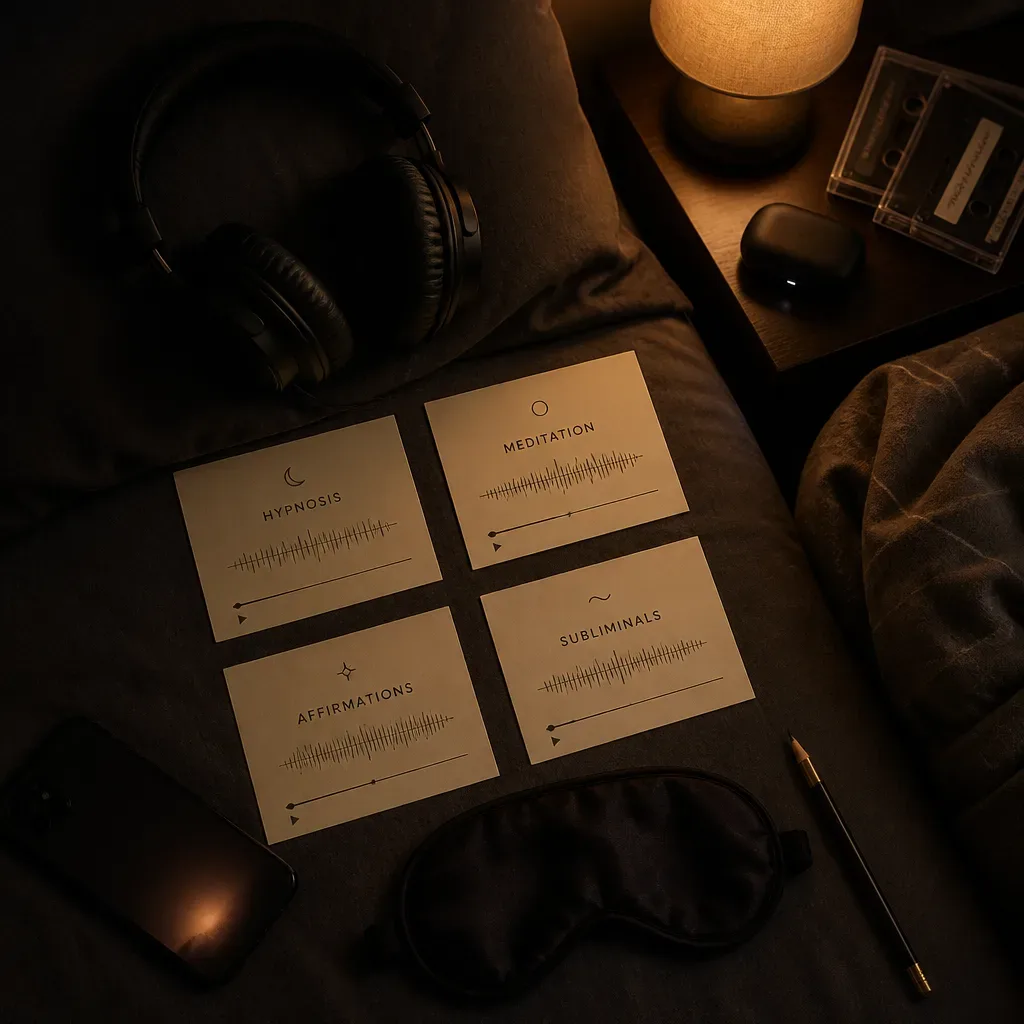
Audible affirmations are less mysterious. You hear the sentence. You can reject it, edit it, or repeat it. That’s why I prefer clear audio at night. If a sentence is going to keep me company in the dark, I want to know what it says. The Sleep affirmations pillar is useful if you’re deciding whether spoken repetition fits you better than induction or breath.
AYA sits near affirmations, but it’s not just a list of positive lines. The recording is built as a Dream-Self Moment: short, personal, and narrated from the version of you who is already living what you intend. Joe Dispenza often talks about rehearsing a future self; Neville Goddard wrote about assuming the feeling of the wish fulfilled. AYA makes that rehearsal audible and repeatable. You still sleep. You still live the next day. But the sentence starts to sound less foreign.
The self you describe nightly, in your own voice, stops feeling like a stranger.
How do you choose without overthinking it?
Test each style for seven nights, track two or three signals, and keep the one that makes sleep easier rather than more dramatic.
Don’t decide from one bad night. Sleep is noisy data. Caffeine, late meals, alcohol, stress, temperature, and light can all change the result. The CDC has reported that about 1 in 3 U.S. adults don’t get enough sleep, which means many people are asking night audio to compensate for a whole day of strain. Be fair to the track, but be fair to your body too.
Try this simple seven-night test:
- Pick one sleep hypnosis track for nights 1 and 2.
- Pick one sleep meditation for nights 3 and 4.
- Use an audible affirmation or personal audio for nights 5 and 6.
- On night 7, repeat the one you resisted least.
- Each morning, write down sleep onset estimate, night waking, and mood on waking.
You don’t need a wearable. If you use one, treat the numbers as clues, not verdicts. Consumer sleep trackers can estimate patterns, but even research-grade sleep staging uses EEG, eye movement, and muscle tone. Your watch may be helpful. It’s not the judge of whether you rested.
A good fit usually has three signs by week two: you stop shopping for new tracks, you lower the volume naturally, and you remember less of the ending. That last one matters. Night audio is allowed to disappear. It doesn’t need to impress you.
If you’re still unsure, choose the least complicated option. A 10-minute body scan beats a 90-minute track you dread. A clear personal recording beats a subliminal you don’t trust. And if the method costs you sleep, it costs more than it gives.
You can also pair your choice with the Subliminals pillar if hidden-word audio keeps pulling at your curiosity, or return to the AYA Method if what you really want is a voice that sounds like you.
Choose the voice you can return to tonight.