subliminals
Subliminal Affirmations: 25 Sleep-Safe Examples
Subliminal affirmations can be sleep-safe when they stay quiet, simple, and non-medical. Use these 25 examples to build a softer night audio.
Subliminal affirmations are short positive statements mixed so quietly into audio that you don’t consciously hear them. For sleep, the safest versions are simple, believable, non-medical, and quiet enough not to wake you. Use them as gentle priming, not proof that hidden words can force change overnight.
What makes subliminal affirmations sleep-safe?
Sleep-safe subliminal affirmations are calm, specific, non-coercive statements placed under audio that protects sleep rather than competing with it.
A subliminal is an affirmation you can’t consciously hear. That’s the whole trick, and the whole problem. If you can’t hear the words, you also can’t easily audit the words at 2:00 a.m. That means the script matters more, not less. Before you hide a sentence under rain, brown noise, or music, read it in daylight. If it sounds harsh when spoken plainly, don’t let it whisper all night.
Sleep is not empty time. The American Academy of Sleep Medicine recommends at least 7 hours of sleep for most adults, and the CDC has reported that roughly 1 in 3 U.S. adults gets less than that. A sleep audio that steals even 20 minutes from you is not a good bargain. If a method costs you sleep, it costs more than it gives.
Good sleep-safe statements share a few traits:
- They don’t make medical promises.
- They don’t insult your current self.
- They don’t demand instant results.
- They don’t use fear, shame, or urgency.
- They can be believed at least 5 percent.
- They fit one theme per recording.
That last point is plain engineering. A single 3-minute loop about calm sleep is cleaner than a 60-minute file trying to cover money, dating, body image, discipline, and memory. In cognitive psychology, priming effects are usually studied with narrow targets, often measured in milliseconds or minutes, not across a whole life. Keep the target narrow.
The safest sentence is one your nervous system doesn’t need to argue with. I am learning to rest will usually land better than I am perfectly healed forever. One is practice. The other asks your sleeping mind to accept a legal document it never signed.
For a broader foundation on how hidden audio is usually made, read the Subliminals pillar. It goes into masking, volume, and why YouTube claims should not be confused with lab research.
Which 25 subliminal affirmations work best before sleep?
The best sleep subliminal affirmations are short, present-tense lines that feel steady when repeated for 30 nights.
Use these as examples, not commandments. Change any line that makes your body tighten. In small priming studies, wording and context matter; a 1996 Science paper by Greenwald, Draine, and Abrams found unconscious semantic activation under brief exposure, but the effects were modest and task-specific. Your bedtime script should be even more conservative than a lab stimulus.
Calm body and safe night
- My body knows how to settle.
- I let the day become quiet.
- I am safe enough to soften.
- My breath can slow without effort.
- Rest is allowed tonight.
Self-trust
- I keep small promises to myself.
- I can return to what matters.
- I hear myself with patience.
- My choices can be steady.
- I trust the next right step.
Focus and study
- I begin with one clear task.
- I remember more when I rest well.
- My attention can come back gently.
- I prepare before I rush.
- I can finish the next small piece.
Confidence without pressure
- I belong in rooms where I am learning.
- I can speak slowly and still be heard.
- I don’t need to perform calm to practice it.
- I can be seen without leaving myself.
- My voice is allowed to take up space.
Identity and manifestation
- I rehearse the self I am becoming.
- My actions can match my chosen story.
- I notice evidence of change in ordinary days.
- I can want more without rejecting now.
- I return to the life I am practicing.
A good affirmation doesn’t bully the future into arriving. It makes the next repetition easier to believe.
Notice that none of these say you will never feel fear, never fail, or never wake during the night. Sleep science is full of normal variation. Adults typically cycle through sleep stages every 90 to 110 minutes, according to standard sleep medicine texts, and brief awakenings are common even in healthy sleepers. A good night audio should not treat every waking as failure.
If you prefer audible words instead of hidden ones, compare these with the guidance in the Sleep affirmations pillar. Audible affirmations let you hear and consent to every line. Subliminals ask for more trust, so they deserve more editing.
How should you write a subliminal script you won’t regret hearing all night?
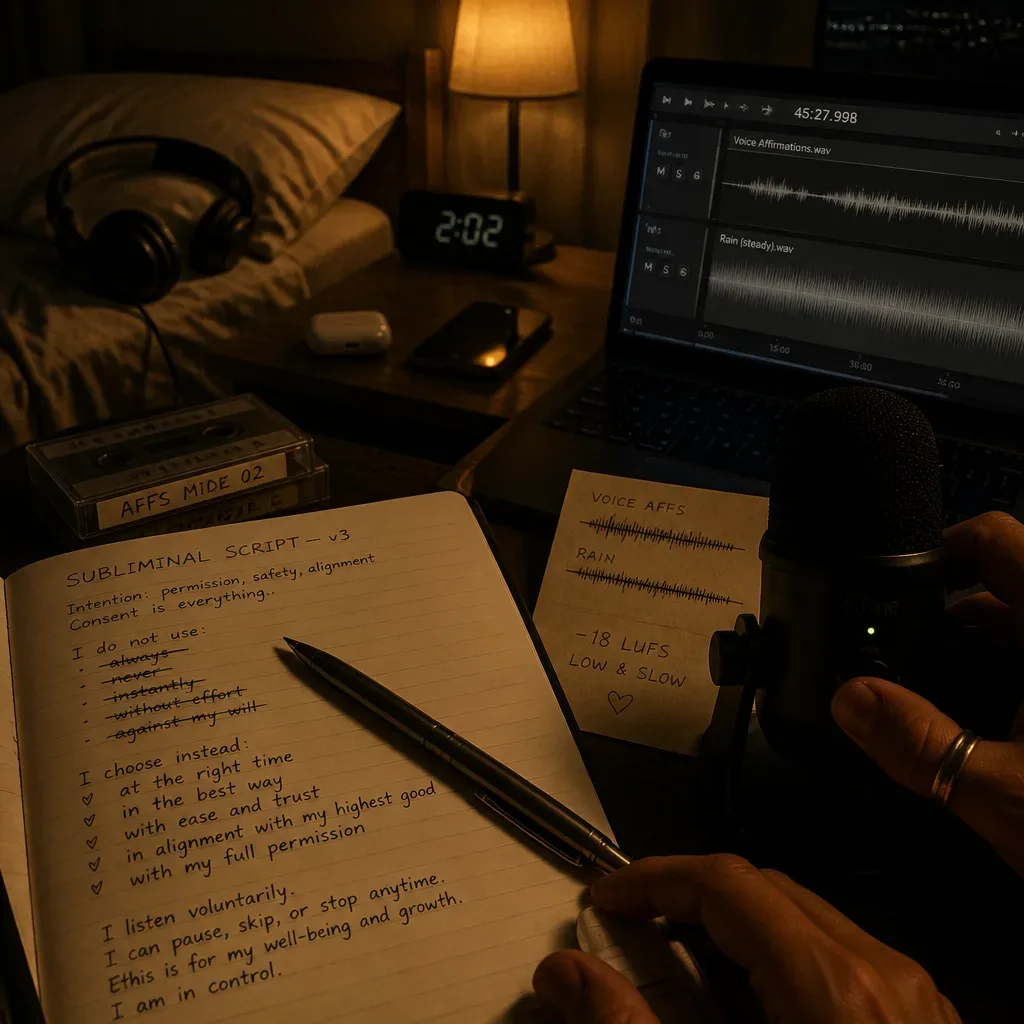
Write the visible script first, test it aloud, then make it subliminal only after it still sounds kind in daylight.
Start with 5 to 12 lines. That is enough for a 60- to 180-second loop, which is long enough to avoid feeling mechanical and short enough to revise without drama. I like 8 lines for a first recording because it forces choices. If I can’t say the whole script once without cringing, I don’t hide it under rain.
Use this order:
- Pick one theme, such as sleep, study, confidence, or self-trust.
- Write 10 rough lines in plain speech.
- Remove any line with always, never, instantly, permanently, or guaranteed.
- Read the remaining lines at a low volume.
- Keep only the sentences your body doesn’t resist.
- Record slowly, leaving half a second between lines.
- Mix the voice lower than the masking sound.
Here is a simple edit table:
| Risky line | Sleep-safe revision | Why it is better |
|---|---|---|
| I never feel anxious | I can meet anxious moments gently | Allows normal feelings |
| I am rich overnight | I make steadier choices with money | Connects identity to action |
| Everyone loves me | I can be warm and present with people | Avoids control over others |
| I must wake up perfect | I can begin again in the morning | Protects sleep from pressure |
The word must is usually too loud, even when mixed quietly. Hidden pressure is still pressure.
For recording, a phone memo is enough. Speak 6 to 10 inches from the microphone, use a soft voice, and avoid recording when you’re angry or rushed. Consumer microphones often exaggerate mouth noise, so leave a little distance and use a blanket or curtain nearby to reduce room reflections. Audio engineers measure room noise in decibels; in a quiet bedroom, 30 to 40 dB is common, while a normal conversation is about 60 dB.
Before exporting the final file, listen once with the voice fully audible. Then listen once with the voice masked. Write down the date, the theme, and the lines. If you find the file 6 months later, you should know exactly what you gave the night.
How loud should subliminal affirmations be while you sleep?
Keep the track low enough that sleep comes first, and don’t use overnight headphones if they irritate your ears or wake you.
There are two volumes to think about. The first is the whole track: rain, music, brown noise, or a fan recording. The second is the hidden voice. The hidden voice should sit below conscious recognition, but not because you’ve turned the whole file loud. A masked voice under loud audio is not gentler; it’s just more noise.
Occupational safety standards are not a bedtime goal. NIOSH recommends limiting exposure at 85 dBA over 8 hours for workplace noise, and that is already far louder than most sleep audio should be. The World Health Organization’s night noise guidance has used 40 dB outside as a health-protective reference point for environmental noise. Your bedroom track should feel closer to a soft room tone than a concert.
A practical test: start the track, place the speaker where you plan to keep it, lie down, and ask whether you could ignore it for 20 minutes. If the answer is no, lower it. If you use earbuds and notice ear soreness, trapped heat, or morning headaches, switch to a speaker. Sleep is tactile as well as auditory.
Use timing too. You don’t have to play a subliminal all night. Many people do better with 20 to 45 minutes as they fall asleep. If you’re planning the timing around sleep stages, the Sleep cycle calculator tool can help you choose a bedtime and wake time that protect full cycles rather than guessing.
The last ten minutes before sleep are suggestible. Choose what goes in, and choose how softly it enters.
What does the evidence actually say about hidden affirmations?
The evidence supports modest unconscious priming in controlled settings, not the sweeping claims often attached to subliminal affirmation videos.
This is where honesty matters. Subliminal perception is real in the narrow sense: people can process some stimuli without conscious awareness under certain lab conditions. Greenwald and colleagues reported unconscious semantic activation in 1996, and later reviews have continued to debate how strong, durable, and meaningful those effects are. The replication debate around social priming after 2010 also made one thing clear: dramatic claims need careful methods.
Sleep learning is similarly limited but interesting. Research reviewed by Schreiner and Rasch in Current Opinion in Neurobiology in 2015 suggests that cues presented during sleep can sometimes support memory consolidation when connected to material learned earlier. That is not the same as learning a foreign language from scratch while unconscious. It is closer to nudging a memory trace that already exists.
So what can you reasonably expect from subliminal affirmations? Think of them as repeated context, not command. They may make a chosen idea more familiar. They may support a bedtime ritual. They may pair a sound with a self-concept you are already practicing. Those are useful claims, but they are not magic claims.
The YouTube claim is usually too large: listen once, wake up changed, no effort needed. The research claim is much smaller: under specific conditions, information outside awareness can influence a task a little. The practice lives between those two sentences. You can care about the ritual without pretending the evidence says more than it says.
Joe Dispenza and Neville Goddard are often cited in manifestation spaces because both emphasize mental rehearsal and identity. Their work is influential in communities, but it is not the same as a randomized sleep-audio trial. Dr. Andrew Huberman often reminds listeners that sleep quality anchors learning, mood, and attention; that part is well supported across decades of sleep research. Don’t sacrifice the well-established thing for the speculative one.
How do subliminal affirmations compare with audible sleep affirmations and the AYA Method?
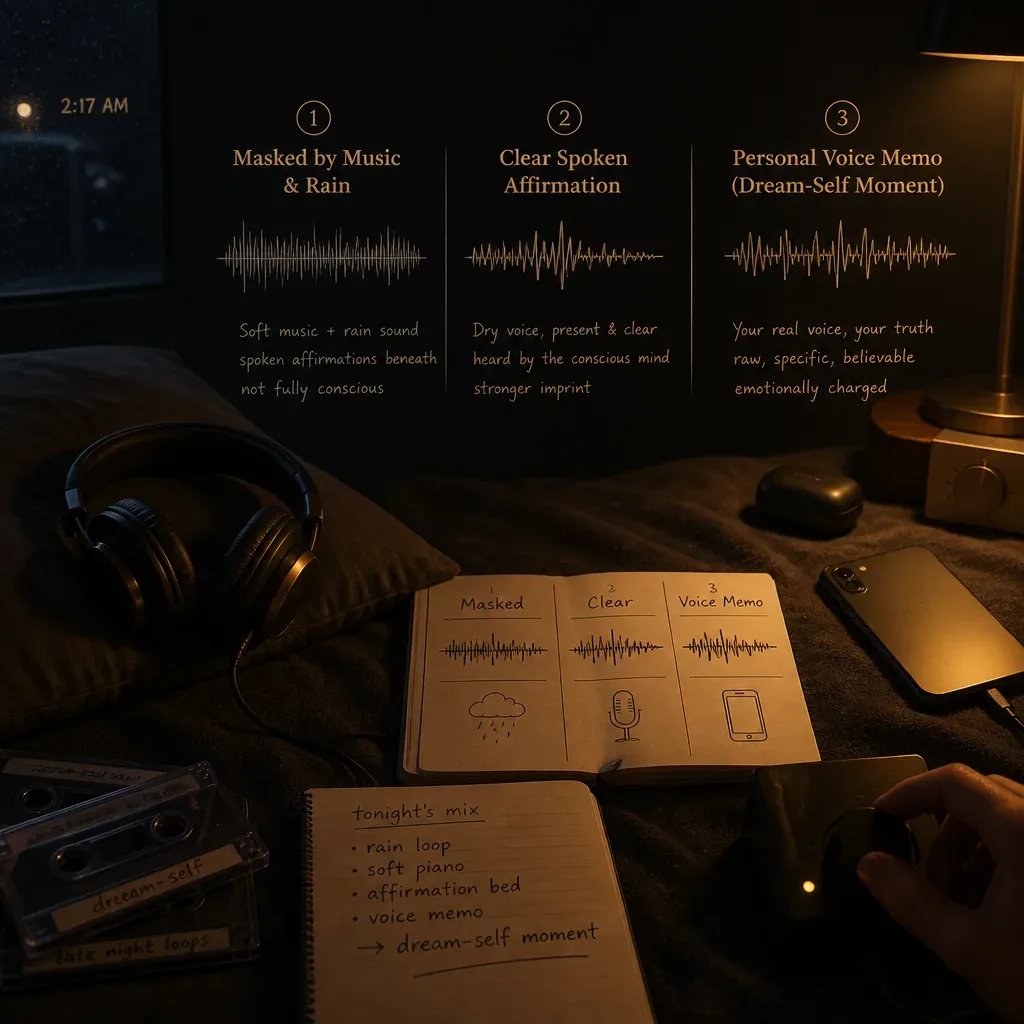
Subliminals hide the words, audible affirmations reveal them, and the AYA Method makes the voice personal and central.
Here is the clean comparison:
| Practice | What you hear | Best use | Main caution |
|---|---|---|---|
| Subliminal affirmations | Masked words under sound | Gentle repetition when you trust the script | You can’t audit it while listening |
| Audible sleep affirmations | Clear spoken lines | Conscious consent before sleep | Bad wording can feel irritating |
| Self-recorded audio | Your own voice clearly spoken | Identity rehearsal and personal meaning | Recorded voice may feel strange at first |
| AYA Method | Your personalized Dream-Self Moment | Daily audio manifestation practice | Requires daily listening, not passive collecting |
The AYA Method is a daily audio manifestation practice. Each day you listen to a short personalized recording, your Dream-Self Moment, narrated from the version of you who has already manifested the life you intend. Listening is the practice. Repetition is the work. The audio is the method.
That difference matters. A subliminal hides the words under sound and hopes the message lands. The AYA Method makes every word audible, personal, and repeatable. The daily affirmation and Manifestation Board can support the practice, but they are complements. The audio is not decoration. The audio is the method.
If you already use subliminals, you don’t have to reject them to try audible work. You can run a fair test: 14 nights with your subliminal track, then 14 nights with a clear recording in your own voice. Keep bedtime, volume, and wake time as similar as possible. In behavior research, changing one variable at a time is basic hygiene; it is also kinder to your sleep.
Your own voice can feel wrong for the first week. That is normal. The voice in your skull reaches you through bone conduction, while a recording reaches you through air, so playback often sounds thinner or more nasal. By week two, many people stop flinching. The sentence starts to matter more than the microphone.
For more on clear nighttime wording, return to Sleep affirmations. For hidden-word mechanics, keep the subliminals guide open while you edit.
What should you expect after two weeks of nightly listening?
After two weeks, expect familiarity, small behavioral cues, and clearer preferences, not guaranteed visible change.
Fourteen nights is a useful trial because it is long enough to notice a pattern and short enough to stop if the audio is wrong. In habit research, repetition in stable contexts matters; a 2009 study in the European Journal of Social Psychology by Lally and colleagues found that automaticity varied widely, with an average around 66 days for simple habits. Two weeks is not a finish line. It is a listening check.
Track four things in the morning:
- Did I fall asleep within my normal range?
- Did the audio wake me or irritate me?
- Which sentence stayed with me, if any?
- Did I act even 1 percent closer to the script during the day?
The fourth question matters. If your script says I keep small promises to myself, the sign is not a flash of certainty at midnight. It might be washing one cup, sending one email, or closing one tab when you’re tired. Identity practice becomes believable when it leaves fingerprints on ordinary behavior.
By week two, you may also learn that a track is too busy. If you wake with fragments of words stuck in your head, reduce the number of lines. If the masking sound annoys you, change it. Brown noise, rain, and soft room tone all sit differently in the ear. There is no moral value in enduring a sound you dislike.
If sleep gets worse for more than 3 nights in a row, pause the experiment. Persistent insomnia, panic at night, or distressing dreams deserve real support from a health professional. Audio can be a ritual. It is not a substitute for care.
When should you change, delete, or stop a subliminal track?
Change a subliminal track when it disturbs sleep, feels dishonest, or no longer matches the life you are actually practicing.
I keep old scripts in a dated folder. Some age well. Some don’t. The strangest ones are not the obviously bad ones; they are the lines that went quiet because they were never mine. After 6 months, a sentence can reveal whether it came from desire, envy, fear, or someone else’s definition of success.
Delete any track you did not make and cannot verify if it makes you uneasy. That is not paranoia. It is consent. Hidden audio asks for trust, and trust should be earned. If a creator refuses to show the script, you can choose another track or write your own 8 lines in 10 minutes.
Change the track when:
- It wakes you more than it soothes you.
- It contains claims you no longer believe.
- It mixes too many themes at once.
- It uses shame as motivation.
- It keeps you chasing sleep instead of resting.
- It makes daytime action feel less necessary.
That last one is important. A good night practice should make daytime life more honest, not less. If subliminal affirmations become a way to avoid making one phone call, setting one boundary, or practicing one skill, the audio has become a hiding place.
You can keep the ritual simple: choose 5 to 12 lines, record them once, mix them softly, listen for 14 nights, and review the effect on sleep first. The best track is not the most complex one. It is the one you can trust in the dark.
Lower the volume, choose the sentence, and let the house stay quiet.