subliminals
Subliminal Booster: What It Is and a Safer Audio Swap
A clear look at what a subliminal booster is, why evidence is thin, and a safer audio swap for night listening without hidden claims.
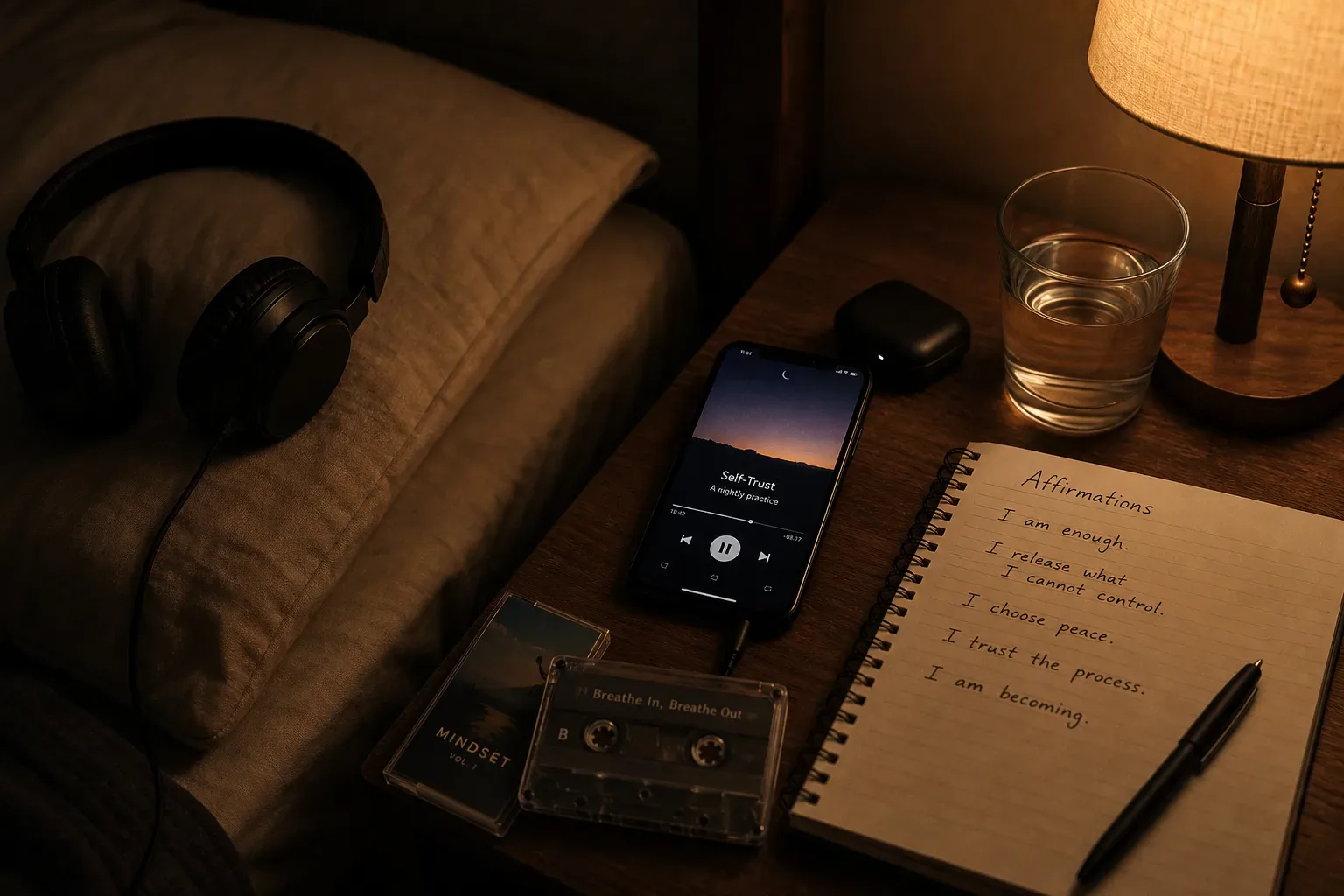
A subliminal booster is an audio track claimed to make another subliminal work better, faster, or more completely. The claim is bigger than the evidence. A safer swap is simple: use clear, audible, personal sleep audio you can understand, consent to, and repeat without giving up rest.
What is a subliminal booster, exactly?
A subliminal booster is usually a short audio made to “boost” the effects of other subliminals, often by layering hidden affirmations under music, rain, static, or tones.
In practice, you’ll see boosters described as blockage removers, mindset openers, result accelerators, detachment tracks, or “permanent results” audios. Those labels come from online subliminal communities, not from a clinical field. Pew Research Center reported in 2024 that YouTube reaches about 83% of U.S. adults, which helps explain why a niche term can spread quickly through playlists, comments, and titles.
The basic promise is simple: play the booster before, during, or after your main subliminal, and the main subliminal will work better. Sometimes creators suggest listening 3 times, sometimes overnight, sometimes for 21 days. The specific numbers are rarely tied to research. They are usually ritual numbers, habit numbers, or community norms.
A subliminal is already hard to verify because you can’t consciously hear the message. A booster adds a second hidden layer and asks for more trust. That’s the quiet problem. If you can’t hear the words, you can’t consent to the sentence.
That does not mean everyone making boosters is careless. Some creators publish written affirmations, keep volume gentle, and avoid dramatic claims. But the term itself tells you very little. A “booster” could be soft rain with ordinary confidence lines, or it could be a dense track with hundreds of hidden phrases you never see. The label is not a safety standard.
For a broader primer, start with the Subliminals pillar. It gives you the cleaner definition before the community vocabulary gets layered on top.
Do subliminal boosters have evidence behind them?
There is modest evidence for some subliminal priming effects, but there is not good evidence that subliminal boosters amplify life outcomes on command.
The honest distinction matters. Laboratory studies have found that words or cues presented below conscious awareness can influence quick judgments or choices under certain conditions. The effects are usually small, brief, and sensitive to context. A 2006 study in the Journal of Experimental Social Psychology found goal-related priming effects, while later psychology replication work made clear that many priming claims are weaker than early headlines suggested.
That is a long way from saying a 10-minute booster can make another hidden audio produce guaranteed changes. YouTube claims are not the same as sleep or cognition research. A creator’s comment section may contain sincere reports, but testimonials can’t control for expectation, repetition, mood, age, sleep quality, placebo effects, or the simple fact that people often start new habits when they start a new playlist.
There is also a measurement problem. If a booster claims to make “results arrive 10 times faster,” what is being measured? Faster than what? By whom? Over how many days? In research, a claim needs a defined outcome, a control condition, and a sample size. In booster culture, the outcome is often private, vague, and emotionally charged.
Here is the cleanest way to sort the claims:
| Claim you see | Evidence status | Safer reading |
|---|---|---|
| “Primes can affect attention” | Some lab support, usually modest | Possible, not magic |
| “This booster removes all doubt” | Not established | A relaxation track may help you settle |
| “Results in 24 hours” | Not credible as a general claim | Marketing language |
| “Listen overnight at high volume” | Risky for sleep | Lower the volume or stop |
| “Hidden script, no details” | Not verifiable | Choose disclosed wording |
Belief can change behavior, and behavior can change a life. But a hidden audio claim should not borrow authority from research it does not actually match. A booster that keeps you awake has already failed its first promise.
What are the safety issues with subliminal boosters at night?
The main safety issues are unknown wording, sleep disruption, volume, anxiety, and the habit of chasing one more track instead of resting.
Sleep is not spare time. The American Academy of Sleep Medicine and Sleep Research Society recommend that adults get at least 7 hours of sleep per night on a regular basis. If a booster routine cuts that down because you’re stacking tracks, checking comments, or restarting playlists at 2 a.m., the cost is not subtle.
Volume is the first practical concern. NIOSH uses 85 dBA over 8 hours as a recommended exposure limit for occupational noise, and safe exposure time drops as sound rises. Your phone volume percentage is not a decibel reading, but the principle still helps: night audio should be low enough that it does not pull you back to waking attention. If you need it loud to “work,” it is no longer sleep-friendly.
Content is the second concern. A subliminal booster can contain affirmations you would never choose if they were spoken clearly. Some are harmless. Some are grand, harsh, or fear-based. Some use pressure language: “I must get results,” “nothing can stop this,” “my mind obeys.” I write affirmations for a living, and I would delete most lines like that. At night, a modest sentence you believe beats a grand line you fight.
Watch for these red flags:
- The creator will not share any script or topic list.
- The title promises permanent results in a fixed number of hours.
- The audio uses sudden volume spikes, alarms, or aggressive frequencies.
- The instructions tell you to ignore discomfort.
- The routine requires sleeping less or looping all day.
- The comments punish doubt or questions.
If insomnia, panic, compulsive listening, or distress continues beyond basic sleep hygiene, talk with a qualified health professional. Audio can be a practice. It should not become a private test you’re scared to fail.
How can you tell whether a booster is worth skipping?
Skip a booster when it asks for more trust than it earns, especially if you do not know the script or it changes how you sleep.
A good filter takes less than 2 minutes. Before you add any booster to your night routine, ask what it costs: attention, sleep time, emotional steadiness, and volume. The CDC has reported that about 1 in 3 U.S. adults do not get enough sleep. That means many people are already listening from a sleep debt, and sleep debt makes every “just one more track” rule more expensive.
Use this simple check:
- Find the words. Look for a written script, topic list, or clear description. If there is none, assume you do not know what you’re repeating.
- Check the claim. If the title promises exact results in 1, 3, or 7 days, lower your trust.
- Listen awake once. Notice volume jumps, harsh textures, or anything that makes your body brace.
- Set a stop rule. Try it for 7 nights, not forever. Stop if sleep gets lighter or mood gets tense.
- Keep only one variable. Do not add 5 new audios at once. You won’t know what helped.
That last point is boring and useful. In behavior research, a cleaner routine is easier to evaluate because there are fewer moving parts. If you add a booster, a detachment audio, a frequency track, and 3 new subliminals in one week, your diary will not tell you much.
A night practice should make your mind less crowded. If the booster makes you negotiate, count, worry, and compare yourself with strangers, it has become another screen in the dark. The safest audio is the one you can stop without fear.
If you still like hidden affirmations, stay close to basics. The Subliminals pillar explains how to choose gentler tracks, and the Sleep affirmations pillar shows the audible version of the same idea: short lines, repeated softly, with no mystery.
What is the safer audio swap for a subliminal booster?
The safer swap is clear, audible, personal audio played softly before sleep, so you know exactly what your mind is hearing.
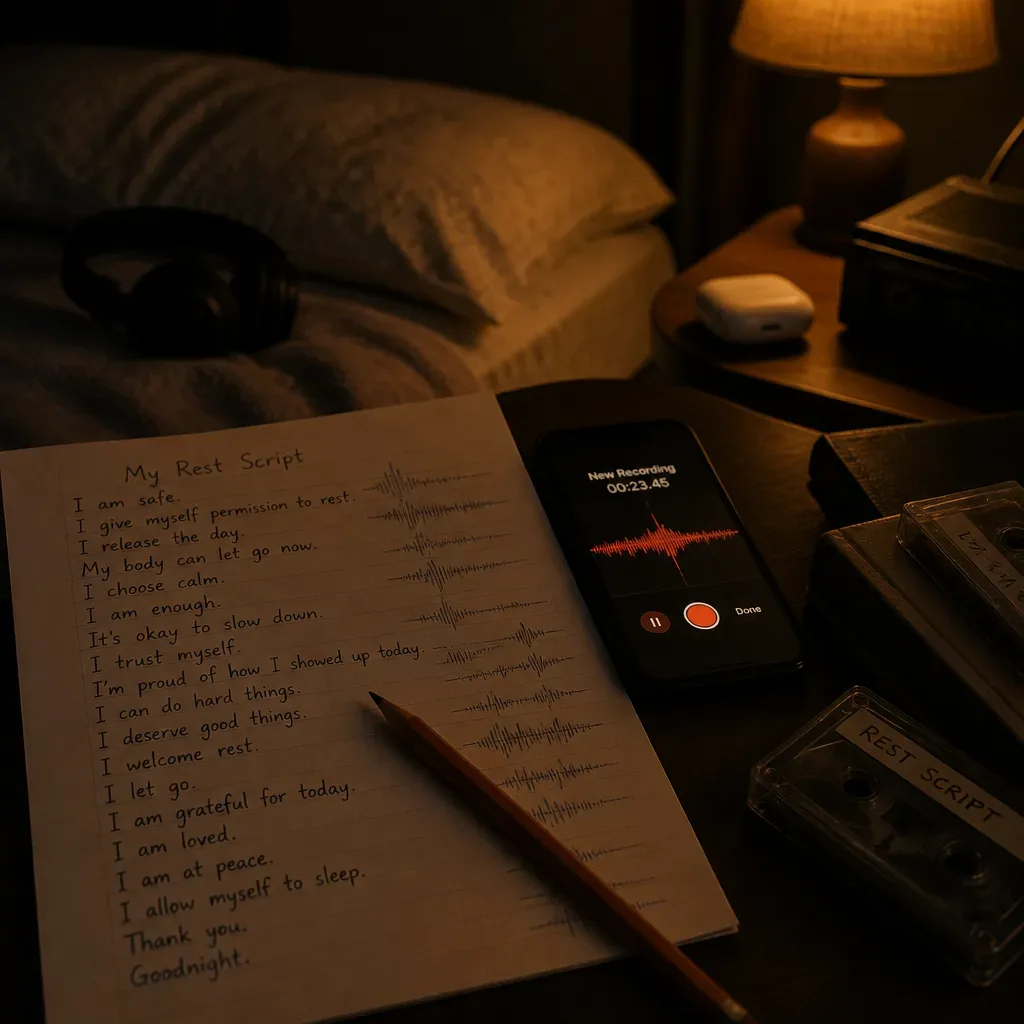
That can be as plain as a 2-minute voice memo. Write 6 to 10 present-tense sentences you can believe on a bad night. Record them in your own voice. Play the recording once before sleep, not as a test, and not as a punishment. The method is not louder. It is cleaner.
The structured version of this is the AYA Method: The AYA Method is a daily audio manifestation practice. Each day you listen to a short personalized recording — your Dream-Self Moment — narrated from the version of you who has already manifested the life you intend. Listening is the practice. Repetition is the work. The audio is the method.
The difference from a booster is not only that you can hear the words. It is that the recording is built for you, and you return to the same script daily instead of chasing another hidden add-on. In habit research, repetition and cue consistency matter; a 2009 study in the European Journal of Social Psychology found habit formation took a median of 66 days, with wide variation. That does not prove any manifestation claim. It does remind you that repeatable practice beats constant switching.
Here is a safer night setup:
- Length: 2 to 5 minutes.
- Timing: last 10 minutes before sleep, or during a wind-down period.
- Volume: soft enough to fade into the room.
- Wording: first person, present tense, concrete.
- Frequency: once daily for 14 nights before judging.
- Screen rule: start the audio, then put the phone down.
You can still use a daily affirmation or a visual board as a complement if it helps you remember the direction. But the audio is the practice. The safer swap is not a louder claim. It is a clearer voice.
For timing, you can use the Sleep cycle calculator tool to choose a bedtime that gives you full sleep cycles rather than a half-hour of extra playlist searching.
What should your replacement script actually say?
Your replacement script should use short, believable sentences that name the state you want to rehearse without arguing with your nervous system.
Most bad affirmations fail because they overreach. “I am completely fearless forever” sounds impressive on a poster and false at 2 a.m. A quieter line works better: “I can feel fear and still choose the next right step.” That sentence gives your mind somewhere to stand. In cognitive therapy research, self-statements tend to work best when they are plausible enough not to trigger immediate rejection; Wood, Perunovic, and Lee’s 2009 study in Psychological Science found very positive self-statements could make some people with low self-esteem feel worse.
That study is often overquoted, but the practical lesson is sound. Don’t flatter yourself into resistance. Speak to yourself like someone you want to keep trusting.
Try this pattern:
- Name the present anchor. “I am in my bed. I am safe enough to rest.”
- Name the direction. “I am practicing steadier choices with money.”
- Name the behavior. “Tomorrow, I answer one message and take one small step.”
- Name the identity gently. “I am becoming someone who keeps promises to myself.”
- Close the loop. “For tonight, rest is enough.”
Notice the scale. No impossible vow. No threat. No hidden command. Sleep Spoken’s Sleep affirmations pillar has more examples if you want lines that stay soft.
A few usable lines:
- “I do not need to solve my whole life tonight.”
- “I can return to this tomorrow with more steadiness.”
- “My next step is allowed to be small.”
- “I speak to myself in a way I can stay with.”
- “Rest supports the person I am practicing becoming.”
Sleep is not dead time; it is protected time. Choose sentences that respect that.
How do you test a new audio routine without fooling yourself?
Test a new routine by changing one thing at a time, tracking sleep and mood for 14 nights, and caring more about rest than dramatic claims.
You do not need a laboratory to be more honest with yourself. You need a small note on your phone or a paper by the bed. Track bedtime, wake time, number of awakenings, morning mood from 1 to 5, and whether you wanted to keep listening. The number is not perfect. It is better than memory, which bends toward whichever result you hoped for.
A 14-night test is long enough to notice a pattern and short enough not to trap you. Many sleep studies use multiple nights because a single night can be distorted by stress, caffeine, alcohol, hormones, noise, or one late message. Your private test should be humble in the same way.
Use this decision rule:
| After 14 nights | What it may mean | What to do |
|---|---|---|
| Sleep is steadier, mood is equal or better | Routine may support rest | Keep it simple |
| Sleep is worse, but you feel attached to results | The claim may be hooking you | Stop for 7 nights |
| No change, but you like the ritual | It may be a comfort cue | Keep only if it costs little |
| More anxiety or checking | Routine is too charged | Return to plain audio |
If you use subliminals, keep them boring in the best sense. One track. Low volume. Known topic. No booster stack. Link your routine to a clear bedtime using the Sleep cycle calculator tool, then leave the phone alone.
The point is not to win an argument against subliminals. The point is to stop handing your night to audio you cannot evaluate. You can be open and careful at the same time.
Keep the voice low, and keep it yours.