subliminals
Subliminal Flush: Meaning, Risks, and Safer Reset
A clear guide to subliminal flush audio, what listeners mean by it, what evidence can and can't say, and how to reset safely at night.
A subliminal flush is an audio track or break meant to clear the perceived effects of subliminals, especially after an unwanted playlist, anxiety, or overuse. Evidence does not show that flushes erase hidden messages. The safer reset is simpler: stop, lower the stakes, choose audible audio, and protect sleep first.
What does a subliminal flush actually mean?
A subliminal flush means a listener wants to reset what they have been hearing, not that science has confirmed an audio eraser.
In subliminal communities, a flush is usually framed as a cleaning track. Some videos promise to remove unwanted affirmations, reverse results, clear negative subconscious input, or make the mind neutral again. The language sounds technical, but it mostly comes from community folklore. It sits beside other named practices: booster playlists, detachment audios, blockage removers, and overnight loops.
A subliminal is an affirmation you cannot consciously hear. That is the whole trick, and the whole problem. Research on subliminal perception is real but modest. Greenwald, Klinger, and Schuh reviewed subliminal self-help tapes in 1991 and found little evidence that commercial tapes produced the changes their labels promised. Later priming studies, including work by Strahan, Spencer, and Zanna in 2002, suggested subliminal cues can nudge behavior under narrow conditions, like thirst-related words affecting drink choice among thirsty participants.
That gap matters. A lab prime shown for milliseconds is not the same as a 10-hour video promising a new face, a new past, or total removal of previous audio. The internet claim is bigger than the evidence. You can respect the practice without pretending every claim has been tested.
A flush is a pause button, not a cure. It may help because it gives you a ritual for stopping. It may help because the audio is calmer than what came before. It may help because naming your concern reduces the pressure around it. Those are ordinary mechanisms, and ordinary mechanisms can still be useful at 1 a.m.
If you are new to the category, start with the broader guide to subliminals before treating any flush as necessary. The basic question is not whether your mind needs cleaning. It is whether your listening routine is making you steadier or more afraid.
Why do people feel like they need a flush?
People reach for a flush when a listening practice starts to feel crowded, contaminated, or out of control.
The most common reason is playlist overload. A listener stacks 12 or 30 tracks, each with different goals, then starts wondering if the messages conflict. In shifting spaces, I have seen this happen after a night of method videos, subliminal bundles, and comment-section warnings. Nobody planned to build a belief system at 3 a.m. It just happened one autoplay at a time.
There is also a consent issue. Hidden words can feel exciting when you trust the maker and frightening when you do not. A Pew Research Center report in 2022 found that YouTube was used by 95% of U.S. teens, which means a lot of young listeners are meeting these practices through recommendation loops, not careful instruction. When titles promise instant change and comments report intense symptoms, anxiety can spread fast.
A flush can become a way to say, I do not want that one. That sentence matters. You are allowed to change your mind about audio. You are allowed to stop a track because the description feels wrong, the creator seems careless, or the comments make you tense. You do not need a supernatural reason to leave.
Watch for these signs that you need an audio reset, not necessarily a flush:
- You feel afraid to sleep without corrective audio.
- You keep checking your body or face for unwanted changes.
- You replay tracks to undo other tracks.
- You are losing 30 minutes or more of sleep to playlist management.
- You cannot explain what is in the audio you are using.
If a method costs you sleep, it costs more than it gives. Adults typically sleep in cycles of about 90 minutes, and losing the first cycle to anxious searching changes the whole night. The Sleep cycle calculator tool can help you see how quickly late-night listening decisions affect morning wake times.
What does the evidence say about subliminal audio and flushing?
The evidence supports limited unconscious influence in controlled settings, but it does not support dramatic flush claims.
Subliminal perception has been studied for decades. Some experiments show that unseen or barely noticed cues can influence quick judgments, especially when the cue matches a current need. The 2002 Strahan study is often discussed because thirsty participants exposed to thirst-related primes drank more than controls. That is interesting. It is not the same as proving that layered affirmations can reshape identity, body, memory, or fate while you sleep.
Commercial subliminal audio has a weaker record. In the 1991 Psychological Science work on subliminal self-help tapes, participants often believed they improved according to the label they thought they had received, even when tapes were mislabeled. That points toward expectancy effects. What you believe you heard can shape what you notice afterward.
That does not make listeners foolish. Expectancy is part of many human practices. Placebo effects in medicine are serious enough to be measured carefully in trials. In audio practice, expectation, repetition, mood, and attention all matter. The honest line is this: subliminal cues may nudge perception under some conditions, but YouTube-scale promises are not the research.
Flushes have even less evidence. I am not aware of peer-reviewed studies showing that a flush track removes prior subliminal effects. The claim usually rests on creator authority and community testimony. Testimony can describe what people felt. It cannot prove mechanism.
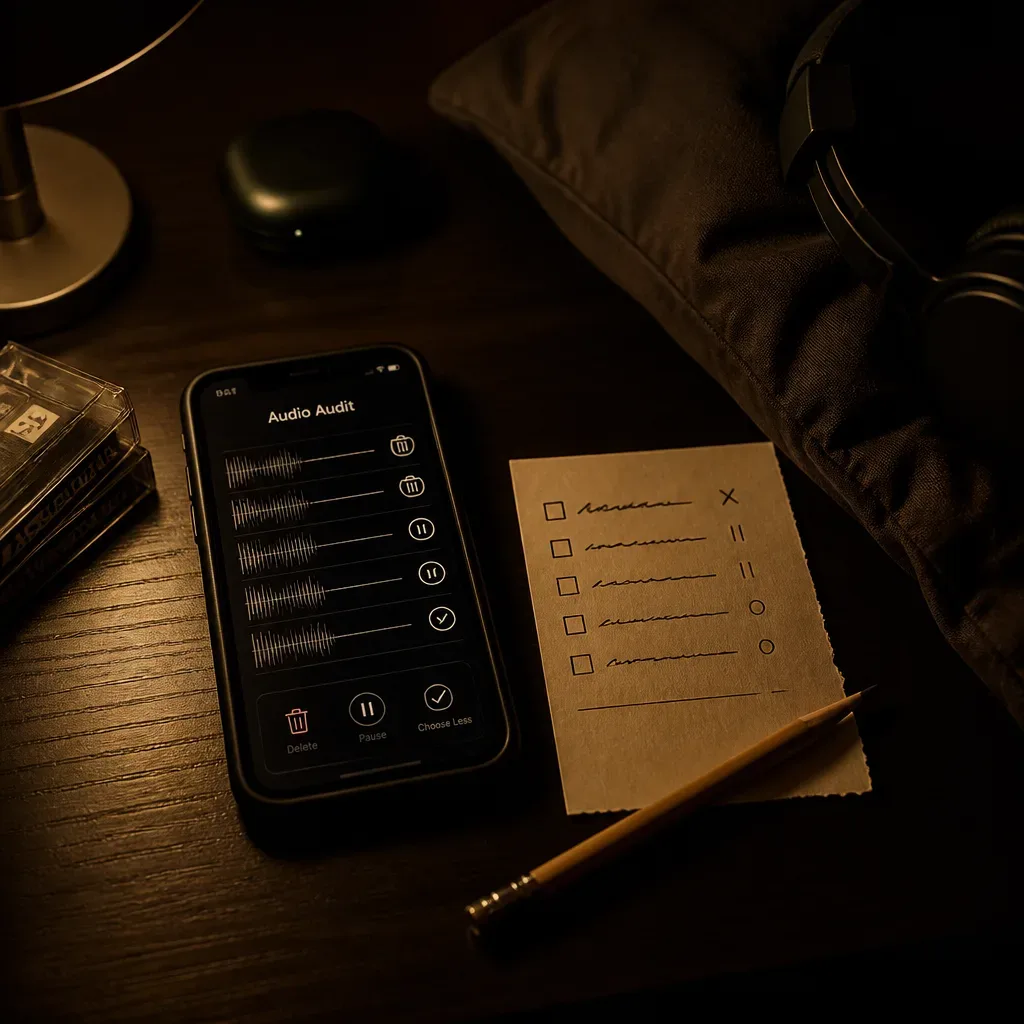
Here is a clearer comparison:
| Practice | What you can verify | Main risk | Safer use |
|---|---|---|---|
| Subliminal playlist | Title, description, comments | Unknown words and overuse | Use trusted makers, short sessions |
| Subliminal flush | The ritual of stopping | Compulsive correcting | Use once, then take a break |
| Audible affirmations | Every sentence | Repetition without rest | Keep wording plain and kind |
| Plain sleep sound | Volume and duration | Masking alarms or discomfort | Use low volume and a timer |
The safest audio reset is boring on purpose. It does not need secret frequencies, emergency wording, or a 10-hour loop. It needs a clear stop, a lower volume, and a return to sleep.
How can you do a safer audio reset tonight?
A safer audio reset is a short, practical routine that removes pressure and gives your nervous system fewer inputs.
Use it when you feel overloaded, not as a daily cleansing requirement. The aim is to reduce stimulation before sleep. The American Academy of Sleep Medicine has repeatedly emphasized regular sleep timing and a wind-down period as part of healthy sleep behavior. That advice is plain, but it holds up better than panic-listening to five corrective tracks.
Try this 20-minute reset:
- Stop the playlist. Do not add one more track to fix the last one. Close the app or remove the queue.
- Write the concern in one sentence. For example: I listened to a bundle I do not trust. One sentence is enough.
- Choose one neutral sound. Rain, fan noise, soft brown noise, or silence all count.
- Set a timer. Use 20 to 45 minutes instead of an all-night loop.
- Return tomorrow. Decide in daylight what you want to keep, delete, or replace.
Keep volume low. The National Institute for Occupational Safety and Health recommends limiting exposure at 85 dBA over 8 hours in workplace contexts, and headphone listening can exceed that without feeling painful. For sleep, you do not need loud. If someone beside you could hear every detail from across the room, it is probably too high for an overnight habit.
If you want words, make them audible. Sleep affirmations are not magic because you hear them. They are safer because you can consent to the sentence before it repeats. A line like, I can rest without fixing anything tonight, is less dramatic than a flush title, but it is often closer to what you actually need.
Do not monitor your body after the reset. Checking creates more checking. Give yourself a simple rule: no mirror inspection, no comment searching, no creator warnings after lights out. If worry keeps spiking anyway, put the phone outside the bed area and let the night become smaller.
When should you avoid flushes completely?
You should avoid flushes when they make you more compulsive, more frightened, or less able to sleep.
There is a difference between a one-time reset and a safety behavior. A safety behavior is something you do to relieve anxiety in the moment that keeps the fear alive long term. If every unwanted thought requires a flush, the flush has become part of the loop. You are no longer choosing audio. You are obeying fear.
Be especially careful if you are younger, sleep-deprived, or deep in shifting content. The shifting community has beautiful creativity, and it also has midnight escalation. One method leads to another. One comment says symptoms mean success. Another says the wrong audio can trap you. Claims like that can hit hard when you are tired. The CDC reported that more than 7 in 10 U.S. high school students did not get enough sleep on school nights in recent survey years. A practice aimed at possibility should not add to that shortage.
Avoid flushes if any of these are true:
- You feel you must play one before you are allowed to sleep.
- You believe one missed flush will harm you.
- You use flushes several times a week after ordinary content.
- You are hiding the amount of listening from people close to you.
- You feel detached from daily life after long sessions.
No audio practice should train you to distrust your own mind. If anxiety, intrusive thoughts, or insomnia are persistent, it is time to speak with a qualified professional rather than keep testing tracks. That sentence is not a threat. It is a handrail.
You can also replace the flush with a consent check. Ask: Do I know what this says? Do I like the creator’s wording? Would I play it for someone I care about? If the answer is no, delete it. Deleting is allowed to be the whole ritual.
What should you listen to instead of a subliminal flush?
Listen to something you can understand, tolerate, and stop without fear.
The cleanest substitute is silence or neutral sound for one to three nights. Brown noise, rain, or a fan track gives the mind less narrative material to wrestle with. A 2021 systematic review in Sleep Medicine Reviews found that evidence for continuous noise improving sleep is mixed, with study quality varying widely. So keep claims modest. Sound can help some people mask interruptions. It is not a guaranteed sleep treatment.
If you want spoken audio, choose words you can hear. That is where the line between subliminals and audible practices matters. With audible affirmation audio, you can reject a sentence. With a hidden bundle, you rely on trust. Trust is fine when earned, but it should not be your only safety feature.
This is also the useful bridge to the AYA Method. The AYA Method is a daily audio manifestation practice. Each day you listen to a short personalized recording, your Dream-Self Moment, narrated from the version of you who has already manifested the life you intend. Listening is the practice. Repetition is the work. The audio is the method. The daily affirmation and Manifestation Board can support it, but the listening is not a side feature. It is the center.
That difference is not a moral ranking. Many people like subliminals because they are soft, private, and easy to loop. But if you are looking for a reset after feeling unsafe with hidden words, audible personal audio gives you more control. You can hear every word. You can edit the script. You can stop without wondering what your mind absorbed.
A simple replacement plan looks like this:
| Night | Audio choice | Rule |
|---|---|---|
| 1 | Silence or neutral sound | No subliminals |
| 2 | Same neutral sound | No searching after bed |
| 3 | One audible track only | Stop if wording feels wrong |
| 4 to 7 | Keep or revise | No stacking playlists |
For more context on night wording, the Sleep affirmations pillar explains how repeated sentences before sleep can be kept gentle and specific. If you still want subliminal formats later, return through the Subliminals pillar and choose with more daylight around you.
How do you know your reset worked?
Your reset worked if you are sleeping more steadily, checking less, and feeling less urgency around audio.
Do not measure success by tingles, dreams, pressure in the forehead, angel numbers, or comment-section signs. Those markers are easy to chase and hard to verify. Measure ordinary things for 7 nights: bedtime, wake time, number of tracks, volume level, and whether you searched for reassurance after getting into bed. Specific numbers calm vague fear.
You can use a small note like this:
| Metric | Good enough target |
|---|---|
| Tracks after lights out | 0 to 1 |
| Time choosing audio | Under 5 minutes |
| Volume | Low enough to ignore |
| Reassurance searching | None after bed |
| Sleep window | Consistent within 30 to 60 minutes |
By week two, many listeners notice the real result: less drama around the playlist. Not a dramatic sign. Not a cinematic shift. Just fewer urges to fix, cleanse, and check. In behavioral terms, that matters because repeated checking can strengthen the habit you are trying to leave. In sleep terms, fewer decisions near bedtime usually means less arousal.
If you want structure, set a seven-day rule. For seven nights, use only one chosen audio source, or none. Keep it below the level of attention. Do not read comments in bed. Do not change goals after midnight. If you miss a night, you do not restart the count as punishment. You return the next night.
The last ten minutes before sleep are suggestible. Choose what goes in. That sentence does not require you to fear every sound. It asks you to treat bedtime like a threshold, not a dumping place for every promise the algorithm offers.
Put the sound down softly, and let the night be yours.