subliminals
Subliminal Music: Hidden Words vs Dream-Self Audio
Subliminal music hides affirmations under sound; Dream-Self audio keeps the words audible. Here is what the evidence says before sleep.
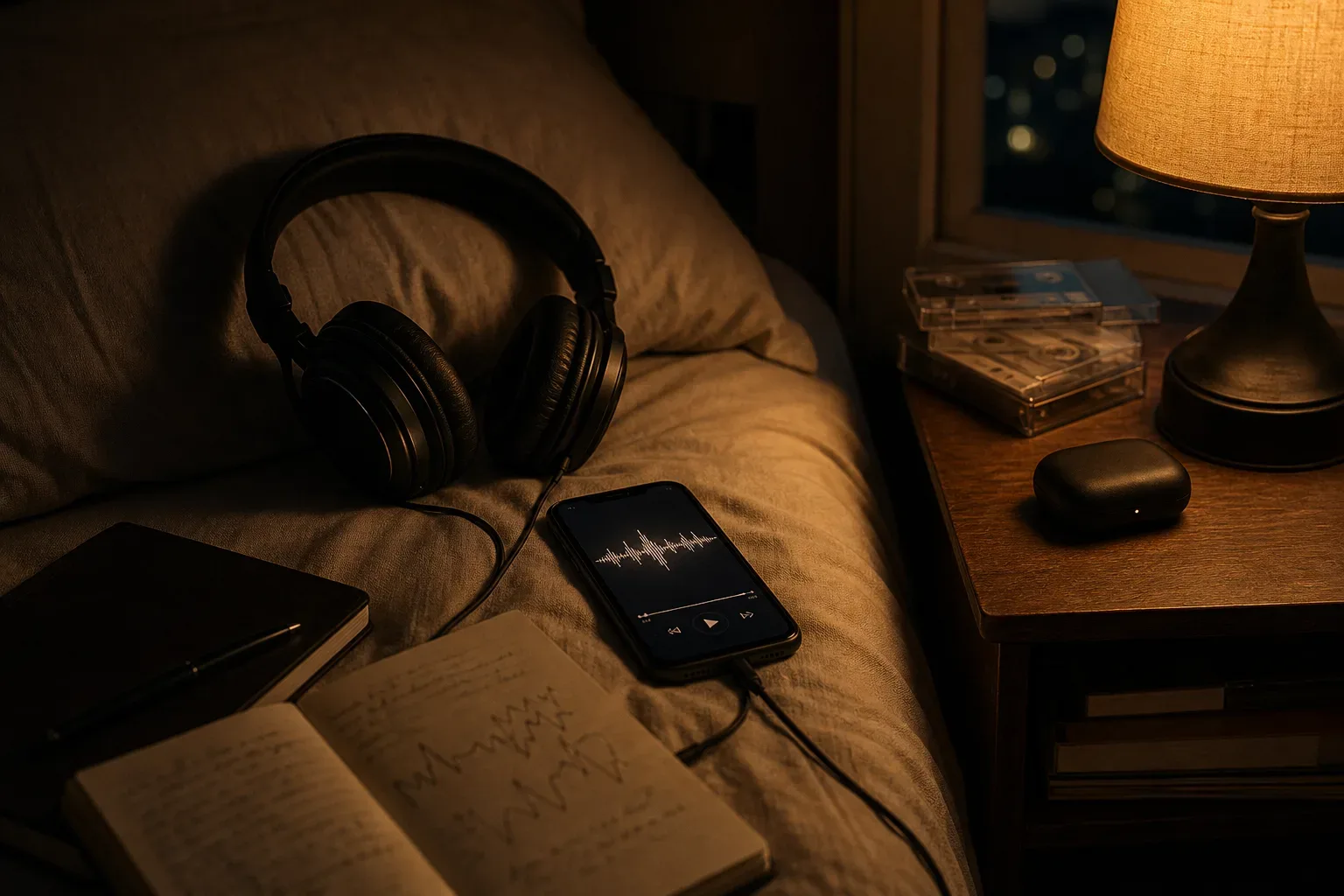
Subliminal music is audio that hides spoken suggestions beneath music, rain, tones, or noise. Dream-Self audio does the opposite: it lets you hear the words clearly, in a personal future-self script. The honest difference is simple: hidden words ask you to trust the track; audible words ask you to practice listening.
What is subliminal music, exactly?
Subliminal music is music or ambient sound with speech mixed so low, fast, or masked that you cannot consciously identify the words.
That definition matters because many online tracks use the word subliminal loosely. Some contain whispers you can almost hear. Some use text-to-speech under rain. Some layer affirmations at low volume beneath 432 Hz pads, brown noise, or piano. Others may contain no verifiable speech at all. A subliminal is an affirmation you can’t consciously hear. That’s the whole trick, and the whole problem.
The research background is older than YouTube. James Vicary’s famous 1957 claim that hidden cinema messages increased popcorn and Coca-Cola sales was later exposed as unsupported; Advertising Age reported on the controversy in 1962, and Vicary eventually admitted the evidence was not what he had claimed. That story still matters because it gave subliminals a myth larger than the data.
Modern perception research is more careful. Reviews by Stanislas Dehaene and Lionel Naccache in the early 2000s showed that the brain can process some unseen or unheard cues under specific lab conditions. But those effects are usually brief, simple, and context-bound. They are not the same as becoming confident, changing your face, or shifting your whole identity through a track you cannot inspect.
If you want the wider evidence map, start with the Subliminals pillar. It separates subliminal perception, priming, placebo, expectation, sleep ritual, and marketing claims. Those are not all the same mechanism. When you mix them together, everything sounds magical and nothing can be tested.
Hidden audio is not automatically deeper audio. Sometimes it is only less accountable audio.
How does hidden-word audio compare with Dream-Self audio?
Hidden-word audio hides the message; Dream-Self audio makes the message audible, personal, and repeatable.
The difference is not only aesthetic. With subliminal music, you cannot easily check the script. You don’t know whether the wording is gentle, exaggerated, self-critical, or even present. With Dream-Self audio, you hear the statement in plain language. You can notice whether your body softens or tightens. You can revise words that feel false. That feedback loop is part of the practice.
The AYA Method is a daily audio manifestation practice. Each day you listen to a short personalized recording — your Dream-Self Moment — narrated from the version of you who has already manifested the life you intend. Listening is the practice. Repetition is the work. The audio is the method.
That definition is deliberately plain because the method depends on what you can hear. The daily affirmation and Manifestation Board can support the practice, but they are complements. The audio is not decoration around the method. The audio is the method itself.
Research gives a modest reason to prefer audible, self-relevant material. In behavior-change literature, implementation intentions have shown reliable small-to-moderate effects; Peter Gollwitzer’s 1999 review helped define the field. Sleep learning research is narrower, but Rasch and Born’s 2013 review in Physiological Reviews found that sleep can support memory consolidation, especially for material already learned while awake. In plain language: rehearse before sleep, then let sleep stabilize what was already heard.
| Feature | Subliminal music | Dream-Self audio |
|---|---|---|
| Can you hear the words? | Usually no | Yes |
| Can you check the script? | Rarely | Yes |
| Main mechanism claimed | Hidden suggestion | Repetition and self-directed rehearsal |
| Best use before sleep | Soft ritual, if it relaxes you | Clear intention, then rest |
| Main risk | Trusting unknown words | Overloading the script |
A practice gets stronger when you can tell what you are practicing.
What does the evidence say about subliminal music?
The evidence says subliminal cues can influence quick judgments in lab settings, but the effects are limited and much smaller than online claims suggest.
A useful anchor is Anthony Greenwald’s work on subliminal self-help tapes. In a 1991 study published in Psychological Science, participants used commercial tapes labeled for either memory or self-esteem. The labels were sometimes swapped. People often reported improvement in the area they believed the tape targeted, even when the tape was mislabeled. That is not a dismissal. It is a finding about expectation.
A 1996 meta-analysis by Charles Trappey reviewed subliminal advertising studies and found little support for strong behavioral influence. Later priming research did find effects under narrow timing and attention conditions, but many effects weakened when labs tried to replicate them. Psychology spent the 2010s taking replication seriously; the Open Science Collaboration’s 2015 project replicated 100 studies and found that only 36 percent reached statistical significance again. Not all of those were subliminal studies, but the lesson applies: clean claims need repeatable evidence.
This is where honest practice begins. If subliminal music helps you fall asleep, that may be because the track is predictable, quiet, and emotionally associated with rest. The benefit may come from ritual, not hidden commands. Ritual is not fake. Bedtime routines are recommended by sleep clinicians because repeated cues help the nervous system anticipate sleep.
The American Academy of Sleep Medicine and Sleep Research Society recommend at least 7 hours of sleep for most adults. If your subliminal routine helps protect that number, it may be useful. If it keeps you awake checking comments, switching tracks, or waiting for proof, it is taking more than it gives.
The YouTube claim is often stronger than the science. The practice can still be meaningful when the claim gets smaller.
Is listening before sleep a special time for suggestion?
The minutes before sleep are suggestible because attention narrows, memory is active, and the day is closing, but they are not a loophole in the mind.
The hypnagogic period, the transition from wakefulness into sleep, often contains drifting imagery, looser association, and reduced external attention. Many people notice that the last sentence they read or hear can echo in the mind. That does not prove hidden messages override choice. It does make the bedtime window worth treating with care.
Sleep science supports a measured version of the claim. Research on targeted memory reactivation has shown that sounds linked to prior learning can influence later recall when replayed during sleep. In a 2009 Science paper, Rudoy and colleagues used sound cues to improve memory for object locations. These were not secret affirmations. They were cues tied to learned material. Again, sleep seems to consolidate what waking attention has already touched.
That is why audible audio has a cleaner bedtime logic. You listen while awake or drowsy. You hear the words. You let the nervous system pair the script with the slow ritual of night. Then you stop trying. If you want timing help, the Sleep cycle calculator tool can help you choose a bedtime or wake time around roughly 90-minute sleep cycles, a common estimate used in sleep education.
A simple before-sleep structure works better than a heroic one:
- Choose one track for at least 7 nights.
- Keep the volume low enough that you could ignore it.
- Use a timer between 10 and 30 minutes.
- Avoid tracks with ads, sudden bells, or frequency spikes.
- Notice sleep quality before you judge results.
The last ten minutes before sleep are suggestible. Choose what goes in.
When should you choose subliminal music instead of audible audio?
Choose subliminal music when the sound helps you relax and you are comfortable not knowing every word; choose audible audio when meaning, consent, and revision matter.
There are fair reasons to like subliminal music. Some listeners find direct affirmations too bright at night. Others get caught arguing with every sentence. For them, rain with buried speech may feel softer. That preference is not irrational. In clinical relaxation research, comfort and adherence matter. A practice you repeat for 14 nights teaches the body more than a perfect script you abandon after one.
But use standards. If the creator will not share the script, ask why. If the title promises permanent physical change in 24 hours, be cautious. If comments encourage obsessive looping, step back. Pew Research Center reported in 2024 that YouTube remains one of the most widely used online platforms among U.S. adults, with 83 percent saying they use it. Scale is not the same as quality control.
You can audit a subliminal track without becoming harsh about it:
- Does the description include the exact affirmations?
- Is the audio free from sudden volume changes?
- Can you sleep without checking for results?
- Does the creator avoid medical or guaranteed claims?
- Do you feel calmer after 20 minutes, not more vigilant?
The best subliminal music behaves like a lullaby with an intention attached. It should not make you dependent on secrecy.
If you want audible language but still want softness, Sleep affirmations may be the better bridge. They keep the words available while letting the delivery stay low and slow. You can also read more about hidden-message practice in the Subliminals pillar before choosing a track for tonight.
How do you build a safer night audio practice?
Build the practice around sleep first, then repetition, then meaning.
Start with the body-level facts. Most adults need at least 7 hours of sleep, according to the AASM and Sleep Research Society joint recommendation from 2015. Blue light, stress, caffeine timing, and irregular wake times can all matter more than the exact words in a track. If audio improves your sleep, it has earned its place. If it cuts sleep short, no affirmation is worth the debt.
A safer night practice is boring in the best way. Same track. Same volume. Same window. The brain likes prediction before sleep. In habit research, context repetition is one reason simple routines stick; a 2009 study by Phillippa Lally and colleagues found that habit formation varied widely, with an average of 66 days for a behavior to become automatic. That number is not a deadline. It is a warning against judging a night practice after two listens.
For Dream-Self audio, keep the script short enough to absorb. Two to five minutes is often better than 30. Use concrete language: where you wake, how you speak, what you choose, what you no longer rehearse. Avoid stuffing the recording with every desire you have. A crowded script becomes noise.
For subliminal music, keep it transparent where possible. Save the written affirmations if available. Do not use medical tracks as treatment. If insomnia persists beyond basic sleep hygiene, talk with a qualified health professional. That sentence is not a formality; chronic sleep loss changes mood, attention, and pain sensitivity in ways a playlist cannot responsibly handle.
Try this 14-night test:
- Nights 1 to 7: use one subliminal music track, 10 to 30 minutes, timer on.
- Each morning: rate sleep quality from 1 to 5 and note one sentence about mood.
- Nights 8 to 14: use audible Dream-Self audio with the same timer.
- Compare sleep, calm, and willingness to repeat, not only results.
- Keep the format that protects sleep and makes you less frantic.
The question is not which audio sounds more mystical. The question is which audio you can trust at low volume in the dark.
What should you expect by week two?
By week two, expect familiarity, easier settling, and clearer preferences, not proof that hidden words have changed your life.
Seven to fourteen nights is enough time to notice whether an audio practice fits your nervous system. You may fall asleep faster because the track becomes a cue. You may resist certain phrases because they feel untrue. You may discover that wordless rain works better than any affirmation. All of that is useful data.
Small changes count, but name them accurately. If your bedtime drops from 12:30 a.m. to 11:55 p.m. for 5 nights, that is a real behavioral shift. If your average sleep rating moves from 2 to 4 on your own scale, that matters. If you feel kinder toward yourself after hearing your own future-self script, that is not subliminal persuasion. It is repeated contact with a chosen story.
Joe Dispenza and Neville Goddard are often quoted in manifestation circles for the idea of living from the end. A skeptic can translate that without sneering: rehearse the identity you want to make more available. Cognitive psychology would call part of that mental simulation, self-schema, or expectancy. The language differs. The practical question stays close: what do you repeatedly hear yourself becoming?
This is where Dream-Self audio and subliminal music part ways most clearly. Hidden words ask you to believe something happened beneath awareness. Audible audio lets you return to the sentence and decide whether it belongs to you. There is dignity in that.
If you keep subliminal music, keep it honest. If you choose Dream-Self audio, keep it simple. If you use both, let the hidden track be atmosphere and the audible track be the practice. What you hear while you sleep shapes you most reliably when you have chosen it while awake.
Lower the volume until the words can rest beside you.