subliminals
Subliminals Not Working? Try a 3-Minute Audible Swap
Subliminals not working after weeks of listening? Try a 3-minute audible swap before sleep, with clear words, low volume, and honest tracking.
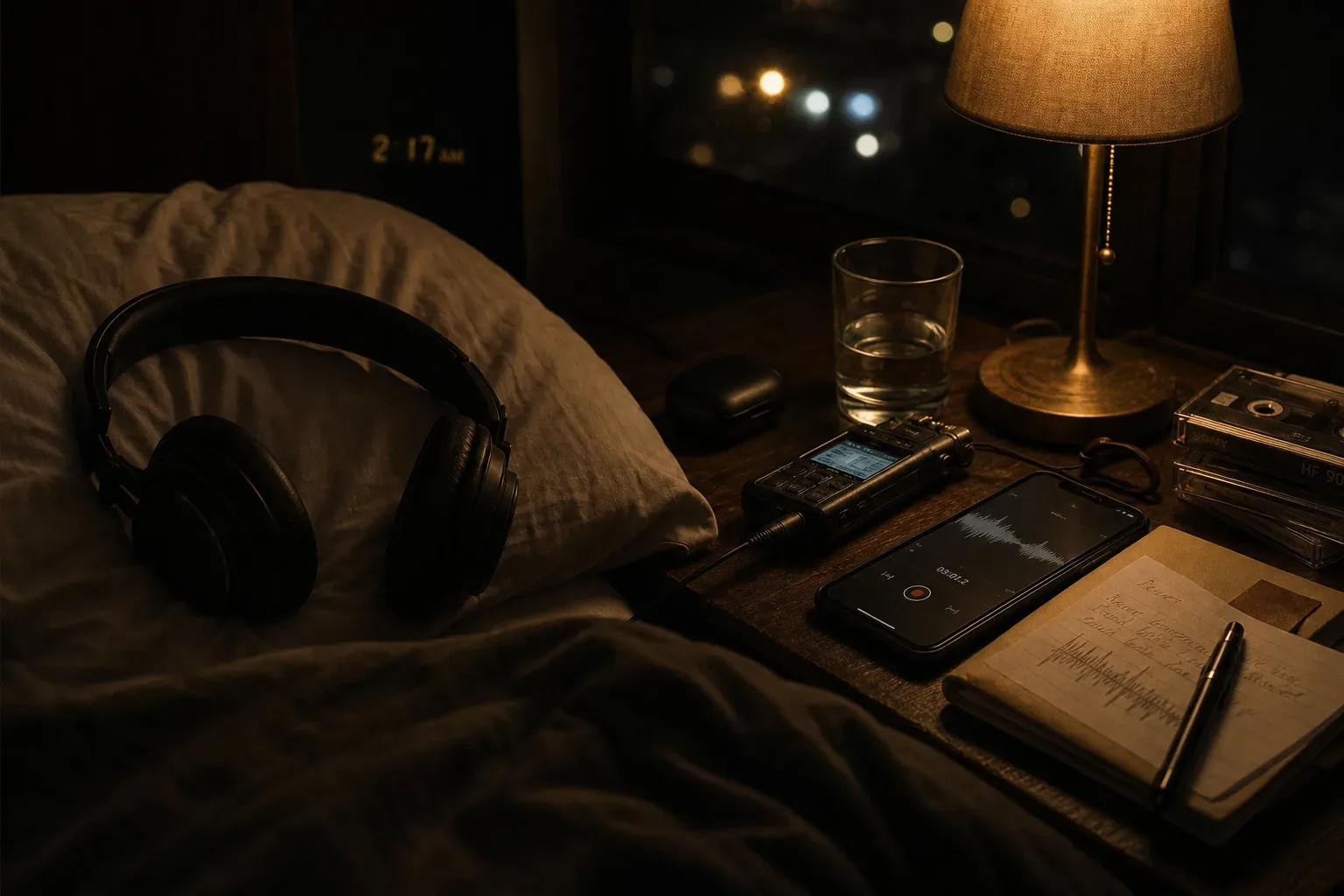
If your subliminals are not working, don’t add louder rain or another 8-hour playlist first. Try a 3-minute audible swap: take the hidden intention, speak it clearly in your own words, and listen before sleep for 14 nights while tracking one small change.
Why can subliminals stop feeling like they work?
Subliminals often stop feeling useful when the words are too hidden, the promise is too large, or the listener has no clear signal to watch.
A subliminal is an affirmation you can’t consciously hear. That’s the appeal, and that’s also the engineering problem. If a voice is mixed far below rain, music, or brown noise, you may be trusting the title more than the tape. In audio terms, a vocal buried 20 to 30 decibels below masking sound can become hard to detect on common earbuds, especially once streaming compression has touched it. Respect the listener’s ear, and label what’s on the tape.
The research case is quieter than the internet case. Subliminal priming studies have shown small, context-dependent effects, especially when a person already has a related goal. A 2016 paper in Neuroscience of Consciousness discussed how unconscious stimuli can influence behavior, but not as a blank-check command system. That matters. A hidden phrase may prime attention. It doesn’t reliably rewrite your day while you sleep.
Sleep adds another layer. The last few minutes before sleep can be suggestible because attention is soft and the room is low-stimulus, but sleep is not the same as consent to every file you play. Dr. Andrew Huberman has often pointed to state changes around non-sleep deep rest and sleep onset as times when the nervous system may be more plastic, but he doesn’t claim every whispered track becomes destiny. If a method costs you sleep, it costs more than it gives.
So when you think, “my subliminals aren’t working,” the better question is technical and practical: what exactly did you hear, how often did you hear it, and what were you measuring? A hidden audio habit with no testable behavior can feel sacred for a while. Then it starts to feel like fog.
Hidden words can’t help you notice progress if you never know what the words were.
What is the 3-minute audible swap?
The 3-minute audible swap is a short spoken recording that replaces a hidden subliminal with clear, personal words for two weeks.
You aren’t giving up night audio. You’re changing the signal. Instead of playing a file called “confidence subliminal” and hoping the script matches you, you record three minutes of audible sentences that name the same intention plainly. The point is not volume. The point is intelligibility. You should be able to understand every word if you choose to listen.
Here’s the basic format:
- Name the result your subliminal promised.
- Write three believable present-tense lines.
- Record them slowly for three minutes.
- Play the recording before sleep for 14 nights.
- Track one small behavior the next day.
Three minutes is enough. At an easy speaking pace of 120 to 140 words per minute, three minutes gives you roughly 360 to 420 words, including pauses. That’s more than enough repetition without turning your bedtime into a project. The American Academy of Sleep Medicine notes that consistency around bedtime supports sleep timing; adding a short ritual is usually easier to keep than adding an hour-long one.
The swap also gives you something subliminals rarely give: a way to audit the script. You know whether the line sounds kind or forced. You know whether it asks for a life you actually want. You know whether it makes you tense. Audio doesn’t become more useful because it’s secret.
For people who want a more structured version of personal audible practice, the AYA Method is a daily audio manifestation practice. Each day you listen to a short personalized recording, your Dream-Self Moment, narrated from the version of you who has already manifested the life you intend. Listening is the practice. Repetition is the work. The audio is the method.
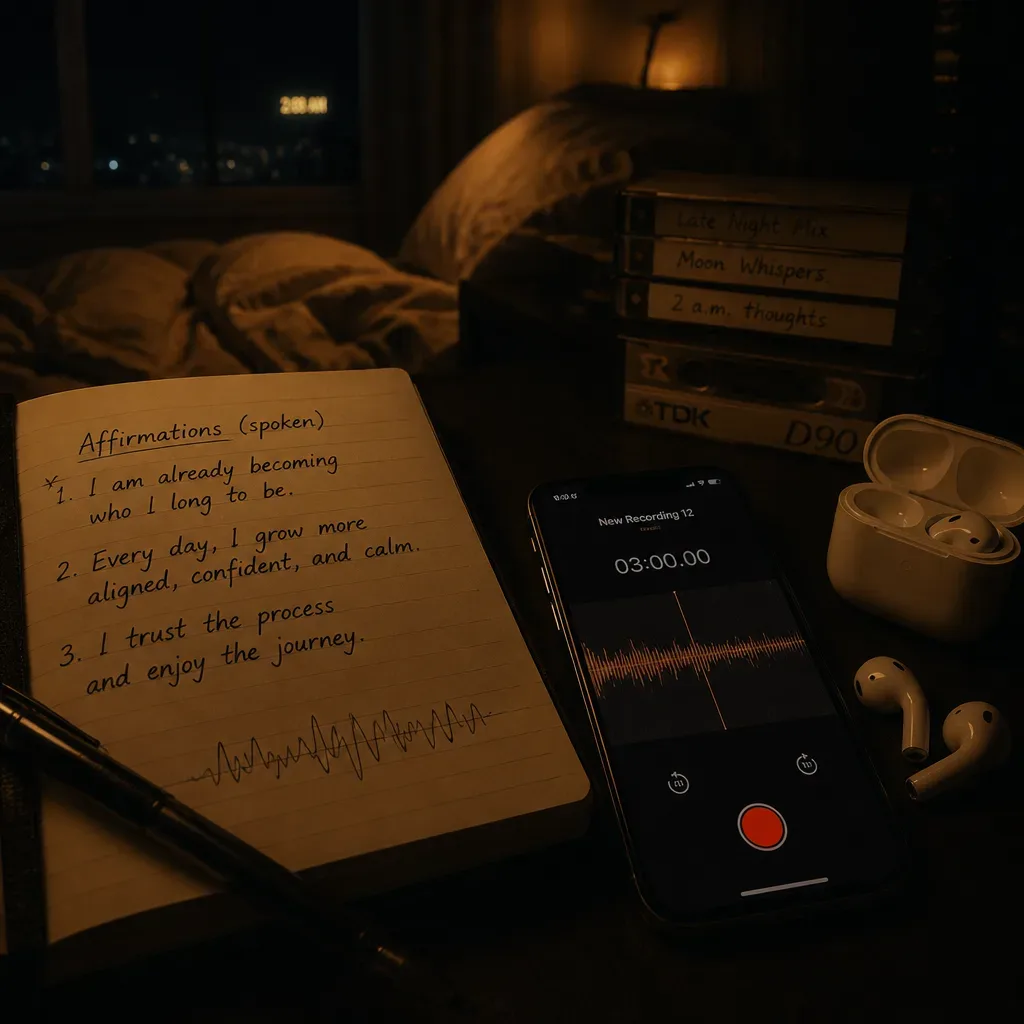
How do you write audible lines that don’t fight your mind?
Write lines that are specific, believable, and close enough to your actual life that your body doesn’t argue with them.
The fastest way to ruin an audible swap is to record sentences you don’t believe at all. If you feel broke, exhausted, and afraid, a line like “I am perfectly calm and rich in every way” may sound like a stranger trying to sell you something at midnight. Neville Goddard’s style of imaginal practice often used the feeling of the wish fulfilled, but even there, the scene had to be lived inwardly, not shouted over your resistance.
Use bridge language. It keeps the line honest without making it weak. A bridge sentence doesn’t pretend the finished result is already obvious. It rehearses the direction you’re choosing. In cognitive behavioral work, small, believable replacement thoughts are often easier to repeat than extreme positive claims; the Journal of Behavioral Medicine has published decades of work showing that self-regulation improves when goals are specific and trackable.
Try this table before you record:
| If the subliminal promised | Don’t record | Record this instead |
|---|---|---|
| Confidence | ”Everyone admires me" | "I speak a little more clearly when it matters” |
| Money | ”I attract endless wealth" | "I notice useful chances and follow through calmly” |
| Study focus | ”I become a genius overnight" | "I return to the page for one more focused block” |
| Self-worth | ”I am flawless" | "I treat myself with more respect in small moments” |
The best line is not the most dramatic line. It is the line you’ll let into your room every night.
Keep the number small: three lines, repeated. That limit matters. Working memory research often references George Miller’s classic 1956 paper on the “magical number seven,” but for bedtime audio, even seven ideas can be too many. Three gives your mind a pattern without making you study.
If your goal is sleep-specific, you can borrow the clarity of sleep affirmations without turning them into a speech. “My room is quiet enough for rest.” “I don’t need to solve tomorrow tonight.” “I return to the breath and let the next thought pass.” Short lines work because they leave space.
How should you record and mix it so it helps sleep?
Record it cleanly, softly, and plainly, with no tricks that make the words harder to hear.
Your phone microphone is fine. Sit 6 to 10 inches away from it, speak slightly slower than normal, and record in a room with fabric: a bedroom, closet, or curtained corner. You don’t need a studio chain. You need a voice that doesn’t stab the ear. In broadcast work, spoken-word loudness is often normalized around -16 LUFS for stereo podcasts, but bedtime audio can sit lower because the room is quiet.
Keep the recording simple. If you add rain, keep the voice in front. If you add music, avoid bright high notes or sudden swells. A sleep track should not audition for attention. Consumer earbuds vary wildly; many cheap pairs exaggerate 2 to 5 kHz, the range where speech bite lives. That can make a close vocal feel sharp at night.
A practical mix target:
- Voice: clear at the lowest comfortable volume.
- Background: at least a little quieter than the voice.
- Pauses: 2 to 4 seconds between lines.
- Length: 3 minutes, not 30.
- Playback: phone speaker, pillow speaker, or one earbud if safe and comfortable.
Don’t use ultrasonic claims as your upgrade. Many adults lose sensitivity above 15 to 17 kHz with age, and many phone speakers don’t reproduce 17,500 Hz cleanly anyway. A file can contain a high tone on a spectrum analyzer and still contain no useful spoken message your ear or speaker can handle. Mystery is not a mixing technique.
If you use streaming platforms, remember that lossy compression can smear quiet details. AAC and MP3 are clever, but they remove information judged less audible. That’s fine for music. It’s not ideal when the entire claim depends on a whisper under water. Your audible swap avoids that problem by putting the words where speech belongs: within reach.
When should you play it, and for how many nights?
Play it during the last 3 to 10 minutes before sleep for 14 nights, then judge by small signals.
The timing matters because bedtime has fewer competing cues. You don’t have email, traffic, and kitchen noise fighting the words. You also don’t need to play it all night. The National Sleep Foundation has long recommended adults aim for 7 to 9 hours of sleep, and anything that fragments that sleep deserves suspicion. If a loop wakes you at 3 a.m., it’s not a better practice because it ran longer.
Use the recording as a closing cue. Brush your teeth, set the room, press play, and let the words be the last deliberate input. If you’re trying to time it more carefully, the sleep cycle calculator can help you choose a bedtime that fits your wake time, but don’t turn timing into another obsession. Bedtime math should serve the body, not police it.
For 14 nights, track only three things:
- Behavior: Did I do one small action related to the line?
- Mood: Did the line feel less strange by night seven?
- Sleep: Did the audio help, harm, or leave sleep unchanged?
This is not a clinical trial. It’s a home practice with notes. Still, notes beat memory. A 2019 Pew Research Center report found that 81% of Americans said the potential risks of data collection by companies outweighed benefits, yet many people track private patterns informally because the feedback helps. Keep your tracking local, boring, and yours.
By week two, don’t look for thunder. Look for friction changing. Maybe you send the email faster. Maybe you stop replaying one sentence after a hard conversation. Maybe nothing happens, and that is data too. A quiet practice is allowed to be tested.
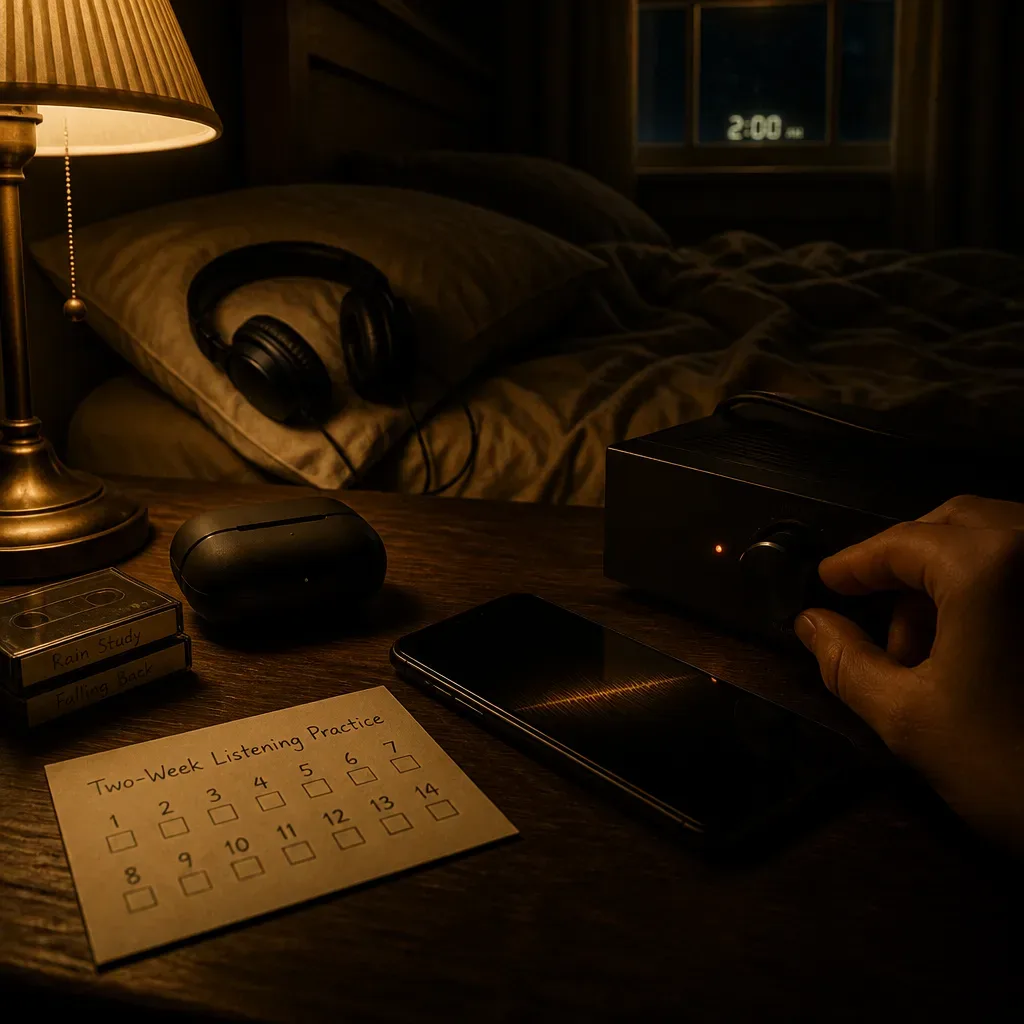
How is this different from regular subliminals or sleep affirmations?
The audible swap sits between subliminals and sleep affirmations: clearer than one, more personal than many of the other.
A classic subliminal hides the message below conscious hearing. That can feel comforting because you don’t have to confront the words. It can also make the whole practice impossible to inspect. If the creator says there are 5,000 affirmations under the rain, you usually can’t verify the script, the level, or the edit. As an audio engineer, I don’t think listeners should need blind trust for a file they sleep beside.
Sleep affirmations are usually audible. They can be useful, especially when the speaker is calm and the lines are not inflated. The limitation is fit. A public track has to speak to thousands of people, so it often uses broad lines: “I am safe,” “I welcome rest,” “I am enough.” Those can help. They may also miss the exact sentence you need to hear.
The audible swap is narrower. It takes the intention from the subliminal and gives it your voice, your pace, your wording. Joe Dispenza often talks about rehearsing a future state until it becomes familiar; you don’t have to accept all his claims to understand the rehearsal principle. Repetition teaches salience. What you repeat becomes easier to notice.
Here’s the plain comparison:
| Practice | Can you hear the words? | Is it personal? | Best use |
|---|---|---|---|
| Subliminal | Usually no | Sometimes | Background cue, if well made |
| Sleep affirmations | Yes | Usually no | General calming before sleep |
| 3-minute audible swap | Yes | Yes | Testing one stuck intention |
| AYA Method | Yes | Yes | Daily personalized audio practice |
You can still use the subliminals pillar if you like the hidden format, and you can still use sleep affirmations when your goal is rest. The swap is not a moral victory over either. It is a diagnostic tool. When the hidden track gets vague, make the signal audible.
What should you expect by week two?
By week two, expect familiarity, not fireworks: the words should feel less foreign, and one small behavior may be easier to repeat.
The first three nights can feel awkward. Most people are not used to hearing their own recorded voice. Bone conduction makes your live voice sound lower to you than playback does, which is why recordings often feel thin or exposed. That doesn’t mean the recording is bad. It means physics has been flattering you privately for years.
By nights four to seven, the lines usually become less noticeable. That’s good. A bedtime cue should soften with repetition. In habit research, context stability matters; Wendy Wood’s work on habits has repeatedly shown that repeated behavior in stable contexts becomes more automatic over time. Fourteen nights won’t build a whole new identity. It can build a familiar cue.
By nights eight to fourteen, watch the day. If your line is “I return to the page for one more focused block,” the signal is not a dream. The signal is whether you sit back down once. If your line is “I speak a little more clearly when it matters,” the signal is whether you pause before answering. Small is not fake. Small is where behavior can be heard.
Stop or revise if the audio makes sleep worse, increases rumination, or feels punishing. If insomnia is persistent or distressing, speak with a qualified health professional. No manifestation audio should be asked to do medical work.
After 14 nights, choose one of three moves:
- Keep the same recording for another two weeks.
- Rewrite one line that feels false or too broad.
- Return to subliminals with better questions about the script and mix.
A good night practice doesn’t need to impress anyone in daylight. It needs to be clear enough to repeat, soft enough to sleep beside, and honest enough that you don’t have to hide it from yourself.
Leave the words low, and let the night stay yours.