subliminals
Subliminals for Beginners: 3-Minute Sleep Start
Subliminals for beginners can start audibly: a 3-minute sleep routine that keeps the words clear, low, and honest before you drift off.
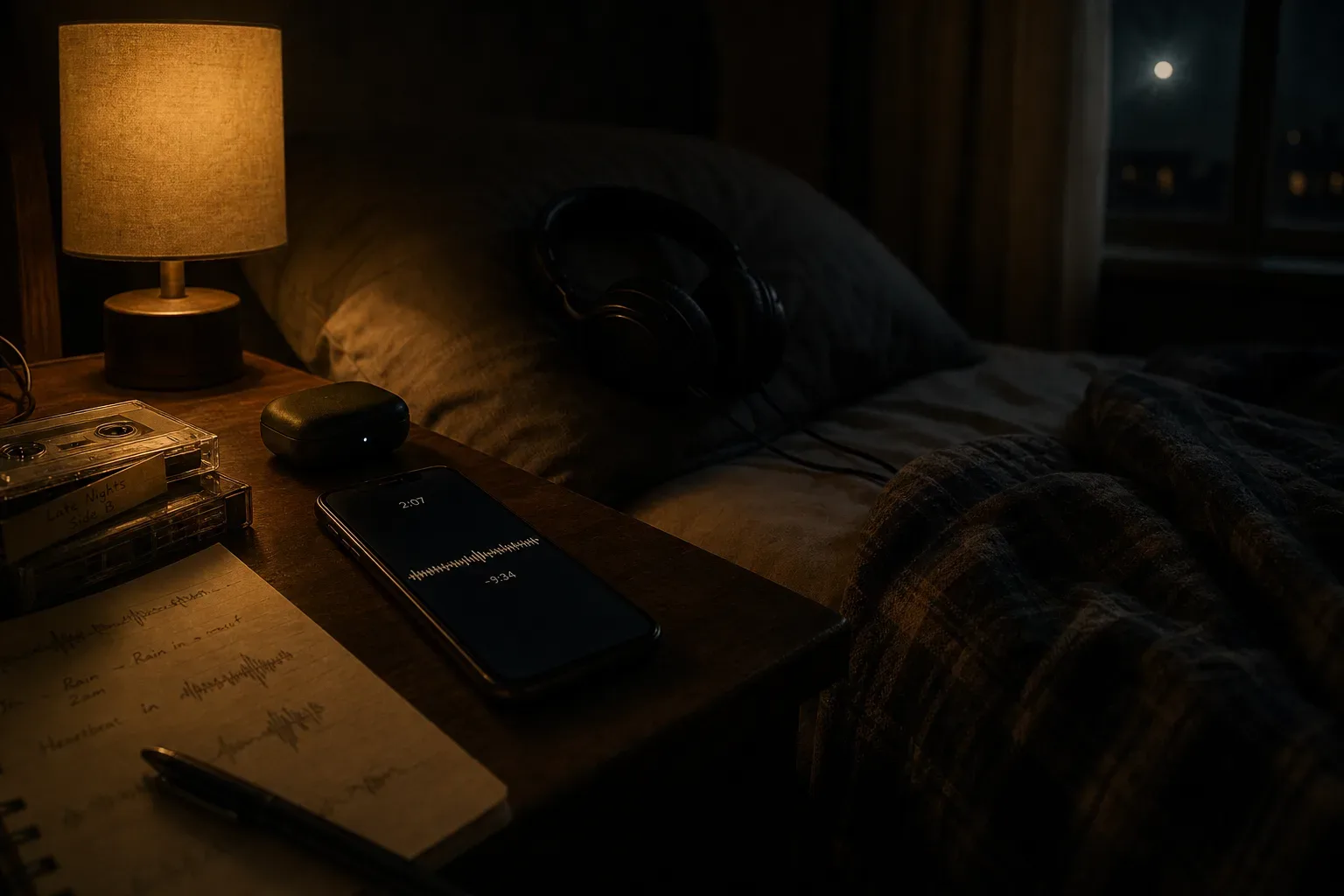
Subliminals for beginners should start with words you can hear: 3 minutes of low, clear sleep audio, played during the last moments before sleep. This is not a classic hidden-message subliminal. It is a safer first step that lets you check the wording, soften your attention, and repeat one intention without losing sleep.
What should a beginner know before pressing play?
A beginner should know that a true subliminal is below conscious awareness, and that hidden does not automatically mean stronger.
A subliminal message is usually defined as a stimulus presented under the threshold of conscious detection. In audio, that often means a voice masked under rain, music, brown noise, or another sound. The trouble is practical: if you can’t hear the words, you also can’t easily inspect them. For that reason, I like an audible start. You begin with the voice low, but still understandable when you attend to it.
The science is more modest than the internet claims. Subliminal priming has been studied for decades, and effects can appear under controlled conditions. A widely cited review by Strahan, Spencer, and Zanna in 2002 found that subliminal cues work best when they connect with an existing goal, such as thirst, not when they plant a brand-new desire from nowhere. The famous 1957 popcorn and cola claim by James Vicary was later admitted to be unreliable, which is why honest subliminal practice needs a quieter tone.
A subliminal is an affirmation you can’t consciously hear. That’s the whole trick, and the whole problem.
For a first week, treat sleep audio like a rehearsal, not a force. You are giving your attention a phrase to return to as the body gets drowsy. If you want a full primer on hidden audio, read the Subliminals pillar before you start stacking tracks or playing 8-hour mixes.
Here is the clean distinction:
| Type of sleep audio | Can you hear the words? | Best beginner use |
|---|---|---|
| Audible affirmation | Yes | First 7 nights |
| Quiet masked affirmation | Partly | After you know the script |
| Classic subliminal | No | Only with trusted wording |
| Sleep hypnosis | Yes, guided | When you want structure |
The last ten minutes before sleep are suggestible. Choose what goes in.
How do you set up a 3-minute audible sleep start?
Set up the practice by choosing one intention, one short script, one low volume, and one fixed bedtime cue.
Three minutes is not magic. It is small enough to repeat, and repetition matters more than duration. The National Sleep Foundation commonly recommends a consistent wind-down period before bed; many sleep clinics suggest 30 to 60 minutes of lower stimulation, but your audio practice can live inside the final 3 minutes. Small is useful because it removes friction.
Use this sequence tonight:
- Pick one theme: calm, courage, patience, ease, or self-trust.
- Write 3 to 5 sentences in plain present tense.
- Record them in your own voice, or choose a track with visible wording.
- Set volume around 20 to 30 percent on a phone speaker, lower with earbuds.
- Stop at 3 minutes, or use a track that fades out.
A beginner script might sound like this: “My body is allowed to rest. I can leave today alone. I return to one quiet thought. I can begin again in the morning.” That is enough. Do not add money, romance, productivity, and six identity claims into one tiny recording. When a practice tries to say everything, the nervous system hears noise.
If you are using headphones, keep safety in mind. The World Health Organization has warned that prolonged high-volume listening can harm hearing, and many phones now include headphone level warnings around 80 decibels. Bedtime audio should be much lower than entertainment listening. Low means you could ignore it if you wanted to.
You can also time the practice with your sleep window. If you are unsure when to go to bed, use the Sleep cycle calculator tool to choose a wake time and work backward in roughly 90-minute cycles. The calculator is not a medical device, but it gives you a calmer plan than guessing at midnight.
What should the words actually say?
The words should be simple, believable, and sleep-safe enough that your body does not argue with them.
Beginners often choose sentences that are too grand. The mind hears “I am perfectly confident forever” and quietly objects. In cognitive psychology, this matters because self-statements interact with existing beliefs. A 2009 paper in Psychological Science by Wood, Perunovic, and Lee found that very positive self-statements could make some people with low self-esteem feel worse, at least briefly. That does not mean affirmations are bad. It means the wording has to meet you where you are.
Try phrases that are close enough to believe:
- “I can soften one part of my body.”
- “I do not need to solve this tonight.”
- “My breath can be simple.”
- “I can practice this again tomorrow.”
- “Rest is allowed before proof arrives.”
Notice the scale. Each sentence gives the mind a place to land without demanding instant certainty. This is also where Sleep affirmations pillar can help, especially if you want examples that are designed for night rather than daytime performance.
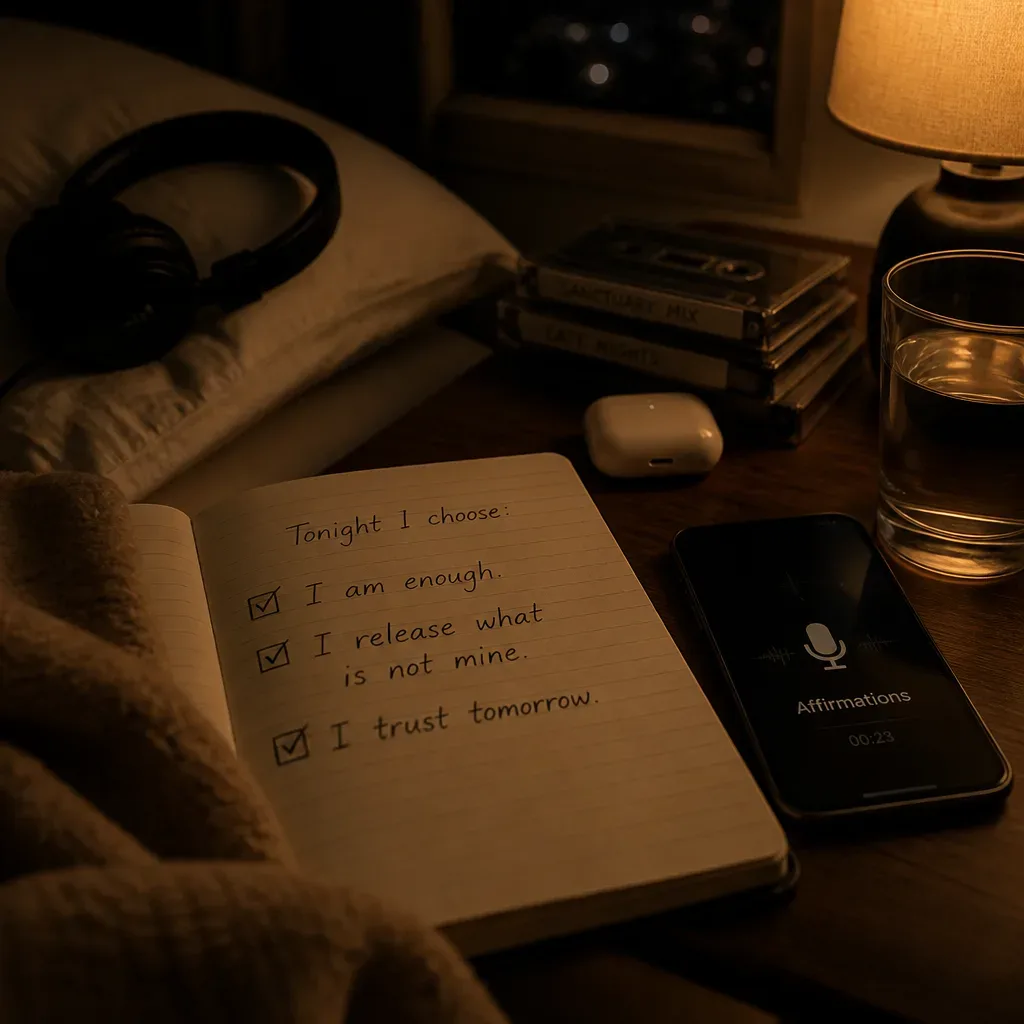
If you are drawn to manifestation audio, keep the audio at the center. the AYA Method is a daily audio manifestation practice. Each day you listen to a short personalized recording — your Dream-Self Moment — narrated from the version of you who has already manifested the life you intend. Listening is the practice. Repetition is the work. The audio is the method.
That differs from a hidden subliminal because you can hear every word. The voice is yours, or built from your own intake, and the daily affirmation and Manifestation Board are complements, not the pillars. If you are a beginner, that audibility is not a weakness. It is how you keep consent inside the practice.
A good sleep sentence does not conquer the mind. It gives the mind something softer to repeat.
How loud, how long, and how often should you listen?
Listen nightly for 3 minutes at a volume that is clear when you focus and forgettable when you relax.
The first useful number is 7 nights. A week gives you enough repetition to notice patterns without turning the practice into a verdict on your life. In behavior research, consistency is usually measured across days and weeks, not one dramatic session. A 2009 study by Lally and colleagues in the European Journal of Social Psychology found that habit formation varied widely, with an average of 66 days for automaticity in their sample. You do not need 66 days before you learn something, but you do need more than one night.
Use a tiny tracking note, not a spreadsheet. Each morning, write one number from 1 to 5 for sleep ease, and one short phrase such as “fell asleep faster” or “too alert.” After 7 nights, keep what helped and remove what irritated you. The practice belongs to your sleep, not the other way around.
Here is a simple beginner schedule:
| Night | Length | Volume | What to notice |
|---|---|---|---|
| 1 to 3 | 3 minutes | Audible, low | Does it keep you awake? |
| 4 to 7 | 3 minutes | Slightly lower | Do the words feel familiar? |
| 8 to 14 | 3 to 10 minutes | Low or fading | Is sleep still protected? |
If a method costs you sleep, it costs more than it gives. That line matters with subliminal playlists, shifting methods, hypnosis loops, and any track that promises too much. Sleep deprivation has measurable effects on mood, attention, and appetite; the CDC reports that about 1 in 3 U.S. adults do not get enough sleep. Do not donate more wakefulness to a practice meant to help you rest.
If insomnia is persistent, distressing, or paired with anxiety, pain, trauma symptoms, or medication changes, talk with a qualified professional. Bedtime audio is sleep hygiene, not treatment.
What should you expect by week two?
By week two, expect familiarity, easier settling, or clearer resistance; do not expect proof that hidden audio can change your life by itself.
The honest evidence points toward small mechanisms. Repetition can increase fluency, which makes phrases feel easier to process. Bedtime ritual can lower decision load. Expectation can change what you notice. None of that is cheating. In placebo research, expectation and ritual are part of how humans respond to care and context. A 2015 review in The Lancet discussed placebo effects as psychobiological events, not mere fakery.
Still, you should keep your claims clean. If you sleep better after 10 nights, the cause might be the script, the fixed bedtime, the lower screen use, the softer lighting, or the comfort of hearing your own voice. Often it is the pattern, not one ingredient. That is why I prefer audible practice before masked tracks: you can adjust the parts you actually understand.
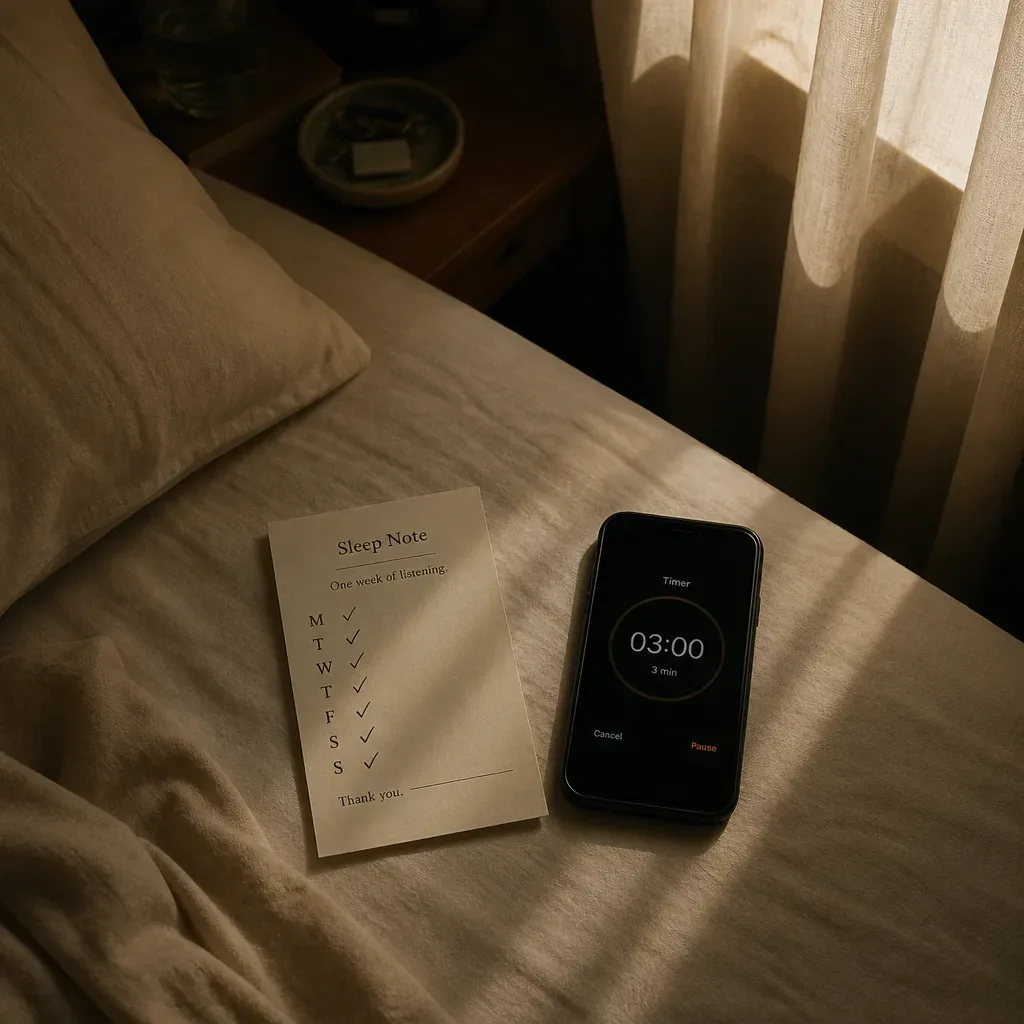
Watch for these week-two signs:
- You start yawning during the same phrase.
- The recording feels boring in a good way.
- You remember the words during daytime stress.
- You lower the volume without losing the thread.
- You notice one phrase feels false and rewrite it.
Boredom can be a sign of safety. The nervous system does not need novelty at bedtime; it needs a repeated cue that nothing more is required tonight.
If you want to try a true subliminal after two weeks, only use audio from a source that publishes the script. Listen once while awake if any part is audible. Keep the volume low. Do not layer five tracks. More input is not more change; after a point, it is just more sound.
How do you know whether to keep using subliminals?
Keep using them if they protect sleep, reduce mental noise, and remain honest in their claims.
Your test is not whether the track feels mystical. Your test is whether your nights are kinder. Use three measures: sleep onset, waking mood, and daytime recall. If you fall asleep 10 minutes sooner, wake less tense, or remember a steadying phrase at 3 p.m., that is useful data. It is not laboratory proof, but it is your own small observation.
Compare your first 14 nights with the week before you started, if you can. The American Academy of Sleep Medicine often emphasizes sleep diaries because memory is unreliable when nights blur together. A one-line diary is enough: bedtime, estimated sleep time, wake time, and one note. If the audio makes you stay up hunting for the perfect track, stop. If it becomes a quiet cue, keep it.
Here is the beginner rule set I trust:
- Hear the words before you hide the words.
- Use one intention for at least 7 nights.
- Keep the track shorter than your patience.
- Lower the volume before you add layers.
- Believe your sleep data more than a comment section.
For deeper context on what subliminals can and cannot claim, return to the Subliminals pillar. For wording that stays close to rest, keep the Sleep affirmations pillar nearby. And if bedtime is drifting later each night, check the Sleep cycle calculator tool before choosing another track.
The practice is not in the hiddenness. The practice is in the return.
Put the voice low, let the room stay dark, and leave the rest for morning.