subliminals
Subliminals While Sleeping: A Safe 7-Night Guide
Try subliminals while sleeping safely with a quiet 7-night plan: volume, timing, track choice, morning notes, and when to stop.
Subliminals while sleeping are best treated as a low-volume, 7-night test: choose one clear topic, vet the track while awake, use a sleep timer, and stop if your sleep worsens. The evidence for hidden messages is modest, but repetition before sleep can shape attention, mood, and self-talk.
Is it safe to play subliminals while sleeping?
Subliminals while sleeping are usually low-risk when the volume is quiet, the content is vetted, and the audio doesn’t reduce sleep quality.
The first safety question isn’t mystical. It’s practical: what are you asking your ears and nervous system to do for 6 to 8 hours? The American Academy of Sleep Medicine says adults generally need at least 7 hours of sleep per night, and anything that fragments that sleep deserves caution. A track that keeps waking you up is not a good track for you, no matter how many comments say it worked.
A subliminal is an affirmation you can’t consciously hear. That’s the whole trick, and the whole problem. If you can’t hear the words, you’re trusting the maker’s script, mixing choices, and ethics. The research on subliminal priming is real but narrow; laboratory effects often measure tiny shifts in attention or choice over minutes, not sweeping life changes over a playlist. YouTube claims are not the same thing as peer-reviewed evidence.
The safest way to begin is to make the sleep part non-negotiable. Use one audio, one topic, and one week. Keep the volume low enough that the sound could fade into the room. If you use earbuds, be more conservative. The CDC and NIOSH commonly cite 85 dBA over 8 hours as an occupational exposure limit, not a target for bedtime listening.
If a method costs you sleep, it costs more than it gives.
If you have persistent insomnia, panic at night, tinnitus, trauma-linked sleep fear, or symptoms that don’t respond to basic sleep hygiene, talk with a qualified clinician. Subliminals can be a personal practice. They’re not medical care.
What should you play on night one?
On night one, play one calm, narrow subliminal that you’ve listened to while awake and can tolerate without tension.
Start with a topic that won’t argue with your body at 2 a.m. Calm sleep, basic self-worth, or steady focus is easier than a dramatic identity claim. A line like “I rest safely tonight” asks less of you than “I am completely fearless forever.” The mind rejects flattery it hasn’t earned; at the edge of sleep, it rejects it faster.
Before bed, listen to at least 10 minutes of the track while awake. Read the written affirmations if the creator provides them. If the description lists hundreds of benefits, exaggerated promises, or “forced” results, choose something quieter. A 2023 Pew Research Center report found that YouTube remains one of the most widely used online platforms in the U.S., which means quality varies wildly. Popularity is not vetting.
Use this simple filter:
- The topic is specific enough to remember in the morning.
- The background sound doesn’t spike, startle, or change suddenly.
- The creator shares the affirmation text or gives a plain summary.
- The title doesn’t pressure you with urgency, fear, or guaranteed results.
- You feel neutral or calmer after 10 minutes awake.
If you’re new to the category, read Subliminals pillar before choosing a track. It helps separate masked affirmations, ultrasonic claims, binaural-style audio, and ordinary affirmations with music. These labels get mixed together online, and the difference matters when you’re sleeping.
Night one is not for stacking. Don’t run five playlists on beauty, money, shifting, confidence, and revision. The cleaner the test, the more honest the result.
How loud should subliminals be while you sleep?
Set subliminals as low as possible: audible as soft background sound, never loud enough to compete with sleep.
Volume is where a gentle practice can turn careless. If you play audio through a speaker, begin one or two steps above silent. Lie down, close your eyes, and ask whether the sound feels like something you can stop monitoring. If your attention keeps checking the hiss, rain, music, or whisper, it’s too loud or too busy.
Earbuds need extra caution because they put sound close to the ear canal and can create pressure over long sessions. The World Health Organization has warned that more than 1 billion young people may be at risk of hearing loss from unsafe listening habits, largely because duration and volume compound each other. Overnight audio can easily become 7 hours of exposure.
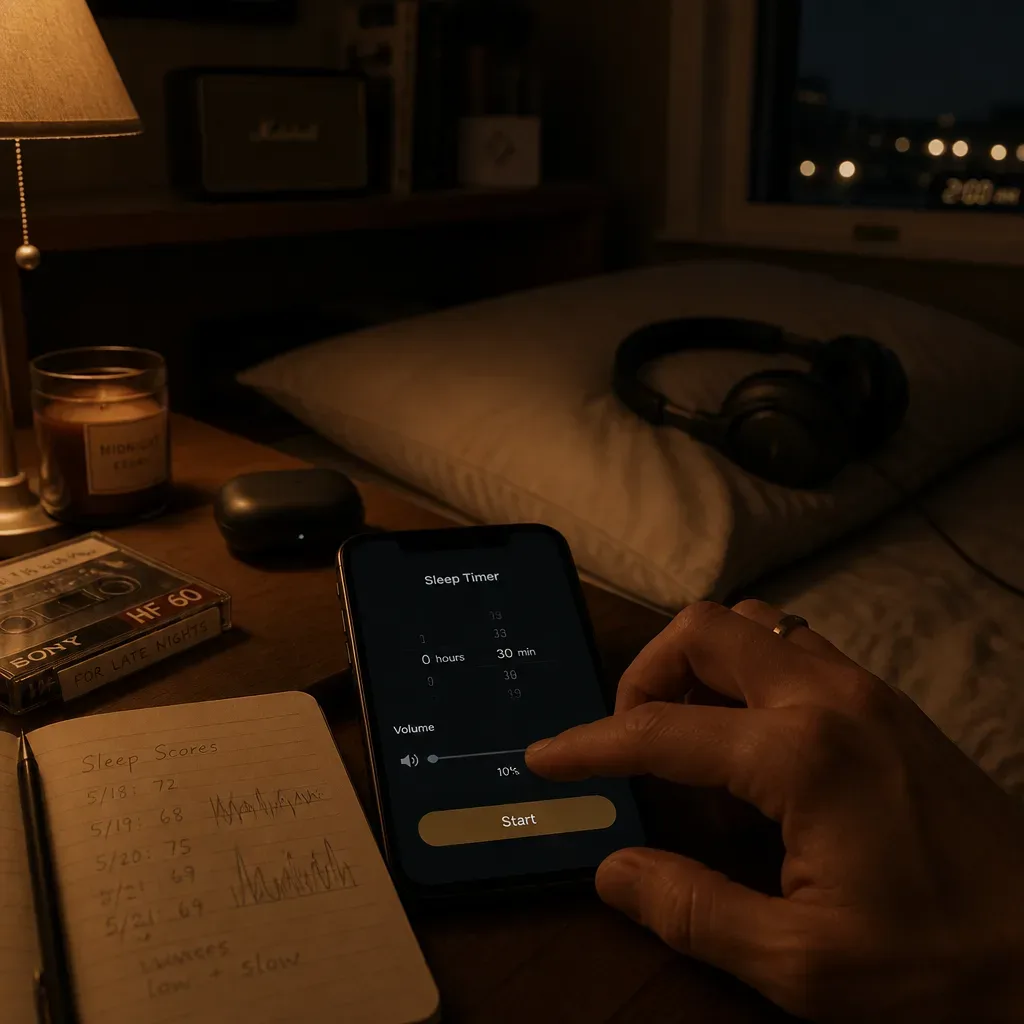
A timer is kinder than an all-night loop. Start with 30 to 90 minutes. That covers sleep onset for many people without forcing sound through every sleep cycle. Typical sleep cycles run about 90 minutes, according to sleep medicine texts, though the exact length changes across the night. If the audio ends after the first cycle, you still gave the suggestion a repeated doorway without filling the whole night.
Here’s a simple starting range:
| Setup | First-week volume | Timer | Note |
|---|---|---|---|
| Phone speaker across the room | 5–15% | 30–60 min | Best first test |
| Bedside speaker | 5–10% | 30–90 min | Keep sudden ads off |
| Wired earbuds | Very low | 30–45 min | Avoid pressure and tangles |
| Sleep headband | Low | 60–90 min | Check heat and comfort |
The goal isn’t to flood the night. The goal is to place one chosen message near the last waking minutes and then let sleep do what sleep does.
What is the 7-night listening plan?
The 7-night plan is a controlled test: same topic, low volume, timed playback, and a short morning note each day.
Use a week because it’s long enough to notice patterns and short enough to stop before you turn a poor fit into a habit. Behavioral research often uses repeated cues to study habit formation, and the famous “21 days” claim is too neat; a 2009 study in the European Journal of Social Psychology found habit formation varied widely, with an average of 66 days for automaticity. Seven nights won’t remake you. It can tell you whether this audio belongs near your sleep.
Follow the plan in order:
- Night 1: Baseline. Play the track for 30 minutes. Write down sleep quality from 1 to 5 in the morning.
- Night 2: Same settings. Don’t adjust anything unless the volume bothered you.
- Night 3: Body check. Notice jaw, shoulders, dreams, and waking mood.
- Night 4: Timer test. If sleep stayed steady, extend to 60 or 90 minutes.
- Night 5: Language check. Read the affirmations again. Remove any line you wouldn’t say to yourself.
- Night 6: Quiet night. Keep the same audio, but reduce volume slightly.
- Night 7: Review. Decide whether to keep, change, or stop.
Don’t chase signs during the week. Look for ordinary data: Did you fall asleep faster? Did you wake more? Did your inner speech soften by even one sentence? The Journal of Behavioral Medicine has published studies showing self-affirmation can reduce stress responses in some contexts, but those studies don’t prove that hidden overnight audio creates guaranteed outcomes.
A safe practice is boring on purpose. It repeats. It notices. It refuses to bargain with sleep.
What should you write down each morning?
Write three things each morning: sleep quality, waking mood, and any phrase or feeling that stayed with you.
Keep the note small enough that you’ll actually do it. A 30-second log beats a perfect tracker you abandon after night two. Use a 1 to 5 score for sleep quality, then one sentence about mood. If you remember dreams, write one concrete image, not a full analysis. Dream recall is uneven; studies often find it changes with awakenings, interest, and timing, so don’t treat it as proof.
Here’s a quiet format:
- Sleep: 4/5, woke once at 3:20.
- Mood: less rushed than usual.
- Phrase: “I can be steady today.”
That last line matters. Subliminal users often look for external results first, but the earliest change may be self-talk. You might notice less harsh language in the morning, a softer reaction to a text, or a slightly easier time starting one task. Small observations are still observations. “The first sign of a good affirmation is not drama; it’s less resistance.”
If you already use Sleep affirmations pillar, compare the two practices honestly. Audible affirmations let you inspect every word. Subliminals ask you to trust what sits underneath the sound. Neither format needs hype to be useful. Both depend on repetition, timing, and wording you don’t secretly hate.
You can also use the Sleep cycle calculator tool to choose a wake time that doesn’t cut through the deepest-feeling part of your night. It’s not a medical device, but planning around roughly 90-minute cycles can make morning notes cleaner because you’re less fogged when you write them.
How do subliminals compare with audible sleep affirmations and the AYA Method?
Subliminals hide the words; audible affirmations and the AYA Method let you hear exactly what you’re practicing.
That difference is not small. With subliminals, the appeal is bypass: you don’t have to argue with the sentence because you don’t consciously hear it. With audible sleep affirmations, the appeal is consent: you know the line, and you can reject it if it feels false. Both can be repeated before sleep. Only one lets you edit the sentence in real time.
The AYA Method is a daily audio manifestation practice. Each day you listen to a short personalized recording — your Dream-Self Moment — narrated from the version of you who has already manifested the life you intend. Listening is the practice. Repetition is the work. The audio is the method. You can read more about the AYA Method if you want a practice where the words are audible, personal, and built to be heard daily.
The daily affirmation and Manifestation Board can support that practice, but they are complements. The audio is the method. As an affirmation writer, I care about that distinction because a sentence you can hear can be tested: Does it embarrass you? Does it sound like you? Would you whisper it at midnight without rolling your eyes?
Use this comparison before choosing tonight’s audio:
| Practice | Can you hear the words? | Best use | Main caution |
|---|---|---|---|
| Subliminals while sleeping | Usually no | Soft repetition without conscious debate | Hidden wording and sleep disruption |
| Audible sleep affirmations | Yes | Clear self-talk before sleep | Lines may feel false if too grand |
| AYA Method audio | Yes, personalized | Daily rehearsal in your own future-self voice | Requires honest intake and repetition |
Research on mental rehearsal, self-talk, and implementation intentions is stronger than research on online subliminal playlists. Dr. Andrew Huberman often emphasizes sleep regularity and light timing before add-on tools; that’s a useful order. Get the night stable first. Then choose the voice.
When should you stop or change the audio?
Stop or change the audio if your sleep worsens, your body tenses, or the words don’t match what you consent to practice.
Give yourself clear stopping rules before night one. That keeps you from explaining away discomfort because you want the track to work. Stop for at least three nights if you wake more than usual, feel dread at bedtime, notice headaches from sound, or feel pressured by the creator’s claims. If symptoms are strong or persistent, get professional support rather than troubleshooting with more audio.
Change the track if the topic is too broad. “Perfect life now” gives the mind nothing usable. “I speak to myself with more patience” is modest enough to land. Neville Goddard wrote often about the state akin to sleep, and many modern manifestation communities borrow that idea. Warmly held, it can be a useful reminder: the last waking minutes matter. Taken too far, it becomes pressure. You don’t need to perform belief while exhausted.
A good week can still end with “not this one.” That’s not failure. It’s discernment. In small studies on priming, effects often depend on context, attention, and relevance; a mismatched cue may do little or nothing. Your morning log is there to protect you from forcing a story onto mixed data.
Before you continue after night seven, ask:
- Did my sleep stay the same or improve?
- Did I feel calmer about bedtime?
- Do I know what words I was allowing near sleep?
- Did the topic show up in kinder self-talk?
- Would I choose this audio again if no one online praised it?
The night is suggestible, but it’s also practical. Choose the voice with care.
Put it low, and let sleep stay yours.