subliminals
Subliminals While Sleeping: The Honest Answer
Do subliminals while sleeping work? Here is the honest evidence, what sleep can and cannot absorb, and how to listen without losing rest.
Subliminals while sleeping might help you rehearse a feeling, a goal, or a self-concept, but they are not proven to create guaranteed results. The honest answer is narrow: sleep can process some sound, subliminal priming can be real and modest, and your rest matters more than any track.
Do subliminals while sleeping work at all?
Subliminals while sleeping may work as a cueing and repetition practice, but not as a guaranteed command system for the mind.
A subliminal is usually an affirmation mixed so low, masked, sped up, or layered that you cannot consciously understand it. That is the whole appeal, and the whole problem. If you cannot hear the words, you also cannot fully check the message, the pacing, or whether the file says what the title claims. The Subliminals pillar goes deeper into that basic trade: hidden words can feel frictionless, but hidden also means less accountable.
The strongest evidence near this topic does not come from YouTube subliminal claims. It comes from narrower research on priming, conditioning, and sleep learning. In 2012, Arzi and colleagues reported in Nature Neuroscience that people could learn simple tone-odor associations during sleep and show changed sniff responses later. That is interesting. It is not the same as absorbing a full script about confidence, beauty, money, or shifting while unconscious.
Sleep is not a locked room. It is more like a house with certain doors still open. The auditory system keeps monitoring the environment; that is why a parent can wake for a baby’s cry more readily than for random traffic. But sleep architecture changes across roughly 90-minute cycles, and the brain’s receptivity to sound changes with it. The Sleep cycle calculator tool is useful because timing matters when a practice is tied to falling asleep rather than forcing sound through the whole night.
The honest sentence is this: a subliminal can support what you already repeat, but it should not be asked to do the work of clarity, behavior, or sleep.
What does sleep research actually say about hearing words at night?
Sleep research says the brain can process some sounds during sleep, especially familiar cues, but learning complex new verbal material is limited.
Targeted memory reactivation, often shortened to TMR, is the closest serious research cousin to sleep subliminals. In a 2009 Science paper, Rudoy and colleagues found that playing sounds linked to object locations during sleep improved later recall. The sound was not a hidden affirmation. It was a cue tied to something learned while awake. That distinction matters. Sleep seemed to reactivate an existing memory, not install a brand-new belief from nowhere.
A 2013 review by Rasch and Born in Physiological Reviews summarized a large body of sleep and memory research: sleep helps consolidate memories, particularly after learning. Consolidate means stabilize and integrate, not magically write a new identity. If you listen to clear words before sleep, then later play a soft related cue, you are closer to the research than if you run twelve masked tracks with no waking attention.
Here is a simple comparison:
| Night audio type | What you consciously hear | Evidence fit | Main risk |
|---|---|---|---|
| Masked subliminal | Almost nothing | Weak to modest, indirect | You cannot audit the words |
| Audible affirmation | Every word | Better fit with rehearsal | Can feel repetitive |
| Sleep hypnosis | A guided voice | Mixed, depends on use | May delay sleep if too engaging |
| TMR-style cue | Familiar sound or phrase | Stronger for learned material | Needs waking pairing first |
Words before sleep have a special tenderness because the mind is tired of arguing. Neville Goddard called the pre-sleep window the state akin to sleep, and many modern manifestation communities still borrow that idea. The claim is spiritual and experiential, not laboratory proof. Still, the practical overlap is real: the last 10 to 20 minutes before sleep are often easier for repetition because attention has softened.
A sentence heard clearly before sleep has one advantage a subliminal lacks: you can consent to it.
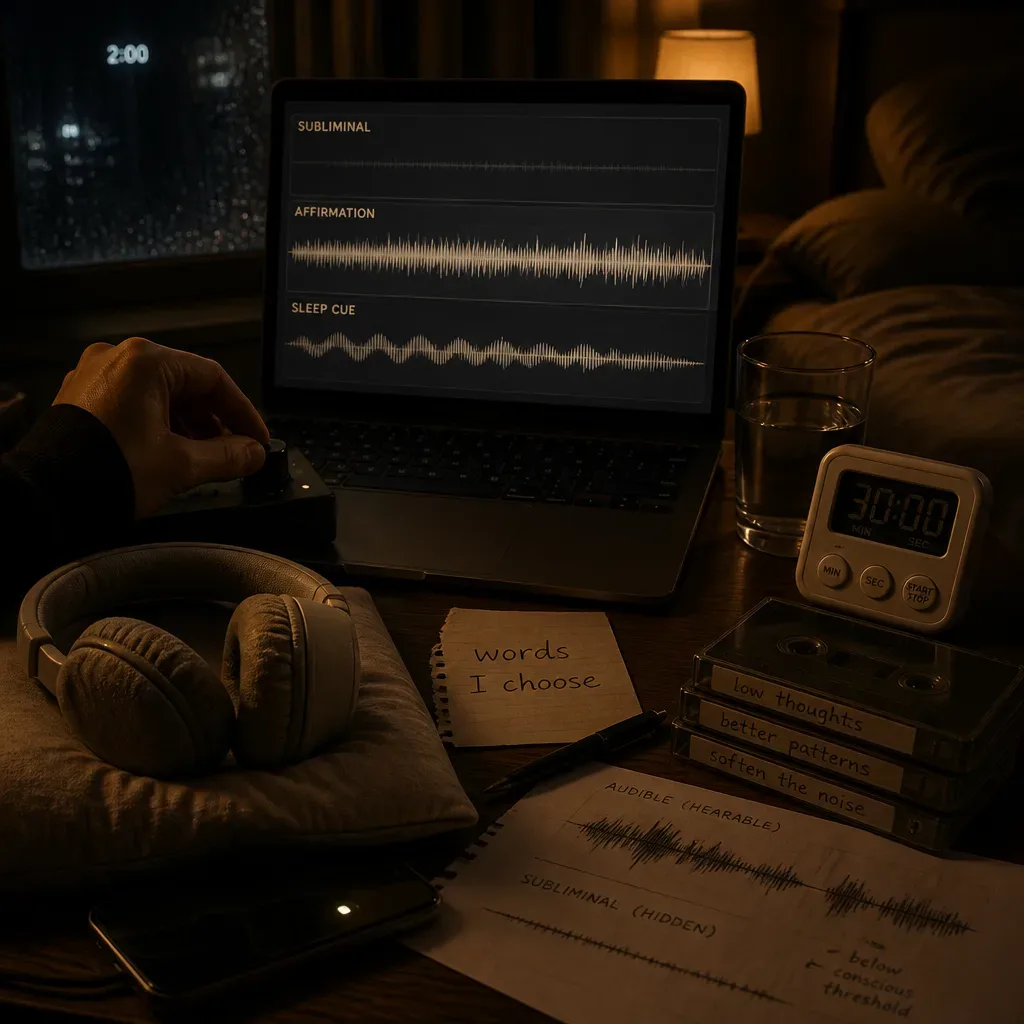
Are subliminals different from sleep affirmations or the AYA Method?
Yes, subliminals hide the words, while sleep affirmations and the AYA Method make the words audible and deliberate.
That difference is not small. With Sleep affirmations pillar, you know what you are hearing. You can reject a line that feels false, rewrite it, or lower the emotional pressure. With subliminals, people often trust the creator, the comment section, or the title. Sometimes that is fine. Sometimes it is not. A file called calm sleep could still include language you would never choose if it were spoken plainly.
The AYA Method is a daily audio manifestation practice. Each day you listen to a short personalized recording — your Dream-Self Moment — narrated from the version of you who has already manifested the life you intend. Listening is the practice. Repetition is the work. The audio is the method. You can read the full practice at the AYA Method.
The important contrast is not that one practice is pure and the other is foolish. It is that audible, personal audio gives you more authorship. Joe Dispenza’s meditation communities, Neville Goddard’s SATS practice, and modern shifting circles all treat inner rehearsal as meaningful. They disagree on metaphysics, but they share one operational truth: repeated identity language tends to matter more when it is emotionally legible.
Use this order if you are unsure:
- Write the sentence you actually want to live with for 7 nights.
- Speak it or choose a track where it is clearly audible.
- Listen before sleep, not after you are already exhausted.
- If you add subliminals, use them as background, not the whole practice.
- Notice sleep quality first, then mood, then behavior.
The audio that helps most is often not the most mysterious one. It is the one you can return to without flinching.
What results should you expect by week two?
By week two, expect subtle changes in attention and feeling, not dramatic proof that a hidden track has changed your life.
A reasonable first sign is recognition. You may notice the same thought arriving with less resistance: I can rest, I can speak more calmly, I can study for twenty minutes, I can stop checking the group chat after midnight. In behavioral research, repetition and cueing are often discussed through habit formation, but the timeline is variable. A widely cited 2009 study by Lally and colleagues in the European Journal of Social Psychology found habit automaticity took a median of 66 days, with a range from 18 to 254 days. Seven nights can start a pattern. It rarely finishes one.
Subliminal communities often report faster results than the research would predict. I do not think every report is fake. I also do not think comments under a track are controlled evidence. Expectancy, mood, selective attention, and social proof all shape what people notice. Pew Research Center has reported for years that teens and young adults use social platforms heavily; when a practice spreads through short videos and comment chains, folklore forms quickly. That does not make it worthless. It makes it communal.
A useful week-two check looks like this:
- You fall asleep within your normal range, or slightly easier.
- You wake without feeling more tired from the audio.
- You can name the intention without needing the track title.
- You notice one small behavior shift during the day.
- You feel less desperate, not more attached.
If the track makes you count results all day, it has become too loud inside you, even if the volume is low. If a method costs you sleep, it costs more than it gives.
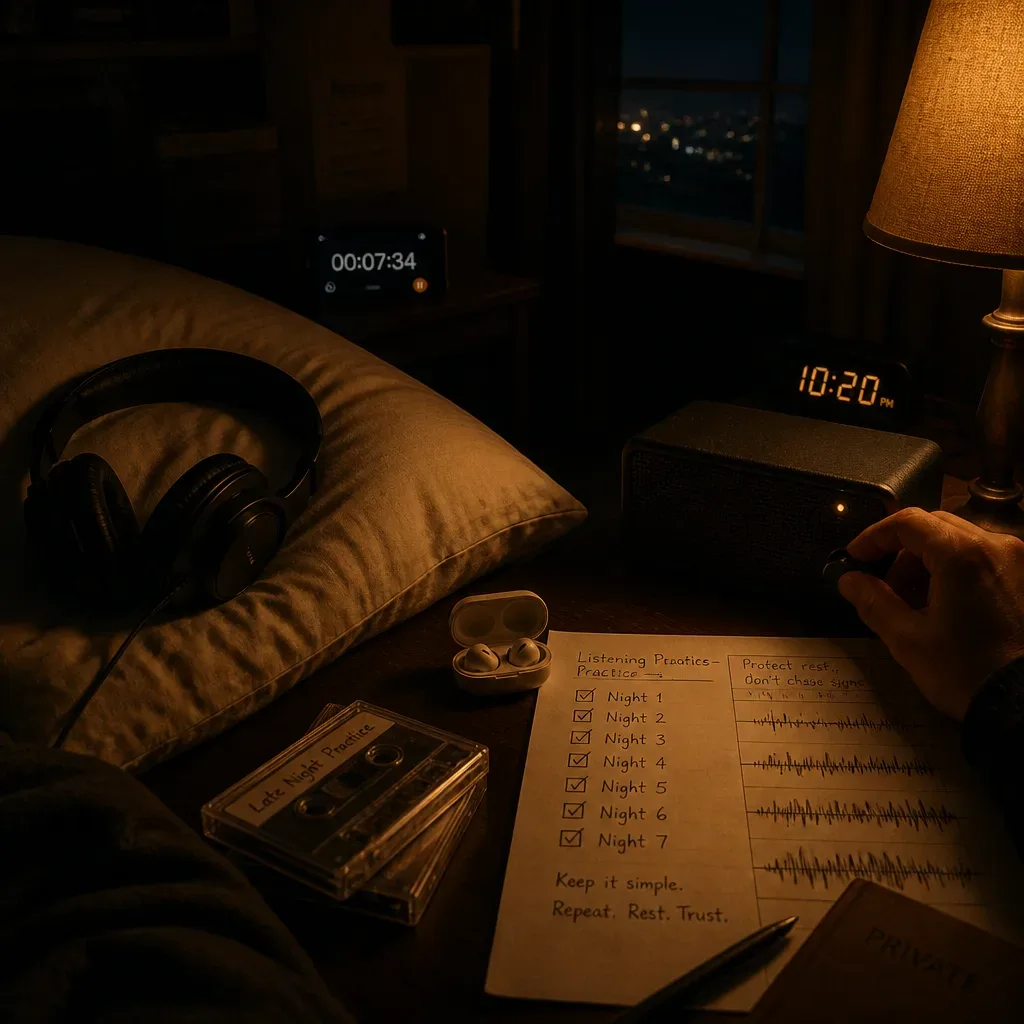
How can you listen safely without wrecking your sleep?
Listen safely by keeping the audio low, time-limited, familiar, and easy to stop.
Start with one track for 7 to 14 nights. Changing files every night makes it harder to know what is helping and what is noise. The American Academy of Sleep Medicine notes that adults generally need 7 or more hours of sleep per night, and sleep loss affects attention, mood, and health. A subliminal routine that pushes bedtime later by 45 minutes is already working against you, no matter what the title promises.
Volume should be soft enough that you are not monitoring it. If you are asking, can I hear it, can I hear it, can I hear it, you are no longer resting. For speakers, many people do best around 20 to 40 percent volume, adjusted to room noise. For headphones, be more careful. The World Health Organization has warned about unsafe listening levels in recreational audio; long overnight headphone use can also cause discomfort even when volume is moderate.
Try this practical setup:
- Choose a track from a creator who posts the exact affirmations or gives a clear description.
- Listen once while awake, at least enough to check the sound quality.
- Set a timer for 20 to 45 minutes instead of looping all night.
- Keep the phone away from your hand so you do not check comments in bed.
- Stop for three nights if your sleep gets lighter, later, or more anxious.
People with insomnia, trauma-related sleep disruption, or persistent nighttime anxiety deserve more support than a playlist. If sleep trouble is ongoing or affects your daytime life, speak with a qualified professional. That sentence is not dramatic. It is care.
The best night practice is one you can miss without fear.
What is the fairest answer for skeptics and believers?
The fairest answer is that subliminals while sleeping are plausible as gentle cues, unproven as guaranteed change, and safest when they stay secondary to sleep.
Skeptics are right to ask for evidence. The priming research is real but modest, and parts of the field have faced replication problems since the 2010s. Believers are also right that people are shaped by repeated language, especially language tied to emotion, community, and bedtime ritual. A 2018 review in Nature Reviews Neuroscience described sleep as active in memory processing, not passive shutdown. That supports careful curiosity. It does not support wild certainty.
For shifting communities, this matters. Raven method audios, desired reality scripts, subliminal bundles, and sleep hypnosis all orbit the same intimate window: before sleep, when imagination feels close and the room is quiet. I have watched people use those practices with real gentleness. I have also watched people stay up until 3 a.m. trying to force a sign. No script should become a second job. No subliminal should become a test you are afraid to fail.
If you want a plain hierarchy, use this:
| Priority | Question to ask | Why it matters |
|---|---|---|
| 1 | Did I sleep enough? | Sleep is the base condition |
| 2 | Do I know what the audio says? | Consent needs clarity |
| 3 | Can I repeat this calmly for 2 weeks? | Repetition beats intensity |
| 4 | Did my day change slightly? | Behavior is better data than signs |
You can pair subliminals with audible practices if you keep the roles clear. Let hidden audio be atmosphere. Let spoken words be chosen. Let sleep remain sleep. If you want clearer language at night, return to sleep affirmations, compare them with subliminals, and protect your timing with the sleep cycle calculator.
Choose the voice you can trust in the dark.